
Translated material
The school is not for everyone
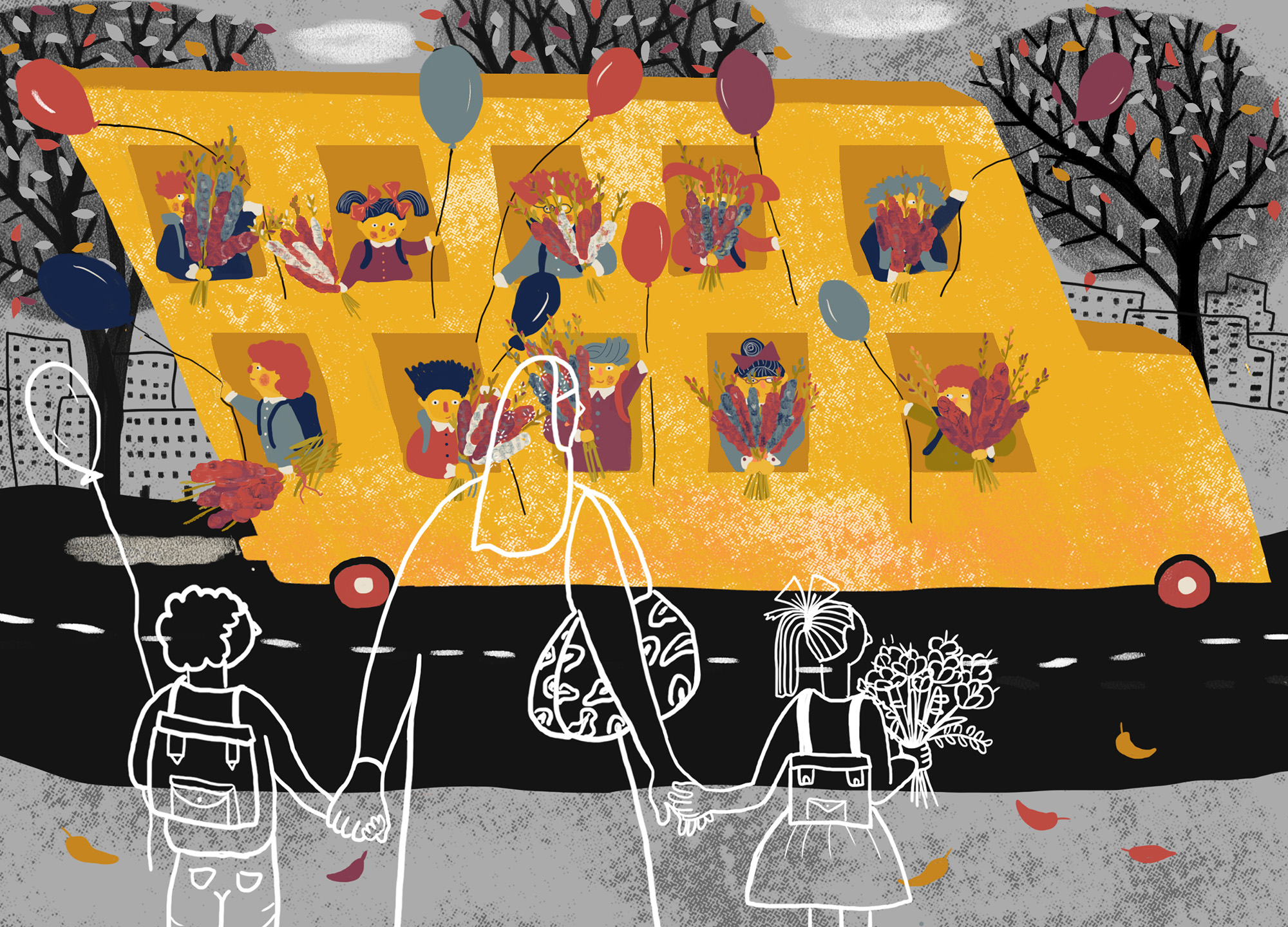
The integration center in Noginsk, where Syrian children are taught the Russian language, mathematics and the world around them, were created to prepare them for study in secondary schools. But on September 1, 2018, children of refugees from Syria will not go to school - they are refused to accept them contrary to the Constitution and the decision of the Supreme Court
We help civil assistance to helpNoginsk. A small room on the ground floor of an office building. Due to the closed door of one of the rooms you can hear how they are engaged in Russian. In the next room are a couple of computers, a printer, several tables and chairs. This is an integration center for children of Syrian refugees, created by the human rights organization "Committee" Civil Assistance "." Hala Dahud every day leads here to the classes of his children: the daughter of Manar and the son of the Bashra.
On the street there are more than 30 degrees Celsius, the room is also stuffy. But, despite the heat, Hala, like most Syriak living in the city, is in closed clothes: a demi -season jacket to the knee, black jeans, light sneakers with a black print. The head is covered with a white scarf in a flower, in the hands - a light bag with pink spots "under a leopard". The woman is noticeably nervous and often smiles.
From Aleppo to Noginsk
Hala, along with her husband Mohammad and children fled to Russia from the war. Until 2012, they lived in the suburbs of Aleppo in their own large house with three rooms. Then the children were very small, Hala spent all the time with them, was engaged in the house, and the husband worked as a hairdresser. But the civil war was approaching. Interruptions in electricity began, more and more armed people appeared on the streets, military aircraft flew in the sky above the city, and the fighting unfolded completely nearby - they were already heard.
Parents were seriously afraid for the children. For two months, they moved several times to one or the other relatives in different parts of the city. When the situation was aggravated and became completely scary, Hala with children moved to her mother and sisters to the west of the country, in Tartus - in the coastal city there was no martial law and people with weapons. Mohammad at the same time lost his job - his hairdresser was closed; There was a threat of getting to the front, so the head of the family decided to go to work in Russia. First I got to St. Petersburg, where I met other Arabs and learned from them that many Syrians live in Noginsk. In the suburbs, he was able to continue to work as a hairdresser and in 2014 transferred his family to Russia.
Syrians have been living in Noginsk for several decades, they come to work mainly in textile factories that belong to their successful compatriots. According to the Civil Assistance Committee, in the city now at least two hundred refugees from Syria. But these are only those who turned to the human rights organization for help. How many unregistered - no one knows for sure.
Hala says that many Syrians live in the city, but the real number of people remains a mystery to her. Two hundred people, including several dozen children - such numbers seem plausible to her. Not all Syrians of Noginsk are familiar with each other, explains Hala. People from various parts of the country live here. They notice each other on the streets, greet, they heard about others, but there is no full -fledged community. Four close friends of the huls living here came from Aleppo, like her. “Of course, I want to return to Syria, but only when the war ends,” says Hala.
And adds: "If it ends." Two years ago, her father died in the warIn Russia, the Syrians try not to change the usual family way: most women, like in their homeland, are engaged in households and grow children. The typical daily routine Hala is this: in the morning it leads the children to the integration center, at 16:00 classes are ending and the three of them go for a walk in the park. If necessary, go to stores. At 19:00, Mohammad comes from work, hala cooks food, puts things in order in the house.
Hala always loved to read, mostly Arab authors: she does not know any languages except her native. She retained this habit, but in Noginsk books on Arabic cannot be taken out, so she reads what is available on the Internet. Fortunately, many books can be found in social networks. When her husband has time, the whole family is chosen to Moscow: they really love to walk around the city together.
Now Khale is 24 years old, Mohammad is 30, he speaks Russian, she-no, despite the fact that in Syria she finished nine classes, and her husband-only two. Daughters Manar-7 years old, the son of the tower is 6. They did not take them to the kindergarten in Noginsk, but Hala really wants her children to go to a regular secondary school: “Every mother wants her children to still be educated. If there was an opportunity, then a hundred percent would give children to school. ”
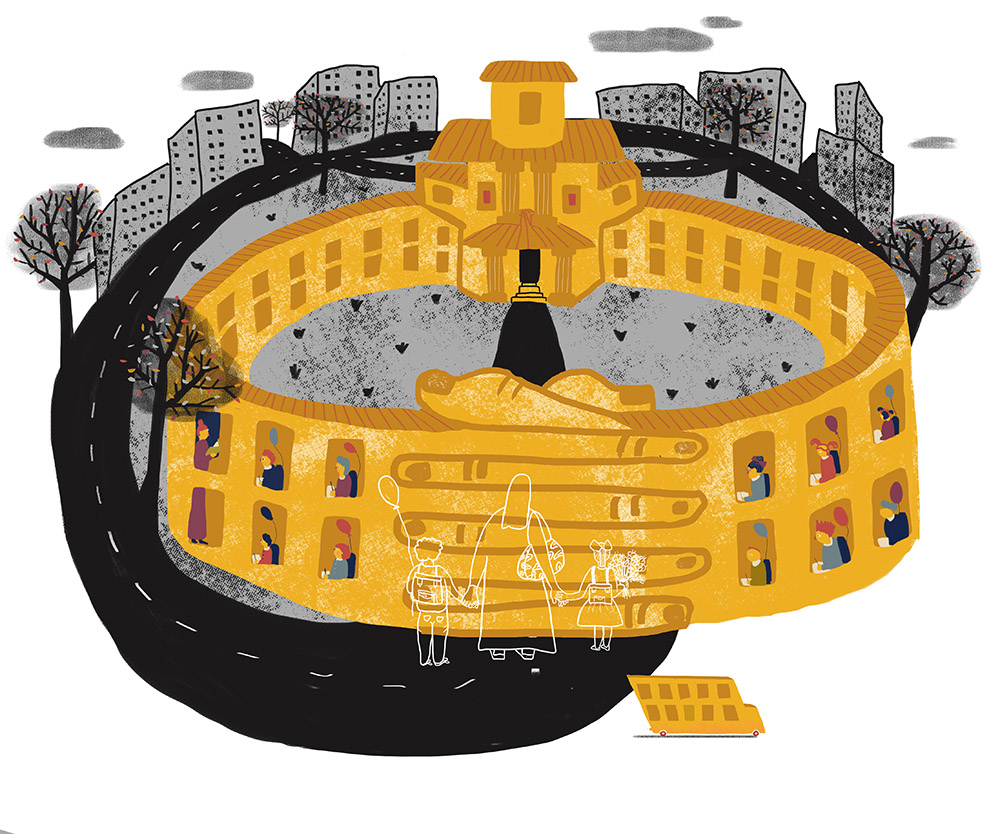 Illustration: Polina Plavinskaya for TD
But the manar and the tower cannot study at a regular school, since the family does not have registration - only a temporary shelter for three months. “In Russia, everything is very complicated. We have in Syria, if the child needs to study, you just send him to school and that's it, ”says Hala.
Registration and innovation
Attempts to arrange refugee children in schools are divided into bureaucratic obstacles that local officials from education repair them. Article 43 of the Constitution of the Russian Federation clearly states that each child has the right to education. But at the same time, there is an order of the Ministry of Education and Science of January 22, 2014 No. 32 “On the Rules for admission to educational institutions”, which states that foreign citizens “additionally present a document confirming the relationship of the applicant (or the legality of the submission of the child’s rights), and a document confirming the applicant’s right to stay in the Russian Federation”.
In 2015, the Committee appealed the order of the Ministry of Education and Science in the Supreme CourtThe court refused to cancel the order, but explained that the lack of registration of the child and documents confirming the right of the parent to stay in Russia could not be the basis for refusing to admit the child to school if there are free places in it. These documents are “additional in relation to the personal statement of the parent of the child,” the court decision says. But in practice, school principals still refuse to accept children, referring to order No. 32.
“The Constitution states that every child in Russia has the right to go to school,” explains Evastrebov, consultant on migration issues of the Civil Assistance Committee. - And when we go to arrange children in school, the directors begin to play the migration service, they say: “They are illegally here.” But their task is to accept the child to school, and not to assume the duties and powers that they do not have. ”
If the individual director “correctly reads” the order and the decision of the Supreme Court will not come true that there are no places, the refugees living in the field of children will still have a chance to get to school - by decision of the director or the district education department. In Moscow, an application for an appointment with school can only be submitted through the electronic portal of public services, where there is a column “Registration”. If it is not filled out, the application will not go. And official registration at the place of stay is literally for units.
Of the two hundred refugees registered in the “civil assistance”, seven people have the status of temporary asylum. “The rest are either in the procedure for applying to the status, or they will appeal the refusal to grant the status, or they are not engaged in any status at all, since they are tired of getting endless refusals,” explains Evgeny Yastrebov. “But we must understand that we often help people seek asylum, but they don’t tell us the result.”
According to the chairman of the Committee “Civil Promotion”, Svetlana Gannushkina, in total in Russia there are from 8 to 10 thousand Syrian refugees. According to the Ministry of Internal Affairs, as of January 1, 2018, 1128 Syrians had the status of “temporary asylum”. Now many are refused to extend this status, so this indicator will only decline. Since the beginning of hostilities in Syria in 2011, only one person received the status of refugees in Russia, one more status had one more.
Center and his children
For children of refugees who do not have the opportunity to study in secondary schools, the Committee founded an integration center in the spring of 2016. Opening it, human rights activists hoped that the situation with the admission of children in schools would change soon, and the children by the time they begin to accept them will already have basic knowledge. But in two years nothing has changed.
Now about twenty children regularly come to the center, they are engaged in five days a week from 10:30 to 15:30, including in the summer. Children are not divided into groups: younger students and adolescents study together, because the center has no place for individual classes and there is no way to pay for several teachers. “Children are tired of the fact that everyone has a different level of training,” says Hala. - This school has only one class, and everyone has different age and level of knowledge. Still, it would be better if children study in a regular school, where all the same age. ” But while studying in the center is the only opportunity for Syrian children to learn at least at the initial level the Russian language, to get the basics of knowledge in mathematics and the world around him.
 Illustration: Polina Plavinskaya for TD
Chala brought to the center Manar and the Bashra as soon as she found out about his discovery from the familiar Syrians. Children go here every day. Hala itself also sometimes sits in the classroom, tries to perceive information by ear. At home she is additionally engaged in children: she teaches reading and writing in Arabic, reads the Qur'an with them.
Hala regrets that not all Syrian families can give children at least to the integration center: most have no time to carry children here, many live very far. But it is not only about education: “Before I brought my daughter here, she didn’t talk to anyone for two months, she was afraid, but here she began to communicate with other children, teachers again. The school socializes. "
At that moment, our conversation is interrupted by the noise in the corridor: the students have a change. Some crawl with a roar on the floor and kick an empty plastic bottle from the cooler, others make something from the designer.
Study under threat
The teacher of the integration center explains: the younger children who now go here could calmly enter a regular school and communicate in a year and study in a year, like their Russian -speaking peers. Their only real problem (not counting those that adults invented) is in the absence of a language environment: with each other, like at home, they still speak Arabic.
And at school they will speak RussianThe center itself is now at risk of closing. Previously, the project sponsored the UN UNKB, but the money ends: it will be enough only until September, there is no funding for the second half of the year. And you need to pay for the materials, the work of the teacher, who travels from Moscow every day and vice versa, spending a total of up to five hours on the road.
In addition, it is extremely important for the center to hire a coordinator who would help teachers directly interact with parents who often do not speak any language except Arabic. There is already a candidate for this position - this is Safaa, about which “such matters” wrote . She lives in Noginsk and, in addition to her native Arabic, knows the Russian language very well. Safaa could play the role of the coordinator and at the same time expand the schedule of children to two disciplines: to teach chemistry and Arabic. But while there is no budget to employ it.
In our power to help Syrian children, not to leave them without a single place in the city where they can receive knowledge. They have nowhere to return: the houses of many families were destroyed, relatives died in the civil war. They fled from their own country to stay alive, and chose Russia. Your monthly donation for the project “Right to Education” in any amount - 50, 100, 500 rubles - or a one -time contribution will help children of refugees study, live a full life and not close in their own world.