
Translated material
Mobile holiness
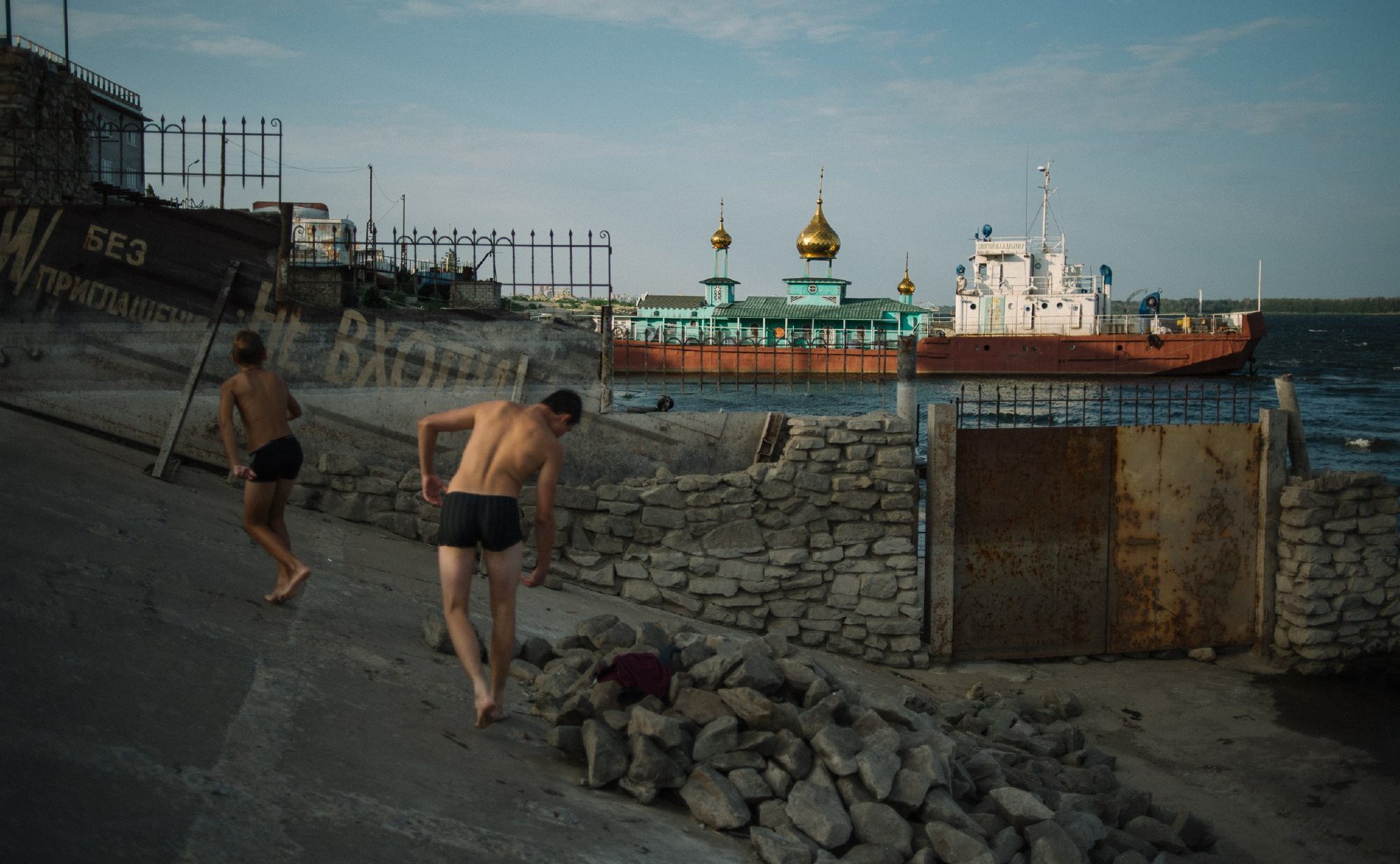
How do you perceive the expression "quoted Rus'"? Do you see a scattering of temples and churches on the map? Is the ringing of bells in the fog over the river? But what if you imagine that some presents are also moving on the map? By the way, this is how they do
In Russia, there has long been a special class of mobile temples that run around the country. They look different, but everyone has one mission: to visit God's forgotten places where there are no churches, and the priest’s leg did not step for a very long time. The inhabitants of such depressed areas either bounced as much as possible to visit the church, or are generally far from the Orthodox faith. Both the temple comes to both, and it is not known to whom it is more necessary in such a situation.
Now in the country there are temples on the basis of wagons, buses, kamazov, there are also landing from air churches, bargain churches and temprays-temples. In general, where the temple will not pass, there it will swim, and in extreme cases it will fall directly from the sky to the joy of the fighters of the Airborne Forces.
In the Volgograd region, a love of floating temples has historically developed. Before the Volga Revolution, the Caspian was walking the temple “St. Nicholas the Miracle Worker”, built on the ship “Pirate”. In 1915, the mission of the temple ceased - there was no funds for repairs. The temple-ship was sold, converted, and later, according to some reports, dismantled scrap metal in Astrakhan. After almost a hundred years, three more floating temples arose in Volgograd.
"Holy Vladimir" - is not a ghost?
- Mom, sailed to the temple! - the boy shouts joyfully.
- They scold us. Swim here, ”mother answers strictly in a swimsuit, looking back at the golden domes behind the fence.
Volgograd, heat under forty degrees, embankment. Tanned beachs are paced by the water, a company of children jumps into the Volga from a small moll. These river children jump with a “pike”, and not a “fish”, as is customary at sea. For Molom, the temple "St. Vladimir" is moored. It stands in the closed territory of the yacht club, and the boys can only sigh and discuss how great it would be with a “pike” from the temple.
“St. Vladimir” makes a strong impression, even standing on a leash. Above the converted landing ship in the haze sway and shine of crosses and poppies, and a slightly faded saint looks from the cutting on swimsuers. On the fence, behind which the temple is hiding, the inscription: "On the territory are evil dogs." I would like to add: "... and not only." Apparently, the owner of the yacht club has three main hobbies: yachts, Orthodoxy and Vladimir Vysotsky. The territory of the club, one might say, shouts: from due to the fence, boats, crosses, chapels peek out, on the walls of buildings-faces and quotes from Vysotsky's songs. At the entrance there is a monument to Barda and then another chapel, and next to it is a scene for the Memory of Vysotsky’s memory festival. At the anchor at the gate, the inscription: "Save our souls." The club itself is located on the embankment named after Vladimir Vysotsky, according to which crosses are placed with reminders that this is a sanctified place: “For non -compliance with order in a holy place and unworthy behavior to the memory of people whose zeal has become part of history - sorrows are sent by the Lord!” [spelling preserved]. The beachs are interested in all this phantasmagoria, look for the fence of the club: “Look, they are building something there.”
 Parishioners of the Saint Vladimir Supervisure During the Service Photo: Sergey Karpov for TD
Actually, the Holy Vladimir Temple and the Corabel is quite in the local principle of trinity: this is the temple, and the ship, and “St. Vladimir”. I am already starting to suspect that the faded saint on the ship is Vysotsky, but then the car takes me and takes me to meet with the former rector of the floating temple, Archpriest Vyacheslav Zhebelev and his colleague Ierey Sergius Savenkov.
“What, Koretsky ran away from you, did not show the temple? - Father Vyacheslav chuckles. - Excuse me, he is always like this: here and there. Probably sailed somewhere. " Vladimir Koretsky-one of the creators of the floating temples of Volgograd and the owner of the same yacht club "Sail" named after Vysotsky. On the fence of the club, by the way, it means: "The creator of the three floating temples of Russia." Perhaps only the history of their appearance is more interesting than these temples.
In 1995, Vladimir Koretsky, along with his fourteen -year -old son, made a passage through the Atlantic Ocean on the seven -meter yacht Vladimir Vysotsky. The team consisted of four people, swimming from Volgograd to Toronto lasted 107 days, 64 of which the yacht fought with storms. Being in the zone of killer waves, Vladimir Koretsky decided to build four temples (by the number of people on board), if the team manages to survive. Meanwhile, in Volgograd, the priest Nikolai Agafonov had the idea of creating floating temples like what existed here before the revolution.
So, with the support of the local clergy and the Kirche in Not (“Church in Beda”), the floating churches “Saint Innokenty”, “St. Nicholas” and “St. Vladimir” were built, and as the fourth of the temple, Vladimir Koretsky built a chapel-Kaliva on the territory of a yacht club.
According to Vyacheslav Zhebelev, the Holy Vladimir Temple is not valid now, it is re-registered, and there are not enough funds for missionary flights: the same diesel fuel is very expensive. “St. Vladimir” was built in 2004 and became the only self-propelled temple in the world.
- Did the floating temples be useful?
Sergiy Savenkov : We have a long-suffering area: it was a red belt and, in my opinion, still remains. We have communism. Strange, but Lenin’s business is alive. Each temple in Volgograd is still being built with battles, pickets, protests. When Metropolitan Herman came here in 1991, there was nothing literally here. One hundred kilometers three temples. There was no diocese. The absence of temples is a very symptomatic indicator. People were extremely aggressive.
- Where did the aggression come from?
- Everyone says the place is heavy. Firstly, the temples here allowed to destroy. After all, there are many cities of Russia in which the temples have survived, and even more so there are cities in the former Soviet republics, where they almost never collapsed - it never occurred to anyone. And here everything is fine [destroyed].
Secondly, the Battle of Stalingrad finished off everything that could be finished off, and almost all local residents died. About 80% of people living here are Volgograd residents in the second generation. It is hard for any city. Volgograd is a city without memory: it has no story, there are no roots. People were attracted here, but it is forcibly impossible to give people to people, everything is non -native to them here. And mobile temples were very useful. They could come to those areas in which it was difficult or impossible to build temples.
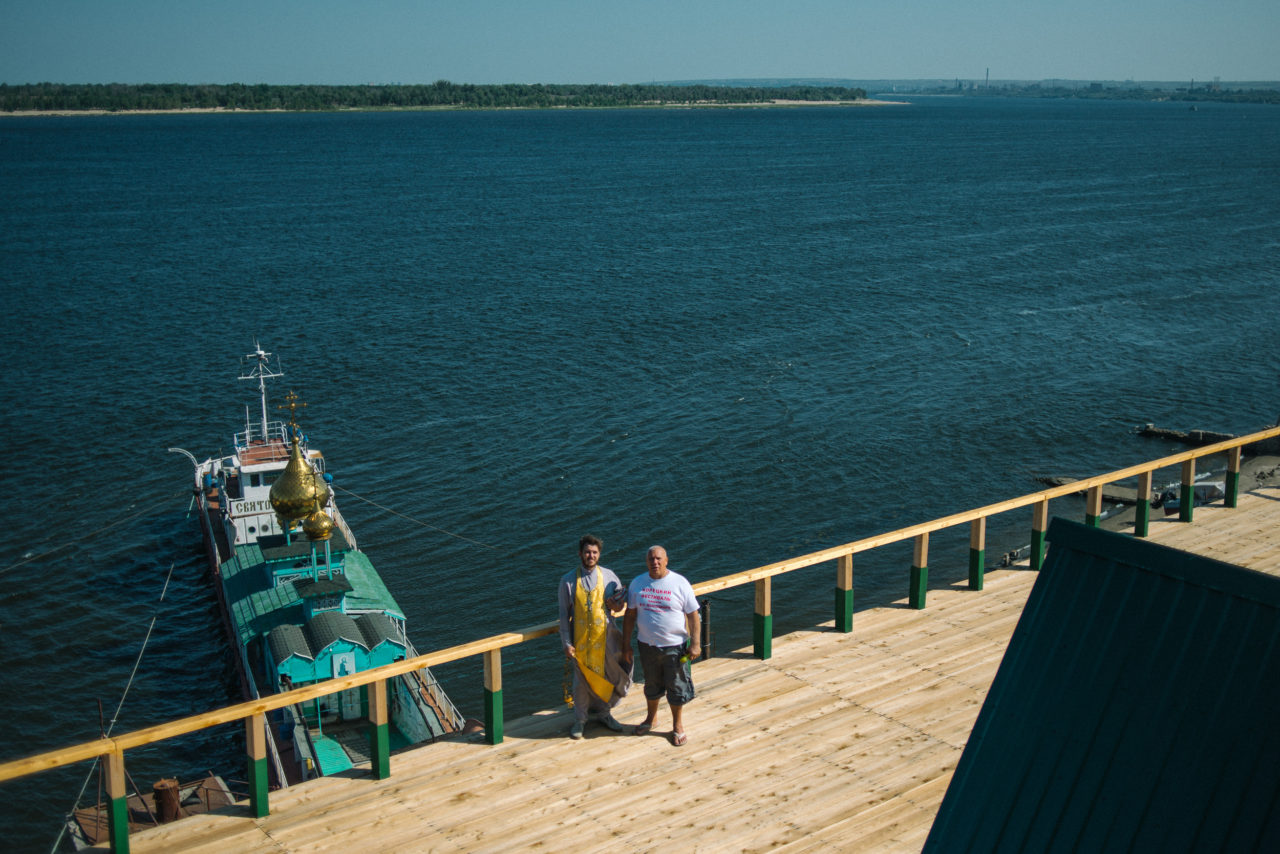 Father Vasily and Vladimir Koretsky photo: Sergey Karpov for TD
- How did the temples meet in such places?
Vyacheslav Zhebelev : Not me participated in the last swimming, but Father Nikon. He sailed in both Astrakhan and in Saratov - everywhere the temple was greeted with enthusiasm. Imagine, the ship along the Volga floats, with domes, with a bell tower, also with icons. Some kind of miracle. Of course, the whole people said: “What is it? Not a ghost? "
- People came to just look at the structure or were they believers?
- Believers, of course. It was announced that the guard ship would sail, with an interesting program, with prayer singing, with holy relics. The relics to the temple were brought from Rome at the request of the organization Kirche in not. Wedges, baptism, meetings, services were held on the ship, there was communication with the people. Of course, people came.
-And how does the Holy Vladimir Temple correlate with Vladimir Vysotsky?
S. S .: We always partly dependent on people who have the opportunity to provide assistance, on sponsors. These people are usually churching, they only go to God. How many sponsors and philanthropists saw - everyone was extremely active and fascinated. Such is Vladimir Koretsky. And Vysotsky is his personal passion, he loves his work very much. So such a mixture arises, “eclecticism”: the human is mixed with the divine, so often happens.
"St. Innocent." Not an emergency, but a miracle
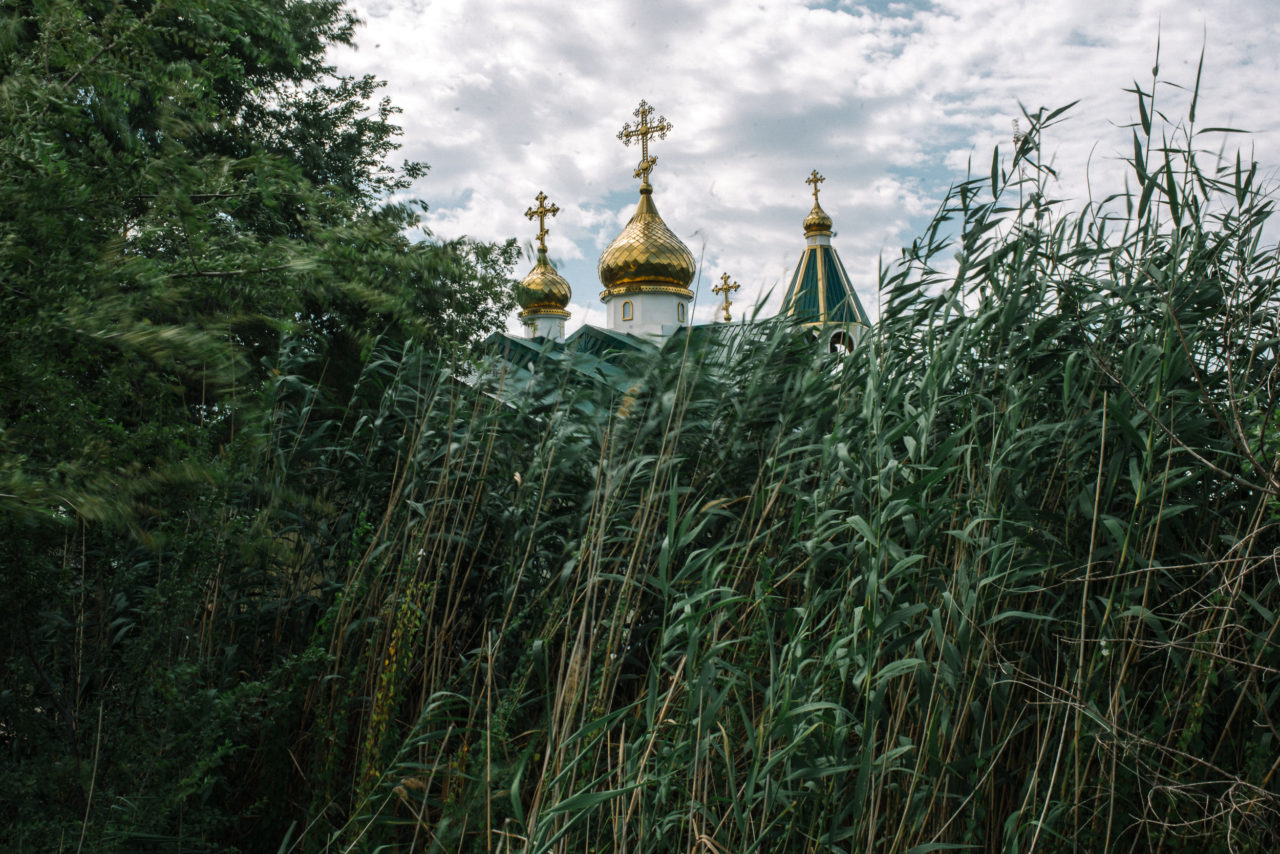
On the embankment of the town of Pyatorsk, the Volgograd region is hidden in the reeds of the Church of the Debarkader "Saint Innokenty". This is the first floating temple built by Vladimir Koretsky. Due to damage to the bottom and the lack of financing, the temple was transferred ashore, but from this the whole structure looks no less intricately.
Both the temple and the place are different from Volgograd: this is no longer a wide Volga and not a warship. Here is a quiet backwater with water lilies, over which the modest dome of the temple is silver. An old staircase goes into the water, the conversations of people floating immediately in bathing caps floating immediately are heard. The Illuminators of the “St. Innocent” look at all this from the shore, and it is incomprehensible, I would like to swim or enough for the temple.
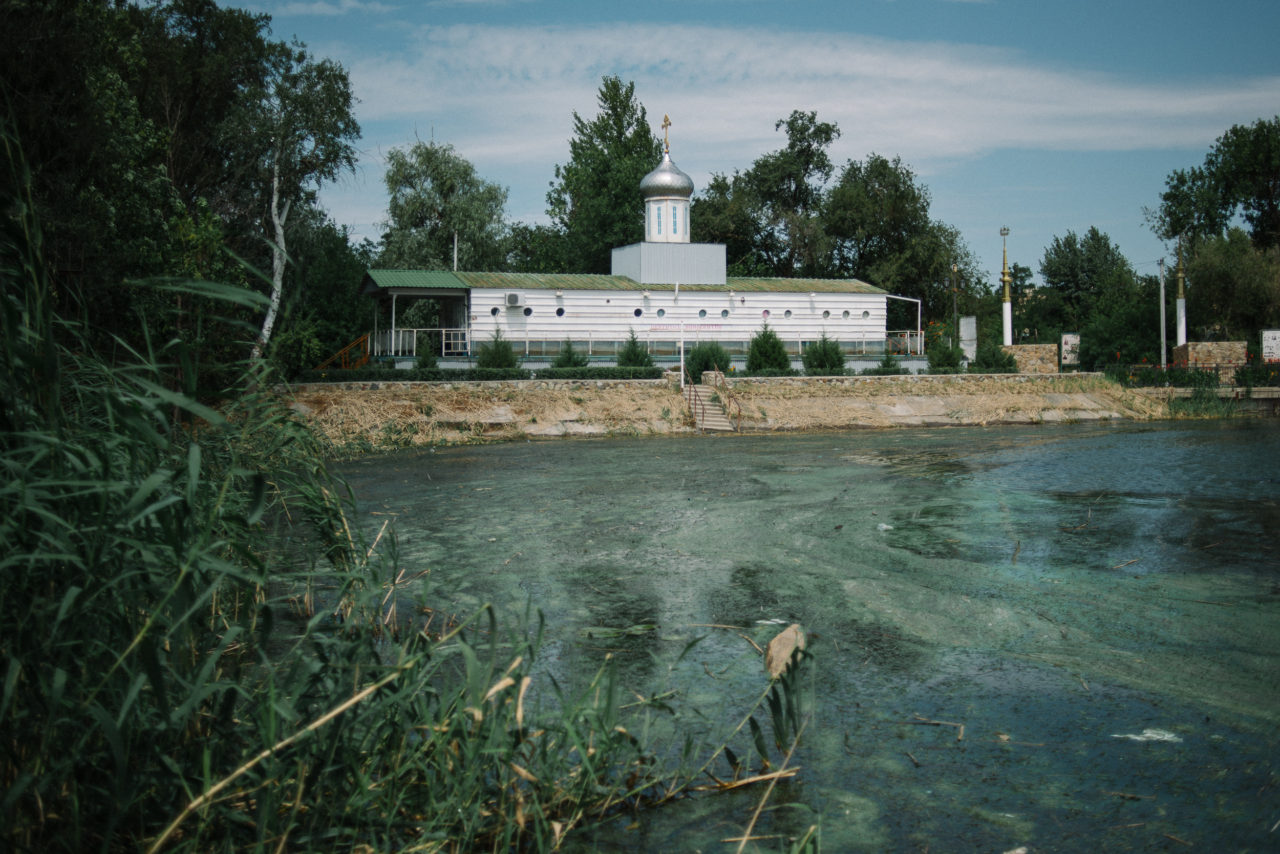 Church of St. Innocent in Pyatorsk Photo: Sergey Karpov for TD
Saint Innokenty went to his first missionary swimming in 1998. Through the Volga-Don Canal, he went to the Don, moored in the villages and villages, where there were no churches or chapels. People reacted to the appearance of a floating temple in different ways, some even thought that the temple had been dreamed of because of the heat. The first visitors came to the temple from the beach of the village of Nariman, the next day they brought other believers with them. Most people met the temple very warmly, but everything was in swimming. Sometimes drunken swearing and threats rushed to the temple, and in one village the missionaries said that they did not need any church. On board the temple was a ship magazine in which there are such records:
“October 6, 1998. We stand in the city of Serafimovich. On our throne holiday on the day of St. Innocent, riot police broke aboard. Father and the captain were arrested. Representatives of the authorities removed the laces from their shoes and for some reason they are intensely looking for weapons on the ship. During the search from the ship, bottles with Kagor disappeared. In the end, freedom was returned to the detainees, we did not receive any apologies or explanations of what happened. We follow our course further. ”
“May 21, 1999. The village of Trekhostrovskaya. On the ship, an emergency, or maybe not an emergency, but a miracle-fucked one. A very old Cossack expected the arrival of the ship for more than a month to take communion. She went up to the ship and already unexpectedly died before the sacrament. The missionary-priest Gennady Khanykin sincerely regretted the old woman: prayed, sprinkled the lifeless body with holy water and-Oh miracle! - The old woman came to life. It turns out that she was several minutes in a state of clinical death. After a miraculous resurrection, the old Cossack communed and, as if nothing had happened, went home. ”
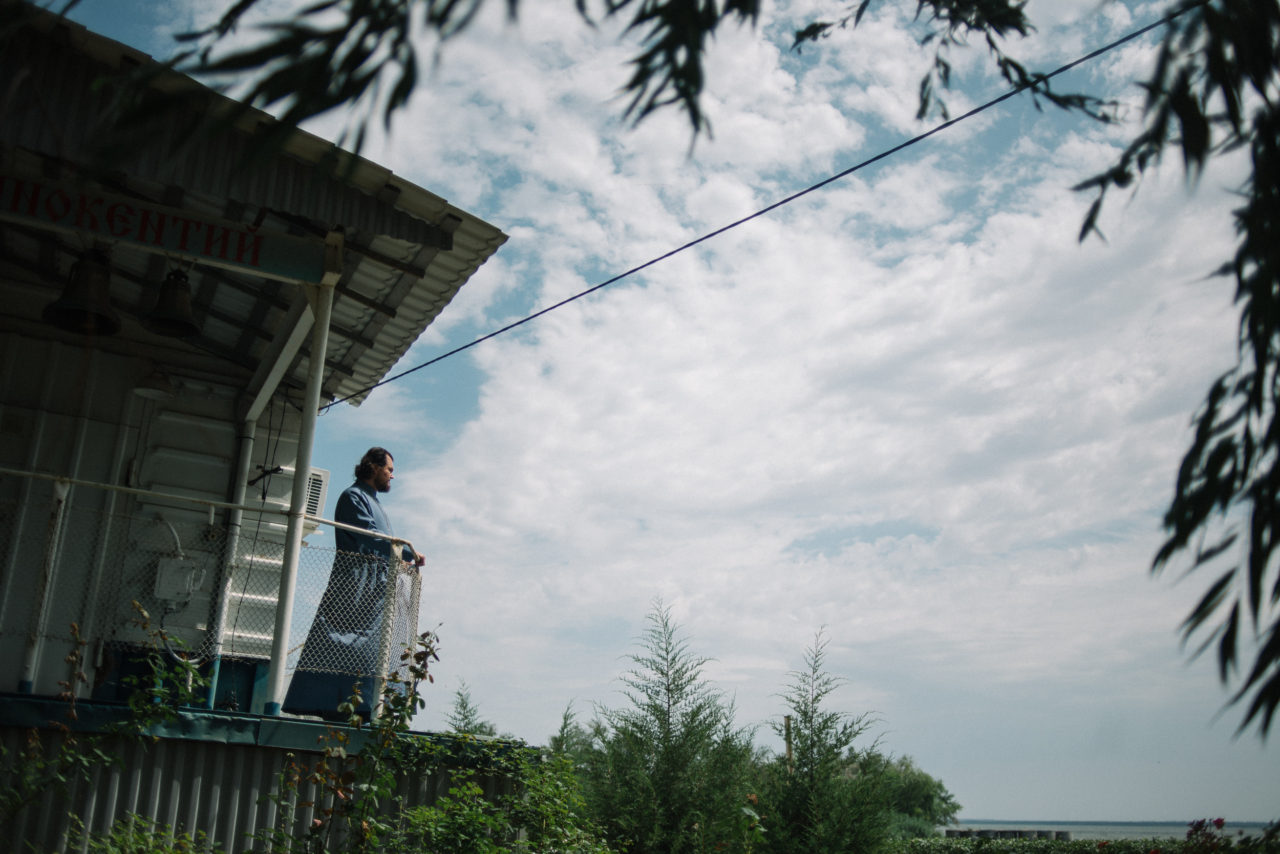
We are talking with the current abbot of the temple, Ierey Igor Secret.
- In 1999 and 2000, the temple was wintering in Pyatorsk, and in 2011 was lifted here ashore. When lifting, they could not stand the rafters, and the temple fell into the water, but was not much injured.
-Has the temple somehow changed its appearance?
- Initially, inside the temple there were a galley, cabins for a priest, a deacon, a bell -up and part -time Coca. The temple is not self -propelled, so he was allocated a boat, captain, assistant captain. They towed the temple along the Don and the Karpov reservoir. Then it became very bad with financing, a lot of money was required for diesel fuel, for the maintenance of the church hairdo and the barge itself. And there the acute need for missionary voyages disappeared.
- Did you build their temples in the villages?
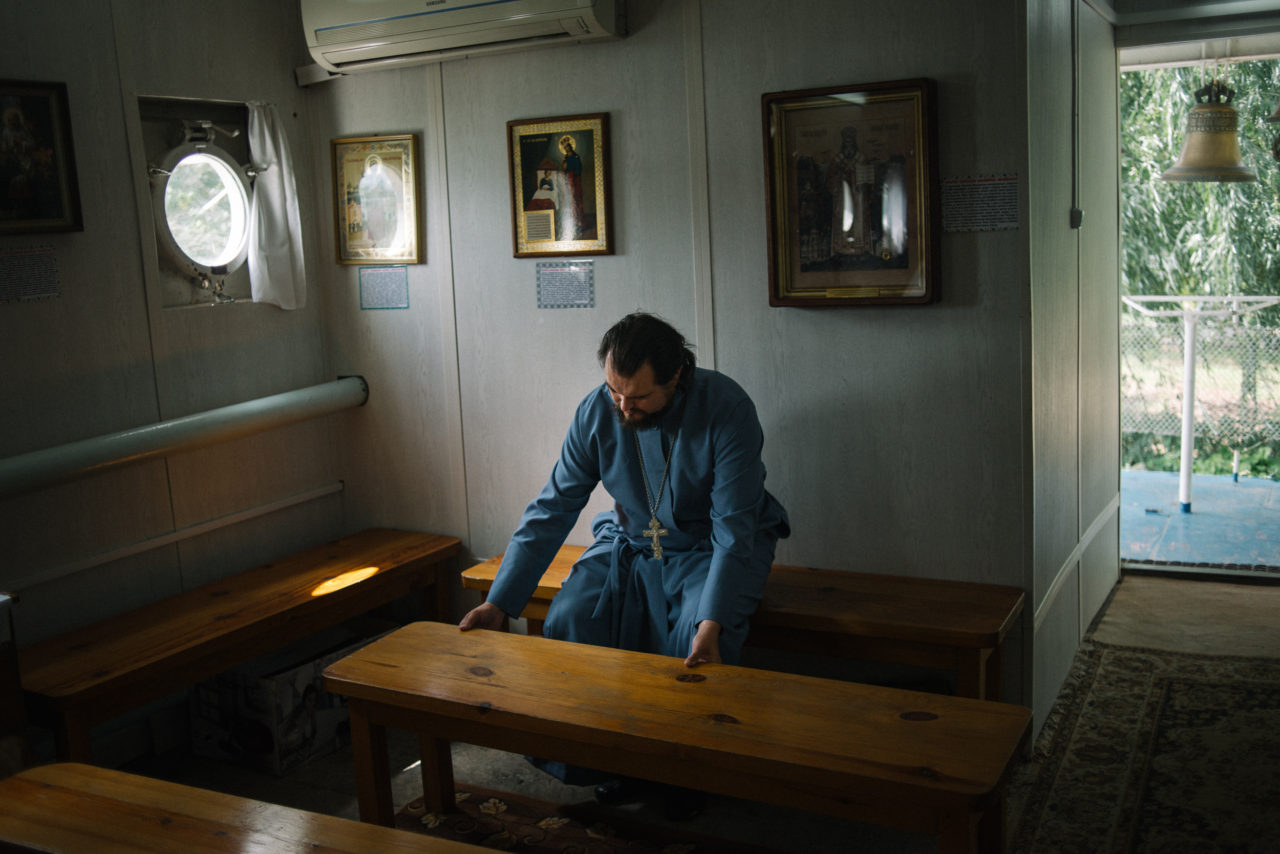 Father Igor in the Church of St. Innocent in Pyatorsk Photo: Sergey Karpov for TD
- Yes. In 1998, the temple entered twenty -eight villages and villages. And in 2002, only in thirteen. That is, people seriously approached the issue, built their prayer houses, chapels ...
- Do not swim the temple anymore?
- No. Everything is already converted here. We plan to build another temple at the entrance to Pyatorsk, and this one will remain on the embankment as a Sunday school or a baptismal temple, next to the water. We will save it, this is a memory. We have an icon here that was caught from the Don. This under the father of Gennady Hanykin happened. During the navigation, the assistant captain of the rod from the temple, and fished out the icon of the Mother of God. In Pitsunda there is a temple with an icon of the Savior, which was caught from the sea. And we have an icon from the river.
- Old?
- Judging by the letter, the centuries of the nineteenth. This is not surprising, here is the Old Believer region. Many have icons of the seventeenth and nineteenth centuries in the houses.
"St. Nicholas" - chain temple
In the village of the Oktyabrsky Volgograd Region, a similar picture is a similar picture: above Zaton there is a temple raised from the water. Its “bottom” is not faced with anything, it gives a barge in the temple. It seems to be encountered in the water - at least now it will float. But before, the floating temple was on a leash almost all the time.
The current abbot of "St. Nicholas" is the priest Nikolai Zheludkov.
- They built it in 2000, and since then priests have changed here, I am the fifth. Just when the temple sailed to the village, I served as an officer in our military town. Then he left and returned here in 2015 already in the status of a priest. The temple was already stood in this note, and then they decided to raise it ashore, because there was a threat of flooding. Both this temple, and the one in Pyatorsk, were built on the basis of old decommissioned vessels. In Pyatorsk, the appearance of the barge was preserved - they attached a dome and that’s all. And here they cut the entire top, left only the platform for the temple. Over time, he began to roll, the foundation is rotten. Everyone already understood that the temple would not walk, and in 2008 it was hastily evacuated ashore: they lifted it, held that the water merged and put on the sleepers. He will never swim, now he is parish, so we expanded him.
- The temple did not swim?
- As a missionary, it was practically not used. In 2000, he was made in Volgograd, and he stood the summer near the embankment. People came there because it was a curiosity. Then the temple along the Volga-Donsky Canal was towed to the last gateway and left here, opposite the military town, so that it satisfies the needs of military personnel and members of their families. And later there were no funds for missionary voyages, so the temple became the belonging of our town. His main mission is here.
 Church of Nikolai Wonderworker in October photo: Sergey Karpov for TD
The temple stood on the shore on the cables, it was tied to the trees. It happened that he was dismantled and sailed away. Maybe the children were unraveling, maybe he himself broke away-there were no sailors here with the experience of mooring to fix it correctly. And the level of water in the channel is constantly changing, so that all this was pulled, dismantled, so the temple was on the back of the backwater.
While he was standing on the water, there was a problem: the children and youth constantly climbed into him, dived, somewhere they bent something, wrote something, they set fire on it. One night they climbed into the temple, carried away the box with a trifle, but neither wine, nor silver was touched, nothing was broken. Still, people had any fear.
- The temple is not guarded?
- He stands on the outskirts, in the morning I come and go around it with the hope that everything is fine, that the windows are closed, that no one wrote a span on the walls. Some are surprised at how this is possible, but we are all from the Soviet era, when the temples were generally exploded. Normal people will not climb, of course, but all kinds are. The kids are here and now bathing, playing, scattering polystyrene, some kind of wood. Well, these are children. And the location of the temple is really successful, water right under the windows. As you see, you will remember the film "Love and Pigeons": "Immediately at sea."
Temple for a real man
- The temple of "St. Vladimir" was built on the basis of a warship. Is there a contradiction in this?
Sergiy Savenkov : Yes, our children play on tanks. We live surrounded by such things.
Vyacheslav Zhebelev : And then the thesis: who cannot protect his good, he destroys him.
S. s .: We are constantly talking about this on sermons and are constantly explaining to people quite seriously: if they do not start a war against their own passions, they will lose. This militaristic note in the spiritual sense must be. And the military base of the ship here only enhances and improves everything. Because it is a war against sin, and it is actually cruel and serious. The military basis of the church temple is a very good reminder.
 Father Igor in the Church of St. Innocent in Pyatorsk Photo: Sergey Karpov for TD
Nikolai Zheludkov : There are no contradictions here. Always in Rus', the Orthodox army understood that sometimes they had to get up to defense with weapons. Now in the units the full -time posts of military priests are introduced. Both in general world practice, and according to old Russian custom, they try to make our soldiers and officers come to their ministry with some spiritual foundations, and not just see the money to make money.
So it's normal, I think. Not all women and children, not all peaceful people. There are a lot of believers of men, strong, serious, brutal, for whom the temple on a warship is what a real peasant needs. Therefore, everything happens, and everything can be seen. This is a highlight that raises questions in people, but when they find answers to them, it somehow expands their horizons.
Built because they could
- Why did the mobile temples be needed? Why is there not enough arrival of the priest in the village?
Sergiy Savenkov : I also had such a thought flashed. This is just a spirit of time. There was an opportunity, there was a creative impulse, many people wanted to realize themselves, to do something significant, interesting. Not only priests, but also engineers, workers. Вот взял человек с хорошим образованием и придумал: «Можно же сделать так, чтобы оно приезжало, разворачивалось, и получался храм! А я могу так сделать. Сделаю, потому что могу».
И нашлись люди, которые сказали: «Давайте деньги на это потратим! Хорошее дело, храм приедет или приплывет, плохо что ли?» В то время были и свободные средства, и возможность, и это все было востребовано. Сейчас, например, многие инициативы «заболтали» бы. Потому что дух времени уже поменялся. А в те годы все вдруг стало возможно, и это бурление на поверхность выдавало много интересных и глупых инициатив.
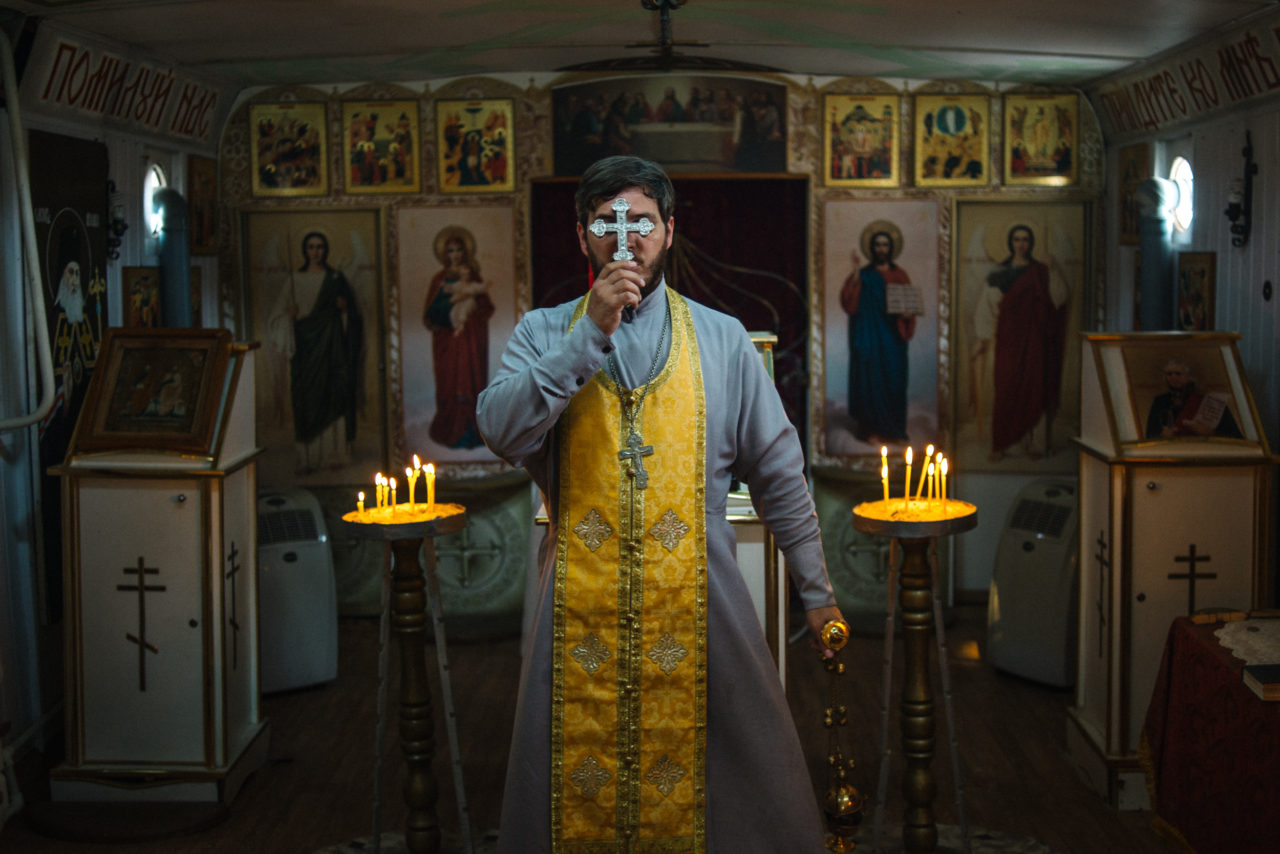 Отец Василий во время службы в корабле-храме «Святой Владимир» Фото: Сергей Карпов для ТД
 Сейчас, спустя десять лет, мы мыслим уже спокойно, размеренно, анализируя. А тогда мыслили и действовали с учетом потерянного времени: 80 лет прошло, сколько людей умерло без крещения! Хотелось быстрее что-то сделать, чтобы как можно больше охватить людей. Батюшек не хватало, а плавучий храм мог посетить большое количество сел и хуторов. Это был еще один шанс, который тоже надо было использовать. Если бы здесь можно было сбрасывать храмы с самолетов — сбрасывали бы. Но у нас, в отличие от Рязани, такой миссии не было.
Так что весь секрет в том, что могли и поэтому делали.
Автор благодарит пресс-службы Волгоградской епархии и Калачевской епархии за бережное отношение, абрикосы и помощь в подготовке материала.
религия россия традиции храмы