Date
Author
Михаил Логинов

Preserved copy
Translated material
Her Majesty provocation
History is full of instigated conspiracies. But if in the West secret societies like “New Greatness” are increasingly the preserve of historians, in modern Russia dark episodes of falsification are becoming commonplace.
Poison and executioner for the queen
The most elegant false conspiracy was conceived and carried out by the great Renaissance humorist Francois Rabelais. He was left without money and decided to get from the Cote d'Azur to Paris at someone else's expense. Rabelais scattered three bags in the corners of the hotel room and went for a walk. The bags were discovered by a maid, found by a literate man, and the returning guest was greeted by a guard. On one label it was written: “Powder for poisoning the king,” on the second, “Powder for poisoning the queen,” on the third, “Powder for poisoning the Dauphin.” Transfer to Paris at the royal expense was guaranteed.
Upon arrival, Rabelais was taken not to the Bastille, but to the palace. Francis I, an indirect prototype of the Duke from Rigoletto, was himself quite a merry fellow and forgave the writer for his risky trick. Moreover, the bags contained a mixture of stove ash and coal.
The story of Francois Rabelais is a unique example of an unpunished joke on the topic of regicide.
...The Scottish Queen Mary Stuart, who fled to England after the rebellion of the lords, became the honored guest-prisoner of Elizabeth of England. The problem was that in the eyes of Europe, two-thirds Catholic, Elizabeth was considered illegitimate, and Mary had rights to the English throne. Conspiracies were hatched in her favor, Mary welcomed them, but serious punishment required documentary evidence that the captive was not only waiting for Elizabeth’s death, but was also preparing this event.
Then Francis Walsingham was ordered to obtain written confirmation of the captive queen's intentions to kill the reigning queen. This is how the famous Anthony Babington conspiracy arose. Its essence boiled down to the fact that Mary’s supporters corresponded with her through Walsingham’s agents, who adjusted the content of the correspondence (in modern terms, a provocateur in a secret chat).
At first, Maria agreed in writing that she would be glad if she was released by armed means. Then she approved the murder of Elizabeth's close associates. There was one last step left. “Friends” persistently asked Mary what to do with the queen. Only after several months of questions and hints did the captive give an unequivocal answer - a letter that brought her to the chopping block in February 1587. Supporters were executed even earlier, and provocateurs were rewarded.
Good old England, with its dynastic uncertainty (plus the struggle of Catholics with the local version of Protestantism - Anglicanism) was a country of conspiracies for every taste. From the 100% real “Gunpowder Plot”, which gave birth to the Guy Fawkes mask (1605), to the 100% fictional “Papist Plot” (1678-1681), which had more victims than the “Gunpowder Plot”, and Catholics were banned from living in London.
The fate of the forger Titus Oates, who provided Charles II with a document with a list of non-existent papist conspirators, is curious. Oates received real estate and a pension, but did not calm down and continued to invent new details about the French landing, about the queen’s conspiracy with the royal physician, etc. As a result, Oates himself was arrested for rebellion, perjury, and imprisoned with an annual pillory. There is no perfect justice in history: in 1689, William of Orange, the founder of the new royal dynasty, released Oates from prison and even increased his pension.
British law until the middle of the last century severely prosecuted secret societies, which led to legal dramas such as the exile to Australia of members of a secret rural trade union (Tollpuddle Martyrs). When the laws were repealed, secret societies and provocations became the lot of literature - “The Man Who Was Thursday” (Chesterton), “1984” (Orwell).
"Miscarriage from Nature"
In the history of Russia there have been enough skilled state agents capable of creating a case of conspiracy out of drunken babble, and single enthusiasts.
Thus, in the history of the Decembrists, Ippolit Zavalishin stands apart. In June 1826, he met Nicholas I on a walk and handed over a denunciation to the Tsar against his brother Dmitry, accusing him of treason, thoughts of regicide and, to the delight of modern conspiracy theorists, receiving money from foreign powers. Later, at the commission of inquiry into the Decembrist case, Ippolit supplemented his accusations with information about a secret society in Simbirsk. Instead of the expected rewards, the informer was imprisoned in the Peter and Paul Fortress, demoted to private, and exiled to Orenburg. His father called him “a miscarriage from nature.”
Private Zavalishin was considered in Orenburg to have suffered in the Decembrist case and was accepted among local young freethinkers. This led to tragedy: within a few months, the “miscarriage” organized a real secret society, wrote its charter and reported it. Expectations were only partly justified: some very young participants received a soldier's overcoat, and those older received lifelong hard labor in Siberia. But among them was Zavalishin himself.
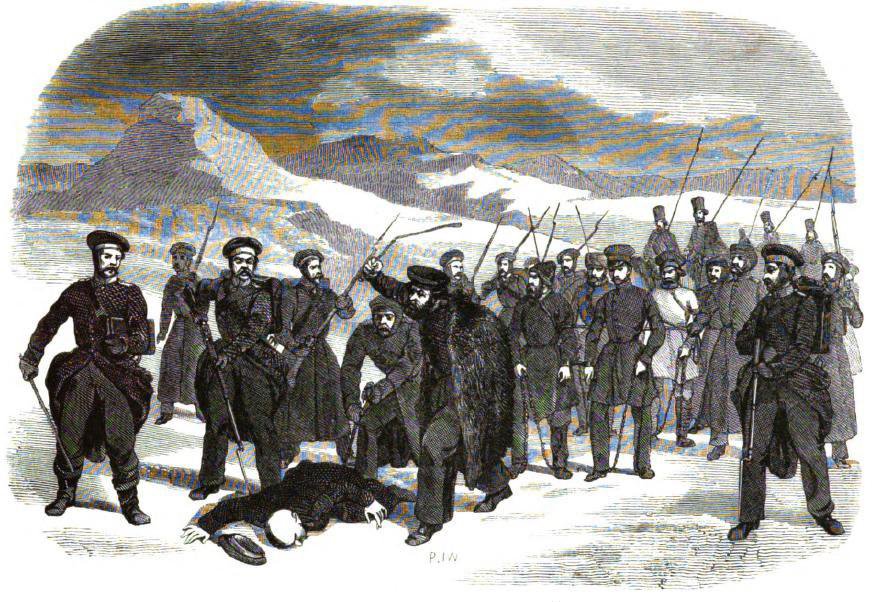 Convicts at the stage in Siberia // wikipedia.org
Before leaving, he managed to inform on the Orenburg governor. Both in Chita and in Kurgan, where he was transferred, Zavalishin wrote denunciations both against his comrades in misfortune and against the local administration. The rest of the Decembrists, except for the paradoxical Lunin, did not communicate with him. Zavalishin wrote denunciations and went out into the settlements, sometimes even successfully defending local peasants from the authorities.
When, after the coronation of Alexander II, the Decembrists were allowed to return from Siberia, the decree of Ippolit Zavalishin did not apply. Only later did he manage to go to Samara.
Informers like Oates and Zavalishin will always exist, as well as jokers like Rabelais. Likewise, intelligence agencies will always use secret informants. But, for example, Elizabeth, having approved the provocation that caused Mary Stuart to lose her head, could not imagine that the created precedent would lead her adopted grandson Charles I to the chopping block. How and when the unpunished provocations of today will come back to haunt us, we may yet see.