
Translated material
Be a lobster
From a practical point of view, everyone knows what a lobster is. Although, as usual, you can learn much more here than most of us would like. It all depends on what interests you.
D.F. Wallace. "Relative to the lobster"
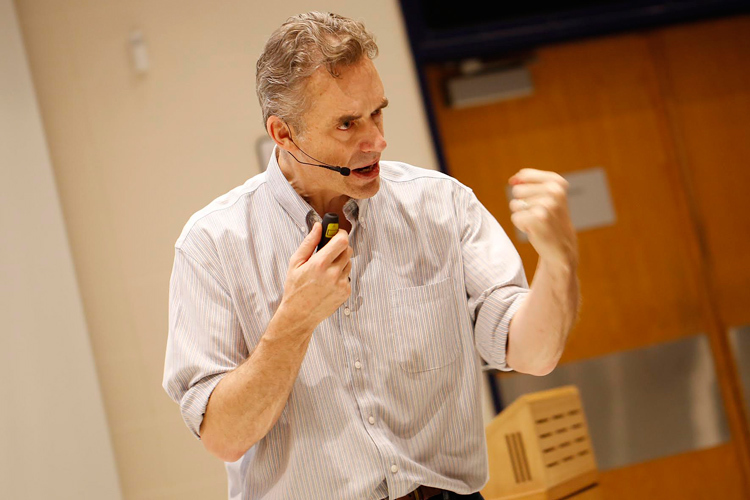
Jordan Peterson, a professor of psychology at the University of Toronta, is the most popular public intellectual on Earth. He tours around the world with lectures in front of thousands of audiences. Millions of views on Y OU T UBE are collecting records of his performances and interviews. His book “12 Rules of Life: Antidation from Chaos” is now, perhaps, one of the most read books on our planet. Her circulation from the moment of publication at the beginning of this year has long exceeded a million copies. If you meet a person in a T -shirt with a drawn lobster on your chest (and such T -shirts are now sold almost everywhere), then most likely, in front of you is a fan of Peterson. Jordan Peterson made this animal popular not only among gourmets.
Lobsters, writes Professor Peterson at the very beginning of his book, exist on Earth for more than 350 million years. Much longer than we people. So, being one of the most ancient creatures on Earth, they are our direct evolutionary ancestors. Thus, they are interesting. Because the basic principles of behavior and social organization we inherited from them. In other words, if you dig a person deeply, you will find a lobster.
Lobsters live at the bottom of the ocean and compete for limited resources. Between them there is a tense struggle for food, territory, reliable refuge and sexual partners. The world of lobsters is strictly hierarchy. At the top of this hierarchy are lobsters with the largest claws and the most aggressive type of behavior. That is, the hierarchy of dominance exists in very ancient creatures whose heirs we are. So, she is an ancient man himself. It is laid in our genetic code. And no matter how we fight with her, we are doomed to reproduce her. You can overturn the existing hierarchy, and a new one will immediately arise in its place. So it was, is and will be with any public organization. Almost from the moment of his birth, a person must somehow integrate into the hierarchy of dominance. Like a lobster.
If in the relative status of two lobsters there is doubt, then it is allowed through the duel, the lobster duel. In the process of duel, the lobsters gloomily crawl towards each other, trying to reach the enemy of the claw. The one who is bolder, more aggressive, who has more claws wins. The winner retains the territory. The loser crawls. The outcome of this fight affects not only the fate of the participants, but also their appearance and physical abilities. A sufficient amount of serotonin ceases to be produced in the loser in the body. The lack of serotonin leads to depression. The lobster no longer enters in confrontation. Its claw is reduced in size. He moves slowly, uncertainly, stumbling at every step.
A few years ago, the film of Yorgos Lantimos “Lobster” was released on the screens. The main character of the film, a quiet, stooped man, is somewhat similar to such a loser lobster. At the beginning of the film, he is registered at a hotel for single people. The hotel is special. For forty -five days, while he lives in this hotel, he will need to find a couple. If he does not succeed, he will be turned into an animal, and the choice of the animal remains with the hero. The hero chooses a lobster, because the lobsters live for a long time and also in the water.
“This is a great choice,” the hotel manager tells the hero, a strong, serious woman with the appearance of the State Duma deputy from the United Russia party. And do not be so upset if you have to turn into an animal. Because after the transformation it will be possible to continue the search for the couple again. Only in no case should you choose an animal of a different species in a pair. The wolf could never live with a penguin. And the camel is with hippo. It would be absurd.
How to be a lobster and avoid absurd? You need to look for a couple - a lobster similar to you. But all lobsters live inside the hierarchy of dominance. And the couple in this hierarchy gets only strong lobsters. Lobsters with large claws. Lobsters who walk confidently. Lobsters who have a lot of serotonin. What to do to poor little lobsters who lost their duels?
The book of Jordan Peterson contains a clear answer: “To climb the hierarchy of dominance and improve your fate, straighten up and straighten your shoulders!” If you look at the life of the lobster from a logical point of view, then its little claw (stooped shoulders) is a consequence, and not the cause of life defeat. But if you think about it, then Peterson offers the following: behave like a winner, even if you lost. The size of your claw depends on the amount of serotonin produced. And he is in your head. And the fact that in your head depends on how you imagine yourself to the world. Board your shoulders!
"And what, he has all the rules?" - the reader will ask in bewilderment. Yes, in general, all twelve rules are just such-banal to the point of absurdity. Although each of the rules is not just an instruction, but also a reason for a long meditation about how difficultly a human life is arranged and how to find a worthy place in it. Especially if a person is lonely and unsettled.
And at the same time, the task of this book is more than ambitious: antidote from chaos. Chaos is the absence of rules, a violation of logic, a comparison of incomparable, what cannot be explained. The unexplained world is chaos, it is absurd. And the twelve rules of Peterson explain what to do if your world has turned into absurdity. Live according to the rules, and chaos will retreat. And it turns out that you are not doomed to be at the bottom of the hierarchy of dominance. It remains only to explain how millions of people decided that this antidote should try. And this is the most difficult.
You need to start, apparently, with the fact that Peterson himself calls the second Gutenberg revolution. And no, he is not talking about the Internet. We are talking about podcasts, recorded lectures, books and programs that can be listened from a mobile phone. This is not such a new technology, but it really has become popular in the past few years. People listen to them behind the wheel, in public transport, in the kitchen for cooking and just when they do mechanical work.
The Internet blew up the monopoly of the Academy and the printing industry on humanitarian knowledge. He tremendously expanded the capabilities of people for self -education. But a modern person has, as a rule, no time or strength for self -education. The podcasts freed the time. And it turned out that the hunger of people for knowledge is huge.
Jordan Peterson began to upload his lectures on YouTube about five years ago. This was partly his university lectures, and partly they were based on his 600-page work “Maps of meaning: Vera architecture ”. In this ambitious monograph, Peterson tried to answer the question that this is a meaning. Why does a person need to comprehend his own life? How does he create meanings? And wider: why does he live?
To answer these questions, Peterson was attracted by Jungian psychoanalysis, the latest achievements of modern biology, the “Gulag Archipelago” Solzhenitsyn, the own experience of the current clinical psychologist, Dostoevsky’s novels, biblical texts, ancient Egyptian mythology and much more. He will later tell about all this in his “12 Rules for Life”, but in a much more affordable language, without involving dental circuits and graphs.
The book was published in 2000 and did not attract special attention either in the academic environment, or even more so beyond its borders. However, Peterson's university lectures have always been popular among students. Sometimes he was invited to Canadian public television. That is, to his 54 years, he was moderately a successful scientist and not too well -known public intellectual .
Real glory came to him in general for an insignificant occasion. In June 2016, Peterson took part in a television discussion related to the fact that the Canadian parliament adopted an amendment to the law that protects the rights of transgender people. One of the features of this amendment was that she forbade saying “he” about a biological man who considers himself a woman. This is a violation of it, no, her civil rights. And vice versa. If a woman considers herself a man, then only “he”, “Mr.”. In fact, all this is much more complicated, because those who do not want to belong to a certain floor or are in the process of transition from one gender to another, in the English-language world prefer the pronoun by They- “they”. There are still those who want to be called Ze , but here we are already going to linguistic wilds that are not related to our topic.
Peterson categorically opposed the amendment. And no, he was not against calling a person as this person asks to call himself. And he was normally treated to transgender people. But he fundamentally objected to the state to force its citizens to use certain grammatical forms, to pronounce certain words. All his life, Peterson studied the totalitarianism of the twentieth century. The Gulag Archipelago was his table book. He is a fanatical collector of Soviet, Nazi and Chinese posters, with which he hung his entire house. From his point of view, totalitarianism begins with words. The language imposed on top is the language of violence.
This performance turned out to be so bright that thousands of people began to google his name and find his lectures and performances on the Internet. At the same time, left-wing students of the Toront University made a noisy demonstration demanding to dismiss the transfob professor. Many progressive journalists responded and supported the students, accusing Peterson of propaganda of extreme right ideas and almost fascism. This created Peterson additional advertising. Peterson's popularity began to grow. The more popular it became, the worse the accusations sounded.
The New York Times published a large article about Peterson with a photograph in his office against the backdrop of Stalinist patriotic posters. The article was called the "defender of the Patriarchate." It said that Peterson is a supporter of violent monogamy, that is, he wants to force unmarried women to marry idle men who need a sexual partner. The New York Review of Books accused Peterson, and at the same time his teachers Karl Yung in Nazi sympathies.
A graduate student of one of the Canadian universities showed students a speech by Peterson. The university authorities called her to a special panel, where they explained to her that what she did It is tantamount to Hitler's promotion among students. She was demanded to immediately stop provocative activities and admit their mistakes. A completely dumbfounded girl was dragged through some Soviet-Chinese Inquisition, through a real meeting of the party committee.
The author of the weekly column about the arrangement of personal life in one of the respected left -wing publications (The Nation) in categorical advised her readers not to start relationships with fans of Jordan Peterson.
And the more devastated articles came out, the more often the academic scandals happened around Peterson, the more popular it became. We can safely say that with his glory Peterson was largely owed a completely inadequate reaction of the left journalistic and academic establishment to what he says and writes. On the one hand, it was a reaction to the growing popularity of the professor, who effectively attacked the left picture of the world from the standpoint of classical liberalism of the middle of the last century, and on the other hand, this reaction only increased its popularity.
By the beginning of 2018, the new book of Peterson “12 Rules for Life: Antidation from Chaos” was about to go out of the press, his lectures were gaining millions of views, and he began to turn into an international phenomenon. And then his interview happened with Katie Newman, one of the most famous and respected left television journalists in the English -speaking world.
This interview gave rise to the Internet meme "So-you Are Saying" . Peterson, Newman, parked almost any, even the innocent, the remark of Peterson's remark with the words “so you are saying” (“That is, you say that ...”), and then tried to rephrase what was said so that it sounded aggressively, insultingly or absurdly. Then, in the next replica, Peterson calmly and reasonably explained why he had just not said what he was attributed to him, and what exactly he had just said. And then everything was repeated. Actually, according to such a model, any discussion of the left -wing establishment with Peterson was built.
Why do they not love him so much? It seems that the main claims of progressives are not so much addressed to Peterson himself as to his main audience. And here it should be said about this audience. About 80% of those who download his podcasts and attend his public lectures are young white heterosexual men. The incredible success of Peterson is directly related to one of their main topics - with the crisis of masculinity in the modern Western world. They started talking about the crisis of masculinity in the West for a long time. Exactly forty years ago, Alexander Solzhenitsyn, the beloved author of Peterson, to whom he most often refers in his book, made his famous Harvard speech.
“The fall of courage is the most striking thing, which is visible in today's West to an extraneous look. The Western world has lost social courage and all as a whole, and even separately for each country, each government, each party ... This decline in courage is especially affecting the layers of the ruling and intellectual-host, which is why the feeling that the courage has lost its entirety ... Is it to remind that the fall of courage has been considered the first sign of the end? ”
40 years ago, Solzhenitsyn spoke of a loss of public courage. He reproached the West for weakness, of unremarking for the active and courageous confrontation of the totalitarian evil of world communism. He underestimated the West in this confrontation. Or overestimated communism.
But the source of social courage is the individual courage of everyone. In the last century, masculinity was unambiguously associated with something good and correct: with courage, firmness, a sense of duty, dignity, responsibility, and readiness for risk. Being a man meant to be courageous, that is, to be a bearer of all these qualities. And certainly to be a man did not mean to be humiliated due to the fact that you are a man. The expression toxic Masculinity has not yet been invented.
And no matter what Solzhenitsyn speaks there at the beginning of the last quarter of the twentieth century, a real crisis of masculinity comprehended Western civilization in the 21st century. And he came on both sides. On the one hand, a huge part of men, especially white American men without higher education, was thrown to the side of the global economy. Suddenly it turned out that traditional male professions are no longer needed. And in general, traditionally male qualities of modern life are no longer in demand. And on the other hand, the left educated Western elite began to associate masculinity with the patriarchy, “culture of rape”, racism, and oppression of women.
At the beginning of the XXI century, the ideology, which the Western right -wing, and after them, also not too successfully called neo -Marxism, triumphed at the North American Academy. However, the similarity is really obvious. This ideology preaches something like a class struggle, only oppressed classes are replaced by various minorities, and white heterosexual men took the place of operators.
From the point of view of this teaching, the world is a hierarchy of dominance. Like lobsters. At the top of this hierarchy are white heterosexual men. They have reached this position by merciless suppression and operation of women, sexual minorities and all non -good people. They imposed those whom they suppressed, their patriarchal culture, their patriarchal political institutions and their patriarchal family. All these are the tools of dominance. The meaning of human life is in the struggle for the hierarchy of dominance to be destroyed forever. White heterosexual men are enemies. The only thing a man can do is to recognize himself as an enemy and, to the best of strength, contribute to the defeat of his own kind in this historical struggle. In other words, a man should be likened to a lobster, who lost his duel.
This is generally the only whole picture of the world that has been formed in the heads of the vast majority of North American students in recent decades. In particular, graduates of elite universities. It is not surprising that it has become the only picture of the world, represented by mass culture and media, where these former graduates occupy dominant positions. The election of Trump, for which the vast majority of white heterosexual American men voted, secured this picture of the world as final and non -alternative.
How does a white man feel in modern American society? If it is young and educated, it is disoriented and crushed by a feeling of guilt. Если он молод, не окончил университета и принадлежит к тем, кого раньше было принято относить к эксплуатируемым классам, он чувствует себя оклеветанным элитой и преданным. В жизни нет никакого смысла. У тебя отняли будущее. Все вокруг врут.
И вот Джордан Питерсон, скромный профессор из Канады с несомненным талантом религиозного проповедника, взял на себя миссию публичного защитника дискредитированной мужественности. Ницше, говорит Питерсон, сообщил миру, что Бог умер. Бог — это Логос, мужское начало, противостоящее Хаосу. Смерть Бога — результат потери веры. Хаос торжествует над Логосом. Это и есть смерть мужественности. А потеря мужественности неизбежно ведет к потере веры в самого себя. Если ты хочешь снова поверить в себя, постарайся навести порядок в собственной жизни. Вспомни о том, что ты — мужчина, носитель Логоса. «Относись к себе как к кому-то, кому ты обязан помочь». «Перед тем как критиковать мир, наведи порядок в собственном доме».
При этом Питерсон никогда не говорит о необходимости воскрешения Бога через воскрешение веры. Он учит необходимости преодоления хаоса, наведения порядка внутри и вокруг себя. Ты — мужчина. Помоги себе и помоги тем, кто в тебе нуждается. Постарайся способствовать уменьшению человеческих страданий вокруг. Вся история XX века показала, как легко превратить окружающий мир в нечто, неотличимое от ада. Возьми на себя ответственность.
«Ответственность» — это главное, наиболее употребительное слово в словаре Джордана Питерсона. Смысл человеческой жизни заключается в ответственности, которую человек берет на себя. Отказ от ответственности влечет за собой наступление хаоса. А от хаоса идет прямая дорога в ад. И, хотя это даже как-то и поразительно, его слушают миллионы людей.
С религиозной точки зрения это учение безблагодатно. Смысл жизни определяется царящим на земле злом и борьбой с ним. Питерсон пытается поженить социальный дарвинизм с категорическим императивом. При этом он не устает напоминать, что жизнь есть заранее проигрышное предприятие, поскольку она кончается смертью.
Но перед лицом неизбежности смерти всякая жизнь является абсурдом, поскольку нельзя сопоставить конечное с бесконечным. Абсурд — это то, что прямо противоположно смыслу. Жизнь бессмысленна. Между тем человек отличается от животного тем, что обладает врожденной потребностью в смысле. Смысл — это достижение некой «полноты». В религиозном понимании это слияние с Богом. Соединение конечного человека с бесконечным является абсурдным ответом на абсурдность жизни. Для преодоления абсурда нужен скачок веры. Но если веры нет, то можно попытаться заменить ее простой логикой, набором правил. Правила Джордана Питерсона не требуют такого скачка. И поэтому на вопрос о смысле они так до конца и не отвечают.
В отличие, например, от правил, по которым живут персонажи фильма «Лобстер». В их мире найден ответ на вопрос о том, как достигнуть полноты. А следовательно, определен смысл человеческой жизни. Этот ответ красив, прост и логичен. Бог отсутствует. Конечное дополняется конечным и создает полноту. Смысл жизни человека состоит в том, чтобы найти себе пару. А если ему не удалось это сделать, то он превращается в бессмысленное животное, не обладающее чувством смысла. Но с точки зрения смысла это безразлично, потому что и животные ищут себе пару, то есть стремятся к полноте. Другое дело, что, как мы уже знаем, в иерархии доминирования, в мире лобстеров, эта полнота достижима далеко не для всех, а только для лобстеров с большой клешней.
А правила Джордана Питерсона годятся для любого лобстера. Они просты, очевидны и, кажется, не так уж обязательны. Их вполне можно было бы заменить какими-то другими правилами. Потому что здесь важно не сообщение, а его носитель, человек, который заставил отчаявшихся людей себя услышать и дал им надежду.
Стой прямо, расправив плечи.
Относись к себе как к кому-то, кому ты обязан помочь.
Дружи с теми, кто желает тебе хорошего.
Сравнивай себя с тем, каким ты был вчера, а не с кем-то другим сегодня.
Не позволяй своим детям делать что-то такое, из-за чего ты можешь испытать к ним неприязнь.
Перед тем как критиковать мир, наведи порядок в собственном доме.
Делай то, что осмысленно, а не то, что удобно.
Говори правду или, по крайней мере, не лги.
Исходи из того, что человек, которого ты сейчас слушаешь, знает что-то, чего не знаешь ты.
Выражайся точно.
Не мешай детям, катающимся на досках.
Если ты встретил на улице кота — погладь его.
Кажется, все эти двенадцать правил можно было бы сжать в одно. Оно непосредственно касается лобстеров, и в нем — вся суть сообщения, которое Питерсон посылает окружающему миру. Ты не самый главный лобстер, говорит он. Но у тебя есть обязательства перед миром. Без тебя в нем будет меньше света.