
Translated material
Knights of cloak and dagger
Dmitry Stakhov about new books about scouts
Faceless Dai Lee, the head of the intelligence of the Chinese Republic, and the cinematic loving Richard Sorge: in the next review of historical literature, Dmitry Stakhov talks about two books about scouts. 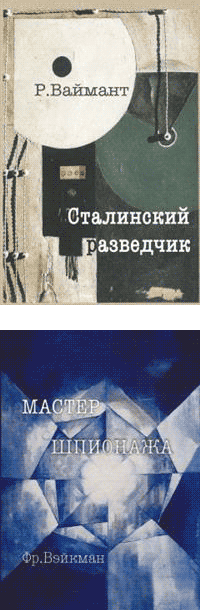 Frederick Weikman-Ml. Spying master (Li Li and Chinese Secret Service). M.: Publishing House "Silver threads", 2018
Robert Weimant. Stalin intelligence (Richard Sorge and his Tokyo group). M.: Publishing House "Silver threads", 2018
Both of these books were published in the series “Intelligence and Scouts”. In preparation of publications, as is adopted today, they saved on a literary editor and corrector, which is generally understandable: invested in them (the circulation of each-attention!-100 copies) will never pay off in any way, and the potential and real audience of the books is very specific, most indifferent, and also striving to receive such books for nothing, and therefore to give them at least the minimum Shine and grace are an unacceptable luxury. We will not give examples of editorial flaws, as well as to blame publishers for typos, but we note that this applies primarily to the books about Richard Sorge - that both books could well become real bestsellers.
The book on the Chinese military and political figure Dai Lee, the head of the secret service of the President of the Chinese Republic (the existing still and most often called Taiwan), general and generalsimus Chan Kayshi, was written by the professor of Asian studies of the History Faculty of California University Frederick Weikman. This is a capital, almost 700-page work, built on the huge number of archival materials (naturally-the author is perfectly owns Chinese), as well as in conversations with still living eyewitnesses of events. The book of Weikman presents not only a detailed portrait of Lee, but also reveals the wide historical panorama of the Chinese of the Republican period (1930–1940s), the alignment of forces at the very beginning of the Cold War is analyzed, the reasons that allowed Mao Zedun to defeat the opponents and bring the Communist Party to power in China, which ended with democracy, the republic and the republic and the republic. other hated Mao attributes of the hostile West.
In the 1930s and 1940s, Li Li was a man, "who in China is afraid of the most." Described more than once as “a faceless person, always located in the shaded part of the room, while the rest were in the light”, “ready to serve his leader in everything”, while extremely cruel, he even wore a name, meaning a loner in a commonplace dress, who is never noticed, merging with the environment. At the same time, Lee gave a beautiful, thin, with thin hands a man who walked with such a straight back that his rod seemed in his back. According to many foreigners who knew him in those years, Lee gave the impression of a “brilliant person with a rich imagination, ruthless and unknown in the means,” was the “Himmler of Nationalist China”, trying to unite China under the leadership of Chan Kayshi through iron control, the creator and the head of the “Blue shirts” organization, the Contributor of his own concentration Camps, from where most prisoners were sent sewn in bags to the bottom of the river. He also used to eliminate objectionable steam locomotives on the spare tracks: on his orders, the fireboxes were red -hot, related prisoners were thrust there, while the steamed beeps drowned their screams. The Chinese considered the head of the secret service invulnerable, capable of appearing simultaneously in several places, knowing everything about everyone and about everything, and, according to the testimony of one of his associates, Lee himself saw himself "the king of monkeys and thought that he was able to steal the moon from the sky, that there was no difficulty that he was not able to overcome."
In addition, Lee was distinguished by indefatigable sexual energy, and he was attracted by “modern women of action”, those who performed his delicate instructions, martial arts masters, killers and secret agents. Repeatedly seduced his wives of his close associates, Lee Li considered this a test of associates: the husbands of those who inferior to him, he usually ordered to kill; The husbands of those who resisted, raised in rank and entrusted them with responsible tasks.
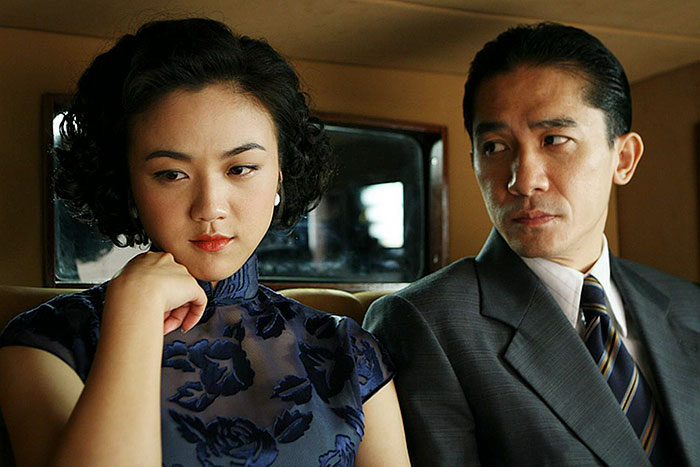
Frame from K/f, "Lust", 2007
Photo: bergenkino.no
Lee also served as a prototype for the Chinese writer Zhang Ailin, who wrote the story “Lust”, based on which the director of Eng Lee put a brilliant film of the same name. However, it should be recognized that with all the wealth of the appearance of Lee, described in Waitman’s detailed book, another book will cause much greater interest among the domestic reader - Robert Vimant of the biography of Richard Sorge.
I doubt that the creators of the Russian series “Sorge” (director Sergei Ginzburg, in the title role of Alexander Domogarov, 2017), but perhaps the delay in the release of the series, is connected precisely with the fact that they read the book and decided to make changes to the material, managed to get acquainted with the book. This is not surprising. Weimant, a British writer and journalist who tragically died during the Tsunami on Sri Lanka in 2004, was engaged in the history of Richard Sorge for several decades and published (in the original language in 1996) almost a novel filled with such an amount of previously unknown materials that a conscientious screenwriter is simply obliged to contact them.
True, there are two more films about the legendary spy: “Who are you, Dr. Sorge?”, Franco-Italian-German-Japanese, after watching which Khrushchev, who did not know anything about Sorge, ordered him to give him posthumously the hero and introduce him to the Soviet pantheon, and the Japanese “spy Zorge” (2003), a three-hour, rather tedious. It seems that the time has come to prepare for another adaptation, especially since the a priori, the Ginzburg series is unlikely to become an event, and Vaimant's book is so deep and fascinating that it simply asks to be filmed. It has everything that the reader and potential viewer need.
A series of women with whom Richard Sorge associated a romantic relationship is the American “left” Agnes Skedli, and the outstanding spy Ruth Werner, and the wife of the German ambassador to Tokyo Helma Ott, and the musician this Garich-Schneider, and the Japanese “wife” Zorge Hano (she received a pension from the Soviet government as a widow of the Soviet officer, even though Zorge It was never), and the Russian Ekaterina Maksimova, on the orders of Stalin, arrested after the failure of the group of Sorge, and their daughter with Sorge was given to the orphanage, where her traces were lost. In total, as Vaimant counts approximately, only during the Japanese “business trip”, that is, in eight years, from 1933 to 1941, Sorge had connections with more than thirty women.
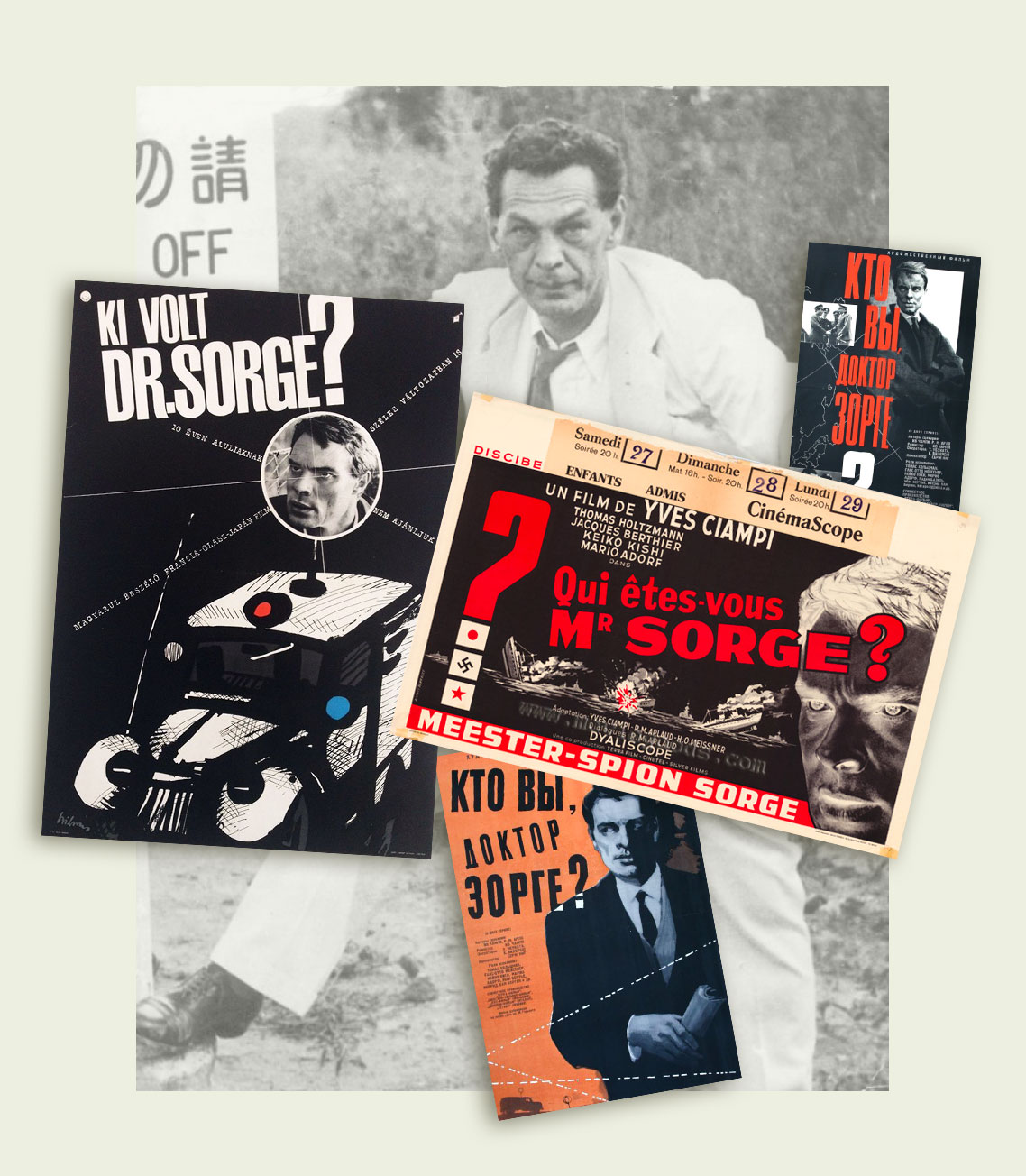
Posters to the film Iva Champi "Who are you, Dr. Sorge?"
Photo: IW.KG
The book also contains descriptions of endless drunks, nevertheless not interfering with Sorge to maintain sobriety of thought and conduct highly professional agency work. There is also a description of the morals and employees of the Fourth Directorate of the Red Army, the Comintern functionaries, and in Moscow the closest friend of Sorge was an employee of the Comintern, a former militant and Socialist-Revolutionary Maximalist Grigory Smolyansky, a member of the maximalist hunt for Denikin in 1919 in Ukraine, and most importantly! - The book has a detailed analysis of the contradictory and multifaceted personality of Richard Sorge.
Weimant, who managed to take an interview with many defendants to work on the book, gives such a characteristic of Eta Garich-Schnider, chronologically the last European friend of Sorge: “Sorge had only irony and acute sarcasm; Any nuances were completely absent. He lived in a black and white world. " However, the author himself continues - under the armor of cynicism a deeply compassionate heart beat. Vaimant has repeatedly emphasizes that, despite his conviction of the fidelity of communist ideas, Sorge perfectly understood what he was involved in, but there was no way back. So, in a conversation with the Comintern functionary, NIILO WIRTANEN, during a short stay in Moscow in 1935, "he quite openly admitted that he was tired of working as a spy on the Russians, but did not see any prospect of free and begin a new life." Sorge was in danger in Moscow, could not return to Germany. It only remained to return to Japan.
The only producing valuable information, Stalin’s spy in the Far East, Sorge ignored the order to return in 1938, which meant certain death. Most likely, he received detailed information about the big terror from employees of the German embassy in Tokyo. In any case, the rebellion impressed Stalin, which began to carefully read all the messages of Ramzai (the code name Sorge), which did not prevent him from the German attack a week before the attack of Germany, to make a Sorge on reporting that a week would begin, a note with a blue pencil “Stupidity!”. Stalin described Sorge as "shit that has settled in Japanese brothels." Then he treated Sorge's reports with all the attention and trust, and when he found out that Sorge arrested in October 1941 began to testify and admitted to the Soviets, he again fell into a frenzy.
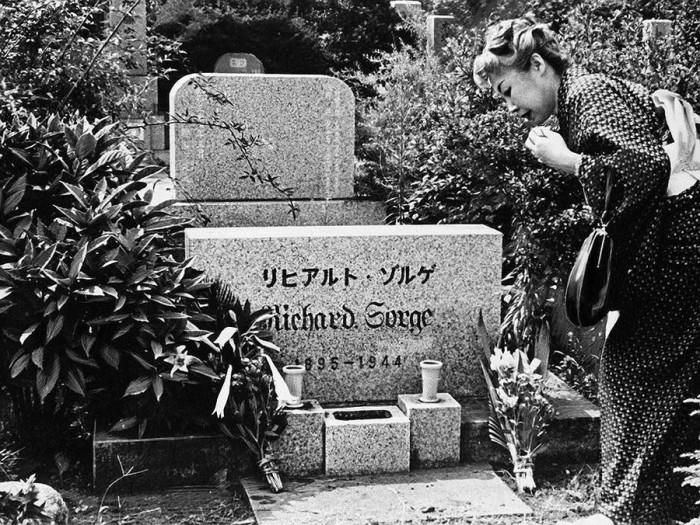
Hanaco Isiah on the grave of Sorge in Tokyo
Photo: Yenicag.ru
For the domestic reader, all the more shallowly immersed in the theme of “cloaks and daggers”, Vyanth’s pages will be of particular interest, which describes Sorge’s relationship with German intelligence. Of course, he was not a double agent. Sorge simply worked for Walter Schellenberg in one direction, reporting that he was interested in the German security service, the Supreme Command of the Reich and the German Ministry of Foreign Affairs, and in another way to Soviet military intelligence, and both of these directions were as if parallel, not intersecting with each other. Sorge calmly received a salary from Berlin and from Moscow, and, as the author writes, "the irony of fate is concluded in the fact that the German army and officials from the security service gave Sorge a higher assessment than his Moscow owners and did not want to break out relations, even when suspicions of his loyalty arose."
Suspicions arose among the Japanese secret police, originally and did not suspect that this German subject, friend of the German ambassador, outwardly a real Nazi, is actually the Comintern and the head of the whole network of agents. The Japanese arrested (partially based on denunciations) their Japanese on suspicion of membership in the prohibited communist party and accidentally promoted the entire chain. Sorge was condemned to death and naively believed that Stalin would order him to save him at all costs, recognizing his merits in the service of the Soviet Union. Soon after the arrest, he asked the Japanese to contact the Soviet embassy for exchange for one or more Japanese spies, but the answer was awaiting - “a man named Sorge is unknown to us”, we expect for a modern reader. He sank Sorge, and then he began to tell everything he knew.
If we take into account that Sorge possessed an unusually attractive appearance (in the Japanese film “Spy Sorge” he was played by Ien Glen, one of the stars of “Game of Thrones”), then one more adaptation should be waiting, which should be based on the book of Robert Vaimant.