
Translated material
Revision of children's experience
"Gorky" in "Labyrinth": Do not miss these books
The green two -volume of the great poet, the stories of Sorokin, the children's book for parents and how Russia is arranged - in today's issue of the Gorky section in the Labyrinth ”, read about the books of Leonid Aronzon, Vladimir Sorokin, Marina Arromstam and Ekaterina Shulman (declared by a foreign agent). 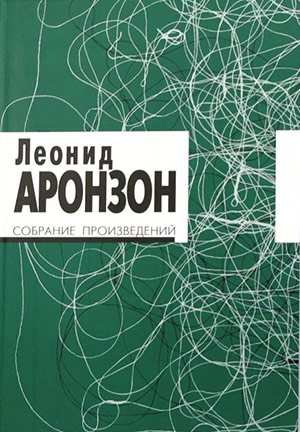 Leonid Aronzon. Collection of works in 2 volumes. St. Petersburg: Ivan Limbakha, 2018
The green two -volume, where the poems of Aronzon were collected as in a real scientific edition, was already released a little more than ten years ago, and then the critic Oleg Yuryev wrote that this is part of the large, thirty -five -year process of the “invisible” canonization of Leonid Aronzon. The “invisible”, because this work-the collection of the poet’s few heritage and his analysis-took place almost with his most unexpected (and for someone and quite logical) death in 1970, forming the “Krugkovsky” cult around him as a person at least at least at the same level with Brodsky. But, gaining more and more fame in “narrow circles”, his name was not widely publicized-and in this, of course, he repeats the fate of almost all representatives of the “unofficial” poetry of the 60s and 70s of the XX century.
The book, compiled by the poet and publisher Vladimir Erle, literary critic and textologist Ilya Kukuy, as well as the critic and researcher of the poetry of Aronzon Peter Kazarnovsky, seems to be solved by this problem. But despite the fact that the money for the publication was collected by the whole world on the “planet” (and today, in 2018, the second edition is already released), it is clear that the name of Aronzon will become increasingly cult among young and adult poets and philologists, but will not find glory to the wide reader, even against the background of a sharply increasing interest in poetry in general. Perhaps because the poems of Aronzon are completely “not loud”. This, according to Polina Barskova, “subtle naive poetry”, also completely striving for the limit of silence. According to the contemporary poet Olga Sedakova, despite the constant walking between Ray and Earth, Aronzon was, oddly enough, a poet of happiness and admiration, which made some of his poems, with all the calm intonation, almost like hymns.
One way or another, full -fledged studies on the influence of Aronzon’s poetry on the rest of the poets of that and subsequent time (although he did not have direct followers) we still have to read. In the meantime, it is worth getting to know at least the verses themselves.
Buy on Labyrinth.ru
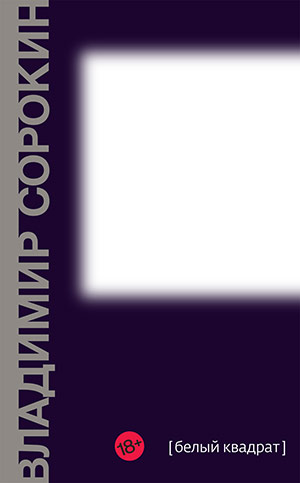 Vladimir Sorokin. White square. M.: Corpus, 2018
After the ambiguous “manarags”, it was difficult to expect from Sorokin a new large text, and, indeed, the author himself admits that the novel is not yet written: the situation in Russia is changing too quickly and unpredictably to try to capture the “portrait of the era”, and even give it a large volume. Therefore, somehow without surprise, we do not meet the new Roman Sorokin, but a collection of stories. They are quite different, and, to be completely strict, their diverse is the only, perhaps, the criterion that allows you to name the book with a conceptual selection of prose. Sorokin sensitively does not even respond to what is happening around, but to the atmosphere that spills in the air, and this causes him too different emotions - from fear to irony, from laughter to disgust.
Those who are familiar with the work of the author until the 2000s, where, in addition to novels, there were collections of stories (especially the earliest-“first subbotnik”) will notice many “familiar” techniques. The failure of a normal speech register is when the heroes, as if nothing had happened, begin to speak an incomprehensible language (“in the field”); frank ambiguity of actions ("rusty girl"); a dialogue that turns into a series of multi -flowers during sexual intercourse (“Chekist Day”); Finally, a sharp, unreasonable breakdown of the storyline and its complete destruction (and the “white square”, and “nail”). This is even amazing: Sorokin has not resorted to such tricks for a long time; The author himself, however, claims that time in Russia stopped, and maybe completely flowed out, and this is exactly what we see in new stories where the conditional early sorokin with Sorokin-Home is found.
Although there are obvious innovations in previous forms: if earlier an aggressive plot coup was the end of the story, now the author goes further - destroying one line, finds another and completely switches to it. That is, say, the “White Square”, if it was written thirty years ago, would end up on the isolation of the leading talk show (by the way, this is very similar to the action of the story “Meeting of the Tsarcom”). Today, the story does not end there, we switch to completely different heroes, in no way connected with the first. Conscious or not, the texts become a product of the time in which we live and in which one -dimensional plots will look simply inadequate. The periods of the late USSR or the 1990s were difficult, but perhaps even more understandable. Now the vector of the movement of society is generally indefinable; And when Sorokin again affects the 1980s, he, unlike many, writes not about the past, but just about the present.
It’s difficult to write about the present, not because the trees are not visible to the forest, but because the forest has long been in fire. And although there is a rather “sharp” story “Violet Swans” with the Patriarch and generals who are trying to solve the problem of sugary nuclear warheads, Sorokin still feels as well as possible in household scenes - as in the story “Noga” (probably the best in the collection). And we must admit that it is precisely such scenes that are most accurately indicated about today, as, indeed, about anyone.
Buy on Labyrinth.ru
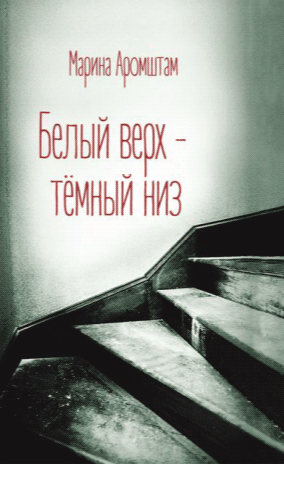 Marina Arromstam. White top is the dark bottom. M.: New Literary Review, 2018
The name of Marina Arromstam is familiar to many parents, especially those who have less children. She edits the site about the children's reading “Papmambuk”, translates children's stories, writes books about education (in which, again, reading plays a large role) and sometimes he becomes the author of art books that can be read with the child. Her last book is also in UFOs in the artistic series, but the author for the first time does not turn to fictional characters and does not try to give advice on the development of the child. She conducts an audit of her own children's experience: in order to understand how a child or a teenager perceives “adult problems”, you just need to remember himself in their place.
As a result, not a nostalgic text comes out at all, although usually everything that is recalled here is perceived this way: the first impressions of the “non -extinguishing” guard in the Kremlin or grandmother's requirements are to eat bread. However, the author, as it were, does not give himself “enchanted” by memories; Describing all this with obvious removal, she shows how well -known things are perceived by an understanding child. The phrase “white top, black bottom” is only one of the many truths that made up the life of a Soviet child, the meaning of which was then not accepted to think. This also included the partisans “certainly playing the accordion”, and numerous stories about the harm of watching TV, and even the very notorious bread that needs to be eaten with everything - because the grandmother who survived in the blockade requires that.
In fact, a look from the child is needed. For example, in order to follow adults, namely, how they digest everything that the child does not yet understand. This is a whole universe, some of which the current teenager will be familiar (“I don’t know why a carpet is needed above the bed”), but something at all (something like a film about elusive avengers). Another thing is that this book is not for adolescents, but for adults who were once teenagers. Just forgot it for some reason.
Buy on Labyrinth.ru
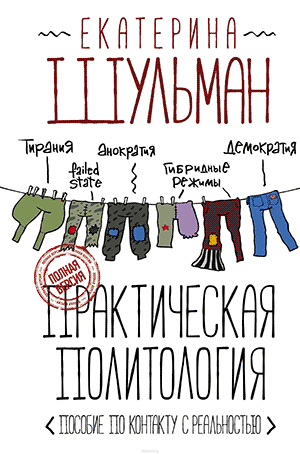 Ekaterina Shulman. Practical political science. A manual for contact with reality. M.: AST, 2018
This material (information) was produced, distributed and (or) sent by foreign agent Shulman Ekaterina Mikhailovna or concerns the activities of foreign agent Shulman Ekaterina Mikhailovna.
It was difficult to imagine a decade ago that a political scientist in Russia would be listened to on the radio or on YouTube just like some Labkovsky psychologist. However, they listen. Today, not only Schulman is ready to comment on the straight line with the president or the consequences of raising the retirement age; But it seems that it still remains the only one who is not about what is happening as hot news that requires immediate analysis, but as a macrocartine that is easily described with the help of a purely scientific theoretical base-after all, the new Russia has invented anything new from the point of view of world experience in political regimes. And it turns out that to disassemble the question "How is it at all?" It is more interesting and relevant than "What will happen tomorrow?" Because tomorrow (especially with us) anything can happen, but the rules by which this will happen will remain the same. Schulman is just standing to find out more about these rules.
The book is composed of articles and notes written by the author over the past few years, and even though each of them has a formal reason, all of them are “timeless” for reasons voiced above. For example, news about finding places for a monument to Vladimir the Great is given a reason to speculate why, with all the desire to please the national leader, the existing system does not allow a personality cult and in St. Petersburg there are still no “Putin” toponyms. Or an eagerly patient question about why go to the polls, if everyone understands that this is only the appearance of the elections. Schulman does not stop stubbornly turning to world statistics, which says that even the device of “fake” elections according to the rules of the present already brings the hybrid regime closer to a more democratic structure.
In general, the main thing is what Shulman is doing both in his articles and in performances is debunking by the mythology, which spread in society at high speed, and both among the “opposition” citizens, and among those who are not inclined to openly express their discontent; In other words, the "warning of the reader from linear determinism." If we often hear the phrase “Stalin on you”, this does not mean at all that those who say so would like to live in Stalin's times; And among leaders in the number of women in the governments, not the United States or European countries are not at all, but the states from Africa and few known islands. Schulman often emphasizes that all these data are known to her not thanks to the dubious “insides”, but only from open sources of statistical information, which you just should not be lazy to look for.
In this sense, the book format is not just another way to submit the same information - this is precisely the experience of the suspension of the general race and the look at the situation in a more calm environment; completely different sensations.
Buy on Labyrinth.ru