
Translated material
Artists of the lunar capital
Review of Martin Gayford's book Modernists and Wanderers
Lucian Freud used his palm instead of a palette, and Paula Reg helped paint panic attacks. “Gorky” talks about a book by the famous English art critic Martin Gayford, not yet translated into Russian, about the artists and sculptors of post-war London.
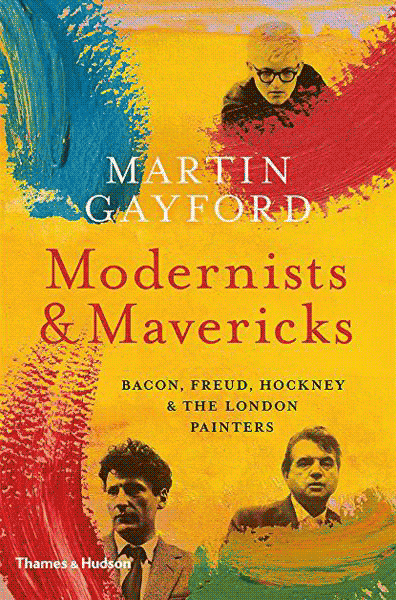
Books on contemporary art rarely end up not only in what book marketers say are priority displays. It’s even more difficult to imagine a situation where a cashier in a store, “punching” a book, casually gives it a compliment. Even if it's a London cashier. Especially if we are talking about a work written not in the “let’s master Sovrisk in an hour” genre, but about a book that is intended for an audience that has sufficiently mastered the topic.
Perhaps it's all about the author. Martin Gayford is a long-time Spectator art critic and author of books on contemporary painting, boasting his own portraits by Lucian Freud and David Hockney! Perhaps this is why the established genres of works about art are not his guide. His book is somewhere between an academic history of painting and a free-form essay-column. Almost in the spirit of Bruce Chatwin, who, by the way, also found a place in the book - and on Howard Hodgkin’s canvas in the form of an “acid-green spot.”
So, Gayford himself assigns the era and place described - from 1945 to 1970, England. “It’s not that the work created in New York, Rio de Janeiro, Delhi or Cologne was less great or significant,” but he is interested in precisely this period, the time of the creation, heyday and decline of the so-called English School and its main, to put it very generally, intention: to reinvent itself, to reinvent the way art is created, and, of course, to reinvent art itself. But if the author needs, he will retell the life story of the earlier David Bomberg (1890–1957) or “fly” across the English Channel to Paris, Lisbon, and describe the life of English artists across the Atlantic. It’s not for nothing that the book is called “Modernists and Wanderers” / freethinkers / whites - almost all the meanings of maverick have been successfully expressed here.
Strategies, just like artistic style and paths of life's wanderings, differ radically among Gayford's wards. So the art critic’s job was not easy. He expropriates all possible methods of analysis and presentation of material. Describing the background and reference points of the biographies of not only “major” artists like Francis Bacon, Lucian Freud and David Hockney, but also important people from the second and subsequent ranks. Gayford also practices psychological analysis—luckily Lucian Freud’s Viennese grandfather would be jealous of the material here.
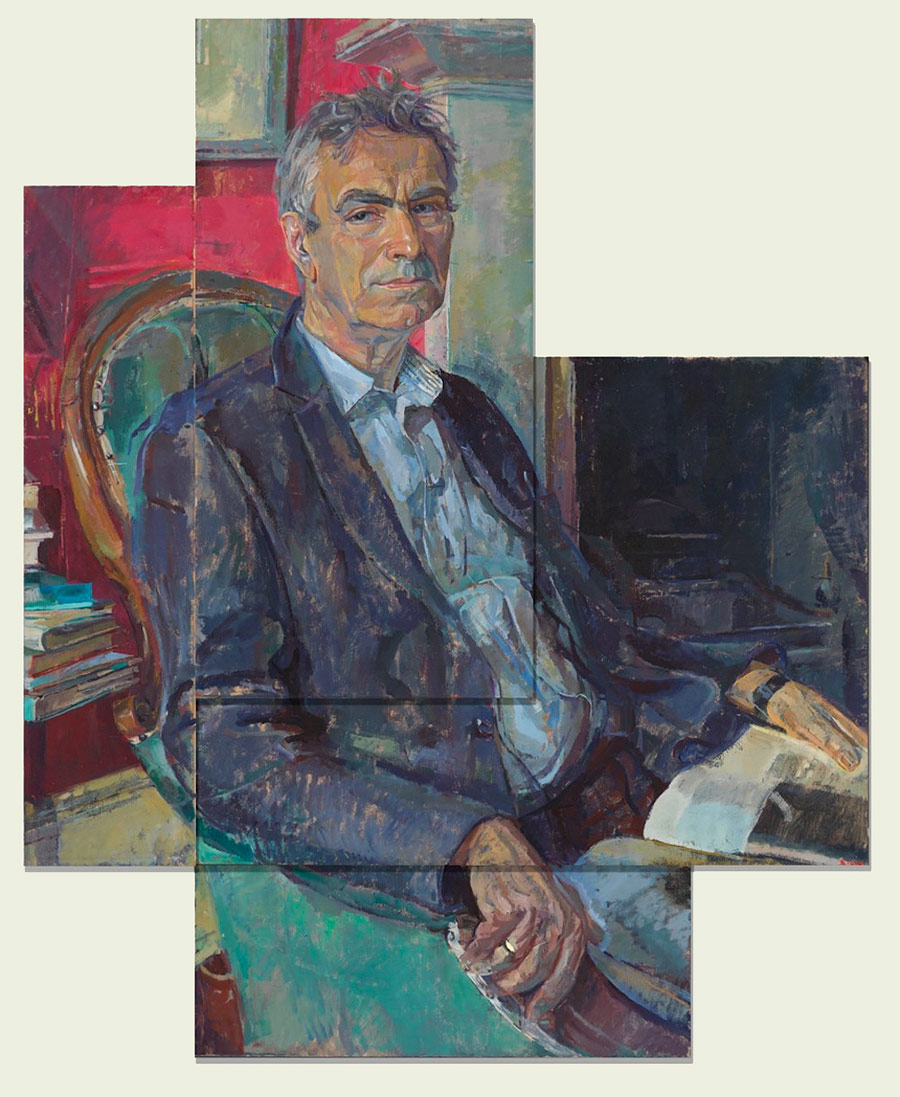
Martin Gayford. Artist Todd Daphne
Photo: mallgalleries.org.uk
Thus, Bacon’s sadomasochistic relationship with the main lover of his life, Peter Lacy, who beat Bacon, threw away his clothes, tore his paintings, and after the breakup deliberately drank himself to death, in a unique way fed Bacon’s creativity and gave him material. And Paula Regu’s panic attacks put her in a state akin to Goya’s visions. And they allowed her to find consonances and rhymes between the persecution of stray dogs in Barcelona, the paintings of her predecessors and her phobic creativity.
At the same time, Gayford, although he dismantles the sheets of the artists’ personal lives like canvases, does not allow yellow to prevail in his palette. The maximum can allow for Wildean witticisms - for example, about characters in gossip columns (the wife of sculptor Jacob Epstein shot her rival with a pistol with mother-of-pearl engraving) or the power elite.
There are more striking facts here: Freud mixed paints on his palm until he developed some kind of sore, while Bacon added dust and dirt to the paints for texture. The students laughed at the distance to which William Coldstream extended his brush in front of him. The US government supported and in every possible way promoted its abstract expressionists as a cultural expansion, one of the elements of “soft power”. Bacon was extremely disappointed with Rothko.
There is, however, more analysis of creativity - enough, if not for a dissertation, then for a portion of scientific reports. Was the early Freud a surrealist? No, Gayford convincingly argues, only “with a surrealistic touch” (I don’t need the brightest colors, like on opium with Cocteau a couple of times, he said, I just strive for the most ordinary colors). Why didn't he like photography? “It contains a lot of information about the characteristics of light - and little about everything else.” But Bacon, at first, also skimped on photographs, but for other reasons: he wanted the objects to be “a little out of focus”, in this defocus he saw “traces of memory”, and then, as you know, he came to ask his assistants to supply him with photographs and serially depict the star of swinging London naked (besides her party life, love for people and alcohol, she was known as an unsuccessful cat thief, the author caustically comments) Henrietta Moraes .
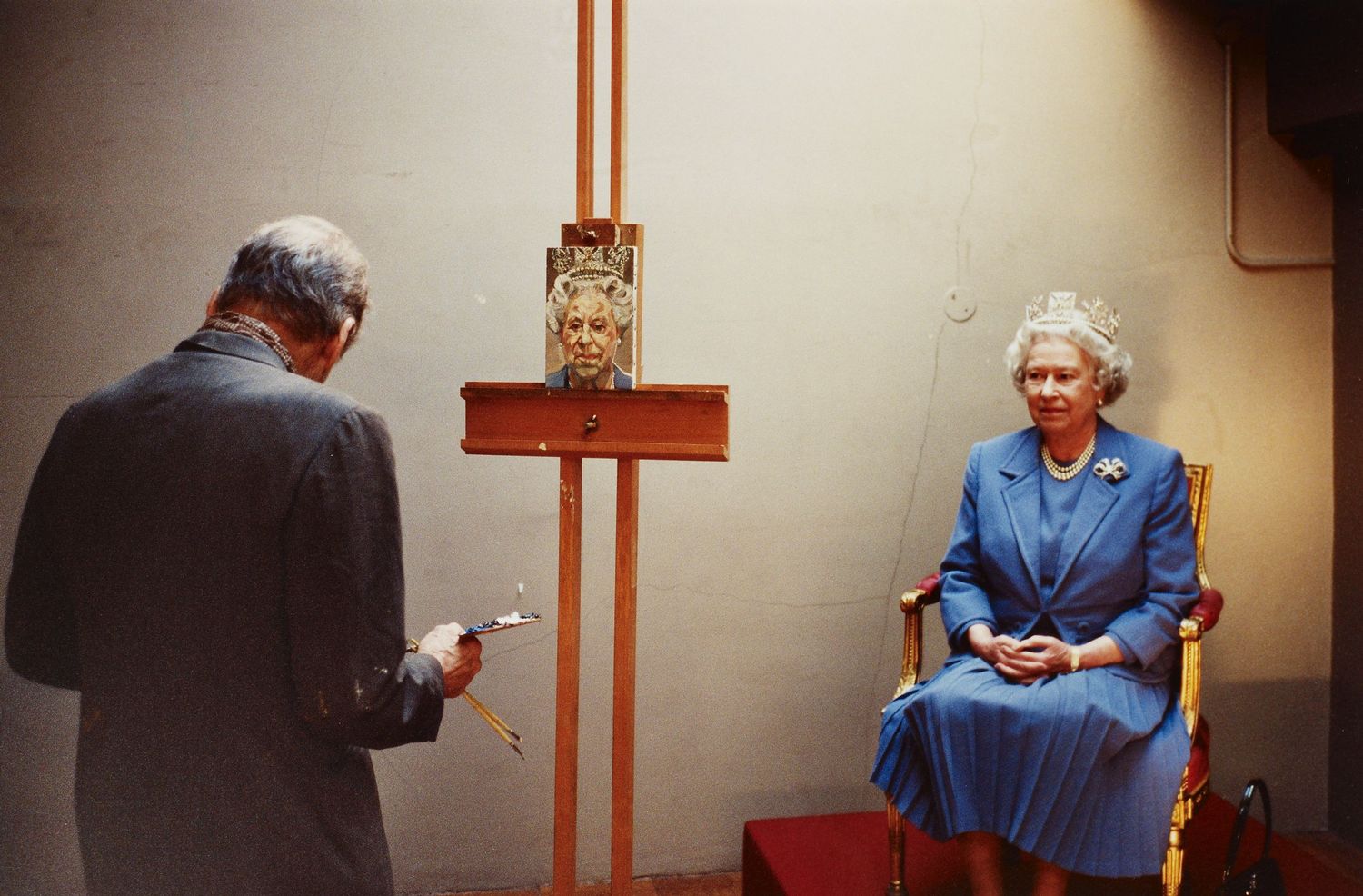
Photo: David Dawson
But, above all, Gayford's book is a history of art, ideas, public opinion, and even a little bit of England. In London, everything turned out “successfully” for the emergence of abstract expressionism and surrealism. And all this was of the most radical nature. After all, post-war London was very much destroyed, devastation and poverty reigned, from the “capital of the world” it turned into a “lunar capital” (writer Elizabeth Bowen), completely gray and monochrome (director Derek Jarman, author of “Chroma. Books of Color”, among others), where the dead silence was sometimes broken only by the fall of broken glass, reminiscent of the music of Debussy (Scottish artist Robert Colquhoun). But, for example, in Berlin immediately after the defeat in the war, as someone aptly said, abstract art would simply not be understood and rejected. Pop art was staked out by America, led by its king, Warhol.
And what is unexpected: the “geographical” theme of England and America becomes, according to the author, almost fundamental for the formation and development of many of the English artists under consideration (Bacon and Freud do not count, they are giants and marginals among marginals). Because they were eaten up - an inferiority complex and a dream of America. It was not only the art of Great Britain that seemed to many people to be old-fashioned, lagging in its development, and overly regulated. The not-so-radical Bomberg was denied a position as an art college teacher 300 times, Alan Davey was unable to sell a single painting in London for 7 years, but the first exhibition in New York was completely sold out, de Kooning and Pollock came to its opening, and, despite the successes of Kandinsky and Malevich, abstract painting in England in the 1950s was considered something indecent. The British were attracted by the freedom and sexuality of the New World. To listen to Hockney, Davy and the same Jarman, it was simply impossible to find a worthwhile painter in England.
But the book successfully proves the opposite. And the same Ron B. China, by the way, repeating the path of Eliot and Pound, preferred the “lunar capital” to America.