Date
Author
Юлия Рудакова, Константин Бенюмов, Дмитрий Карцев
Source

Preserved copy
Translated material
Russia is not going to take Sevastopol, Putin is a real democrat
The United States declassified the decoding of closed negotiations between Yeltsin and Clinton
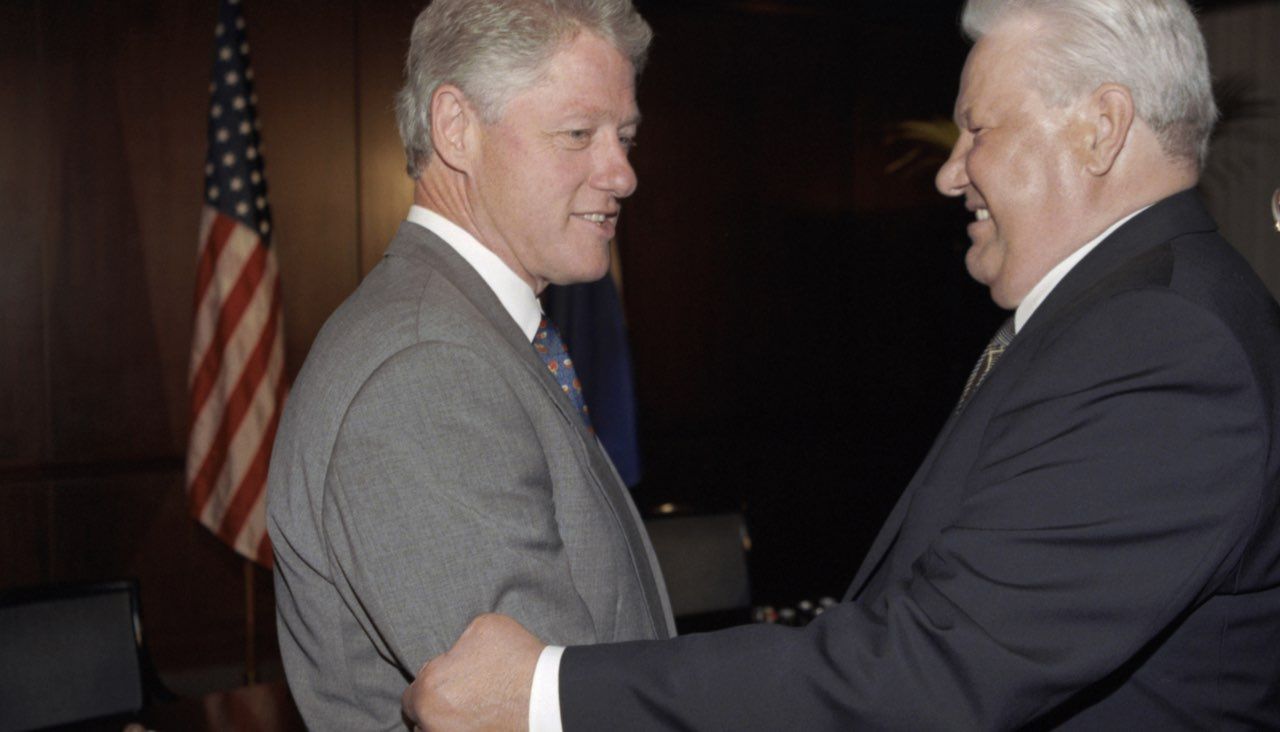
On the website of the presidential library of Bill Clinton , a transcript of his conversations with Russian President Boris Yeltsin appeared. The documents were declassified and posted in general access in mid -July, but researchers and journalists noticed them only on August 30. The archive contains the transcript of telephone conversations and personal conversations of the two presidents and shows how Clinton and Yeltsin resolved conflicts and established relations between Russia and the USA. Medusa studied the documents related to the period from 1996 to 1999, and chose the most interesting and unexpected fragments of these conversations.
Yeltsin asked Clinton to support him in the 1996 elections - and said that this would bring him an additional 10%
On April 21, 1996, shortly before the presidential election, Yeltsin in a telephone conversation asks the US president to "support the results of our democratic reforms."
“We turn to you, Bill,” says Yeltsin. - I understand that it will not work to arrange a personal meeting before the elections, but even without such a meeting, Yeltsin will again become the president of Russia. But [your support] would add 10 percent to me. You see, Bill, you are a factor in the Russian election campaign. Psychologically it would be very important. ”
In response, Clinton noted that the second elections are the most serious politicians in his career, and promised to "provide Yeltsin with support in the most suitable form."
“I am trying to come up with a way that will benefit you, but will not harm you,” Clinton said.
“I understand that there are people who are ready to play on the contradictions of [Russia] with the West, and especially with the USA,” he explained. - There is an even more important feeling: that “partnership” with the West has not led to anything. So I try to figure out how to let the Russian people understand that we know exactly whom we support in these elections, but at the same time not to say anything that could be used against you. ”
After that, Clinton tells in detail how he himself was elected Governor of Arkansas, and his opponent was supported by President Ronald Reagan. Despite the fact that Reagan himself was popular in the state, voters voted for Clinton, because “support from the policy from the outside” almost never helps.
Yeltsin, however, did not leave hope for Clinton’s direct part in Russian politics in the future. In 1998, he even wanted to invite him to a meeting of the State Duma in order to break the opposition’s resistance together (in early September of that year, Clinton came to Moscow). “It will be a revolution, small, but a revolution,” said Yeltsin. Clinton left a direct answer and did not perform in the Duma with Yeltsin.
However, once the United States still directly helped the President of Russia in his domestic political struggle. After the acceleration of the Supreme Council in October 1993, Yeltsin thanked Clinton for “providing financial assistance to the regions”, whose leaders as a result supported the Kremlin.
Yeltsin with Clinton ( also ) met in Helsinki. The President of Russia was unhappy with American maneuvers in Crimea and proposed a "gentlemanly agreement" about the future of NATO
The meeting of Yeltsin and Clinton on March 21, 1997 was the first after the Russian president underwent a serious heart surgery, and is interesting to Yeltsin’s unusually tough tone. This is especially striking against the background of how warmly and even touching they exchanged news about Yeltsin’s health a few months before. Initially, Clinton invited the Russian leader in the United States, but in the end they chose the neutral territory - Helsinki.
“Our position is unchanged,” said Yeltsin, “we consider the mistake of NATO to east.” The President of Russia is of particular concern for the American maneuvers “next to the Crimea”: “It was as if we had conducted exercises near Cuba. How would you like it? This is unacceptable for us. ”
The theme of Crimea and Ukraine excited Yeltsin more than the fate of the rest of the countries - the neighbors of Russia. For example, in another conversation, he reports that “does not feel any jealousy” about the participation of the United States in resolving the Armenian-Azerbaijani conflict. And in Russian-Ukrainian affairs, it unequivocally demands from Clinton to maintain “restraint”.
Yeltsin emphasizes that Russia respects the territorial integrity of the post -Soviet republics and is “not going to take Sevastopol”, but offers a “gentleman's agreement” that none of these countries will be part of NATO. “Let's conclude it verbally, we will not fix it anywhere, we will not make it open,” says the President of Russia.
Clinton did not like this idea. “This will destroy our efforts to build a new NATO,” he replies, explaining that this would mean that the Alliance remains anti-Russian, expects “something bad” from Russia, but agrees to stop its expansion on a certain border. “In addition, this is a secret agreement, but there are no secrets in the modern world,” Klinton added.
Yeltsin asked for assurances that NATO would not expand at least in the near future - he needed them to agree with the opposition Duma - but did not receive them either.
For almost a year, the presidents did not raise the topic of NATO - up to the occurrence of a conflict in Kosovo.
Yeltsin warned Clinton that after the bombing of Yugoslavia, the relations of Russia and the USA would change forever. And offered to secretly meet on a submarine
Throughout 1998 and 1999, the main theme of Russian-American relations-as well as personal relations of Yeltsin and Clinton, became the situation in Kosovo. Both from the very beginning understood that events in Yugoslavia risk greatly complicating the relations of the two countries.
March 24, 1998 Clinton says to Yeltsin:
-I know that you do not support us, but I want to emphasize: I will do everything that is possible to prevent everything that we have achieved and what we have to achieve together disappeared because of our disagreements.
“I'm afraid this will not work,” Yeltsin replies. -<...> We need to try to save at least something that we managed to achieve. But our people will now be much worse belonging to the USA and NATO. I remember how difficult it was to make people and politicians [in Russia] relate to the West, to the USA. I succeeded, but now all this will be lost.
Yeltsin asks Clinton to abandon the bombing “In the name of you and me, in the name of the future of our countries, in the name of the security of Europe”, offering to meet and develop an alternative plan of action against Slobodan Milosevich together.
In April, when Clinton and Yeltsin again discuss the situation in Kosovo, the Russian president notes that the actions of the United States and NATO are extremely negatively perceived in Russia and that he himself has problems with the opposition.
“I am literally besieged by the Communists,” Yeltsin complains. “They want me to send a weapon and soldiers there [to Kosovo].” They want to unleash a pan -European or even world war. ”
The Russian president is trying to show that he does not want escalation. “Today I gave the order to withdraw the previous decree on sending seven ships to the conflict zone, leaving only one, reconnaissance,” he said.
In a conversation a few days later, Yeltsin assures Clinton, which will prevent the sending of the Russian military to Kosovo, and those who stutter about this without his disposal will dismiss the armed forces.
“There is one, commander of the Far Eastern Military District, Colonel General of Chechevat. He was going to send the battalion to the aid of Milosevich. I fired him, ”says Yeltsin, emphasizing that he completely controls the army and“ there will be no surprises. ”
In response to these steps, Yeltsin requires the cessation of bombing, but Clinton says that this is impossible - although he assures that he will never approve of the settlement plan without Russia's participation and without guarantees for Serbs in Kosovo.
The UN resolution in Kosovo was adopted on June 10, 1999, but the disagreements of Russia and the USA in this region did not stop. A new voltage point is the airport of Protina, which the Russian paratroopers managed to take NATO forces before the arrival of the forces.
On June 13, Clinton on the phone tells Yeltsin that the story with the airport interferes with settlement in the region, and also negatively affects the image of Russia. “The whole world believes that some kind of madness is happening there,” says the American president. - Until recently, in Russia, they did not dull souls, they said that Russia returned and helped establish the world. Now, because of the situation with the airport, we cannot introduce peacekeepers there. ”
During the conversation, Yeltsin insists on a personal meeting with Clinton, and offers to hold it in a place that no one will know about and where no one can interfere with it, for example, on a submarine. Clinton politely replies that no meetings are impossible until the situation around the airport is resolved. At the same time, the next day, on the phone, the American president tells Yeltsin about the plan of Albanian militants to attack Russian soldiers at the airport.
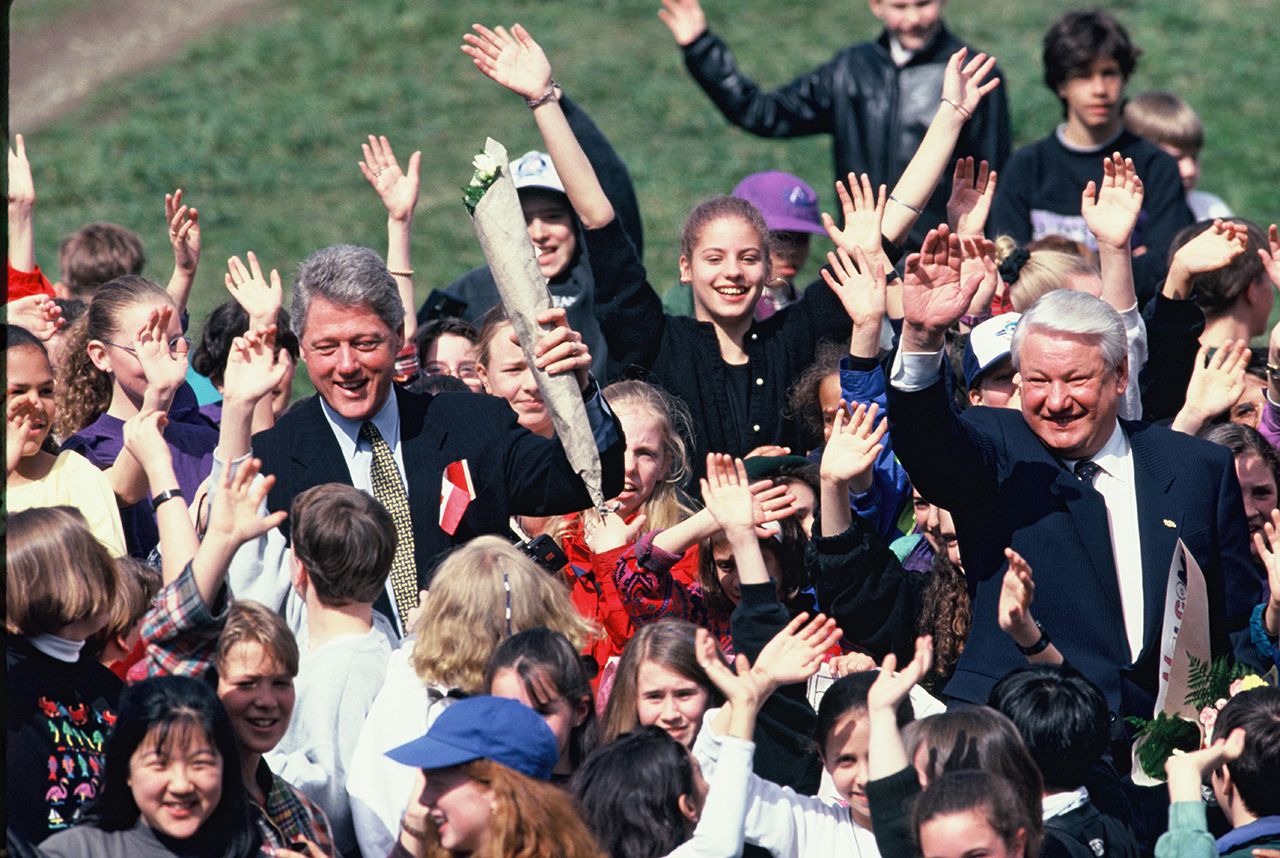
Yeltsin very much asked Clinton to cancel Jackson's amendment, Vanika. They joked a lot on Jewish topics, and canceled it only under Barack Obama
In the negotiations of the presidents of Russia and the United States, the topic of Jackson - Vanika’s amendment regularly sounded. It was adopted in the mid-1970s in response that the USSR prevented the emigration of Jews to Israel, and limited imports to the United States of a number of goods from Russia, including metals. Despite the fact that Clinton in 1994 actually brought Russia out of its action, Yeltsin many times asked his interlocutor to cancel the law.
On May 27, 1997, the President of Russia once again raised this issue.
“I fully support this,” Clinton answered, “the only problem that is in the congress is your law, according to which people working in sensitive areas should wait for permission to emigrate ten years instead of five, as before.” Now, if you found a way to return the old rules ...
- We do not have such a law, there are no such rules, there is no such law!
- Strogub? (This refers to Telbott Strogub, then Deputy Secretary of State - approx. Medusa.)
“It seems to me that he is, but we, of course, consult with Mr. Spasski after the meeting,” says Talbott.
“Well, technically, such a law exists,” Nikolai Spassky, director of the Department of North America, was forced to explain to the Russian Foreign Ministry.
“Okay, let's see what can be done,” Yeltsin said after a conversation with the members of his delegation.
The tension was removed with jokes on a Jewish theme.
“You know, I met with [Benjamin] Netanyahu, the prime minister of Israel,” said Yeltsin. - He has no complaints about Jewish emigration. He says: a million is enough.
“Once he may want you to take someone back.”
- Some even in the government, Scharanian, for example.
Another time, right when the presidents discussed the cancellation of the amendment, the light went out in the room.
“The Germans are watching us,” Clinton suggested under a general laughter.
Subsequently, the US President explained the inability to completely cancel Jackson’s amendment, Vanika, a high level of anti -Semitism in Russia. As a result, it was canceled only in 2012, under Barack Obama. Then the Magnitsky act was signed.
Yeltsin missed Clinton's voice. And once he gave him a declassified archive of Soviet documents on the murder of Kennedy
In October 1997, during a telephone conversation, Yeltsin said to Clinton:
- You know, I began to miss your voice.
“I miss you either,” Clinton answered him.
Over the years of joint work between Boris Yeltsin and Bill Clinton, close personal relations have been established. Politicians often exchanged gifts. At the next meeting on June 20, 1999, in Cologne, Clinton said that he was most remembered by a cane in which a telescope was hidden, as well as a miniature with a portrait of his mother.
At the same meeting in Cologne, Yeltsin handed Clinton a folder with declassified Soviet documents related to the murder of US President John Kennedy.
“This is not such a personal gift, but it seems to me that it’s still good, suitable for our friendship,” Yeltsin announced. - Manage them at your discretion. But if you decide to convey to someone, then only reliable people.
Two years earlier, Clinton gave Yeltsin the statuette of an Indian rider descending along a steep slope.
- As you can see, the horse is not easy, but the rider is strong and knows how to stay in the saddle. It seems to me, Boris, this is a suitable metaphor: after all, you also have to cope with a complex landscape.
On May 2, 1999, during the discussion of the situation in Kosovo, Yeltsin asks Clinton to accept Viktor Chernomyrdin in Washington, shortly before the envoy in Yugoslavia. Clinton promises to organize a meeting at the proper level and connect to it vice president Albert Gora.
Yeltsin: Bill, have we agreed?
Clinton: Yes.
Yeltsin: On occasion, I will squeeze you in bear arms.
Clinton: Yes, I will not abandon the bear embrace.
In June 1999, in the same informal expressions, politicians finally agree on a compromise in Yugoslavia: the United States and NATO stop bombing, and Milosevich allows Albanian refugees to return to Kosovo. After that, politicians agree to develop a resolution on the settlement of the conflict to the UN.
“I will call Madeline right now and say that I will double the efforts,” says Clinton. - Will you call Ivanov ?
“Of course, of course, Bill, I’ll call immediately,” Yeltsin replies.
In the last conversation with Clinton, Yeltsin says a lot about Putin and calls him a democrat
On November 19, 1999, Yeltsin first submits to Clinton the new Prime Minister of the Russian Federation Vladimir Putin.
“In the near future you will meet with Putin, so I want to tell you what kind of person it is. I thought for a long time who in 2000 would become the next president, and could not find a candidate for a long time. Finally I found Putin. I studied his biography and became convinced that this is a reliable person, but at the same time strong and sociable. ”
At the end of this meeting between Clinton and Yeltsin, another dialogue about Putin takes place.
Clinton: Who will win the elections?
Yeltsin: Putin, of course. He will become the successor of Boris Yeltsin. He is a democrat, and he knows the West well.
Clinton: He is a very smart person.
Yeltsin: He is strong. He has an inner rod. And I will do everything possible to win - within the framework of the law , of course. And he will win. You will work together. He will continue the Yeltsin course on democracy, economic development and expansion of Russian relations. He has energy and brains for this.
On December 31, 1999, Bill Clinton was the last time Boris Yeltsin calls to express support in connection with his decision to resign.
“Boris, I believe that historians will write about you as a father of Russian democracy,” says Clinton.
Yeltsin in response again tells him about Putin:
- I fully support Putin. I gave him three months - during this time the people will get used to him. I am sure that he is a democrat and a man of a wide soul, that he is strong and smart, I had to make sure of this personally.
“I was glad to be your friend,” Yeltsin continues, “and I hope that I can stay, that our relationship will continue.”
- Continue.
“But everything else [will decide the new] president.” Putin will cope with his tasks. And now I want to say thank you, Bill. Thank you for deciding to call, I really appreciate it. I believe that Russia should lead Russia in the third millennium smart, strong and energetic people. So it should be, and it will be so.
Dmitry Kartsev, Konstantin Benyumov, Julia Rudakova