
Translated material
"Trump - ours"
As the film "Our New President" talks about the essence of Russian propaganda by its own methods
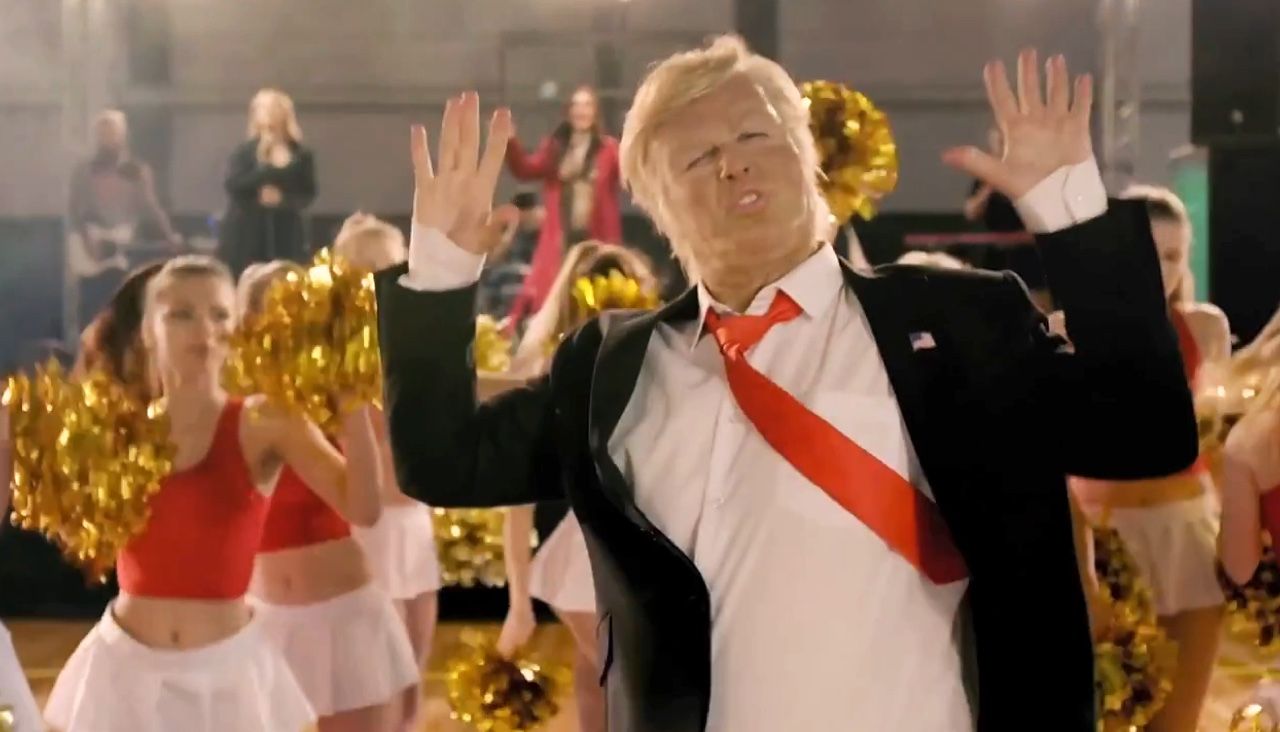
"Medusa" begins to talk about the competitive program of the Festival of Documentary Cinema "Artdokfest", which will be held from October 19 to 23 in Riga and from December 6 to 12 in Moscow. This year, the competition is attended by the painting “Our New President” (Russia, the USA) of the Russian director Maxim Pozdrovkin, one of the authors of the film “Showing Process: the History of Pussy Riot”. Using excerpts from news releases on federal channels and “patriotic” UTUB blogs, the documentary show how the Russian televisionopaganda, on the eve of the election in the United States in 2016, intensively created the positive image of Donald Trump-and how quickly admiration was replaced by disappointment. Dmitry Kartsev, journalist of Medusa, tells more about the painting “Our New President”.
In the mid-1990s, archaeologists found a mummy of an ancient woman who died at the age of about 25 years in Altai. She was nicknamed the "Altai princess" and attributed to her a variety of mystical properties. Maxim Pozdorovkin’s film “Our New President” begins with the report of the NTV television company about how Hillary Clinton in 1997, when her husband was president of the United States, visited Novosibirsk, where Lady Altai was most interested in “Lady Altai”, after which “strange things” began to happen with her: fainting, outbreaks of revenge, attacks of uncontrolled laughter. “Shamans warned about danger,” the plot, published on the eve of the 2016 elections, reports.
The film Pozdrovkin is a cut from the releases of Russian news and the work of "patriotic" bloggers. The storyline is the election admiration for Russian media Donald Trump. This feeling is most reminiscent of the attitude to their favorite team: fans tend to attribute to her a variety of positive qualities, including those who have nothing to do with sports, and its opponents, on the contrary, all kinds of shortcomings, including dishonesty, corruption, hypocrisy, “excesses of all sorts of bad things”.
At the same time, for any external observer it is obvious that pain is a purely irrational process, since the influence on the final result of the team is almost impossible to evaluate. The second-level sublimation turned out here: nothing would have happened on the Russian material due to the lack of any political competition, so you have to be content with an imported political product.
I must say that Russian television hurt gambling and fun, carefully convincing the audience that "Trump is ours." But shortly after the candidate became president, admiration was replaced by disappointment. And now, Russian telepsychiatrists diagnose the same mental disorders that they had previously been looking for Hillary - uncontrolled laughter and sin in its various manifestations. And finally, it also turns out-also from the issues of Russian television news-that the Princess from Altai was a young man of 12-13 years old.
Outwardly, the film Pozdovkin is a linear narrative with a splash of several parallel stories. For example, about how the language of Russian propaganda mimicated to Western standards using the Russia Today channel. About how the presenters once said on NTV that Putin "said a lot and kept silent about a lot." The fact that more than half of the viewers once did not trust the president.
But in fact, the picture performs a more ambitious task - to tell about Russian propaganda by means of Russian propaganda.
The Putin Goskanals are not Soviet, they declare almost nothing and do not keep silent about. They do not hide that the death surrounded by Hillary Clinton seem suspicious only to “those who are called conspiracyrs in America,” but still retell the version of these “conspiracyrs” in detail - and immediately move on to another topic. They do not say that Clinton is sick, they only list “strange cases” - and the conclusions, as they say, “do it yourself”.
There is no author’s voice in the film of Pozdovkin at all - only the names of fragments, rare actual comments and a couple of quotes. But after the plot about the “disorder” Clinton in the next fragment, some Muscovite says about the presidential candidate that “she is probably sick.” The director, as it were, winks: think for yourself why she decided so.
Immediately after the final words of Yevgeny Kiselev, the leading program “Results” in 2001, about the “clumsy actions of the authorities, trying to take NTV under control, the doors of the Andreevsky hall of the Moscow Kremlin are opened - and in 2018 Vladimir Putin goes to his next inauguration. And the host of the “Results of the Week” program Irad Zeynalova promises that “before the whole heraldry, all the symbols, the whole history of Russia, he will say the main words, how we will continue to live,” so that no one should have any doubts who have been responsible for what has become NTV over the past 17 years.
Fragments from the programs of the central channels are interspersed with inserts from various blogs, including clearly marginal, specializing, for example, in astrology. This is most like mentioning the notorious American conspiracy therapists in Russian news - this is how the viewer creates a very specific context.
But the level of metatex in this film is even higher. “Our New President” is a story about how the Russian media blinded the American president “from what was.” And the Russian viewer must once again make sure that the manipulation on domestic television reached.
But one can imagine the reaction of the American viewer to the film Pozdovkin. After the Summit in Helsinki, the Western media explained in detail how Trump went about Putin’s lead - immediately the American viewer will see the toasts of Russian bloggers for the “peaceful capture of America”. The special prosecutor Robert Müller has been investigating the intervention of the Russian special services in the American elections for several months - and in the film director Tigran Keosayan is getting over with Irada Zeynalova about whether Entayshniki will increase the salary for Trump's victory. What will the poor American think, who is constantly talking about Russian hackers when he hears Dmitry Kiselev praises Trump, who allegedly “grunted to the rotten American system”, what is this: propaganda or recognition?
Trump is not ours, the princess is not a princess, stupid Russian propagandists really won the elections. The circle of absurdity is closed.
Dmitry Kartsev