
Translated material
Insatiable
"Head of the DPR" Alexander Zakharchenko and his right hand Tashkent stopped arranging Moscow on the eve of the explosion in the Separ cafe
Alexander Zakharchenko died on the evening of August 31 from the bomb explosion. The explosion occurred at five in the evening in the Separ cafe in the center of Donetsk, the bomb was laid in the lamp. According to the source of the New "in the" DPR ", Zakharchenko died immediately from the traumatic brain injury-the explosion practically torn his head.
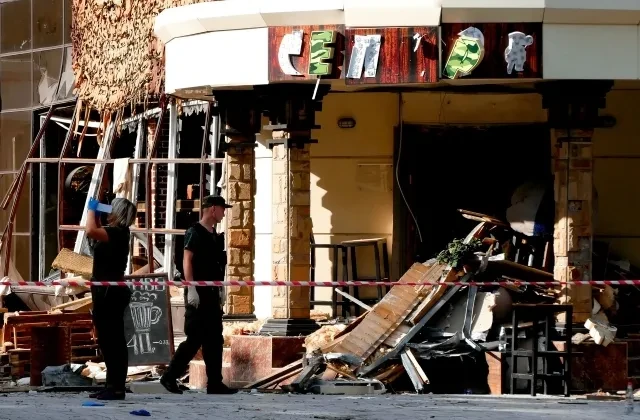
Together with the leader of the “DPR”, his guard also died; Among the wounded is the Minister of income and fees of the Republic Alexander Timofeev, aka Zakharchenko’s right hand and his closest partner. Together they came to remember their fellow countryman Joseph Kobzon.
Representatives of the “DPR” called the incident a terrorist attack and, according to tradition, were responsible for the Ukrainian security forces. Promptly commented on the death of the leader of the unrecognized republic in the Russian Foreign Ministry, the State Duma; President Vladimir Putin also promised not to quit the population of Donbass in trouble.
The death of Zakharchenko continues the series of mysterious deaths of separatist leaders who die “at the hands of Ukrainian saboteurs” in the rear. Moreover, in the early years of the “Russian Spring”, Ukrainian saboteurs chose, according to official information, their goals close to the Russian border in the “LPR”. So the commanders of the brain, Ishchenko and Dremov died. The groups controlled by the murdered groups poured into the combined corps created by the Russian military specialists, and feuds ceased in the territories themselves. Later, Ukrainian saboteurs began to put order already in the “DPR” - so Motorola and Givi were killed. However, sometimes the “sabotage” ends bloodlessly - for example, this was the case in the case of the overthrow of the head of the “LPR” Igor Plotnitsky, who was called a Ukrainian spy in Lugansk. Nevertheless, he managed to flee to Russia and escaped. They say that if he had died, he would remain a hero, not a spy.
The wide audience of Zakharchenko will be remembered as a military man who was not afraid to go to the people and was close to a simple person. In June 2015, I myself was a witness to the people. In the center of Donetsk, a anti-war random rally of residents of the Kyiv district, which was under constant shelling of the Armed Forces due to proximity to the airport, was held in front of the DPR government building. People demanded that the “DPR” display equipment from residential arrays, not to provoke response and fight away from the city. Surrounded by the indignant crowd Zakharchenko looked confused, he was interrupted and plugged. In the end, he managed to say that on one day the war could not end, we must be patient, and the rally quickly left the Black “Lexus”. At the same day, Zakharchenko announced that the anti -war demonstration was organized by forces from the outside and had nothing to do with the will of the people.
The biography of this person is also noteworthy by the fact that he had nothing to do with military service, and his whole career was connected with trade. Prior to the conflict in the Donbass, he worked as a trading representative of the Ukrainian manufacturer Kuryatina "Gavrilovsky Kurchata". At the same time, he headed the Donetsk branch of the Kharkov fighting organization Oplot. In May 2014, after the activists of the “Russian Spring” capture of the Donetsk regional administration, the Oplot fighters took the city hall’s building, as well as the billionaire’s office Rinat Akhmetov. In an interview with me, the future head of the “DPR”, introducing himself then Zakharchenko Sasha, said that “this is for the safe work of strategic institutions.” “I will no longer comment on,” he said. - Let's wait. Negotiations are underway every day, soon everything will become clear, you yourself will see, to make a sho. ”
And really. Spring protests in Donetsk in 2014, initially initiated by the Donetsk billionaire Rinat Akhmetov for pressure on revolutionary power in Kyiv, began to be controlled by Russian curators. Zakharchenko himself, in fact, in May 2014, who worked on Akhmetov, offered the owner larger. Soon after the death of the Boeing, the “Prime Minister” “DPR” Borodai, and Zakharchenko became the “head of the republic” and hung a portrait of Putin in his office.
His powers were largely nominated - especially in matters of war and peace, which were resolved exclusively in Moscow. In the jurisdiction of Zakharchenko, only the "economic aspects" of the local semi -criminal economy remained.
Under the command of Zakharchenko, a militarized group acted - the Republican Guard, based on the basis of the local "stronghold". After the unification in 2015-2016, the Armed groups of the DPR and LPR in the unified army corps of the guard remained the only major formation, not controlled by the Russian military curators. Moscow and numerous departmental security and security services did not control - such were at almost every ministry in the DPR. For example, as part of the Ministry of income and fees of the same Tashkent, Ministry of Transport and Prosecutor General. And the locals called these departmental armies "special forces on the reduction of property." In recent years, a lot of news came from Donetsk about how the special forces of Tashkent storm the offices of local firms, factories and shops, Pavel Gubarev complained about Tashkent and the Donetsk People's Governor.
According to New, in early July, Moscow demanded to disband departmental groups and give all the weapons of the army. In Donetsk itself, the news was perceived as a signal about the ambulance Zakharchenko, whose powers ended this fall. But, as they say in Donetsk, Zakharchenko did not want to leave at all.
The interlocutors of Novaya say that dissatisfaction with the behavior of Zakharchenko accumulated in Moscow for the last year and was primarily associated with the "insatitude" of the leadership of the "DPR". In connection with the weakening of the main Donbass curator in the Kremlin Vladislav Surkov (they talk about his resignation from May) Zakharchenko could lose his only defense. In the hands of the “insatiable” pair Zakharchenko -Timofeev, almost all the profitable businesses of the “republic” were concentrated. Under the control of Tashkent, there was a mining coal and anthracite, as well as their transportation to Russia - this coal was then returned to Ukraine (metallurgy and most of the country's CHPs exclusively on coal from the Donbass) as Russian raw materials). For his simple services, Tashkent charged the “fee”, which was ultimately paid for by Ukrainian consumers. The restoration of the Ukrainian economy that began in the last two years has greatly increased the country's needs in its own angle, which affected the trade with Russia. After a dramatic fall in the first years of the war (from $ 28 billion in 2014 to 10 billion in 2016), an increase of 28% arose in 2017, and in the first half of 2018, the turnover increased immediately by 30%. As they say in Donetsk, Timofeev wanted to receive “commission”, proportional to the turnover.
However, the new economic situation attracted not only Timofeev and Zakharchenko, but also the Russian intelligence services, the structures of the Yanukovychi and their “wallet” by Sergey Kurchenko. “The pie has sharply became large, and everyone wants most of them, and not to share in a civilized way,” one of the former leaders of the Novorossia project told “New”. “For Bati ( Zakharchenko’s nickname *. - P.K. *) and Tashkent to conflict with large fish were no teeth.”
However, the departure of the odious Zakharchenko may have important political consequences.
His death caused more indignation in official Moscow than the murders of much more famous Donetsk “people's commanders” by the motorcles (blown up by unknown in the elevator in the house where he lived) and Givi (killed by unknown people from the flamethrower in the office).
Although it should be noted that Official sorrow is laid by Zakharchenko on formal status: together with Plotnitsky, he signed the Minsk agreements on reconciliation, undertaking to fulfill them. The removal of both signatures, it would seem, jeopardizes the agreements themselves, which are already not realized by almost any point. However, the departure of figures associated with the war and irreconcilable separatism can give Minsk a new chance, and first of all, the chance of the political part of the agreements. On both sides of the distinction, the most odious persons and groups are removed. The presence of volunteer battalions on the Ukrainian side is reduced. On Friday evening, three hours after the murder of Zakharchenko, the need to “confirm the readiness of the Russian side for a constructive conversation” was stated, for example, Russian ambassador Anatoly Antonov, who said that he was now waiting for a meeting with the special representative of the United States in Ukraine Kurt Volker.