
Translated material
Blessed | Colta.ru

On September 9, the Fields festival describes its format as a combination of electronic and academic music in Gorky Park. One of its participants will be the American musician Edward Larry Gordon, better known as Laraaji . 74-year-old Laraaji is primarily known thanks to the Ambient 3 record ( Day of Radiance ) ” , released in 1979 under the patronage of Brian Ino and included in a series of four albums, which actually set the canon of the Embipant genre.
You can list his merits for a long time (since then he recorded several dozen albums, became a classic of New Age and worked with such musicians as Bill Laswell, Michael Brook and Sun ARAW ; In addition, Laraaji is perhaps the most famous performer in Citer), but it is not only interesting for this. Laraaji is a man with an extremely unusual biography. Even against the background of a motley musical world, in which there are actually no laws and rules, how to succeed, Laraaji looks slightly blessed. Its forty -year -old career seems to develop not “thanks”, but “contrary to” as a continuous chain of happy accidents. He accidentally bought his favorite tool, citr - at a pawnshop, and with Brian Ino also collided on the street.
To begin with, it seems to have not been going to become a professional musician Edward Gordon, but some kind of highest power intervened. “At 10, I began to learn to play the violin, and shortly after that, also on the piano. My mother, who worked at a state school in the city of Perth Ambo, New Jersey, always supported my childhood hobby for music and inspired me. But in high school, I did not think at all about becoming a musician, but was going to enter the engineering college. And suddenly at 17 years I came to the realization that the performance and composition of music is more important to me. This made me change the training program and enter the music college. As a result, from 1962 to 1966, I studied at the College of Arts of Howard University, but I never received a diploma. ”
The young Laraaji did not think about any experimental music either. He loved jazz, soul and pop music, like many Americans of those years. “At that time, I was inspired by violinist virtuoso Florian Blacks, pianists Liberache, Andre Previn, Dave Brubek, Oscar Peterson, Errol Garner, as well as Curtis Maifield, The Beatles , Aret Franklin, Marwin Gay, James Brown, Fats Domino, Smoki Robinson. ”
Without success in the system of American musical education, Laraaji decided to devote himself to another art. He moved to New York, began to compose humorous sketches and try himself as a comedic actor. But even here strange coincidences began to occur. “When I practiced in a stand-up in Greenwich Willij in the late sixties, in the clubs where I performed, they often played the anti-aircraft units. The musicians there often played an unusual instrument that interested me very much. It was an autoarthrough; It is also called chord's citrus. ”
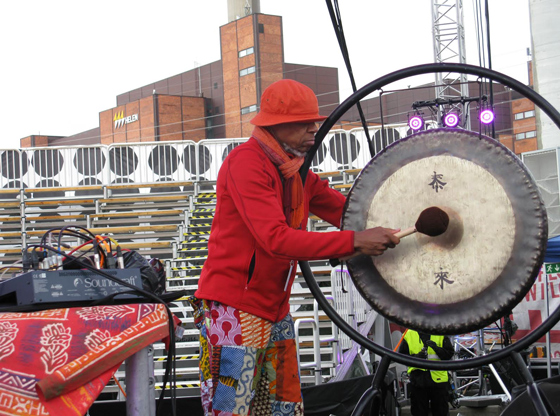 © Nick Zavriev
Further in the life of Edward Gordon, another thing happens, thanks to which we know it today as Laraaji . He discovers eastern philosophy for himself (which in the late sixties - early seventies was, one might say, part of the cultural code of modern man: recall at least the Beatles ) and is fond of yoga and meditation. And here - again a happy coincidence. “Eight years after I first saw Citru, some mystical insight led me to the Queens to the sale of musical instruments from the local pawnshop. There I bought my tool. It was a time when meditation and spiritual teachings opened my path to cosmic consciousness. Citra seemed to push me to experiments and the search for a new sound. I could improvise for hours, deeper and deeper, plunging into an altered state of consciousness. Citra has become for me a tool for meditation and just a friend. Using the experimental techniques of the game and setting it up on an unusual system, I could play and sign up endlessly. ”
Having mastered a little with a new instrument and attaching to it the Sensor, Laraaji according to the old New York tradition (this, for example, did, for example, one of the idols of his youth Sonny Rollins) began to go to the street. Soon (by that time, Edward already had one album recorded under the “passport” name) The musician caught the eye of Brian Ino. Coincidence? Well, you understand. “It was in Washington-Square in New York in 1979. In the early autumn evening, I played there on an electric cycle. I played with my eyes closed, so he just left me a note with his contacts and a proposal to contact about the recording (Brian then worked on a series of albums “Ambient”). Incredibly inspired, I called him the next day, and we agreed to meet at his house in Greenwich Willing. ” Then everything continued to happen as if by itself. “We quickly discussed everything and agreed to arrange a session of the record with Citro. The record passed easily and at ease - Brian immediately liked the variations of the track “The Dance”, but for the meditative part we needed a more quiet studio, away from the metro trains. ”
The album really came out unusual. On the one hand, there is an unusual sound of citra and cymbal (the entire record is recorded, in fact, on acoustic instruments) and eastern meditativeness. On the other hand, in structure, this music had much in common with the then academic minimalism, first of all, with Steve Reich and its endless loops. Edward himself does not deny the influence of Reich, but it is the East-mystical root that is primary in his music, and himself-nothing more than a modest conductor of cosmic energy. “I find the music of Steve Reich very bold. She, no doubt, inspired me to search for trance states through repetitions. But the music that comes to me and flows through me does not have a genre name. She is just beautiful, joyful, she helps to enter a trance state. I try to be open to harmony, look for the system and those combinations of sounds that stimulate the imagination, open the heart of the light and help to find the cosmic order of things. ”
Subsequent records (and the musician was published is eagerly and often), in conjunction with activity in the field of yoga ( Laraaji combined two hobbies and became an expert in the field of ridiculous meditation) made him a New Age classic. But if a New Age as a lifestyle Laraaji treats with warmth, then the musical term seems doubtful to him. “This term can be deceptive or even harmful if it prevents the listener from completely surrendering to the moment. The real New Age lies in this constant presence, and the best New Age-music is not created by people: this is an internal cosmic nadam, a free stream of sound, the vibration of the cosmic field, felt by the cerebral cerebral of the brain, and not the ear. There is neither the beginning nor the end in this stream. And the musicians are nothing more than the channels through which the music comes to our world. ”
When in the late nineties New Age went out of fashion and demand for Laraaji music from the publishers, he discovered samizdat and began to record several albums a year and spread them among the faithful and quite large audience, which visited all kinds of seminars, workshops and retrites associated with yoga. A decade later, New Eaga's opens ended, and Laraaji was again on the crest of the wave. His record was released by the fashionable and advanced Brooklynian label RVNG Intl . , again took up the publication of his music Powerful All All Saints , affiliated with Brian Ino (Ino and Laraaji, became close friends and all this time maintained relations), and in the end the old Laraaji notes materialized where you are not waiting for them at all-on the American gigant of Stones Throw Records , or rather, on its unit - Leaving Lable Records .
“With Matthew David McKuin, the producer of the Leaving Lieving Records label, we met in Los Angeles at the Seminar for Laughic Meditation through the remarkable visionary of Douglas McGovan (founder of Yoga Records and art director of the Chicago label Numero Group . - Ed.). Matthew suggested sending him cassettes with my early records, which I did, after which he collected from these cassette release for his label. This meeting and what came of it is a great example of what I call New Age. Pleasure, awareness, not subject to time. "
The most amazing thing is that Laraaji managed to fit perfectly into the modern context. Current musicians from Daniel Lopatin to Sun ARAW formed, among other things, under the influence of his music and in every possible way emphasize this continuity. And he himself not only releases records on fashionable labels, but also tours through large festivals like the Finnish Flow , where he collects a full house, playing for people who are suitable for his grandchildren and hear his music for the first time. He finds the experience of playing new spectators absolutely positive: “I got the impression that they are deeply immersed in sound, and not just get superficial experience. And this very inspires me to continue to spread the world that was given to me with space. ” On the eighth ten, he still looks at a completely elderly professor, but a fit, cheerful and youthful hippie in colorful outfits. And it seems to play with the same ease and with the same energy as 40 years ago in the Washington Square Park, when Brian Ino caught my eye.