
Translated material
Repost-modne | Colta.ru
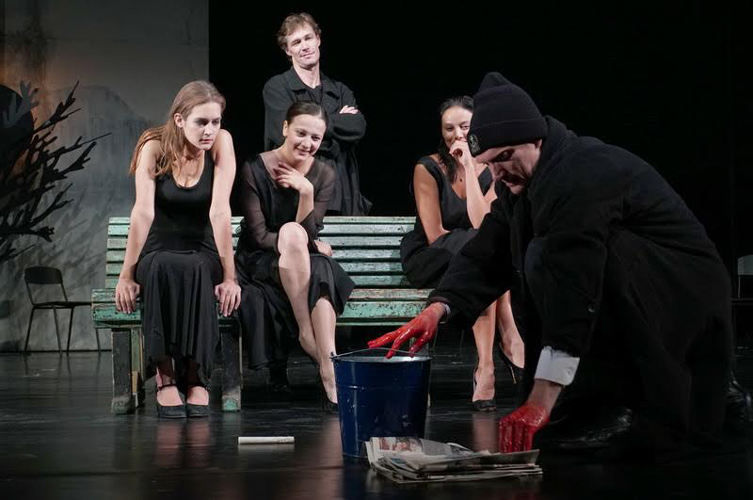
The play “Man from Pisces” by the young Petersburg playwright Asi Voloshina is a 35-page one-act. It seems that Yuri Butusov, which composed on its basis, did not pull at all about four hours on its basis. This contradiction between two different durations is the main charm and main strangeness of the performance.
Why did Butusov turn one act into three? From pure love for the duration of theatrical action? Let's look at how he disposes of the material of the play. It has six characters; Five of them are present on the stage, about the sixth-the girl Audrey, the daughters of Sveta-only they say, or rather, there is a substitute on the stage: a plywood silhouette, a shadow, a ghost. But it is with this girl that the main event is connected - in the final she is abducted by guardianship authorities. The very word and mystery, the namelessness of the horror present in the play, bring it closer to the Nabokov “event”. Butusov realizes not only this literary rapprochement - he expands the already rich intertextual field of the play as much as possible.
Only the mention of Tarkovsky’s “nostalgia” turns into a large prologue - or, if you like, into a detailed epigraph that does not have the author. However, the very function of the epigraph in the play is present - the author plays with the epigraph to the Nabokovsky “Gift”, repeating it in every way: “Oak is a tree. Rose is a flower. A deer is an animal. Sparrow is a bird. Russia is our Fatherland. Death is inevitable. ” If a sparrow is a bird, and an oak is a tree, then with Russia it is more and more complicated, not to mention death. Here the reverse logic of syllogism does not work. But the performance is delayed and delayed, circles three around the epigraph - precisely because of an unclear answer to these questions. Russia is our Fatherland? Is death inevitable?
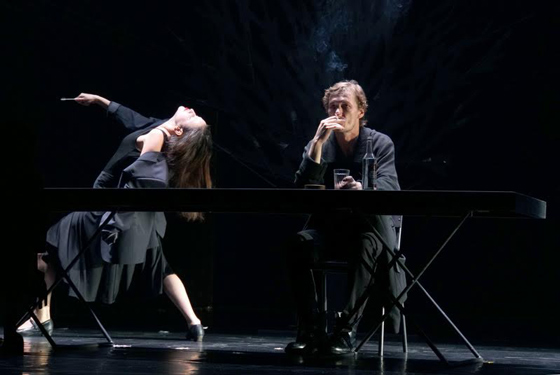 © Ekaterina Tsvetkova
To the second act, it begins to seem that Butusov directly constructs Voloshina’s play in the logic of “Events”. However, as someone in her text says, perhaps not. Actually, everything is here - "maybe not." The logic of nightmares begins to seep into the performance from the very beginning, when an actor playing Benois, a French anthropologist, renting a room in a large apartment somewhere on a caravan, is slowly, at the same time along the ramp line. Andrei Burkovsky, without explaining anything, lights the candle and moves from one cululis to another, carefully covering the flame. The magic of a surreal gesture, however, soon dissipates, and the silence, accompanied by the scattered views of three women, is interrupted by an ironic comment on how long this frame lasts in Nostalgia. Those who did not know are shocked: Oleg Yankovsky spends seven minutes of screen time in silence with a candle! Burkovsky unfolds and goes back - "two more and a half minute." The key scene of “Nostalgia” is desacked - but also sung, of course. And one more - the one where a person sets fire to himself, warning the world about disaster. Burkovsky - or already Benoit, because he has a French accent - lowering his hands in a bucket with paint, and they “light up”, giving him the opportunity to perform the bewitching Danse Macabre , which becomes painful for a short time. But he quickly interrupts him in order to speculate with excellent philologists and their friend-writer Drobuzhinsky (Artem Bystrov) about the feeling of doom of the Russians, about their sarcasm and an unexpected lack of passion for him. And also about the girl of the mind-one who accidentally came up with the term “repost-moder” and called the only inuded Snail Oswald. True, not in honor of Spengler - although the adults surrounding it only say that about the end of Europe. Not Europe, but the fact that “a hundred years ago died”, that is, “our Fatherland” is an indirect object of reflection.
The entire text of the play, like the entire performance of Butusov, is built as an over -layered statement, as an endless circle around the epigraph.
Nabokov appears in a “man of fish” and in how sinister and infernal the world of St. Petersburg hipsters appears here. An unreal reality, the boundaries of which are blurred and there are no walls. However, when the walls fall (this attraction, according to the will of the artist Nikolai Simonov, occurs at the very beginning of the first act), they change little. The Fatherland, which perished a hundred years ago, can have any outlines, with or without walls, but none of the heroes have a connection with it. The entire text of the play, like the entire performance of Butusov, is built precisely as an over -laying statement, as an endless circle around the epigraph. So the central, meaning-forming, monologue about Paris was also designed-about how to write about it “after everything” (not “after the attack”, as the French anthropologist suggests, but after everything written; there is an accurate diagnosis and Russian thinking, in which, instead of political reality, a metaphysical groan is pronounced in the first act, the writer Drobuzhinsky, inflammatory-neurophage Non -Charismacle, Non -Radomacho, underwriter. In it, the story of Krysolov, leading the children, while parents selflessly watch the performance, connects with the image of the soap bubble flying through the city-mif and entailing a girl walking in Paris. In the second act, in full agreement with the repost-modest, it is repeated by the beautiful Julia, played (about the miracle of repost!) Elizabeth Yankovskaya, the granddaughter of the same Yankovsky that was in Tarkovsky’s film for seven minutes with a candle. In the third act, closer to the tragic finale, he is pronounced with devastated doom Salmanov - the new Butusovsky Hamlet, Laura Pizzaheuri. She still does not know that her daughter (just like Elizabeth Bam at Harms) disappeared, perished in the paws of infernal custody.
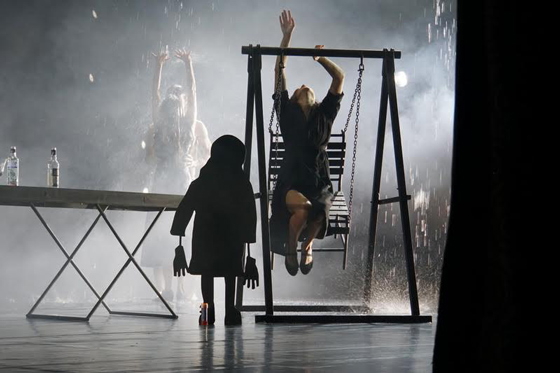 © Ekaterina Tsvetkova
Butusov plays with the text in a postpermatic game when the actors explain the actions or the design of the characters by long “apartments” built into speech. In the final, Laura Pizzhelauri interrupts his monologue-proceeding with a long improvisation, inviting the audience to be alone with the void, with the postponed answer to the question posed. “Russia is our Fatherland? Death is inevitable? "
There, in the third act, by the way, certain objects appear that establish an even more obvious connection with the Nabokov “event”. Remember, there Trochoshkin asks in the final: "Why did my balls scattered throughout the house?" The white ghosts that arose from nowhere-possibly, like fragments of a story about the White Dome of the Paris Basilica Sacre-Cur-scattered throughout the Moscow Art Theater. The Nabokov hero is aware that the ghosts of the endless repetition displace reality, that time stops - there is no future. It seems that in the final of Butusov’s performance, this is also aware of Sveta. Her daughter who escaped after the soap bubble or Knight will be saved-only because she is not in this repostation world.
Or perhaps not.
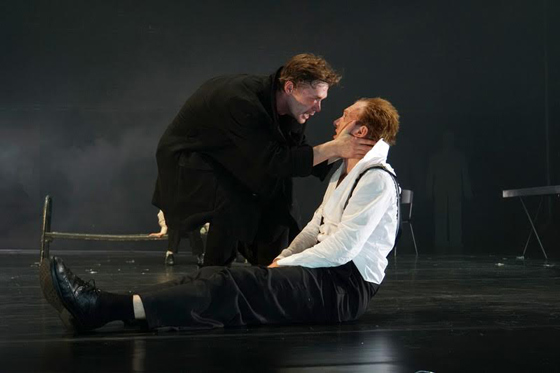 © Ekaterina Tsvetkova
But the bows will be made in a carnival impeccable. Jiga of soap bubbles is an infinitely beautiful holiday for adults, under the nose of which unknown rats leads children. To save. And perhaps not?