Translated material
Why did Petersburg almost remained Leningrad
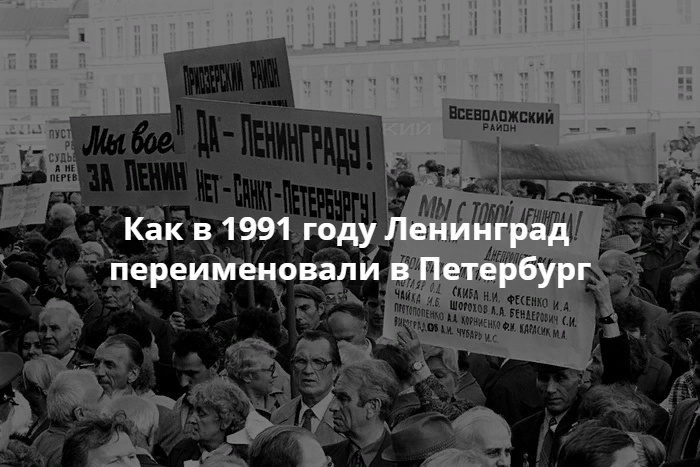
On September 6, 1991, Leningrad officially became St. Petersburg. This was preceded by a survey of the inhabitants of the city, which was essentially a referendum. “Petersburg” won only with a slight advantage, but even after that he almost remained Leningrad.
The ex-deputy of the Leningrad City Council, Yuri Nesterov, told Paper , why in the city they fought for renaming, contrary to the opinion of Anatoly Sobchak, who opposed the change of name and why Leningrad could not become St. Petersburg.
Who decided to rename the city and why
Most of the deputies of the Leningrad City Council were anti -communist. They believed that it was incorrect to assign the city the name of the man who led the coup, which eventually led to the Stalin years. And they believed that politics should not interfere in toponymy at all. If the authorities begin to rename the cities and streets for themselves, so that they are remembered by the great, then disgrace will begin. Therefore, then it was about the return of the historical name, and not about the assignment of a new one.
I find it difficult to say who was the first to voiced this idea in the Lensovet. There were a lot of active people who raised this topic almost from the very election of the convocation of the Leningrad City Council, I don’t remember all the names.
On the agenda in Lensovet, this included in 1991, then we began to discuss the issue objectively. At that time, the Congress of People's Deputies voted to introduce the post of president of Russia and set a date for elections for June 12. And in March 1991 in Lenovet, they realized that it would be very correct to combine the vote for the president and the renaming survey. Then, in March, the Lension also decided to appoint the first mayor’s elections in the city’s history on the same day - June 12. They reasoned that God loved the Trinity.
What about renaming thought Sobchak and Yeltsin
I can say that Anatoly Sobchak first did not support the idea. He did not object ideologically, he simply said that it was untimely and would cost the city of big money. We considered these arguments to be unreasonable, as we came to the conclusion that the whole practical part, like a change of tablets or forms, would be made as it was wear: the forms with Leningrad will end, we will order with Petersburg.
Then Anatoly Alexandrovich did not participate in the discussion - neither in the press or on television. But his wife Lyudmila Narusova was for. And already a day or two before the vote, Sobchak spoke out in support of the renaming. Yeltsin did not express his position: on the same day there were presidential elections, so he was not up to that. It was an intracity story.
Who was against renaming and whether the survey was honest
In the city, this idea, of course, was not accepted unambiguously. Yes, and the result of the survey (the survey was no different from the referendum, but as far as I remember, the regional authorities did not have the authority to conduct a referendum) about this: “for” 54 %voted. Therefore, we offended someone. Perhaps those people for whom the name "Leningrad" is tightly connected with memory, including the blockade. But we still call this a blockade of Leningrad-no one will ever write that it was a blockade of St. Petersburg.
Of course, the Communists were against. After renaming, they carried out some rallies. But in the end, everyone reconciled.
The rupture in the vote was small (54 % against 42 % - approx. "Papers" ), because then no one was naked. It was a wonderful time when it never occurred to anyone to fake.
Then the habit of cheating has not yet started. She appeared later, approximately in 1996, when Yeltsin went for a second term. At least it was in St. Petersburg. Well, everything was organized fine.
Why the city was renamed only three months after the survey of citizens
The decision to rename the city could be made only by the federal government, and specifically - the congress of people's deputies of Russia. The question needed to be brought to the meeting of the Presidium of the Supreme Council, then at the meeting of the congress, and two -thirds of 1,200 people should have been voted. In addition, in August there was a putty. As a result, the issue was considered only in September.
I took a modest part in that the decision on renaming was made. In order for the question to be included in the agenda, someone had to write a proposal for entering. It turned out that none of the Leningrad deputies bothered to do this. I had to take it. A purely formal thing: I entered the document to the office - and then the car drove.
It was fundamentally for me. A survey took place, most citizens said that it was necessary to rename. Why should federal authorities ignore this?
But if I had not introduced, my colleagues would have made in a week. It was inevitable, it just happened that I had a hand. I even think that I did not have a hand, but a finger.
As at the last moment Petersburg almost remained Leningrad
The critical situation arose later, when the question reached the congress of people's deputies. If we had a majority in the Lensovat of the Democrats, then there are less than a third there. The rest came from all over the country: all sorts of directors, secretaries of the district district committees. They were such an idea across the wool. And we needed two -thirds of the votes, because it was about changes to the constitution.
For renaming, the almost large delegation from Leningrad voted then-maybe, with the exception of one or two people. But we still could not get two -thirds on the first attempt. It was proposed to vote again - they did not score again.
Then the entire Leningrad delegation stood up and defiantly left the hall. They said that until the congress would satisfy the position of Petersburgers, we will not return to the meeting room. And other controversial issues remained on the agenda of the meeting, where our votes were required. Ruslan Khasbulatov (at that time the First Deputy Chairman of the Supreme Council of the RSFSR - approx. “Papers” ) understood this, announced a break, gathered heads of regional groups and told them that this would not work: we will vote for the third time - explain to your people that we must support renaming. After that, we were invited to the hall, the third vote took place, in which the necessary number of deputies acted “for”.
Yuri Nesterov
Former deputy of the Leningrad City Council of Deputies and member of the Presidium of the Council, former People's Deputy of the RSFSR