
Translated material
Plow everything, and we wave our hands
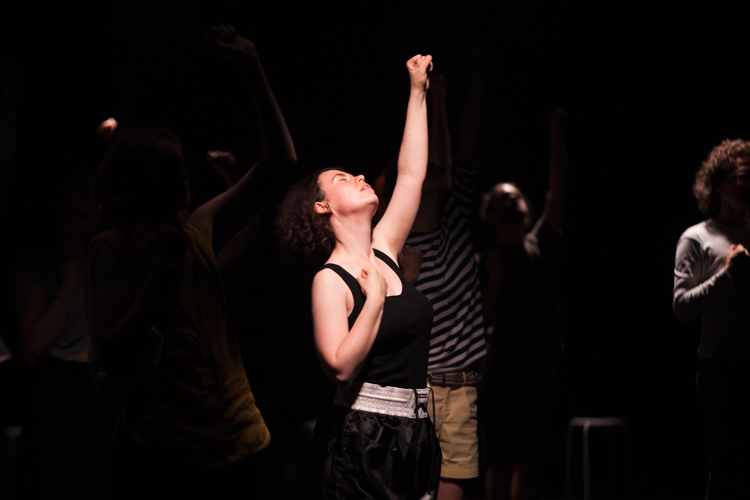
In the Manege on August 20, the exhibition “here and now”, a review of Russian contemporary art of recent years, ended. The exposition caused conflicting response to the art community: from praise to negativity in the informal field of telegram critics.
Some said that the exhibition shows Russian art “how it is today” demonstrates the original solution of space, openness and friendliness in relation to the audience [1] . They attacked several lines: the lack of a well -thought -out curatorial solution and the speculative use of performative elements. Thus, the backstage channel “Zapalisk” reminded the readers that “here and now” was created hastily under the September elections and was sponsored by the Moscow Mayoria. As a result, the channel said, the team of a hodgepodge was obtained from the Council of Artists Familiar to the curator - who had something in the garage ” [2] .
Another attack line passed through the event elements of the exposition, which, in addition to objects, installations and video work, included performances. The exhibition was scolded for zombie-formativity: the speculative use of living bodies, which with one fact of their presence should legitimize controversial or banal ideas [3] .
Often, work is done as if in vacuum and disappear without a trace, and the absence of their archive and understanding does not create opportunities for continuity and development.
Although the case with the exhibition deserves a separate analysis, in this text we use it as an occasion to talk about another phenomenon of the Moscow art scene. In parallel, the Blackbox was collected on the base floor of the arena and showed five works of Russian modern dance (curator - Katya Ganyushin) there. Although the program remained out of the field of interest of apologists and critics of the exhibition, it can be considered the first large review of the new domestic dance in the museum institution. And the shown works, in our opinion, are quite logically selected, became evidence of the existence of the current dance scene in Moscow [4] .
Guide to self -posterity
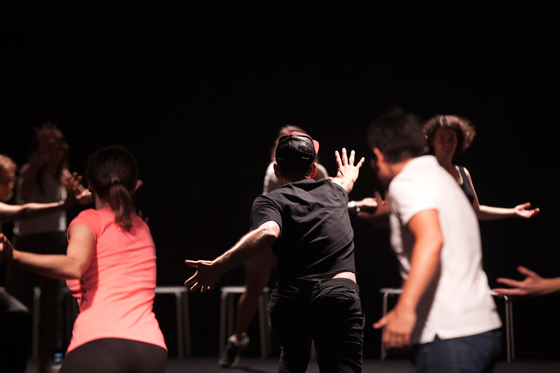 © Ekaterina Pomelova "Laboratory of self -posterity"
Only thirty people can sign up for the "Laboratory of Etvision". You need to come in comfortable clothes, and at the entrance instead of a ticket they give a bottle of water. Further within three hours, the participants undergo training of the empauer under the leadership of three artists: Vika Lashenov, Vera Shchelkina and Dmitry Volkova.
Training exercises are spinning around questions about professional identity, combining energetic workouts (physical activity), assignments for imagination, paired sessions and group discussions. Artists immediately declare that they themselves are impostors in dance and art and generally eternal professional migrants. Vic worked in consulting, then engaged in photography and video, until he realized himself with a modern choreographer. Vera is a translator and part-time dancing artist. Dima came from the world of it , but "I am not sure that the impostor is in art." Further events in the style of spiritual and sedative commercial trainings allegedly help participants "to realize and accept impostors." It looks like a real therapeutic group - if it were not for the disturbing absurdity of some exercises [5] .
At the first workshop, Vic proposes to spread his hands to the sides and feel energy balls in his palms. Then, under the accompaniment of the peppy track, everyone learns to throw these balls, falling exactly on the target-sword or exterminating the enemy .
Fifty years of prohibition on modern forms of movement, a ballet primat (our everything) and the habit of proud of a sports training add glasses in marginalization and so no recognized modern dance.
Further, the participants stand in two lines and share the experience of self -posterity with each other. In a paired exercise, one is trying to “take its place”, and the other is looking for strategies for its displacement. Then everyone learns to take off using concentration, visualization of dreams and the correct weight distribution.
Another workout: you choose the Selebri (Pope, Trump, the president of Croatia or, for example, Internet cowls), work out to imitate his/her gestures and go out with them to the center of the hall, where you meet other characters. At this moment, the laboratory turns into an exhibition of hotel gifs, which, meeting in space, give rise to kinesthetic communicative failures. Trump in triumphant machism nearly kills Queen Elizabeth, the robot enters the strange production central symbiosis with a cat.
Another workout is apparently from leadership training, when participants work out the skill of “leading”. In group set, a fitness-Tanets memorized all the same energetic music, the main pose of which is copied from the monument "Mother Mother Calls." Everything ends in learning the ligament a la Tai-chi under the leadership of Vera Shchelkina, which combines the exercises accumulated for training into a single “healing” complex.
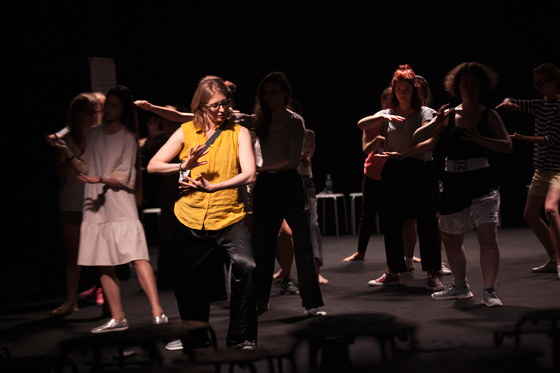 © Ekaterina Pomelova "Laboratory of self -posterity"
The laboratory is nominally dealt with universal self -posterity (when we are forced to constantly change professions, to wander in creative services) and as if it helps to work with psychological discomfort, cultivating self -confidence, positiveness and self -halting. However, obstructive elements are distinguished from real trainings, which together impose anxiety and misunderstanding of the goal and format of what is happening (either it is really training, or a performance without spectators, still suggesting from the outside). One of these elements is aggression, sewn into friendly exercises of “faith in yourself”. You are getting closer, revealing each other the experience of self -posterity, then learn to throw balls into the enemy or shift a partner from a place. The theme of competition is not openly presented with everyone, but looms like an alarming sign hidden in harmless tasks.
Another alarming sign is the forms of bodily practices, blind from perverted dance and somatic exercises. Artists take the practices of bodily-spiritual trainings and introduce iconographic elements from pop culture or Soviet visual history into them. In the process of preparation, the guys collected athletic “images of power”, whether it was the poses of the heroes of comics or heroes of Soviet monuments, and then introduced them into their exercises. If the participant notices this (sees himself from the side), practice loses its visible neutrality and gives out ideologization. And although externally the script looks like a training in flexibility and adaptability (“all - impostors, everything will work out, we must believe in themselves”), dozens of barely noticeable oddities leave the attitude of artists themselves to professionalism, praise and ways to adapt to it.
Please do not dance
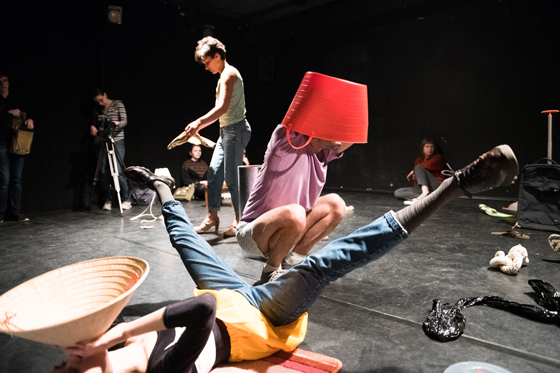 © Ekaterina Kraeva “In principle, everything is fine” of the ONE Tsucker groups. Show in Tsim
“Laboratory of self -posterity” is an ideal prologue for the entire dance program. It shows how the actual dance can be today: formally, meaningfully and at the level of communication with the viewer. The work has nothing to do with popular ideas about the dance as “an art that expresses feelings and thoughts with the help of movement” and shakes the visual stereotype of Contemporary Dance : barefoot people in free clothes are expressively dancing. The remaining programs of the program also do not fit into the common school definition. Strictly speaking, there is not so much dance in them [6] , but almost all work suggests that the viewer not only looks, but also passes them through the body.
For example, the work “In principle, everything is fine” of the ONE Tsucker group is not a performance, but a dance installation. For eight hours, visitors coexist along with performers in Blackbox, lying with them in bed, communicating in a chat, drinking tea or watching solo performances. Preparing different layers of their daily experience - from automatic patterns of movement to household speech - artists are trying to create another, outlined, everyday life, a certain “normal environment” of artistic experience, almost indistinguishable from ordinary life. However, the formal Blackbox frame allows the visitor to develop a special vigilance in relation to this daily normality.
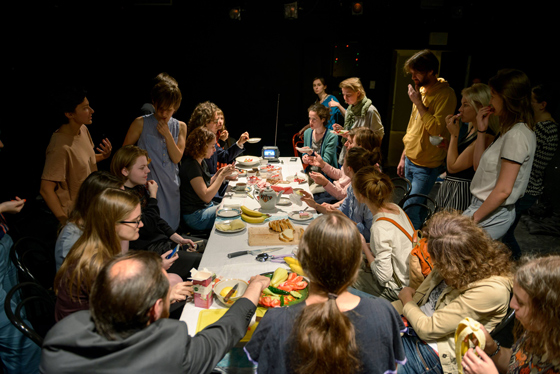 © Julia Zakharova “In principle, everything is fine” of the ONE Tsucker groups. Show in Tsim
Since there is no continuous tradition of modern dance in Russia, it can be assumed that the Laboratory and the installation of ONE Tsucker, and the Tatyana Chizhikova performed by the same performance, “We were here” by V.S. Tans and “Professional” by Tatyana Gordeeva and Ekaterina Bondarenko inherit the lines of the American-European dance dance The avant -garde, which always followed the path of artistic reflection and formal lawlessness.
Its story begins in the United States in the 1960s and is associated with rapprochement with visual art, as well as with the Modern Dance crisis, which focused on movement as a means of expression, authorship, entertainment and emotionality. The period from the 1960s to the 1980s was the time of renewal, radicalization and deep authorship of dance art, leaving a layer of theoretical and aesthetic developments, to which the dancing artists still turn to this day [7] . The continuation of this line can be seen in the European dance of the 1990s-2000s and the Nev-Tanets direction, in which choreographers refuse traditional work with the movement in favor of other theatrical and art media. The same line is characterized by a critical position of choreographers in relation to its art and the conditions of its existence. Since then, everything new in the dance has been connected not so much with the production of a spectacular form (in a conservative sense), but with the search for borders of dance and movement, the study of the methods of bodily communication, studying the dance potential for the production of communities, an emphasis on social information that the body carries, the study of dance as an action, a way to think and produce affects.
In this sense, the concept of “modern dance” today does not indicate one or another form of the work and even the presence of moving bodies in the work of moving bodies, but rather reports that working with the body, action, movement, and time is important for the artist, and as he understands it, it is unknown in advance. Program performances demonstrate this formal irreducibility and understanding of the dance as a field of reflection and artistic experiment. And collected in one program, they present themselves as a special phenomenon in the world of Russian dance - or, one might say, a new dance scene.
On the other side of professionalism
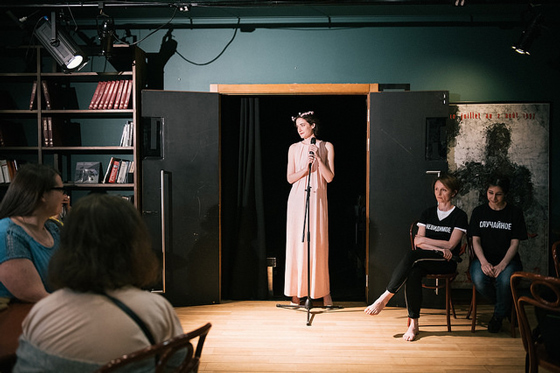 © Ekaterina Kraeva performance "Professional". Show in Tsim
Returning to the "laboratory", it is important to say that the topic (not) of professionalism is one of the central for the current Russian dance. It converges in it painful for the dancers with a classic technical dance and their eternal praise, also tied to the physical capabilities of the body. Although the Western modern dance conquered the right to not be technical back in the middle of the last century, in Russia this knowledge does not seem widely learned, and this is a historical justification [8] . Fifty years of the ban on modern forms of movement, the ballet primacy (our everything) and the habit of proud of sports and dance training, as well as put it as a national treasure, add points to marginalization and so no recognized modern dance. People from related areas often come here, without professional training, and the sphere of the stretch itself can be called professional: there is no clear understanding of how to build education, it is unclear how to make a career and earn money. And although it is possible to build the mentioned work to the Western dance vanguard, it is important to take into account the specific Russian context in which they are created.
Tanya, the former artist of the Kremlin ballet, after leaving for a modern dance could not explain to loved ones for a long time, what she was doing.
This is the context of general low awareness in relation to dance history, which is facilitated by the lack of education in the field of modern dance theory. Although a new dance is often closer to performance and even installations than to a classic theater, it is usually not included in the educational programs of art schools. If we talk about the professional training of dancers, in it physical development is rarely accompanied by art history and theoretical studies. Therefore, the Russian dance is characterized by a stay outside of time and a certain forgetfulness. Often, work is done as if in vacuum and disappear without a trace, and the absence of their archive and understanding does not create opportunities for continuity and development.
In this sense, I would like to think that selected works are trying to settle in the history of art, to correlate themselves with modern philosophical thought, to build art strategies and value positions [9] .
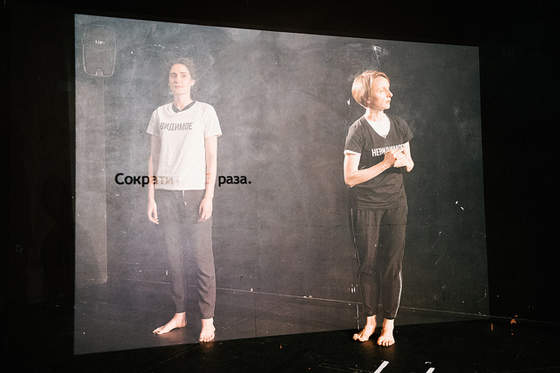 © Ekaterina Kraeva performance "Professional". Show in Tsim
Perhaps that is why the new dance in Russia is especially characterized by abstract. Research and pronouncing the conditions of its existence is a psychological necessity. The “professional” was largely built on this - the performance of Tatyana Gordeeva and Ekaterina Bondarenko, who completed the dance program in the arena. In it, a conversation with the viewer about work is combined with reflection on the professional qualities of the dancer-performer. Tanya, the former artist of the Kremlin ballet, after leaving for a modern dance could not explain to loved ones for a long time that he was doing: in her current work, only his criticism remained from the ballet. Katya is a playwright without a dance education that recently acts as a performer. In the play, she disgraces half a joke with how the viewer should perceive her Nedotaan. At the end, by voting, they measure the level of boredom in the audience, combining therapy and metacherment to work in an ironic gesture [10] .
Fortunately, everything is not limited to self -digging, and choreographers use their position to think and talk about common things - and let the audience experience their work directly through the body.
[1] The concept of the exhibition, the conditions for its creation and the list of works are available at this link .
[2] The text of the post is at this link .
[3] The text of the post is at this link . Performans were criticized here, which were periodically repeated during the exposition: for example, the performance of Elena Kovylina “Cultural Covilina”, originally shown in the Danilovsky market.
[4] The dance program included five works created in 2017-2018 and before that shown at other sites in Moscow, St. Petersburg, Minsk and Kiev: “Laboratory of self-posterity” Vika Lashenov, Vera Shchelkina and Dmitry Volkov, “In principle, everything is normal” ONE Tsucker, Tatyana Chizhikova, “we were here” The company "According to V.S. Tans" and "Professional" Tatyana Gordeeva and Ekaterina Bondarenko. The authors of these works belong to different generations of Russian modern dance, but everyone is more likely modern dance artists than choreographers in the classical sense of the word (people who come up with movements and gather in ligaments). The program collected in this way is interesting to contrast the festival of modern dance Open Look , which is focused on showing a technical spectacular dance without special complaints about criticism or relevance, to the same dates in St. Petersburg.
[5] “Laboratory” can also be considered in line with the newly emerging trend to submit (pseudo) trainings, yoga classes, parties, raves, somatic practices and therapeutic sessions as new forms of representation of dance and performance.
[6] Although the “laboratory” does not thematize stereotypes around dance art, the very presentation of such “non -standard” works in the modern dance program persistently declares that this field is much wider than specific techniques or styles. Since the Russian spectator from modern dance is often waiting for a technical, expressive movement, the selection of such works is a conscious curatorial solution. We also note that the refusal of choreographers to work with the dance in the usual sense goes back to the French intellectual dance of the late 1990s-the course called "non-Tanets". The incident is known when the viewer, who came to the play “Net-Tan” Jerome Belya, filed a lawsuit for showing him the festival for the fact that there were no expressive movements and jumps to the music in the dance work. “Net-Tanets” and other branches of “Conceptual Dance” actively developed in Europe until about the mid-2000s and were analyzed in the books of Andre Lepyki, Ramzi Bert, Boyana Msolich. Subsequently, the “conceptual dance” was criticized, which was stated, for example, in the essay of the Swedish choreographer Martin Sponberg “Post-Dance, an Advocacy” .
[7] The cult book of Sally Baines “TerShor in sneakers: Dance postmodern”, which first published in America in 1979, tells about this. In 2018, the Garage Museum published a book in Russian.
[8] На российской танцевальной сцене чувствуется противопоставление современного экспериментального танца балету, модерну или техничному contemporary , а иногда и враждебность представителей разных направлений по отношению друг к другу. Хотя новые формы танца активно развивались в СССР, в том числе благодаря популярности школы Дункан, с 1930-х годов их развитие было прекращено. В то время как западный танец проходил последовательное развитие от модерна к постмодерну, не-танцу и посттанцу, в России новый танец возрождается только в конце 1980-х на неблагодатной почве. В почете балет, спорт, гимнастика, а рефлексивный экспериментальный (не)танец либо совсем не воспринимается профессиональным сообществом, либо воспринимается в негативном ключе — как творчество недоучек. Возможно, из-за давления консервативных взглядов экспериментальный танец все больше стремится в галереи, музеи и на площадки ЦСИ.
[9] Помимо упомянутых произведений и коллективов сюда же можно отнести работы кооператива «Айседорино горе», Александра Андрияшкина, Ани Кравченко. Хотя это очень разные художники, их объединяет стремление видеть свою деятельность в широком контексте художественных и общественно-политических процессов.
[10] Подробно об этом перформансе написала Ольга Тараканова в статье на The Village .