
Translated material
Why did the general spoke?
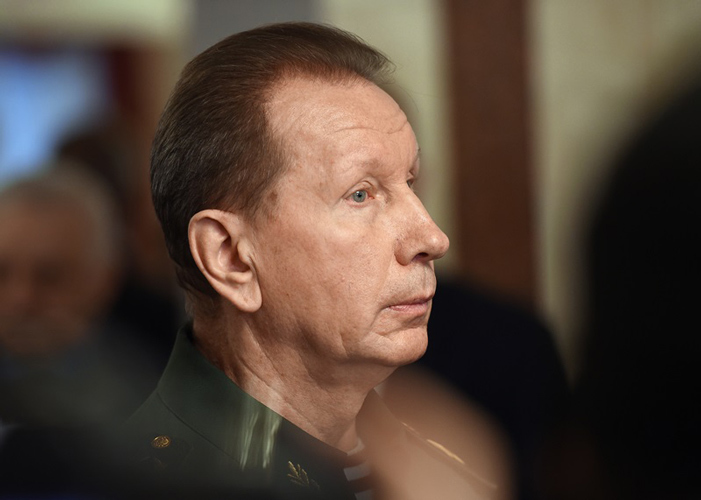
A video message of the head of the Russian Guard, General Viktor Zolotov, to the politician and blogger Alexei Navalny, is unusual even for modern Russia, where, as in those adventures of the girl Alice, "more and stranger ." Zolotov did not become the pioneer of the genre after the video as Alexei Navalny oligarch Alisher Usmanov. He was also discussed in social networks with a mixture of laughter, disgust and at the same time with a certain degree of respect. Usmanov could be unpleasant, funny, but still made the impression of a man defending his own dignity. A new video message is different from Usmanovsky to a lot. Firstly, this is the answer of the official-to a private person, the answer is immediately “for the entire department”, and Alisher Usmanov still responded to personal accusations. Secondly, this is the response of the general to a civilian person, this is not a skirmish of two private individuals. Thirdly, Zolotov for the first time in the recent history of Russia does not just publicly threatens the opponent, but threatens to unfold, obfefly, with sadistic details-earlier generals with bloggers did not talk under the camera.
What forces General Viktor Zolotov, an absolutely non-public person, to sit in a ceremonial uniform in front of the camera and write down a six-minute appeal to someone who is not in his eyes neither influential, nor power, nor (according to him) in general with a remarkable figure? What makes the general say?
Zolotov cannot respond to corruption accusations by direct denial. The words of Navalny are backed up by the FBK documents, and it is difficult to challenge it. Zolotov, however, feels touched and must somehow answer. He is challenged, he goes into a counterattack and responds as he is taught to answer in such cases - a threat of physical reprisal. It seems that in Russian history the officers, even if the gendarme administration (although the analogies between the gendarmes corps and the National Guard are quite doubtful), did not call prisoners to the duel. Not according to the rank! At least this circumstance makes his appeal to officer traditions ridiculous. But, for example, an angry general could order Navalny to kill without any public threats. For some reason, he must publicly declare his attitude towards him.
The resentment of this person is psychologically understandable. Navalny climbs “not in his own business” and at the same time turns to his own subordinates. In addition to personal and obscure for the viewer, psychological reasons for this decision are also different. Navalny created a situation in which Zolotov was forced to speak.
In his video, Navalny rhetorically turns through Zolotov’s head, defiantly violating subordination, to the employees of the Russian Guard. Like, they make money for you. Your existence is a pretext for great financial fraud. At the same time, your products are of low quality. "They steal on you."
And at the same time, Navalny addresses the audience (speaking about the fighters of the Russian Guard in the third person), representing this department as another of many structures serving a criminal conspiracy.
Thus, Navalny simultaneously deprives Zolotov and his entire Rosguard of internal authority. Like any power department, the Russian Guard can exist as an ideological organization, contrasting itself with the organizations and structures by imperisric, that is, simply unique ones (all these “extremists” who are sold to any enemies of Russia - “playing embassies”, as Putin once said about them). So Zolotov with such passion tells about the unprincipled behavior of Navalny - “clone, puppet”, which “set the task”. These accusations of inner trumpiness and soullessness imply an alternative: a spiritual and internally whole person, a guardsman, he serves not for money and random benefits, but for national interest. Therefore, reminders of the early retirement should be very unpleasant to these people - if they think that they serve primarily for the early retirement and similar benefits, this will deprive them of the opportunity to believe in their business. Showing that the Russian Guard exists on a criminal conspiracy, Navalny destroys not only the “external” personality in relation to the department, but also his internal ideology. The second for the department is more dangerous than the first. An employee of the power department, perhaps, is ready to agree that the commander is stealing, but he will not accept that the commander only steals. Navalny frankly neglects in his video any meaning, “spirituality” and traditions for which the Russian Guard exists, and introduces it into its “anti-corruption” coordinate system, where the Rosgvardia organization exists exclusively for the sake of theft. This must be answered with words. Only words can resist the destruction of internal ideology, since it also consists of words.
Therefore, Zolotov is not enough criticism of weapons - he is forced to turn to the weapon of criticism. Navalny creates it as a public figure with his public and evidence -based criticism. Moreover, he interpellates him as a public policy - that is, in general as a politician.
The textbooks of critical theory often gives a classic example of interpellation from Louis Altusser. The policeman screams on the street to the passer -by: "Hey you, stand!" - The passerby turns around, and it is this movement that makes him to whom the policeman addressed. That is, at this moment he turns into an object of police circulation, into a certain “citizen”, “witness” and so on.
What General Zolotov is still doing is not a policy in any of the vocabulary of this word. Navalny's revealing videos cover only the edges of the curtain, behind which the whole world of connections, transactions, conspiracy, agreements and coordinations. The complex life of such people, terrible , is taking place in it, if they look at them, but sometimes forced to pretend that they are guided not only by corporate, but also at least some kind of social interests. This is not a policy, and, directly or indirectly addressing them, the public politician Navalny offers them the opportunity to initiate politics. This challenge must be answered with the appropriate methods. Yes, the “offender” can be killed, but this means losing the opportunity to answer this adequately. The documents shown on the air are a strong rhetorical argument, they can be ignored, but it is impossible to say aloud that they are not (trolls are done, but they are trolls). You have to answer the word with a word, and, perhaps, feeling this coercion to speak, Golden interpelled into the policy physically feels the limits of its capabilities, his loneliness . This is probably a very frightening feeling for a powerful person.
Public political speech creates (establishes) a special reality - accepting the challenge of Alexei Navalny, Viktor Zolotov is forced to act in this new reality. This is the reality of the relationship of power. So General Viktor Zolotov finally really talked about public relations for the first time. And he clearly cannot help the language of ideological cliches, all these grotesque accusations against Navalny and “people like him”, who was still enough for non -public conversations. Its comic-memorable threats are the torment of the birth of a real conversation about relationships. Maybe he will not be born. But this is another case when the indefatigable Navalny made it possible to observe in real time, how people learn to speak.
It is appropriate to mention one small event: from the site K Remlin.ru , the transcript of Putin’s conversation with the workers of the Zvezda shipyard was “disappeared ”. This is an amazing example of non -political speech: spherical in vacuum mutual stroking plus, possibly, loved by political desiders, “Signal Exchange”. How much more interesting it is to read the transcript of the monologue of Zolotov! Behind her reality, she has flesh.
This means that the strategy of Navalny really works. Having survived the political interpellation session, the influential dignitary Viktor Zolotov will not be able to remain who was before. Some of these two will win the just begun party, the rules of which are created right before our eyes. The whole society benefits from what people publicly talk about important, even if they say terrible absurdities.