
Translated material
Moscow diary of St. Petersburg Donochou
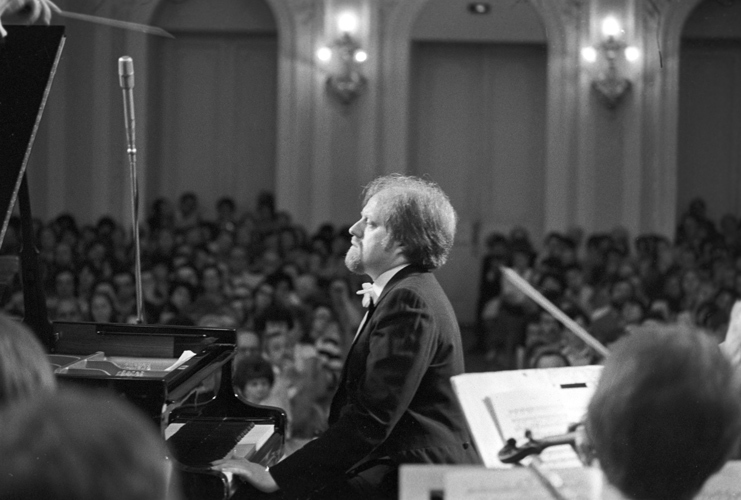
In 1982, the British pianist Peter Donochou divided the second prize with Vladimir Ovchinnikov at the Tchaikovsky contest (with the first first) and became famous. Since then, he has played in Russia many times. On September 16, for example, he plays in Moscow the same third concert of Rachmaninov with the same Vladimir Fedoseyev as 36 years ago. In 2012, he published a diary that led during the competition and which has now become a document of the era. His full Russian version translated by Marina Frolova and edited by Olga Khoili published in the journal Music Academy (No. 3, 2017). Colta.ru offers his most interesting fragments.
June 9, 1982
At the Moscow Airport Sheremetyevo, we were met very unfriendly. The border guard examined my passport and a visa for ten minutes at least (he looked fourteen in appearance, and it seemed that, if he smiles, he had acne dug). He looked from his pieces of paper to my passport, then at me, then again on pieces of paper, and so on to infinity. I was already completely nervous, and then he suddenly asked me: “ Do You have Pen ? " (In the Russian language there are no definite and vague articles, so it sounds in English as if objects have their own names, like pets: “Do you have a pen?”) It seemed strange to me that such a person needed to suddenly ask for a handle from a tourist, but I handed him a BIC ball. He said: “T Hank You , ” he put her in his pocket and finally let me into my mother-Russia.
I was met by the translator Nina (they say that they all work for the KGB), she seems to be from Turkmenistan. She stuck to me like a bath sheet and no longer lagged behind.
All of us were settled in this incredibly terrible hotel "Russia". In the Guinness Book of Records, it is listed as the largest in the world: it has 21 floor, 3200 rooms and 28 restaurants. The elevator must wait five minutes, plus it is still unknown how much the descent down will take or, conversely, the rise. They say that a few years ago there was a big fire and many people died. It is built very poorly, the water supply system is very noisy, and in restaurants there are always only tomatoes, cucumbers, bread and Polish beer. The remaining products are subject to state distribution, and this does not apply to the strengths of the Soviet Union. Everything is so slow, and service in the bar is no good. Russians are allowed to be allowed to be allowed only on passes, apparently, so that they are not undergoing corruption when communicating with foreigners.
It turned out that I was in the same issue with Barry Douglas, whom I met back in 1976 at the Liszt competition in the UK - then he participated in it as a junior.
I was introduced to many other participants, including several Americans who all suffer from paranoia on the basis of propaganda.
In return tickets, all of us at the competition put the date of the end of the first round. Those who go to the second will pass them and receive others in return, with the date of the end of the second. It is felt that they are very happy for us here ...
I was allocated time for daily classes on the piano: from 6:30 to 7:30, starting from tomorrow. It will be in the conservatory, which is twenty minutes by bus. This is the earliest time when they can open the conservatory - I was so lucky and several other unfortunate ones. The bus between the hotel and the conservatory does not go at all early at all, so you have to go by taxi. Wonderful. It is simply well organized, especially for those who usually lie down at three in the morning and get up at eleven.
June 10, 1982
Nina drove behind me by taxi late, so instead of 6:30 we arrived at the conservatory at 6:50. There was a policeman at the entrance, but the door was locked. Nina began to explain to him in Russian who I am, why I am here and that we thought that by this time the door should be open. The policeman embodied the very ineffectiveness itself, his face was motionless and expressed nothing. He was in shape and with a gun. Finally, Nina was able to explain to him that I was an English pianist and that I needed here. He said: " English ?" I replied: "Yes." Then he said: "Paul McCartney!" - showed two thumbs and broke into a smile. I realized that he was starting to carry, and mentioned Manchester United. Then he was even more happy and decided to go somewhere to the key to let me in (it was already 7:10, and I had 20 minutes to rehearse a four-hour program). I have no idea where there were all the others who also had to study from 6:30. I have never seen them once.
On the same day there was the opening of the competition. We were all gathered in front of the conservatory near the monument to Tchaikovsky. There were many television cameras and journalists.
First of all, the welcome word of the chairman of the jury and the Minister of Culture of Georgia Otar Taktakashvili. He is the same composer who wrote one of the two mandatory Soviet works for the second round. I chose another play - will it turn against me?
Then - the welcoming speech of one of the Soviet contestants, Vladimir Ovchinnikov, addressed to the pianists who came to the largest pianist competition in the world. One of the American participants turned to me and said: "And here is the winner!"
After that, the television journalists approached who they wanted - and chose me. "How do you feel by arriving at our grand competition?" I tried to choose as cautious as possible in the political sense of the word. It seems that it is very important not to confuse the text.
After the ceremony there was a draw. I had a number 21. The first tour lasts two weeks, so number 21 is not particularly noticeable. I can play the first round on June 13.
When I returned to the hotel, the phone began to call the phone in the room-someone was mistaken all the time. But at some point I picked up the phone and heard real English. I did not expect this, and, apparently, suspicion sounded in my voice. It was an attache in culture from the British embassy, Michael Sullivan, who himself played the piano and was a great music lover. He congratulated me on arrival in Moscow and invited me to visit his home that evening. He and his wife Jenny lived in an apartment on Kutuzovsky Prospekt, where, for the most part, diplomats live in houses guarded at the entrance to the policeman.
Michael and Jenny invited me to engage in their piano - in case it does not work out with classes at 6:30. It was an oasis of non -confidence. At the same time, every time the conversation went about the competition or at all about something slightly less neutral, Michael turned on the radio at full volume so that we were not overheard and not recorded. I don’t know how true it is, but a certain complex immediately arises.
June 12, 1982
Today again I met with an ordinary McCartney - the door was again locked, and again it was almost not possible to work out. He smiled again and again said: "Paul McCartney." Maybe he somehow felt that McCartney and I had a birthday in one day, but I doubt it.
I already met three Americans close - Richard Bosworth, Jonathan Sheims and James Barbagallo. James is a great guy: he says incessantly - very warm and open. I really like him. The other two are also very pleasant, but quieter than James. All of them, however, are convinced that the result is already predetermined, and and in favor of the Russians. For many years now, such rumors have been going on about all competitions that are organized by Russians. But Van Klibern, John Ogdon and John Lill received gold medals here - well, in the case of the last two, she was divided with Soviet participants, but no one can say that Ashkenazi or Kranev earned their gold medals. It seems to me that there are strange results at all competitions, maybe sometimes they are a foregone conclusion, but I think this is more because the system itself does not work.
The paranoia of the Americans is even funny - they always tell stories, from which it is clear how much their brains were washed about the Soviets as the embodiment of fuccation of hell. One said that a person in a black cloak, apparently, was apparently, an agent of the KGB, who is instructed to get rid of any American who would threaten their beloved Soviet participants ... And the other said that he accidentally entered the door of the hotel and found a cabinet with tape recorders there, they all spun and recorded what they say in the rooms. Well, you already!
Of course, we can’t talk with Russian participants. They do not live here, and one way or another they are not allowed to communicate with foreigners (or maybe they themselves are afraid?). It’s a pity, I would like to talk with them honestly, but the Soviet authorities, apparently, consider it dangerous. And, looking at the prejudices of the Americans against this country, maybe they are right. Of course, paranoids can also have real enemies and propaganda, and on both sides, sometimes it is true.
Indeed, here everything is controlled by the authorities, and life seems boring and gray. I wonder how they are at home? Maybe the family here is more important, because life beyond its borders is so colorless? Maybe, for the same reason, art, music, culture are more important for them? I'm trying to imagine it.
Maybe they follow me, but I don’t know or maybe they listen to our number. My God, now I am already not good for me from this!
June 13, 1982
I played my first tour at 17:00. The audience is incredible here. All places are occupied at any time, at the performance of any participant, and whoever plays, part of the audience is ill for him and supports loudly. They were especially sweet after my performance on Tchaikovsky’s “three” - this melody is well known even to non -recycles. Four sketches were very scary to play, because all the rest are not suitable for Soviet pianists in such things. I was told that Ovchinnikov was played by the Chopen sketch of the OP. 10 No. 2, as if it were a trifle. People came up to me and talked about the “three”: how in Russian it sounded.
All that remains for me to do now is to engage in, drink beer and wait: either pan or disappeared.
June 14-16, 1982
A little entertainment gave us a bidet in the bathroom of our room. Barry Douglas and I liked the idea to have a bidet, and we both worried that water did not flow from the tap. Barry told me that he had been trying to open the crane for twenty times, but nothing happened. Actually, I am proud (although, perhaps, in vain) with my ability to solve the practical problems of this kind and therefore took up the repair of Bidda.
Like Barry, I realized that you can twist the crane before blue - and there will be no sense. Nevertheless, at some point, something inside caught and worked, and even how. There was just no hint of water - and suddenly, from the slightest pressure and turning a millimeter, tsunami collapsed on us. A pair of gallons of water, stagnant and brown in color, spilled in my face, then on the ceiling and eventually flooded the entire bathroom, all my clothes and towels and flowed into the bedroom on the carpet. A real Icelandic geyser woke up in the corner of the bathroom! (The water smelled like an Icelandic geyser - it is clear that no one opened this crane since the October Revolution.) All this happened to the accompaniment of the characteristic sounds of Soviet water pipes - as machine -gun lines that were heard not only in our bathroom, but throughout the corridor. These sounds were heard in the hotel at any time of the day and night and became the soundtrack of the competition. I could not understand what the hell all these people wash at three in the morning throughout this giant hotel stretching for kilometers. It seemed that we were under machine gun fire.
I had to say goodbye to the dream of bidet.
June 17, 1982
I managed to tear myself away from Nina-finally! Having studied in the 21st grade (it leaves me alone for the time of classes), I left the conservatory and quickly went towards Red Square-just about a mile. Nina was not visible, and I did not notice that someone was following me.
I walked around Red Square - although a tourist from me is bad, this is still such a historical place that I had to go there and let it through myself. It was amazing, especially the Kremlin walls, and the gates with a clock tower, and chimes ... I sometimes joking that they remind me of the ringing of metal hangers in the closet. But in fact, the impression was very strong, and you can’t describe it in words. I remembered Boris Godunov. Then there was a change of guard, made with incredible accuracy. When you stand there, it is difficult to imagine that so many problems come from the Kremlin. At any moment, war with these people can begin, and life will come to the planet.
I decided to go back, very little time passed. When I walked up the street of Herzen, a certain type in a tweed suit, a rather eccentric look, approached me, and held out my hand with a smile. He had a very aristocratic English pronunciation, especially in comparison with my own ... He knew what my name was, which I was slightly dumbfounded, but maybe he saw me on TV. He was extremely sweet: how glad he is to see the British at the competition and how he will root for me. I said “thank you”, and he suggested showing me Moscow if I want, and so that I would call him then. He gave me a business card on which it was written only in Russian. It seems he called his name, but I did not hear him, or maybe he did not name him, I don’t know.
God, what a scandal did Nina arranged for me! She said that she would get very much because she missed me, and I apologized and promised not to do it anymore. I did not tell her anything about this allegedly English character. I hope that her authorities did not know about it, but I suspect that this type has been tapped her ...
Later I was invited to the British embassy to meet with Michael Sullivan and other employees. I told Michael about the Englishman who molested me. Michael was immediately very worried. First of all, he told me that anyone who walks in Moscow alone and speaks English, introducing himself as an Englishman or an American, of course, from the KGB-you should not contact them. I said that I was also alone at that moment, and received a reprimand for the fact that "I am in danger." I think Michael had in mind that they could be recruited in spies. But the level of English of this type was clearly such that he could not be Russians - he did not have a trace of the Russian accent. I myself thought that it was either a tourist from the UK or a businessman living in Moscow, but at the embassy these ideas were considered ridiculous. Michael asked me if I had his business card. When I showed it to him, he turned white and hastily pulled out a photo from somewhere in the box: "Is it he?" I said: "Similar, but I'm not sure." He told me that it was Kim Filby. I asked the card to see how Kim Philby is written in Russian, and I almost managed to read it in Cyrillic, and after the last name there were different letters, as if the titles. I wonder how the events would develop if I called him? But this became impossible: Michael took the card and broke it. I did not have time to remember the number.
June 18, 1982
Today I am 29 years old! And, it seems, I get sick. The food in the hotel is terrible. My body clearly lacks vitamin C. I would like to eat fruits, but they are not. Barry told me that there is a chain of stores for foreigners “Birch”, where they accept only firm currency. There is one such store on the corner of the hotel where you can buy large banks of orange juice from Greece. Russian rubles are not suitable for anything: although they are sold by pound for the ruble, there is no way to change them back, and there is nothing to buy for them either (I hope to find a musical store, because the notes here are very cheap). This means that such ordinary things as Greek orange juice are not available to a simple Russian person, since, as a rule, he does not have currency.
Toilets in the Moscow Conservatory and in all other public places are indescribable: there are no seats on them, if there is paper (and it usually does not), then only a newspaper (although, maybe this is the use of Pravda as intended), and there is something like a garbage basket in the booths, where they throw the used paper. The smell is more than disgusting, and in general the whole atmosphere does not have anything. If I did not take paper with me, then you have to improvise. So came the end of one high -quality checkbook of the National Westminster Bank.
The results of the first round. I have passed! And my friend James Barbagallo too. My God, what voltage was when Taktakashvili announced the results in order of the numbers of the draw! When he did not miss number 21 and I realized that he had passed, I experienced a huge feeling of relief. 80 people remained overboard, and there were terribly upset people - tears and acute sense of personal defeat. Horror.
Barry Douglas could not go, which is strange, since he played very well, but we know everything about contests. In the evening, he flooded his grief in our room with him.
June 20, 1982
Barry went home. He arranged a party for the whole night in our room and flew away early in the morning. While he was drunk, I went to the bar, and then the guys and I went for a walk around Red Square and around the Cathedral of Vasily Blessed (Nina would have killed me, but she did not know anything). Now our number is at my full disposal, but I will miss our night conversations with Barry on all kinds of musical topics. The pearls of the Americans gave us a lot of reasons for laughter.
I will play in the second round on June 25. Now we need to deal with every day, and as much as possible; Then a little communication with the Sullivans, and in the evening - in the bar. All the same, there is absolutely nothing more to do here. My cold intensifies.
June 21-24, 1982
Почти каждый день посвящен только четырем вещам:
Безумно занимаюсь. Никогда столько не играл, но сейчас больше ничего не отвлекает, и потом, пройти во второй тур в этом конкурсе — это такой шанс, что я совершенно не собираюсь его упускать. Теперь у меня хороший класс для репетиций, и я могу играть там сколько угодно.
Беседую с англоговорящими и парочкой франкофонов в гостинице — я по-французски говорю неплохо, так как привык к этому во время стажировки в Париже с Ивонн Лорио и Мессианом. Правда, я лучше говорю, чем понимаю.
Ем жуткую гостиничную пищу или чудесную еду у Салливанов.
Без конца беседую с Майклом и Дженни. Я им, наверное, сильно надоел. Иногда мы включаем радио на полную катушку, чтобы нас не понял наш «слушатель» — мы прозвали его Борисом. Мне кажется, ему было бы интереснее услышать какие-нибудь политические или промышленные тайны, а не наши бесконечные музыкальные тирады — если он вообще нас слушает.
Нина все время намекает, что у нее есть какие-то сведения с заседаний жюри. Хоть бы она уже замолчала: во-первых, я ей совершенно не верю, во-вторых, ничего не хочу знать. Единственное, чего я хочу, — это попасть в финал, и загадывать ничего не стоит. Только бы сыграть так хорошо, как никогда не играл, и потом надеяться на лучшее, готовясь к худшему. С простудой все хуже.
25 июня 1982 г.
Мой второй тур. Эта дурацкая простуда, которая продолжается уже пять дней, сегодня разыгралась. Мое выступление в 10:30, на улице — жара. Программа жутко длинная, и на нее нужно много энергии и выдержки. В общем, дела так себе.
Сыграл, и прошло очень прилично, особенно «Петрушка». Как только добрался до гостиницы, лег в постель и проспал до вечера. Чувствую себя намного лучше.
Обязательным «сочинением своей страны» была в моем случае Вторая соната Типпетта. В тот момент, когда в начале последней страницы с кульминационным до-мажорным аккордом фортиссимо (в нем еще есть нота ре) возвращается первоначальный темп, зал начал с энтузиазмом аплодировать. Когда они поняли, что произведение еще не кончилось, они мгновенно затихли, шикая друг на друга. Отдельные смущенные хлопки раздавались каждый раз, когда вновь звучал до-мажорный аккорд, и так до конца. Но когда я действительно закончил, никто уже больше не хлопал. Мне пришлось встать и пригласить их поаплодировать, тут было много смеха.
Моя Соната Листа не всем приходится по вкусу — так было и будет всегда, — потому что я пытаюсь придерживаться того, что написано в нотах, а это сейчас, кажется, немодно. Мне показалось, что я все это прочитал на лицах жюри. Может, тут-то я и промахнулся в своем выборе.
Зато «Петрушка» прошел отлично как никогда. Я даже заметил, что жюри тоже по-настоящему понравилось. А что касается зала... У меня нет слов! Когда ушел за кулисы, не смог сдержать слез — такая замечательная была реакция зала, — а мне вообще-то это не свойственно.
Простуда наконец прошла. Это была самая несвоевременная и жестокая простуда за все последние годы, наверное, потому что в еде не хватает витаминов. Теперь я чувствую себя намного лучше: у меня больше энергии, и настроен я более оптимистично, в основном благодаря этой замечательной публике.
27—29 июня 1982 г.
Ну все, теперь остается только ждать и заниматься, хотя странно репетировать два концерта для третьего тура с таким рвением, в то время как есть шанс так их и не сыграть. Но вся атмосфера так настраивает, что заставлять себя не приходится, и отбрасываешь все мысли о том, что можешь не пройти.
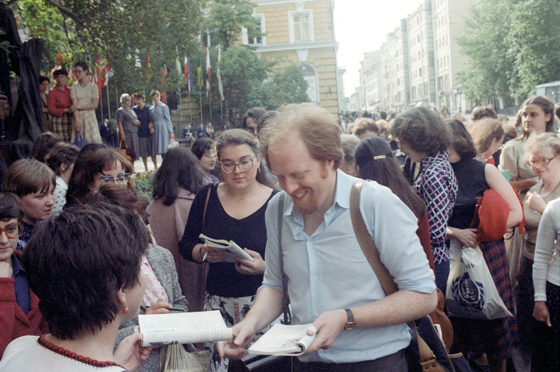 © Александр Чумичев / ТАСС Питер Донохоу дает автографы у здания Московской государственной консерватории имени П.И. Чайковского, 1982
30 июня 1982 г.
Я прошел!!! Такое облегчение и радость, что бы теперь ни произошло. Боже мой, финалист конкурса Чайковского — поверить не могу! Мне надо вернуть мой обратный билет в Лондон и получить взамен другой, на после 8 июля. It's so great!
Расписание репетиций слегка абсурдно. Каждому из нас дается только один час на то, чтобы отрепетировать оба концерта с оркестром. Получается, что не важно, играешь ли ты Второй Брамса, Первый Листа, Третий Рахманинова или Концерт № 9 Моцарта (все это будут исполнять финалисты) — у всех одинаковое количество времени. Это что, проверка на умение репетировать с оркестром? I don't understand.
Я собираюсь ходить слушать почти всех финалистов, которые будут играть до меня, и на основе своих впечатлений спланировать, как пройти концерт Чайковского быстро и сосредоточить все усилия на Рахманинове. Придется на репетиции взять бразды правления в свои руки, потому что Третий Рахманинова скоординировать с оркестром очень сложно. Попеременно будут работать два дирижера, мой — Владимир Федосеев.
2 июля 1982 г.
Я ужасно волнуюсь. Здорово пройти в финал, и легко убедить себя, что этого достаточно. Но когда придет твой час, нужно ведь попробовать взять первую премию, правда? Иначе никогда себе не простишь. Волнение уже превращается в болезнь.
3 июля 1982 г.
«Выпей-ка пива, расслабься», — сказал Майкл Салливан, когда мы сидели в их квартире после обеда. Я сидел с «Карлсбергом» в руке, разговаривал с ними, рассеянно поглаживая большим пальцем правой руки отверстие в банке. Вдруг все вокруг оказалось залито кровью. Я сильно порезал себе большой палец. Боже, какая началась паника! Майкл кричал, что это все его вина, так как он не предложил мне стакан; Дженни кричала, чтобы я немедленно ехал в больницу. Я тем временем размышлял, не придется ли мне сойти с дистанции. Кусок кожи свисал с пальца как раз в том месте, которым надо играть октавы. Как раз то, что надо для Первого Чайковского и Третьего Рахманинова. Я сразу же отправился к врачу, которого нашел мне Майкл вместе с Ниной. Тот выдал мне справку, что мне нельзя играть пять дней, то есть до последнего дня конкурса, 8 июля. Мое выступление перенесли. Это означает, что я буду играть последним и мой Третий Рахманинова завершит весь конкурс.
5 июля 1982 г.
Все выступления проходят вечером, иногда по два человека, иногда по три. Я решил послушать всех, чтобы понять, как ведут себя оркестр и дирижер, и спланировать мою абсурдно краткую репетицию. Так что я прослушал концерт Чайковского уже девять раз.
Оркестр играет Чайковского без всякого намека на старание, что меня удивило, и налицо очень странные советские традиции исполнения этого произведения. Например, последняя строчка вступления ( meno mosso ) идет обычно очень поспешно, как будто она наскучила и ее нужно скорее проскочить. Аккорды деревянных духовых с валторнами в такте 217 первой части были сыграны так себе в первый раз, и чем дальше, тем они становились хуже и хуже. Публика очень недовольна оркестром и этого не скрывает (как и своего отношения к солистам), и теперь они уже смеются над 217-м тактом, что несколько сбивает пианистов в последующем пассаже. Но действительно, звучит это место так, как будто в глубине оркестра режут поросенка.
8 июля 1982 г.
День начался с репетиции с оркестром, которую я заранее в деталях распланировал, чтобы все успеть. Я не знал дирижера Владимира Федосеева, но мы друг друга прекрасно понимали (через переводчика) и хорошо вместе работали. Я выбрал несколько мест в концерте Чайковского, включая тот самый конец интродукции, где meno mosso . Я умолял их не ускорять, а также иногда играть тише, чем mezzo piano (чего они ни разу не сделали в предыдущих девяти исполнениях, которые я прослушал). Потом мы перешли к Третьему Рахманинова и сконцентрировались на самых трудных для ансамбля местах.
Во время самого выступления оркестр играл очень хорошо, особенно в сравнении с тем, что я слышал в Чайковском до этого. Федосеев — замечательный дирижер и почти все время следовал за мной как приклеенный. В Чайковском они сотворили настоящее чудо. В Рахманинове дирижер потерял меня в пятом такте после цифры 56... я всегда подозревал, что там может произойти катастрофа, но со мной этого никогда не случалось. Я сразу, в конце первого такта, сообразил, что он не ускорил темп вместе со мной, и не знал, что делать. Через пять тактов он нашел правильный темп, но отставал при этом на одну долю. К счастью, фигурация из тридцать вторых там повторяется два раза в одном такте, и это дало мне возможность выйти из положения. Вместо двух раз я сыграл эту фигуру трижды, то есть в такте получилось 5/4 вместо 4/4 — тут мы сошлись, и дальше уже все было хорошо. Кажется, жюри ничего не заметило.
Когда все закончилось, я позволил запереть себя в артистической вместе с несколькими другими членами нашего британского сообщества, и мы выпили много «Советского шампанского». Пока мы ждали — а прошло уже много часов, — я был совершенно потрясен криками и шумом, которые раздавались снизу, со двора консерватории. Это было как сон, и я знал, что ничего подобного больше в моей жизни не будет. Я подошел к окну, которое выходило во двор консерватории, и не мог поверить в то, что я увидел: сотни и сотни людей стояли и скандировали мое имя — с таким увлечением, с такой страстью.
В 4 часа утра наконец объявили решение жюри: золотую медаль не присудили никому, а две серебряные дали Владимиру Овчинникову и мне. Я не знаю, почему золотую медаль никому не присудили, но все остальные думают, что они знают причину, и в основном произносят что-то антисоветское. Может, мы никогда не узнаем правды. Хотелось бы когда-нибудь познакомиться с Овчинниковым и обсудить с ним это.
9—11 июля 1982 г.
Звонить по международной связи можно только так: заказываешь разговор у оператора за 24 часа, а потом сидишь у телефона и ждешь, когда на следующий день оператор тебе позвонит — если это вообще произойдет. Maйкл Салливан говорил мне, что это потому, что на всю страну в 200 миллионов человек существует только 14 международных линий. Он говорит: это для того, чтобы КГБ мог следить за каждым звонком и, вероятно, прослушивать и записывать их. Вот уж делать им больше нечего! Я заказал три телефонных разговора — с женой, с мамой и с моим импресарио в Лондоне и только вчера смог сообщить им, что произошло, когда дождался соединения. Реакция мамы на новость о том, что я получил серебряную медаль, то есть, по сути, что мы с Владимиром победили на конкурсе, была такова: «А, ну хорошо. When will you come? Мне тут надо гортензию пересадить». Зная маму, я только улыбнулся этой реплике. Так она реагировала на какие-то очень волнующие вещи — переводила разговор на обыденное, чтобы не заплакать.
12 июля 1982 г.
Один репортер поймал меня прямо в аэропорту Хитроу, как только я сошел с трапа. Не буду говорить, из какой он был газеты, но один из вопросов был: «Скажите, а кто еще победил в этом конкурсе кроме Вас и Чайковского?»
Это было неожиданно прекрасное и невероятное время, и я все время говорю себе: ничего подобного с тобой больше никогда не произойдет.