
Translated material
Why is the Governor's elections in Primorye wins the communist? (Oh, already loses!)
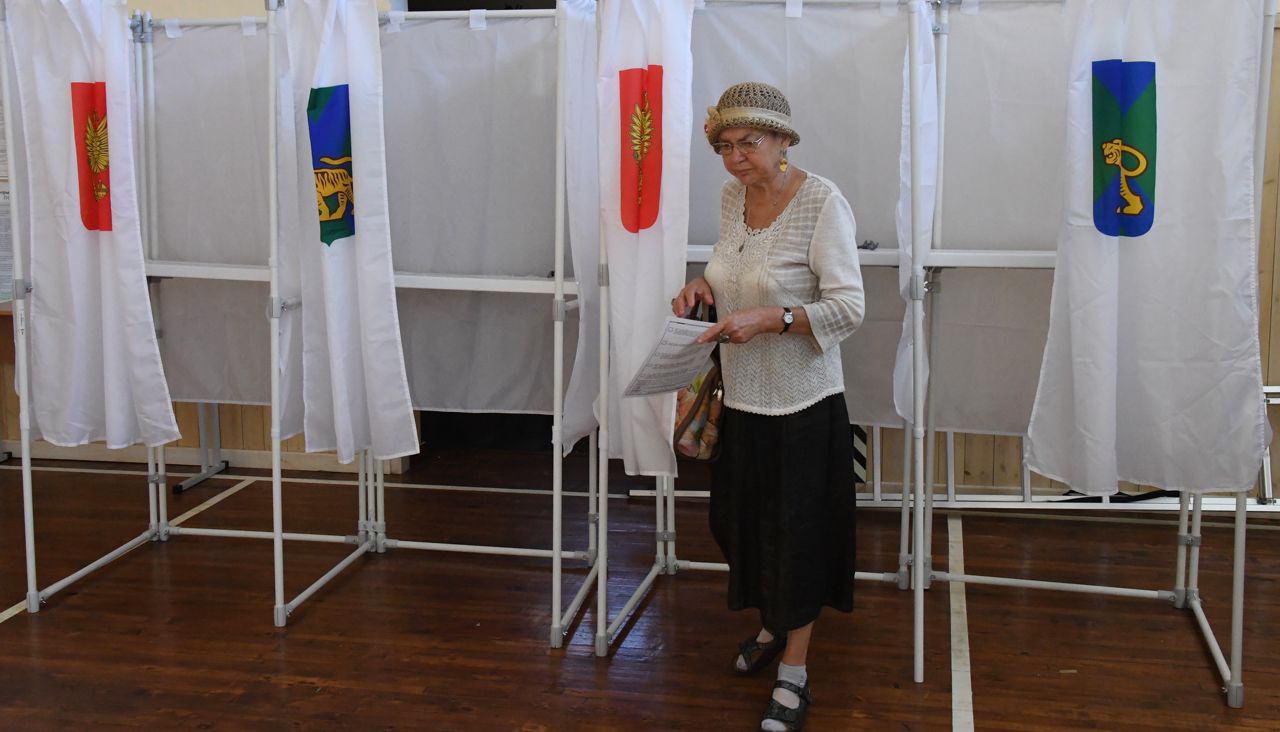
In the Primorsky Territory, the second round of governor's elections was held. In the first round, the acting governor Andrei Tarasenko (United Russia) scored more votes - 46.56% against 26.63% of his opponent, an Communist Party candidate Andrei Ishchenko. But in the second round, Ishchenko convincingly won - until the morning (according to Primorsky time), when after processing the last protocols he suddenly lagged behind the United Russia. The special correspondent of Medusa Taisiya Bekbulatova talked with political scientist Alexander Kynev about how Ishchenko managed to win - and despite this, to lose.
At the time of the conversation, after the counting of 95% of the protocols, Andrei Ishchenko won: 51.6% of the vote against 45.8% of Andrei Tarasenko. Near midnight in Moscow, new data appeared: after processing 99.10% of the ballots Tarasenko escaped forward - 49.55% against 48.06% of the communist. The Communist Party announced the mass postscribes of the votes of United Russia.
- How to explain that Andrei Ishchenko managed to overcome such a gap after the first round?
-This phenomenon has been there since the beginning of the late 1990s-early 2000s. The situation is as follows: the authorities mobilized in the first round of everyone who could, and everyone who was against, voted differently in the first round, some of the people simply did not go, because there is a feeling that the outcome is predetermined, moreover, the beginning of September is an uncomfortable time. This means that in the second round of the authorities there is nowhere to take new votes, because she brought all her supporters in the first. That is, there is simply no way to expand the electoral field, and here the agreement does not help with any parties. Why don't they help? Because the candidates are not the owners of those who voted for them. In such situations, people do not vote for someone, but often absolutely situationally-and when opponents support the current chapter, this does not add anything to him.
Moreover, in the second round, the turnout was higher, because the date is more convenient, and the second round itself was taken by part of the electorate so that it was not pointless to go to the polls. The same thing happened in 2015 in the Irkutsk region, when the turnout in the second round grew, and it was in the cities - and it even fell on the periphery, because it is difficult to mobilize the same people in a week in a list - and the elites understand that you can get rid of the old governor, and begin to sabotage the campaign. The same thing happened in the Primorsky Territory.
- What has become the main factor in this result of Ishchenko - the figure of a candidate or a splash of a protest vote?
-Here, the totality of factors is, firstly, the general trend for the growth of protest voting; It is clear that it is caused by pension reform and increasing taxes. Plus, there is a factor in the delayed irritation, which has accumulated since the time of the previous governor of [Vladimir] Miklushevsky, when for a long time the region has been led quite tough, ignoring the elite interests, pressing local social activists and politicians. People didn't like it. Irritation has accumulated, a socio-economic topic was added to it. The new head of the region, in my opinion, turned out to be better than Miklushevsky, but still part of the problems remained, and all this affected the results of the vote.
The region showed itself, as before, [subject] with a pronounced regional identity and character. This should not be surprised. The geography of voting for Ishchenko is quite diverse - this is not only Vladivostok, it is also a find, a number of areas with a very good percentage voted. That is, it cannot be said that Vladivostok itself, and the edge itself. There are abnormal spots like Ussuriysk, [where the candidate from power leads a large margin], but they, as a rule, as a rule, arouse suspicions that there were falsifications in favor of Tarasenko, and not what Ishchenko lost there.
- Did the Kremlin behave wrong?
Moscow once again demonstrated ignorance and misunderstanding of the regional subculture, regional interests, this affected both the symbolic gestures that were undertaken in relation to the region and on personnel decisions.
In my opinion, the figure of [the former head of the Ministry of Emergencies and the head of the headquarters Andrei Tarasenko Vladimir] Puchkov, whom Tarasenko led to the Federation Council, was very negative. Given the mass of the negativity, which was [in the region] to the Ministry of Emergencies recently, the active public participation of Puchkov as a person of the campaign has not added anything, it was rather an additional minus.
Moreover, I think that the [eastern] economic forum, which was decided to hold under the polls, also played a minus rather, because for people who have the main problem with income, a lot of infrastructure problems in the region, all this was perceived more like a feast during the plague. It is not interesting for people that the big bosses were going to rant, for them it simply creates a lot of problems for several days, they do not like it. From their point of view, it would be better if this money was launched for salaries, hospitals, on roads, on something that they perceive as something useful. In this case, the opinion of people and the opinion of officials about what is good did not coincide.
- It is interesting that Vladimir Putin came to the region and supported the candidate from the authorities - and this did not help.
The fact that this did not help the campaign is very symbolic. I think this is a long -term trend, and it, of course, will have an impact on the situation in the elites. Elections in Primorye showed that the president ceased to be a wand-rush and, conversely, attempts to lean to the figure of the president cause [campaign] rather damage. In my opinion, to connect the President’s rating associations with a negative [pension] agenda, was a great political mistake.
- Will the result in Primorye in the elections in the remaining three entities, where there will also be a second round ( Vladimir region, Khabarovsk Territory, Khakassia )?
Certainly. Undoubtedly, this is a very powerful psychological effect - elections exist. It will raise the turnout. The effect of solidarity and, if you like, political fashion, will have a very strong effect. This happened before, when one symbolic victory raised enthusiasm and was perceived as such a fair wind. This was both in the Russian regions and in different countries of the world. The factor of the information agenda greatly affects people, moreover, I think that this will revive the opposition not only in those regions where voting in a week, but also in others. Many of those who fell into despondency, who believed that everything is pointless, everything is useless, this will give new strength and enthusiasm. Of course, this will encourage the opposition, and, in general, even the system opposition after these elections will feel much more confident and, probably, the authorities will communicate with it is harder.
- What conclusions from what happened will be drawn?
Of the four governors, [who went into the second round], the three were not new. Only Tarasenko was new. As these elections showed, it is easier to spend the new governors through the elections than the old ones who have already managed to break firewood. Therefore, I think that such a result will be summed up - they did the right thing that many were changed, it is a pity that they did not have time to change everyone; If they changed the [head of Khakassia Victor] Zimin and [Governor of the Vladimir Region Svetlana] Orlov, then this would not have happened. Surely this topic will sound. I think that the old -linked and simply unpopular governors who are appointed not so long ago, obviously, should be prepared. I think that this will be perceived as a signal to the fact that it is better to put forward to the elections of a new governor than to try to reanimate the old.
And we had to ask Alexander Kynev after the publication of the interview - and after the CEC suddenly announced that the unicorn Tarasenko was now won.
-Was it ever?
- This was not the case in the election of the governor. In the mayor’s elections, when pointed falsification, the result was changed. This will definitely lead to the radicalization of the situation and public loss of authority of power.
Taisiya Bekbulatova