
Translated material
The world is like a game
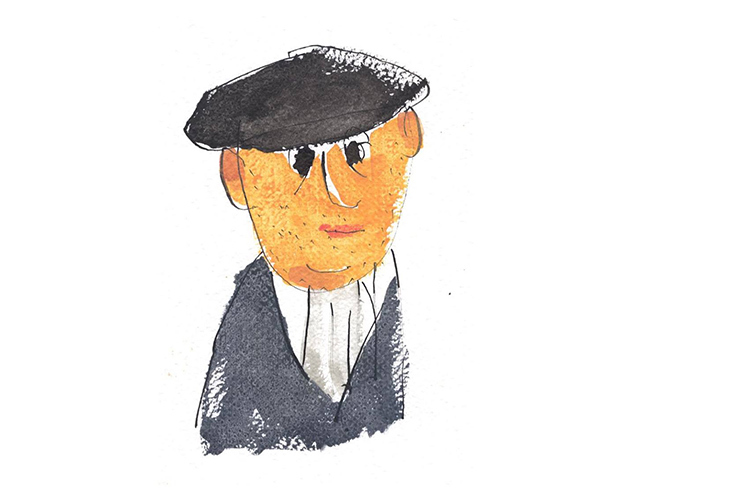
The death of a wonderful artist Vladimir Radunsky is a huge loss for art. Radunsky is known primarily in the world of book publishing and is considered one of the best artists of children's books. Most of his work was intended for large American publishers. In the United States, he had a rather large circle of connoisseurs (both among children and among adults), but he was active and beyond his main specialization - he made wonderful exhibitions, designed performances, wrote, etc. These "side aspects" of his work are important. They outlined a wider circle in which children's books invariably retained the central position. Involuntarily arose that, having worked for adults, Radunsky returned to where he felt as comfortable as possible.
Of course, children's books “fed” the artist, as once children's literature “fed” Oberiuts, Chukovsky, Schwartz and others. By the way, it seems to me that their departure to children, as in the case of Radunsky, is not explained only by material and ideological reasons. In a situation where the culture becomes unnecessarily ideologized or subordinate to the market, the departure to children is a form of protest, and a form of reflection over diseases of the “adult culture” with its unbearable seriousness, pathos or commercialization.
Radunsky reminded me of Peter Pan Pan or Oscar Macerata, the hero of the “tin drum” of Gunter Grass, - literary characters who refused to grow up because the “adult world” is unbearable for them. But the very reluctance to adjoin today's cultural institutions (museums, galleries, collectors, etc.) is partly a conscious challenge. The experience of Radunsky reminds me of a passion for children's art, the experienced Pablo Picasso, who searched in children lost by culture of directness and spontaneity. Picasso once noticed about the children: “When I was at their age, I drew like Rafael; I needed my whole life to learn how to draw how they are. ” In 1969, Picasso created an “artist and child” - a picture in which the difference between a child and an artist was minimized.
Radunsky constantly stylized himself under the child and a little under the clown (his beloved character). He was a real dandy, but the dandy, in which the clown and children's came to the fore. Everyone who knew him is remembered by his funny hats, berets, glasses and so on. And in the image of such a clown, he appeared on the pages of his books. Many years ago, he and his family left New York, where we once made friends with him, to Rome. Of course, the beauty of Rome played an important role in this decision, but it was necessary for me to realize: it was a flight from publishing corporations, galleries, curators to a provincial and still archaic world, poured Fellini.
Thinking of Radunsky, I recall Jean Dubuff, a collector and propagandist Art Brut , created by mentally ill and children. Dyubuffe early imbued with contempt for art institutions and saw in drawing children an antidote against those cultural cliches that are inevitably related to state ideology and normativeness. Today, culture - in any case, in the West - is so closely connected with the market that the children turn out to be an unexpected bastion of resistance. It was not without reason that Baudler said that "a genius is a clearly formulated childhood endowed with mature and powerful organs necessary for him for self -expression." In this sense, a genius, like children, literally opposes the “culture” and its norms.
 © Vladimir Radunsky
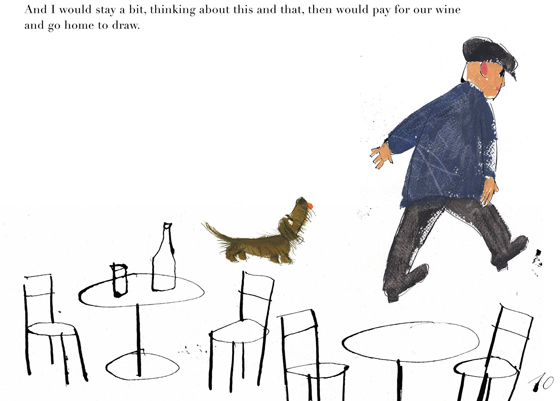
The characters of Radunsky - and his person herself - embody such resistance. But this is the resistance of the frivolous, cheerful, absurd dull rationality of the predictable. His characters walk strangely, jump and fly, fall, even fall out of the motor skills of "normality". Radunsky incredibly honored his friend, architect Alexander Brodsky, in which he saw the ideal of the artist. Architecture - art, probably closest to money and power - in Brodsky’s unusual buildings, was a challenge to the notorious “quality of design” and the geometry of order. Everything here is a little fantastic, artisanal and inclined. But the whole world of Radunsky drawings is a challenge to order, vertical and horizontal normative. He worked a lot to give the thoroughly thought out the visibility of random, improvisational, not handwriting - but handwriting, not worked out, but a sketch, sketch. Therefore, his work is permeated with lightness, foolishness and joy. Where modern design erases the last traces of the human, replacing their ideal computer graphics, the arabesque of the human hand acquires special significance.
There is one quality of the works of Radunsky, which seems to me the most significant. This is their ability to create worlds. In this case, I am talking about "worlds" in the broadest sense. Once Herciting once said that time (eternity) is Aion is a child playing in bones (or checkers). The world is deprived of a plan and morality, it constantly creates and destroys, just as the child plays. Nietzsche saw in a Heraclitian child creating the world, an analogue of the artist. But behind this metaphor is a deeper meaning.
Radunsky has a wonderful book about Einstein, which creates the theory of relativity because he is capable of, like a child, to think of the whole totality of the universe as an amazing game of forces, mass and energy.
The German phenomenologist Oygen Fink wrote a book about the phenomenology of the game, the ideas of which are quite applicable to art. Fink wrote that the world does not exist as a certain total that has meaning and foundation. The world, however, is necessary because it is extracted from it and are things to us. Like a magician, the world makes us visible and significant. But the very incorporeal and meaningless world manifests itself in its integrity only through the game. The unreality and groundlessness of the world is the game in which we realize our own freedom.
It seems to me that such an understanding of the game is easily attributed to the work of Radunsky - the creator and manipulator of worlds and freedom. Contemporary art constantly reflects on the fragmentation of the world found in strange collages, assemblies, heterogeneous collections, installations, interest in ruins and melancholy collecting memory fragments. Some installation masters, such as Ilya Kabakov, try to collect from these fragments the fiction of a holistic world. It is no accident, by the way, Kabakov and Pivovars worked a lot in a children's book illustration. It is precisely against the background of this melancholy, allegorical (as Benjamin would say) universal fragmentation you begin to fully feel the life -giving power of the game in Radunsky. His game is theatrical as the theatrical gesture of a magician who gets a white rabbit from the cylinder. The plastic of the characters is rooted in the bodily experience of the artist himself, eccentrically inhibiting his world . And everything here - people, animals, cars, plants - plays and in this game is fiction in which the lost integrity appears. There are no ruins and fragments, sorrow and nostalgia, but there is absolute freedom of unpredictable, without which there is no happiness.