
Translated material
Suppress and obey
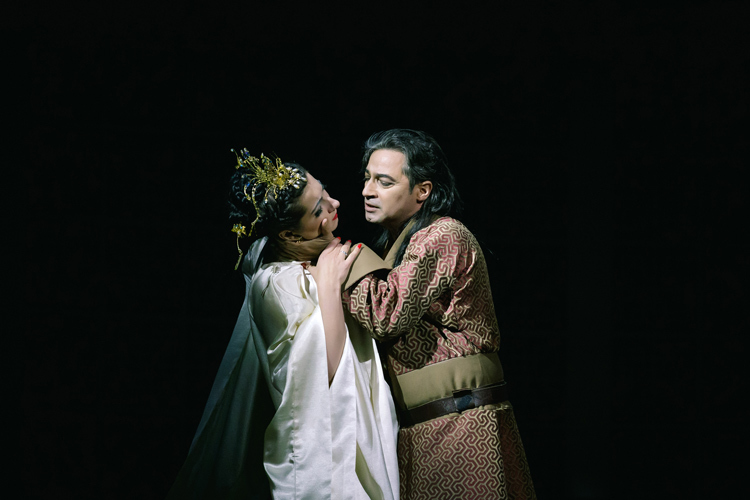
What's wrong with Kalaf? How did it happen that the Puchchinievsky hero, who 30 years ago, in Bohemia, warmed his hand with a fragile mimi, now strives for a woman obsessed with the ideas of violence and revenge?
The director Jean-Romen Weserini gave his answer to the Urals-Opera: his production “Turandot” opened a new season in Yekaterinburg last week. One of the country's leading musical theaters, actively and boldly updating the repertoire, warned immediately: it is not worth waiting for shocks and experiments. In return for the “longing” that left the repertoire, another Puccinievsky performance beloved by the public was needed.
The calculation is understandable: “Turandot” is an unconditional bestseller, the last breath of a large opera style of the 19th century. It was created in the early 1920s and therefore, of course, captured the disturbing flashes of the new musical aesthetics. Puccini died without finishing the score, and there is a share of mysticism in this: his Turandot and the finale, the franco Alfano added, shares not only the musical, but also a clear dramatic seam. Too illogical the simultaneous transformation of a tyrannical cold princess into meekness itself. Alfano is unlikely to be to blame - he acted according to the sketches of Puccini. But it is difficult to resist the assumption that it was this unmotivated of the denouement that prevented the composer from ending the opera.
For soloists, the execution of the Turandot is complicated by the monstrous composition of the orchestra: along with softness, volume and lyrical fluidity, it requires incredible power from the voices - a rare combination, but worthy of September 15 Zoe Cererina (Turandot), Paulo Lardocene (Kalaf), Elena Dementieva (Liu).
 © Olga Kerelyuk
On the stage, everything should be - as it should have happened since 1926, when at the premiere in La Skala Arturo Tuscanini stopped the orchestra where “death pulled a feather from the hands of the maestro”: China, a fairy tale, a cruel princess, a weak -willed emperor, who is exhausting from arbitrariness, who turned into the executioners of ministers - and a madman who is not terrible to put his life and prosperity and prosperity Father, just to answer the riddles of the Turandot and take possession of it.
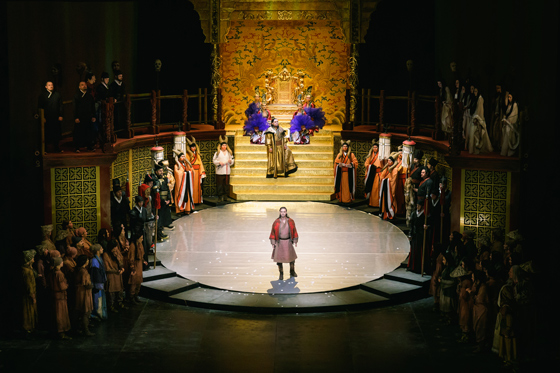
The scenographer and costume artist Dirk Hofaker created a world where poverty and humility are the necessary inside out luxury and power; The semantic nuances give him the light of Christophe Chopin and video projection of Ilya Shusharov. Two symmetrical mobile structures framed the central circle, which has long become a common place for the productions of this story. The designs, closing in front of the advance, depict a great Chinese wall or narrow streets of the city, which became a gloomy dungeon for its inhabitants; That, traveling and turning the back side, turn into the interiors of the imperial palace. Above the stage is a bloody moon that turns pale and dissolves (along the way into a skull-for those who are not enough transparent hints) with the advent of a turandot, dressed in a blood-red outfit closed, similar to a military tunic. A gong will also appear here, with blows into which the madman Kalaf, neglecting the prayers of his father, will declare the desire to solve deadly puzzles.
Not Salome, of course, but not so far.
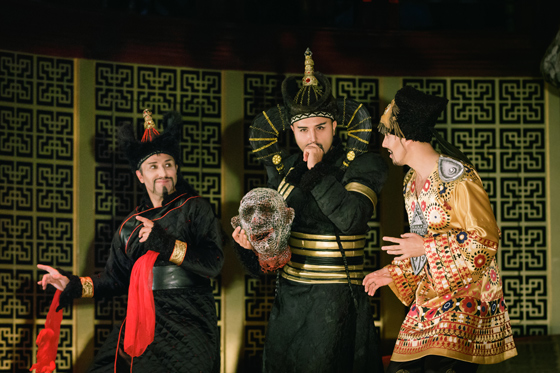
The heroes of the production live in this space according to the routes of the score: obeying the mighty will of the Italian opera, they are focused on solving vocal problems, and therefore, without causing special damage to the whole, they play the mise -en -scenes staticly and predictably, only occasionally discovering the director’s fate. More freely and inventively, Weserini works with the choir and ministers. Pinga, Pong and Panga (Dmitry Starodubov, Sergey Osovin, Vladimir Cheberyak), he turns almost into the heroes of the musical or Disney cartoon. They deliberately entertain the audience: they demonstrate Kung fu techniques, one of them indulges in the dreams of a calm life, romantically swinging on a swing, and they are surrounded by girls with not Chinese, characteristic of trembling fans made of purple feathers. The choir is also musical - dancing and plastic. Several times with him, two shamanic figures appear on the stage in animal skins, ritually “starting” the crowd, which is so easy to inspire the thirst for a bloody spectacle: a fairy tale, and the world where the “Turandot” has been created is already injured by the First World War, even more terrible shocks.
 © Olga Kerelyuk
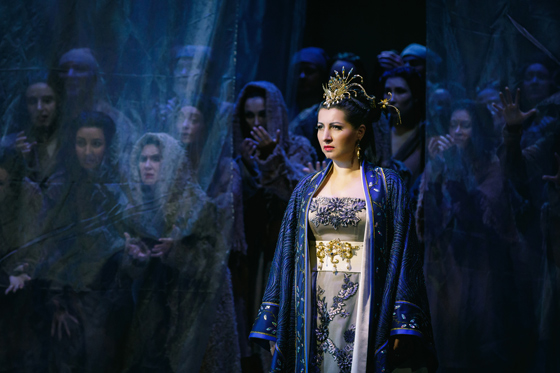
In the last scene finished by the composer, when the only genuinely Puccini heroine - a devoted slave Li - deprives herself of life, saving his beloved master and confusing the cruel princess, the obvious color rhyme of the costumes of Liu and Kalaf is cast into the eyes. He belongs to her world, not at all to the world of Turandot. But this hint will no longer play a role, everything has gone too far.
Having mourned the poor thing, in the next scene he is already next to the culprit of her death. "The Lord of Death!" - He throws a reproach, but at the same time eagerly revels in the aroma of a luxurious robe torn from the turandot. At this moment, already in the musical space of Alfano, the motivation that the director offers Kalafa is becoming clear: it seems that from the very beginning the prince did not see anything human in Turandot, he is attracted to her strength and cruelty. Their first kiss is not his victory at all and not about love at all. Turandot is the first to kiss - eagerly, passionately, before that, putting a dagger to the hero’s throat. Not Salome, of course, but not so far. Yes, and he is more and more clarified by a craving for mortal danger in combination with subordination: he wants to be dependent. And let, having finally learned the desired name, and having received the foundation to execute the prince, Turandot sings about their equality: "Kalaf, you will come to the people with me." He remains motionless: he knelt down, lowered his head and dutifully waits for a decision of his fate.
 © Olga Kerelyuk
The final of the performance, when the “lovers”, canonically stand opposite each other, hold hands, and the world around rejoices, looks like a classic, delighted the happy ending. However, the hypertrophied power of the orchestra under the control of Oliver von Dokhnanya, the rumbling climax, in the prohibitive pathos of which one or the other instrument is, rather, it sounds not to the triumph of love, but the victory of a soulless destructive force that did not at all lose power over the Turandot, and therefore not advice and, rather, the next terrible chapter of history.
The second time in a row, the Yekaterinburg opera opens the season with difficult fairy tales; But if a year ago, Pamina and Tamino flew by flight from the dictatorship of the imposed happiness, now a couple of heroes themselves are in the role of madmen who are ready to cut the world according to their own understanding. The audience thanks the soloists and the topot, the choir and the orchestra for honest and reliable, albeit sometimes uncomplicated-straight, and the staged group-for luxurious costumes, spectacular picture and friendly, unobtrusive directing. The fairy tale, the alarming hints in which the obvious minority is seen, liked it.