
Translated material
Media: Russia modernizes heavy artillery of the Cold War
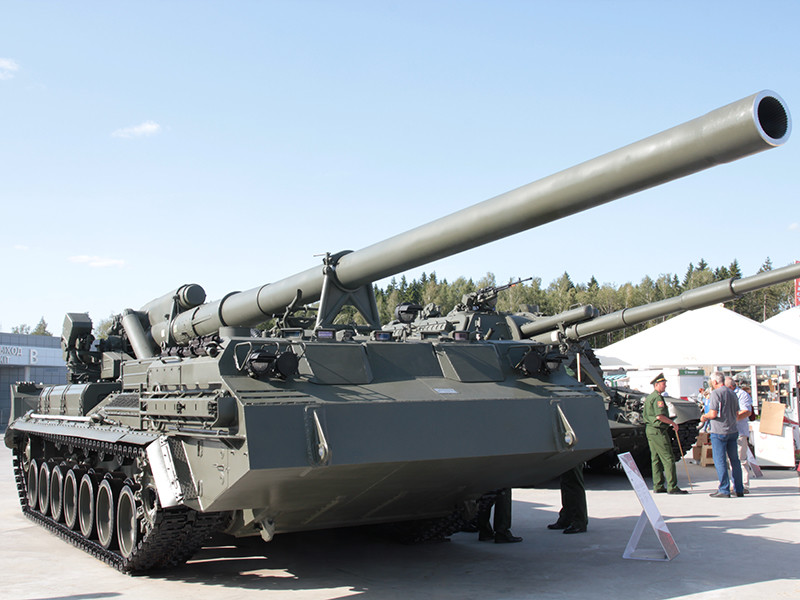
Russia began the modernization of Soviet heavy artillery from the Cold War, which was called the "god of war." According to National Interest with reference to the agency of foreign military studies of the US Army (FMSO), we are talking about 240 mm mortar 2C4 Tulip and the 203-mm GaUBICA 2C7 PION. Both weapons are able to shoot nuclear shells.
After the Cold War, Russia sent most of this large -caliber artillery to warehouses, but now decided to adapt weapons for modern threats. According to one version, such artillery will be used to "wash into powder" of the enemy strengthening. The agency analysts believe that the industrial base of Russia and its financial resources are insufficient for the manufacture of a large number of ballistic missiles, while shells for Tulip and Pion are much faster and cheaper.
"According to some reports, 2C4 is modernized in order to integrate into modern command and control systems and implement improved communication and fire control systems. It is also supposed to update or replace the pipe and mechanism of the return spring," FMSO said. Attempts are made to use ammunition with laser guidance. The 45th artillery brigade and some others are equipped with advanced Soviet weapons.
"Tulip" - Soviet 240 -mm self -propelled mortar of artillery. It was created to destroy fortified buildings, accumulations of personnel and weapons of the enemy. Its operation began in 1972 and it was used during the war in Afghanistan.
"Pion" - Soviet 203 -mm self -propelled gun. It is designed to suppress the rear, destroy especially important objects and means of nuclear attack in a tactical depth at a distance of up to 47 kilometers. In 1975, he entered service, and its production continued until the collapse of the Soviet Union.
Earlier, Deputy Prime Minister Yuri Borisov said that Russia completely replaced the components for military equipment purchased from Ukraine with domestic counterparts, and also completely replaced thermal imagers for armored vehicles bought earlier in France.
He also did not exclude that individual components will be purchased in other countries in the future. "The world is multipolar, the light of the wedge has not converged on the countries of Europe and America. There are very good proposals for the countries of the Southeast region, primarily China, Malaysia, Taiwan, where the main high-tech production are concentrated today," the Deputy Prime Minister said.