
Translated material
What you need to know about Oktoberfest to shine in an conversation: 60 interesting facts from the history of the Bavarian Feast of beer
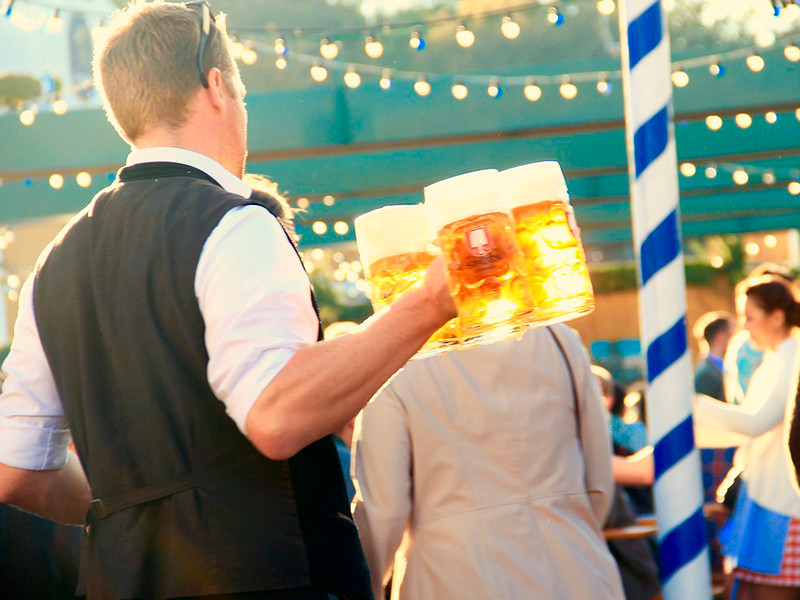
In 2018, the famous Munich "Oktoberfest" takes place from September 22 to October 7. It opens with a solemn parade, the main participants of which are societies and clubs supporting the traditions of national Bavarian costumes, brass bands, as well as carts with beer barrels. Barrels are symbolically taken to the main place of action of the holiday.
Up to ten thousand people in folk costumes from all regions of Bavaria pass through the city. The opening of Oktoberfest is transmitted on television live, and not only the regional Bavarian channel, but also the first German television (ARD) throughout Germany. In the established 14 large beer pavilions-sphats and in more than two dozen small pavilions, up to 119 thousand visitors fit. And the total number of visitors to Oktoberfest in recent years is up to 6.5 million people.
In large tents on working days, beer is poured from 10:00 to 22:30, and on weekends - from 09:00 to 22:30.
Especially for Oktoberfest in Munich, about 7 million liters of beer are boiled. In 2017, the guests of the holiday in two weeks drank 7.5 million liter mugs. And they ate 127 bulls and 59 calves prepared on a spit.
By the way, in 2018, according to the organizers of the holiday, the price of a liter beer mug (Maß Bier) on the Munich "Oktoberfest" will be an average of 11 euros (in the early 2000s it cost almost two times less).
Especially for the holiday, Deutsche Welle has prepared a list of 60 interesting facts regarding the history of the famous Oktoberfest, so that there was something to surprise the interlocutors behind a circle or two of the beer in any corner of the globe.
1. "Oktoberfest" in Munich is the largest not only beer, but also a folk holiday in the world.
2. For two weeks, Oktoberfest visits more than six million people. The 1985 was still record, when more than seven million visitors visited here.
3. The Munich Pivnoy holiday is owed not to the Bavarian national drink, that is, beer, but the wedding of the future king of Bavaria - the Crown Prince Ludwig I and Princess Teresa in October 1810.
4. Even the most avid fans of Oktoberfest are unlikely to know or can call the whole name of the bride without hesitation, but we will still try: Teresa Charlotte Louise Frederick Amalia Saxen-Gildburgusenskaya.
5. The wedding of Ludwig and Teresa celebrated a whole week. The celebrations ended with indicative horse raids on ancient chariots. The venue for these bends was the field on the outskirts of Munich.
On October 6 , 1810, about 30 thousand people gathered on this field - almost the entire population of Munich, in which there were then 40 thousand inhabitants. The folk holiday on the occasion of the marriage of the Bavarian throne of the successor to the glory was a success. The people were delighted.
7. The very next day, the father of the groom, the Bavarian king Maximilian I commanded to name this field in honor of the bride Luga Teresa and supported the idea of holding such races here every year in memory of this joyful event in the dynastic history of the Vittelsbakhov clan.
8. In the following, 1811, the holiday was celebrated for two days in a row. From year to year, the scale of Oktoberfest increased. He liked the Munich to their liking.
9. In 1818, a carousel was first installed for the entertainment of the public on the territory of Oktoberfest. It was a right step in the right direction. Now almost 170 different attractions are operating here: from the Ferris wheel to American slides.
10. For more than two centuries of its existence, Oktoberfest was canceled or carried out very modestly 24 times. For the first time, in 1813, due to the Napoleonic occupation, in 1873-because of cholera, in 1923-due to hyperinflation, and in 1914-1918 and 1939-1945-due to world wars.
11. The traditions of the modern Oktoberfest were somewhere at the end of the 19th century. Then it was decided to start this two -week holiday earlier, in September, capturing only the first October weekend, for the sake of warmer weather.
12. Holes on chariots on Oktoberfest have not been arranged for a long time, but the holiday opens with a colorful procession in the city, in which groups in folk costumes and horse -drawn carts loaded with wooden beer barrels participate. They broadcast this march throughout Germany.
13. In real life, large metal tanks have long been replaced by wooden barrels, and a 250-meter underground pipeline was even laid for the uninterrupted supply of the largest beer tent that contains ten thousand visitors.
14. According to this pipeline, beer is pumped, chilled up to four degrees Celsius, from a huge tank with a volume of 100 thousand liters, installed in the neighborhood, outside the meadow of Teresa.
15. Beer is transported to other tents on tankers with a volume of 3 thousand to 12 thousand liters. For one flight from the brewery, such a car may need to be up to nine o’clock to get to the place, get through the crowds of visitors and pump the strategic cargo into local tanks.
16. In total, almost one and a half large beer tents and more than two dozen smaller pavilions are installed in the meadow of Teresa for the “Octoberfest”.
17. All beer tents and pavilions of Oktoberfest in Munich can accommodate almost 120 thousand guests at once.
18. Although Oktoberfest is considered an international holiday, the share of foreign guests is no more than 20 percent. Most are Bavarians, residents of Munich and the surroundings.
19. Among foreign visitors are guests from the USA, Great Britain, Austria, France and Switzerland. According to the organizers, last year guests from 65 countries visited here.
20. One billion euros - about the same time in Munich in two weeks, visitors to Oktoberfest on beer, fried chickens, sausages, hotels, taxis, public transport, purchases, souvenirs, entertainment, other priority needs and other excesses.
21. About ten years ago, certain entrepreneurs wanted to launch a bus shuttle between Luga Teresa and the largest Munich brothel, but at the last minute the authorities decided not to coordinate the route, that is, they did not give permission.
22. We can’t say anything about prices in brothels, but tariffs for hotel rooms in Munich during Oktoberfest are almost half. Last year, they amounted, on average, 280 euros per room.
23. It is forbidden to hold advertising actions and lobbying events on the territory of Oktoberfest. In 2006, Paris Hilton violated this ban. She tried to spoil the sparkling wine in aluminum banks, for which she was declared on Oktoberfest Persona Non-Grad.
24. Of course, the real champagne on Oktoberfest, if desired, can also be found and drink (140 euros per bottle, simple sparkling - 40 euros), but from glasses, and not from aluminum cans. Beer is poured into weighty liter circles - Maß or Maßkrug.
25. For Oktoberfest, a special variety of beer is boiled in Munich, a little stronger than traditional. One liter mug of such a beer, according to local experts, is equivalent to eight piles of Shnaps. The piles, however, are different. We will not check.
26. The record amount of beer guests of Oktoberfest drank in 2014 - 7.7 million liters, that is, on average, 1.2 circles per brother ... sister, other family members and other visitors.
27. In 2018, a liter beer mug on Oktoberfest will cost from 10.70 to 11.50 euros. In 2002, when, instead of a German brand, they began to pay a single European currency, the circle cost 6.30 - 6.80 euros, and in the very distant 1971 - less than three marks.
28. After the foam is a beer, demand a beer of beer? The permitted short -leaf on the liter mug is 100 milliliters on Oktoberfest. Consumer rights defenders are trying to fight against this generous rule, calculating that in two weeks visitors pay 5.4 million euros for an incomprehensible beer.
29. In Germany, they still recall the words of the former Bavarian Prime Minister Gunter Bekstein, who in 2008 in serious said that after two liter mugs of beer, slowly drunk in six to seven hours, it was quite possible to go home driving the car.
30. Very important information not only for visitors to Oktoberfest. In Germany, there is a border for drivers - 0.5 ppm. In the case of an accident, an aggravating factor is a level of 0.3 ppm of alcohol in the blood.
31. Almost every second visitor to Oktoberfest gets to the meadow of Teresa by trains - about three million passengers. Only on city trains (S -Bahn) - 100 thousand people per day. The DEUTSCHE BAHN schedule at this time includes about 500 additional compositions.
32. Bavarian - a difficult language. When you meet the word "wiesn" during Oktoberfest, do not be surprised: this is not a typo, but a Bavarian version of the German word "meze". "Go to the meadow" (Auf Die Wiesn Geehen) means "go to Oktoberfest."
33. A total of about 13 thousand people work at the festival - waiters, bartenders, cooks, guards, attractions operators and so on.
34. Each waiter passes for a shift, on average, about 10 kilometers. On the working days of the week, it spreads about 100 liter mugs of beer, on weekends - up to 300 mugs. Plus other drinks and different dishes like fried chickens (10-12 euros each) and sausages (7-8 euros each).
35. At a time, waiters usually spread about 10-12 liter mugs. An empty mug weighs at least 1.3 kilograms (some - more massive) + a liter of beer each = up to 27.6 kilograms.
36. The champion of raising and carrying out weights among the waiters at Oktoberfest for many years has been Oliver Stryumpfel for many years. In 2017, he broke his own record. The official jury counted 29 full circles weighing more than 70 kilograms. True, he knocked over two on the way.
37. The average earnings of waiters in two weeks of hard work on Oktoberfest is about 5500 euros, including tips.
38. Since 1956, Catholic worship has been held on Oktoberfest, first of all, for working here. Service participants can not only pray, but also baptize children, and children can accept the first communion.
39. Many employees of firms and attractions working at Oktoberfest have been living here with families for several weeks. According to the laws, in the school season, children are obliged to attend classes, which they do. About 40 such students temporarily go to two closest schools.
40. The German postal concern Deutsche Post opens a special post office on the meadow of Teresa. In two weeks of Oktoberfest, about 130 thousand cards, letters, parcels and parcels are accepted and processed here. In the latter, souvenirs are usually sent.
41. In order to reduce the amount of garbage, Oktoberfest was abandoned several years ago, after which garbage volumes were halved - about 120 tons.
42. A holiday that is attended by six million people needs toilets. In total, on the territory of OKTOBERTEST there are about 900 pussies and almost 1000 seats in the booths that visitors of all sexes can use.
43. Those who are trying to celebrate the need in the wrong place, at Oktoberfest awaits a fine - up to 1000 (!) Euros. If you are lucky, only 100 euros. The police impose it, you need to pay right away.
44. On Oktoberfest there is its own first aid provision. Here, up to 15 doctors and 150 offices from the Red Cross are on duty here. In total, during the holiday - about 2300 people. Most work on a voluntary basis.
45. In 2017, about 7,000 guests turned to medical assistance during Medical help during Oktoberfest. Half of them were helped by the orderlies, the other half required the help of doctors, including emergency surgical - in 1883 cases.
46. The record among medical brigades was set in 2017: 28 outputs for calls for shifts and 32 kilometers on foot through the territory of Oktoberfestay with emergency glass backpacks and a gurney.
47. The number of patients with severe alcohol intoxication during the 2017 Oktoberfest amounted to 670 people, of which ten adolescents under the age of 16 years. Most of these patients were able to leave the first-aid post after one to two hours.
48. The bunches of the Oktoberfest drinking too many are delivered to the medical unit on special catals protected from prying glances with yellow covers. The people are called "bananas" ("Banane"), "Meadow taxi" ("Wiesntaxi") or "Gelber Sarg").
49. Some who have drunk visitors and visitors, on joy, throw off their clothes, scattering the wardrobe items in different directions - do not yet remain what the mother gave birth to. On Oktoberfest, disposable pants are displayed for such grief explosions.
50. Although the mug can be bought in souvenir kiosks, some visitors to Oktoberfest are trying to take their own out of the tent for free. Approximately 120-130 thousand times during the holiday, such attempts are prevented by the guards, in some years this indicator runs out for two hundred thousand.
51. In two weeks, visitors to Oktoberfest eat about 120 bulls and 60 calves prepared on a spit. Pork sausages - about 350 thousand, fried chickens - twice as much, rudders - about 80 thousand. The numbers change from year to year, but the impressive scale remain.
52. During the last holiday at Oktoberfest were lost, five children and fourteen teenagers were found and returned to parents. In recent years, the number of such cases has been reduced due to the spread of mobile phones.
53. In 2017, more than 4,000 things were handed over to the Oktoberfesth Bureau, among them - 1300 documents, 620 clothing items, 600 wallets, 520 phones, as well as ligaments, umbrellas, bags, cameras, and so on. About 1000 of them managed to return the owners.
54. Among the unusual things handed over to the Oktoberfest finds in 2017, there are two rowing oars, a children's car, two devices for measuring the level of blood sugar, a crutch, two engagement rings, one automobile license plate and a tenor Gorn.
55. Not all inhabitants of the Bavarian capital are delighted when they hear about Oktoberfest. About 27 thousand Munichs even specially take a vacation for this time to leave the city.
56. The number of tents for the "Oktoberfest" is limited. The installation license costs two million euros, but this permission can only be obtained if one of the organizers of the holiday decides to leave Oktoberfest. Waiting time is about 20 years.
57. "Oktoberfest" is considered officially open after the current Oberburghmister Munich will uncorn the first 200 -liter barrel - it will bob into it with a special wooden hammer for a crane for a beer. For the first time, such a ceremony took place in 1950.
58. This was the fastest done by Christian Ude (2005, 2008, 2013), as well as Diter Raiter (2015, 2016) - two shock workshops. Most of the blows - 17 or even 19, to drive a crane, was required during the first such ceremony in 1950 Thomas Wimmer.
59. Having driven the crane and filling the first mug, even without waiting for the foaming, Munich Oberburghmister must notify the audience about this, shouting in the Bavarian dialect "O'ZAPFT IS!" - "Wrapped!". One mayor in the 1970s disgraced, confusing the vowels: "I'ZAPFT OS!" This is still remembered.
60. In 1896, 17-year-old Albert Einstein worked in the meadow of Teresa during the preparation of Oktoberfest. The future Nobel Prize winner screwed the bulbs here, which was supplied by the company of his father, Hermann Einstein, one of the pioneers of electrical equipment in Germany.