
Translated material
Concrete hopper of memory
The next experimental section “The Art of Exposition” is devoted to the successes and unusual solutions of modern exposition design. Building the problem from the facade and the inside, we plan to invite critics, architects, artists and curators to the dialogue and will be glad of feedback and oncoming sentences. The art historian, curator and teacher Sergei Khachaturov agreed to open the discussion, who spoke about the museum-theatral project “Store Eternally” in the St. Petersburg Central Military District “Manezh”.
The exposition-performance “Store forever” is a successful attempt to overcome the Putes and the show of the usual exhibition project in order to turn the exhibition into what the theater is called immersive action. Immersion, as you know, implies radical sympathy, complicity, when the viewer is completely freed from the instinct of consumption and becomes the co -author, director, designer of the created performance. Let us pay tribute to the leaders of the four suburban St. Petersburg palaces-museums, the former imperial residences: Gatchina, Peterhof, Tsarskoye Selo, Pavlovsk. Together with the leadership of the Manezh Center, they decided to celebrate the 100th anniversary of the nationalization of former residences and turning them into public museums in an unusual way. Categorically abandoned the presentation of the collections.
The reason is understandable: I don’t want to do in the St. Petersburg arena of the Moscow forum “Intermuseum” ... After all, lonely seized from context are masterpieces (paintings, sculptures, furniture), installed in the boxes of the “EXPO” or antique salon, become blessed and extremely fake, adjustable. In the arena decided to arrange everything on the principle of the exact opposite. They invited people of the new theater and music: the Glavrezh BDT (Bolshoi Drama Theater) Andrei Mogeliy, the Great Alisa Freindlich, composer Vladimir Rannev, artist Vera Martynov. They were just so radical that the dummies of the performance were presented as the original and forced to believe in this authenticity, to empathize with it.
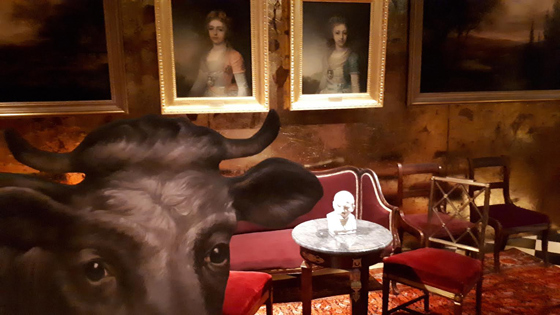 © S. Khachaturov "Store forever." Fragments of the exposition. Director Andrey Mighty. Artist Vera Martynov
At the entrance to the long corridors for a heavy golden curtain, headphones give you. In them you make a trip around the perimeter of the halls of a huge arena. In the headphones sounds so familiar, with the noble hoarseness of Alisa Brunovna Freindlich. She reads a diary collected from the records and biographies of museum employees - the Guardians of Pavlovsk, Gatchina, Peterhof and Tsarskoye Selo. Chronology - from 1918 to 1945. Hell in general. At first, the story was expelled (the October Revolution), in 1941, physically destroyed (fascist occupation). However, the paradox is that the memories belong to those people who, contrary to hell, defended and retained memory and culture, gave hope and freedom to communicate with history today. As an example, you can cite the records of Anna Ivanovna Zelenova. At the end of the summer of 1941, at 28, she became the director of the Pavlovsk Palace-Museum. It is incomprehensible to the mind how many things in the blockade, thanks to Zelenova, were saved, evacuated ... And most importantly, how the palaces lay among the burned skeletons, chopped into small chips, Pavlovsk artifacts were restored. And not like. And in accordance with the highest requirements of scientific restoration ...
So, the script itself involves not a linear museum movement on the stairs of evolution and education, but a certain dramatic stage conflict. On the one hand - the onset of darkness, chaos, entropy. On the other hand, the resistance to them living, suffering, endowed with an inexplicable sense of responsibility of people. The traditional museum and exhibition presentation will not pull such a conflict. You just need to abandon the ambitions of the exhibition in favor of the theater. Which was done. There are almost no original. However, copies and props work as good actors on stage.
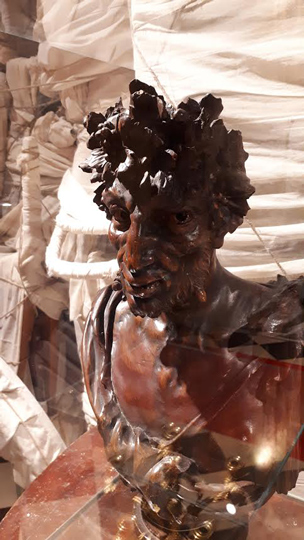 © S. Khachaturov "Store forever." Fragments of the exposition. Director Andrey Mighty. Artist Vera Martynov
Thanks to the accurate ideas of the mighty, Martynov, Rannev, this post-dramatic theater is created without the participation of actors (except for the voice in the headphones), but with the help of the main character of the-lice-space. At the beginning of the path, the author of the collective diary talks about the goals of creating a new public museum. I really liked the words "learn to hear things and help them." “Hear things” ... I understand this metaphor like this: emotionally, sensually experience the space created by objects, to be in a situation of communication with acoustics that arises around them, with those emotions, the order of words and meanings that things determine ...
The traditional museum and exhibition presentation will not pull such a conflict. You just need to abandon the ambitions of the exhibition in favor of the theater.
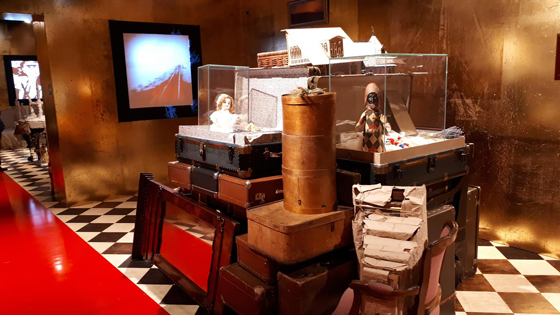
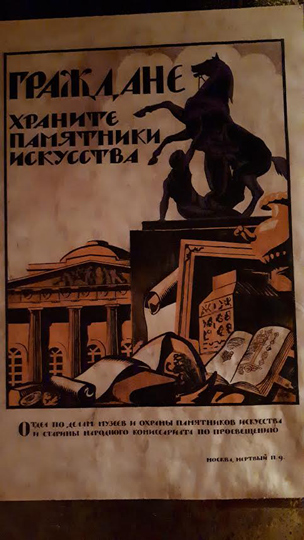
It is on this principle of “hearing of a thing”, its reproaches, suffering, groans, diseases and hopes that the composition “Store forever” is arranged. Once behind the Golden Porter, we wander like in the back of the theater. Technical zones, reinforcement, braids of wires, construction modules, props. Then the space is aligned and opens into a long corridor with shabby walls, glued with gold foil. First, the subject-spatial environment is somehow trying to hold on to the comme il faut, to create a semblance of comfort in the golden caskets of palace bedrooms and children's. However, the furniture is shifted to the center. The composition is violated in the composition. A strange puppet-ginge box appears, where instead of puppets is a royal family. And the words about Kerensky, the temporary power of the Bolsheviks, patience are replaced by news dedicated to the decrees of nationalization, Lunacharsky and Lukomsky, excursions with the trapping parquets of soldiers.
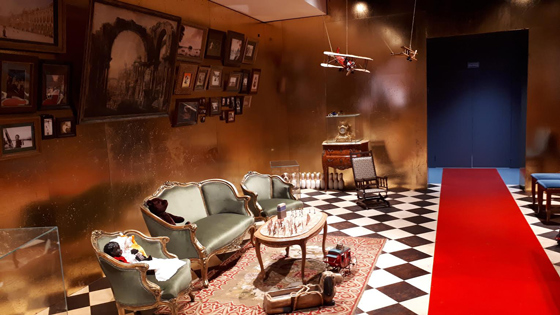 © S. Khachaturov "Store forever." Fragments of the exposition. Director Andrey Mighty. Artist Vera Martynov
Thoughts clearly break through this information stream about the need for methodological work with funds, inventory, the return of the historical image, changed by the latest owners of the palace ... Lunacharsky, Lukomsky, Taleporovsky and other great Soviet museum workers of the first years of October were actually the embodiment of the dialectics of the Marxist method. Their credo is not to flirt with often with ignorant new owners of life, not to indulge in their low tastes, but also not to turn away from them squeamish and spent. It is necessary to educate, armed with the exact method and focusing on the problems not highly specialized, but general. On the example of palace collections, to study the social plastic of the past, learn to understand how and what the nobles lived, and in this way to attract a new class to the collections, to motivate it with complicity in a large performance of life. The “Museum of Life” at the site of the residence implied not to be belittled by artistic treasures, but a comprehensive presentation of all aspects of their biographies, determined by the subjective will of the hosts and builders - and the objective conditions of the social and artistic life of the past. In particular, V.N. Taleporovsky considered it important in the Pavlovsk Palace to chronologically combined the demonstration of the collection of original furniture and paintings with the history of the journey of Pavel Petrovich and his wife - Grand Duchess Maria Fedorovna abroad in 1781-1782. The “equipment” of Pavlovsk by the masterpieces of art is largely owed to this journey.
 © S. Khachaturov "Store forever." Fragments of the exposition. Director Andrey Mighty. Artist Vera Martynov
Alas, by the end of the 1920s, vulgar sociology and a dummy type of presentation of biographies, collections and a self-sophisticated historical process won in a museum business. So the love of the non -wound attractions of today's consumer museum shows that do not work with meanings, but play gawing with instincts of a poorly educated, but well -manipulated crowd, inherits just such a totalitarian rather than a Marxist topic.
The museumification of space by the creators “Store forever” is also presented dialectically. Things are alienated from their natural existence. They are closed. Fold in a heap. At the end of the enfilade in the Gignol box, there are dead dolls. The floor is red. Many busts of Lenin. Anfilad is increasingly mutating the image of the bunker. The gilding turns into rust.
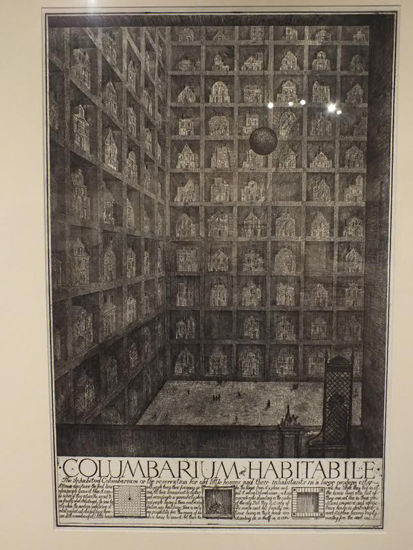 Alexander Brodsky, Ilya Utkin. Columbarium habitabile. 1989/90. Etching
One strong image is recalled - the etchings of Alexander Brodsky and Ilya Utkin with a recent exhibition dedicated to imaginary architecture - “Hypnosis of space” (GMZ “Tsaritsyno”). The curator of the exhibition - the author of this article - also tried to expand the circle of emotional communication with the objects of history, to make a dialogue with them more modern. On Brodsky -Utkin’s etching, a giant concrete cube is depicted, in which, like prisoners in the cell, there are surviving houses of past eras. In the wake of the new construction boom, they were brought here by the authorities with a “humane” decision to give the owners the opportunity to save a piece of old life. If the owner and his family continue to live in the house of their youth - on a shelf in a concrete box - a house is alive. As soon as for various reasons, the house is empty, a cast -iron ball demolishes it, making room for a new “exhibit”. In the totalitarian regime, the artifacts of the past and their keepers - museum employees - are quite accurately associated with these houses and owners, prisoners of concrete shelves.
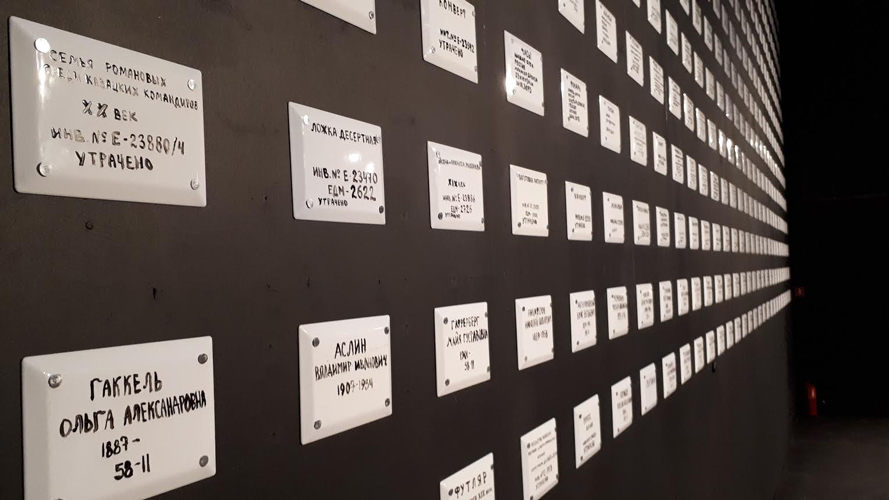
The theme opened by the tandem Brodsky - Utkin, by chance, rhymes with the plastic solution of the alienated corridor space of the exhibition. It is quite logical that the memory wall with ceramic signs includes inventory numbers of deceased objects and brief biographical certificates about their keepers.
 © S. Khachaturov "Store forever." Fragments of the exposition. Director Andrey Mighty. Artist Vera Martynov
The transformation of life in palaces into a conveyor of pleasures for the working masses, likening the visit to the estate of a walk in the Central Bank or at VDNH are remarkably sarcastically represented in the rest of Vladimir Rannev. On many screens surrounding the bronze statue of Venus, heroes from Soviet magazines and posters flash: pioneers march, physical education facilities train, acrobats build pyramids, Komsomol members eat ice cream ... All of them are glued to ancient landscapes and manor enfilads.
In the final exhibition of Anfilad War, the visitor walks not in the bunker, but in the ruin.
The seams of different spatial coordinates very clearly emphasize the dissonance, puppet, fakeness of such paradise. The music with a collage of different acoustic fields is great, from the vanguard to the cultivate pop, sounding from loudspeakers in cultural parks. Again, parallels with the exhibition "Hypnosis of space" are planned, where a separate act of the program was a small projection theater on different panels. He imitated the puppet and represented the history of the philosophical systems of the 18th century and postponement in the version of the booth folk action (director Andrei Silvestrov, artist Stepan Lukyanov, composer Iraid Yusupov, artists of the workshop of Viktor Ryzhakov). In both cases, ranger fun requires complex reflection on the theme of philosophical coordinates of space and time and our places in them.
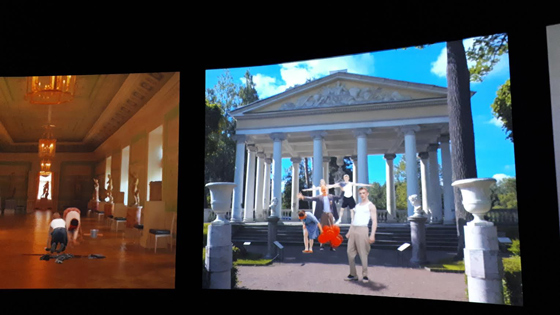 © S. Khachaturov Fragments of a circular video panorama-opera-buff Vladimir Rannev
In the final exhibition of Anfilad War, the visitor walks not in the bunker, but in the ruin. In wooden roughly knocked out corridors are boxes and windows. Behind glass and boxes are visible parts of packed sculptures. In one room there is a porcelain service for a lush feast. In the headphones, the cracked voice of Alice Freindlich talks about life and hunger in the days of the blockade.
In the last room - a large field, a pool with chips - crumbs that disappeared into the fires of the war of things. The scolded parts of excellent architecture and sculpture. And over the ashes - the heroine's voice telling about the readiness to live for the sake of saving collections and keep them forever.
Of course, a given tough scenario of interpretation of the material even more leads away from the topic of the exhibition to the topic of the performance. I would allow myself to say that in the last part, the tragic narrative is mounted solely in order to mobilize righteous anger and horror before the disasters of the war.
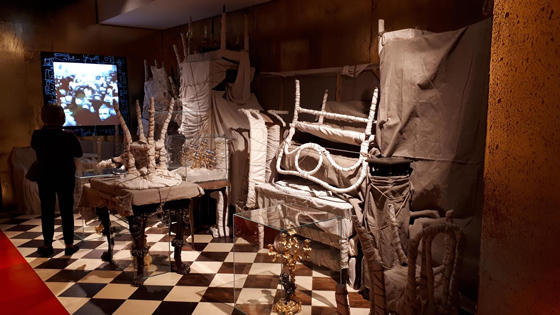 © S. Khachaturov "Store forever." Fragments of the exposition. Director Andrey Mighty. Artist Vera Martynov
The dialectical principle is slightly failing and gives way to the poster. For a volumetric picture, for example, it is precisely the historical facts that I am lacking - evidence of how exactly museum workers saved that it was impossible to save. What first aid was provided to what they managed to do in the then incredible conditions. An example is the diary of Anna Zelenova in 1944, the time of analysis of the rubble of the Pavlovsky Palace: “Work on the consolidation of artistic decor sculptors and painters led with shaky step -ups. Details that did not give in to fixation were carefully removed from the walls and placed in special pantries. There they stored everything that was chosen from the wreckage, extract from the breasts of coal and ash. They created a whole encryption system so that the details seized from the palace - and there were thousands of them - did not lose their “address”. Each hall was given a cipher, each wall is a number. Drawn wall deposits fixing the location and number of each part ... "
The conceptual designer of the Heritage Renaissance developed by Soviet museum employees in ciphers, fragments and marks also claims to be a full-fledged performative installation project in the genre of the new museum (anti-) exhibition-performance.