
Translated material
Nicole was re -glued again
Now Armenia requires the resignation of Prime Minister Pashinyan, how until recently she was waiting for his election

On Monday, Armenia saddened the news of the death of Charles Aznavour - an example of mercy, a national hero who did a lot for the country. In Yerevan, his songs sounded at every corner: in a coffee shop and in a cafe with shawarma, in an expensive restaurant and in the square. But the next day, the mood in the city gave way to combat. The city was already covered by another sound, revolutionary - continuous beeps of cars on all streets forgotten from the May Revolution. So the Armenians express their disagreement. So it was in early May-when the Republican Party did not elect Pashinyan as the Prime Minister. So it happened on Tuesday, October 2, and again the republican is to blame. This time, they adopted a law without much hype, blocking Pashinyan’s opportunity to resign. And he is just acutely necessary for him.
The parties of the current prime minister, in order to maintain political weight, are needed for parliament. Now, out of 105 deputies in parliament, the majority make up political opponents of Pashinyan. In May, the deputies elected Nikola the Prime Minister under the pressure of citizens who took to the streets.
But his supporters remained in the parliamentary minority, and Pashinyan has long wanted to prevail this situation, insisting in early elections.
On Tuesday, October 2, Pashinyan at a meeting with reporters stated that the elections should be held this year - in December. The Armenia Constitution provides for such a mechanism: the Prime Minister can voluntarily resign, then the parliament will have to choose a new prime minister within two weeks. If the prime minister is not elected during this time, the parliament will be forced to self -dissolve. Pashinyan hoped to artificially create such a situation through agreements with parties: again, to convince the deputies by the argument "so the people want."
But, as it turned out, the Republicans did not give up their positions - they reacted with lightning speed to Pashinyan's interviews. On Tuesday, the parliament considered amendments to the law on the "regulation of the National Assembly." Minor amendments were planned, but the Republicans faded and added several details to the bill, in principle blocking the possibility of self -development of parliament. So, the cunning plan of Pashinyan.
When the Prime Minister found out about this, he immediately went live on his Facebook page. Facebook in Armenia is the main tool for democratization. Pashinyan called the initiators of the bill "counter -revolutionaries who declared war on their people." But the deputies were busy making amendments - and Facebook, probably, was not checked. In any case, the anger of Pashinyan did not affect their decision. At about seven in the evening, a hasty meeting of the National Assembly took place on Tuesday - and behind closed doors. The journalists were not allowed, the broadcast was not turned on, they voted with raising their hands.
The decision was made by 67 votes “For” - from the Republican Party and supporting it “prosperous Armenia” and “Dashnaktsutyun”. Then Pashinyan opened Facebook again - and called the Armenians to go out on Bagramyan Street, where the parliament building and the premiere’s residence are located.
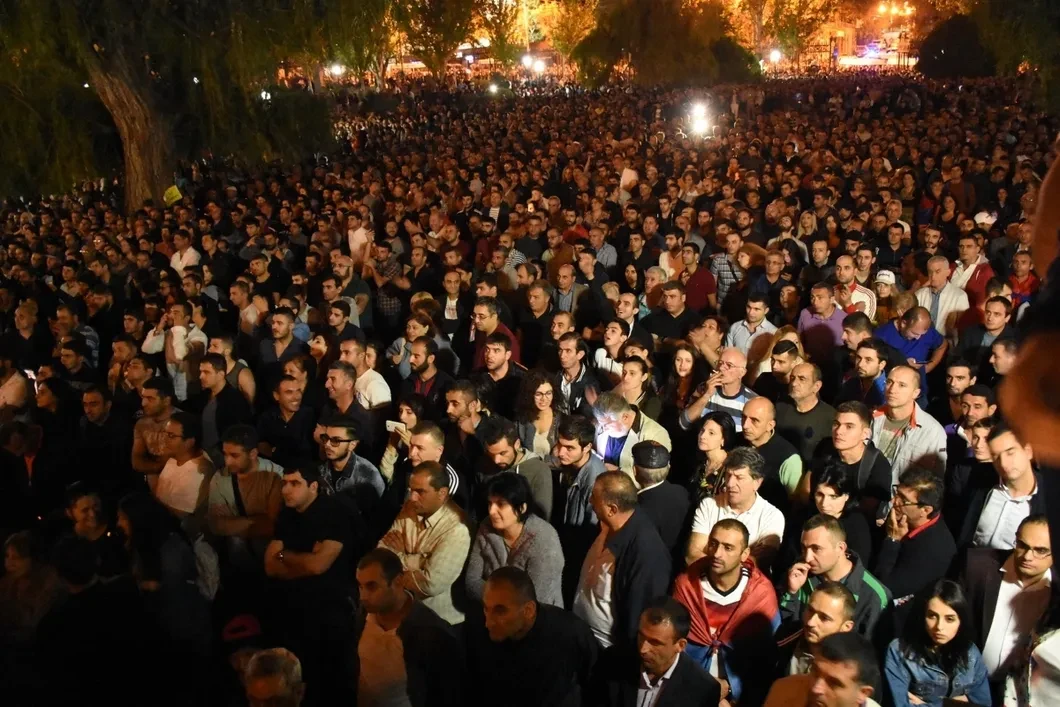
After the revolution, the Armenians are surprisingly easy to climb, and for ten minutes a slim stream of people on Bagramyan Street had to even be blocked for transportation. According to law enforcement agencies, thirty thousand people have already entered the streets at about nine o’clock in the evening. The deputies were blocked in the parliament building.
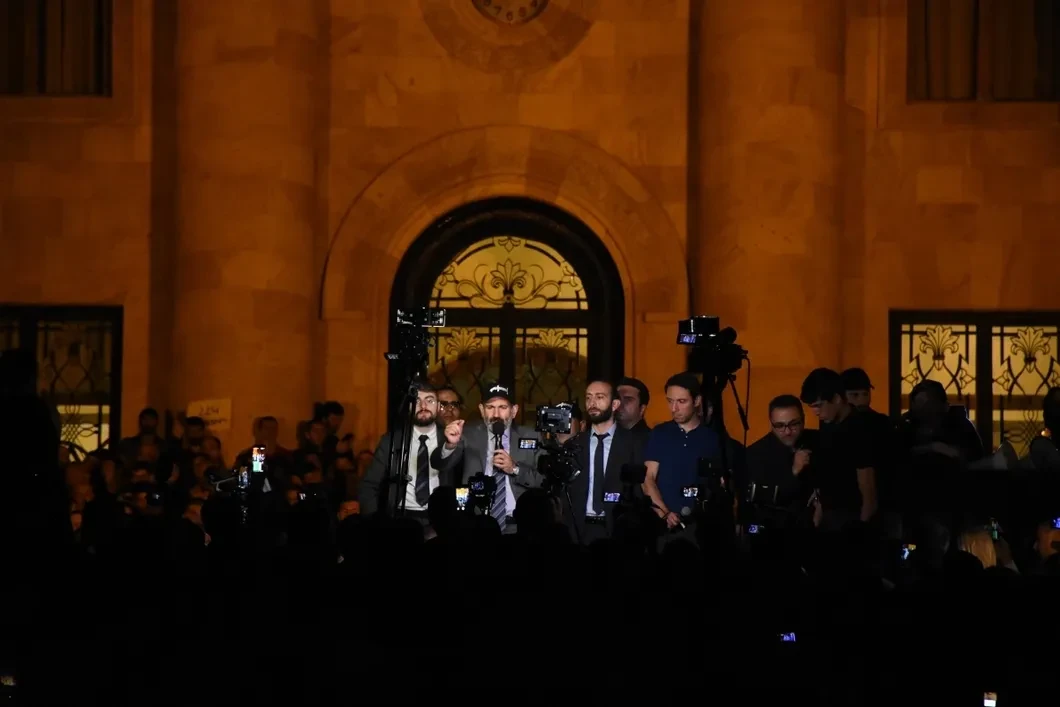
Soon Pashinyan went to the people. Right on the street, literally on his knee, he signed decrees on the dismissal of six ministers who are in parties that voted for amendments. (And the next morning, the president of Armenia Armen Sargsyan envied the decrees.)
All the time until ten in the evening, people crowded at the high fence surrounding the parliament. Since 1999, you can’t just get to its territory, and the same ban has been valid against many administrative buildings of Yerevan. But, for example, on the Independence Day of Armenia, two weeks ago, Pashinyan solemnly opened the gate to the territory of his residence (also on Bagramyana Street, nearby) - "as a sign that power in Armenia will no longer be isolated and divorced from the people."
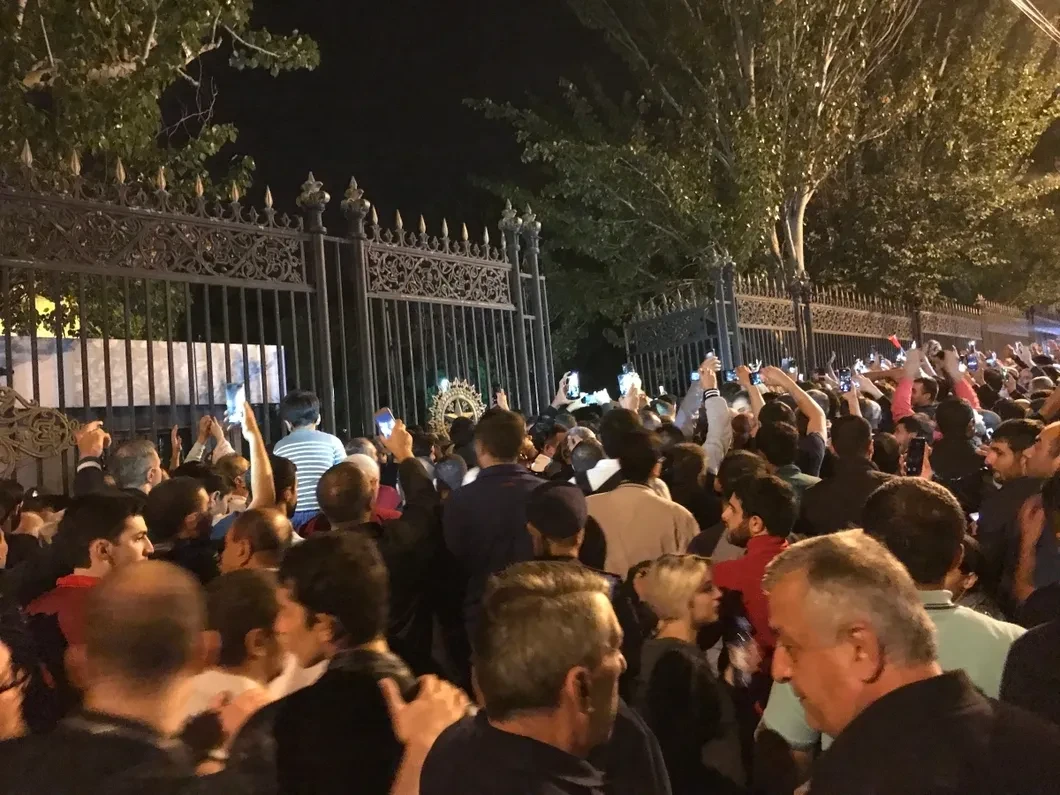
On October second, the second step was taken towards the people (and, apparently, it was made by the guards at the checkpoint) - the gate to the territory of the parliament at about 22.30 opened. People filled a high staircase rising to the entrance, turned on the flashlights on the phones - and turned into one continuous ocean. Someone turned on La Bohème Aznavour.
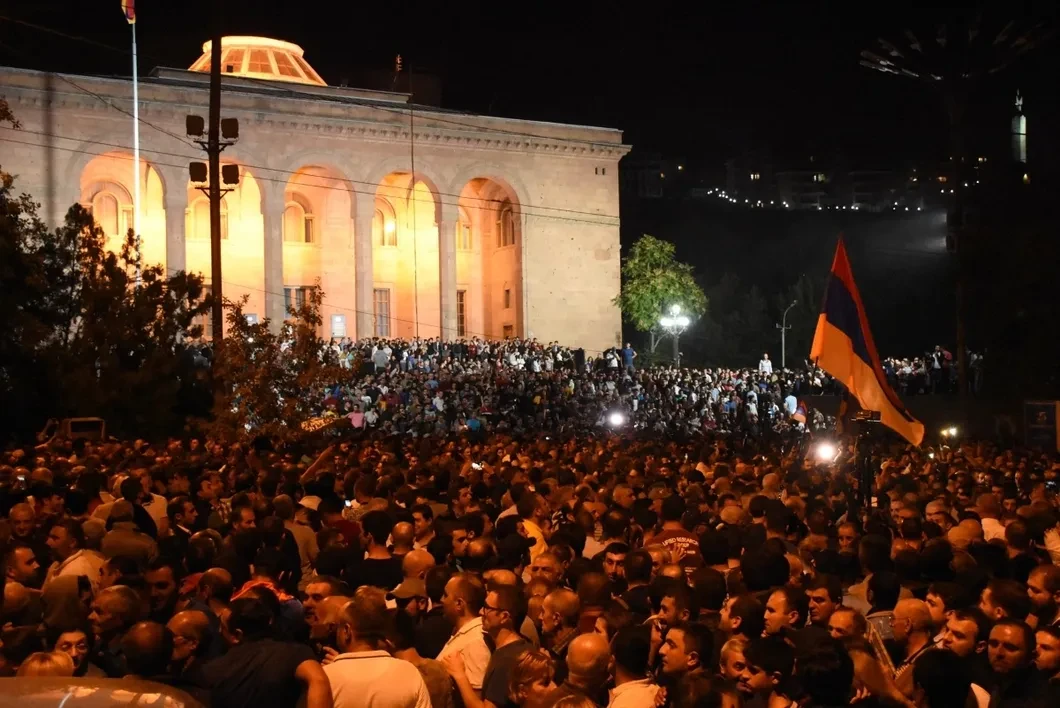
The deputies sat inside the parliament until late in the evening. Pashinyan headed for them - to negotiate. He wanted guarantees that the Republicans and others, in the event of his resignation, did not put forward a candidate from their own, will follow the rules of the game of Nikola.
Far after midnight, Pashinyan went to the crowd and reported the positive results of many hours of negotiations. On this note, reassured Armenian citizens diverged home.
But calm did not last long. The next morning, on October 3, the Republican deputies and others spoke. They said: it seemed to Pashinyan that they were able to agree on something. “The only thing we agreed about is that we have not agreed on anything.” Republicans are ready to go to Pashinyan's terms only if the elections are held in May 2019.
“Republicans think that during this time they will be able to change the layouts and get more votes,” political scientist Michael Zolyan told the “new”. - This is a matter of political survival: if the elections are held in December, it is likely that the Republicans will become nobody. In addition, we are talking about survival in the literal sense of the word. Many Republican deputies have the reason to believe that, having lost their deputy inviolability, they will become defendants in criminal cases.
Now Armenia is waiting for the resignation of Nikola Pashinyan, as he was waiting for his election.
PS
But the gates to the parliament were never closed - now in the park nearby you can not only rally, but just walk.