
Translated material
Literary frost
The "Journal Hall" was closed - the main portal of Russian literary periodicals. We explain why this is bad
The reader judges literature on the result, most often commercial. Tall
circulations are the result. Prizes are the result. Interview on TV channels too. But in addition to the result, there is also a literary process, a living history of modern literature, which was reflected by the portal “Journal Hall” for 22 years. Now on his first page there is an announcement: "The work of the project is stopped, the updates are stopped." What happened?
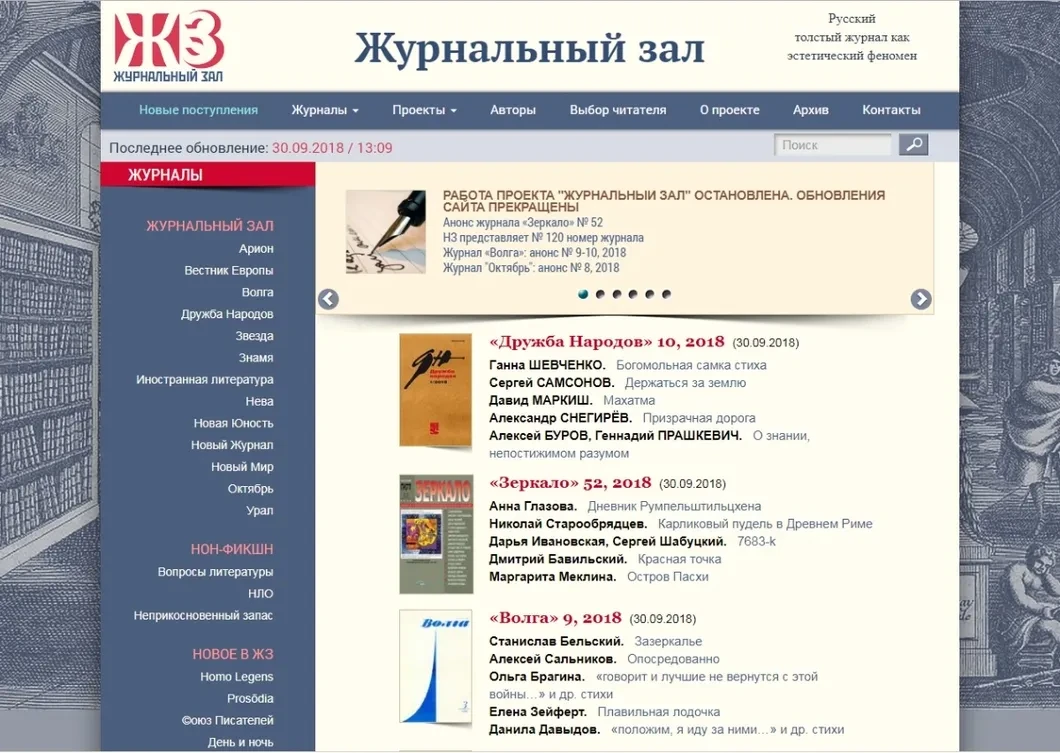
In its format, "ZhZ" is a library. In Lenin, as you know, there is a newspaper fund where all print medias come. And the "Journal Hall" is a literary periodical fund on the Internet. Access to it is free.
Several digits: on the portal 40 magazines, 3822 issues, 21,964 author. Is it a lot or little? It depends on what to compare. On the one hand, so many good writers cannot be, somehow it is not believed in it. On the other hand, on the graphomaniac (sorry!) Portal Poems.ru registered 805 325 authors, forty times more. There is no selection there, and in the "ZhZ" experts are editors of literary magazines. There are no comrades in taste and color, but in literature they at least understand.
About how it all began, says Sergey Kostyko, one of the initiators of the project and its permanent curator.
Sergey Kostyko
curator of the "coffee hall"
-We started working in 1995, on the basis of Agama, which made the Aport search engine, and in 1996 we went on the network. Then Agama sold us to the infoart, information-art-“Telecom”, and since 2001 “ZhZ” invited “Russian magazine”, the project of Gleb Pavlovsky. And for 17 years we worked on his platform. The Russian Journal not only provided us with a platform, but also contained, that is, he paid a salary. To do such a resource is work, it is not done by itself: there are technical tasks, ratings, reviews, and work with archives. And this summer, without any explanation, financing was blocked to us. We worked for free for four months, waiting until the situation is resolved, but it was not resolved.
And we found a new place. I thought that they would calmly let us go, because I understood that we were already a burden, since such painful breaks occur. We needed a redirect, redirecting from an old address to a new one. We asked about it and received a refusal. We realized that the leadership of the “Russian magazine” is not ready to let us go. The situation is patho. There was no choice but to announce the freezing of the project.
It would seem that it's okay. Happens. Projects open, projects are closed. So the Internet and generally business are arranged. But that’s the thing that the “Journal Hall” is not a business, it is anti-Business, and this is precisely its value. Publishers, no matter how good they may be, are forced to think about sales and consider the text not only as a text, but also as a product, as what the buyer needs to be poked. There are a dozen authors, stars who represent Russian literature: Pelevin, Sorokin, Ulitskaya, Bykov ... But this is a squeeze from the Lit Process, and it is necessary to take a squeeze from somewhere.
A simple example. In 2016, the Volga Saratov magazine, which was a circulation of 100 copies, printed a novel by the little famous Ural prose writer Alexei Salnikov (he began at all with poetry and also in thick magazines). The novel was called "Petrov in the flu and around him." A year and a half passed, the Petrovs came out a book and became a hit, one of the largest literary events of the year. Now everyone knows about them. And the circles went from the "Journal Hall".
There are many such examples. Many bestsellers were originally journal publications. The principle is important here: the stars will not appear out of nowhere. We need a medium from which the very hits that everyone likes so much are born. This environment is the current literary process supported by ZhZ.
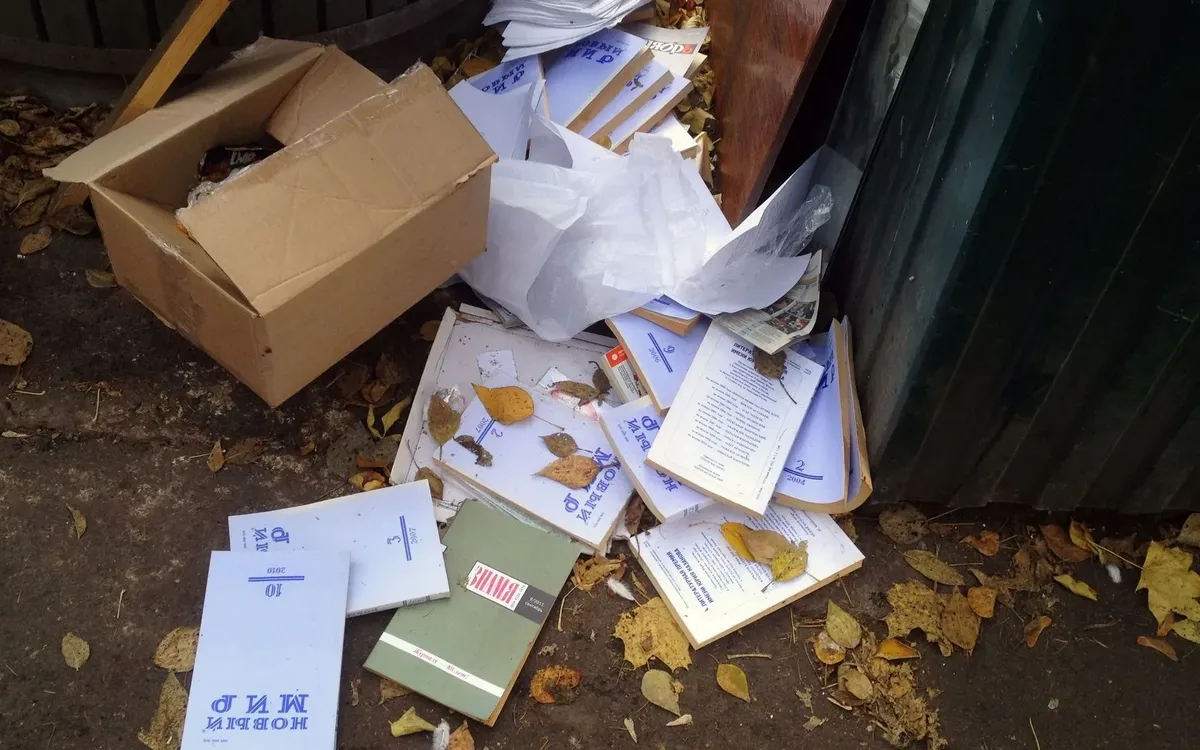
In addition to the writer, there is also a reader. And then again I will give the numbers. At the "Journal Hall" - 115-120 thousand visitors per month. By the standards of news portals - a minuscule. And about one and a half million rages per year. Who are these people? Russia (of course), Ukraine, Israel, Germany are leading the countries. Of course, a lot of writing. Readers 50+ prevail. Read first of all fresh rooms. This is understandable: in paper form they almost do not reach anywhere, the circulations are tiny. Even in Moscow, it is difficult to buy a “New World”, the most successful of them. It is sold at three to four points, including the editorial itself.
Once in the USSR there was a system of distribution of printed products. Then she collapsed. And it turned out that the regions, especially small cities, are cut off from literature. And if they are also cut off from literature on the Internet, what will happen then? The number costs, let's say, three hundred rubles. If you subscribe, then with postal expenses it will cost 600 or more, since sending is often more expensive than the magazine itself. For a provincial audience, especially elderly, especially in the light of pension reform, this is tangible money. There was a way out of this situation - the “coffee room”. Now he is gone.