
Translated material
Praying for those and others
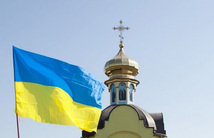
"The church world between Ukraine and Russia is possible" - the thesis paradoxical in the context of the new global church war entered their final document by civil activists and experts who gathered on October 2-3 in Kyiv at the second session of the International Seminar "Truth, Justice and Reconciliation between Russia, Ukraine and the European Union." The first session of this spiritual and brain assault took place in Paris a few months ago. Among the organizers of the seminar are mainly academic institutions of France and Ukraine, related to both Catholic and Orthodox traditions.
Although the seminar participants share the basic values of democracy, humanism and interfaith dialogue, rather acute discussions periodically flashed in the halls of meetings, kindly provided by the Catholic and Orthodox sides. But the source of discussions was not the confessional beliefs of the participants (in this area the ecumenical spirit of the “community” dominated), but cultural -historical and partly - political interpretations of the reasons that caused such a rapid and, as it seems, already irrevocable removal of Russia from Western civilization after 2014.
The speakers and moderators did not doubt the usefulness and inevitability of Tomos about the autocephaly of the Ukrainian Church, which could be proclaimed by the Patriarchate of Constantinople already in October. They tried to mentally go the historical path of the two Orthodox peoples to build new - equal and mutual insistence - relations on the basis of recognition of this autocephaly as the final act of approval of Ukrainian independence and spiritual and cultural identity. As noted in the final document of the seminar, the proclamation of autocephaly, which so far causes only shock and protest in the Moscow Patriarchate, will gradually inevitably lead to the transformation and revival of the Russian Church itself. Its cleansing its imperial complexes, from blind service to the political regime in Moscow will lead to a “rethinking of the history of the Russian Orthodox Church”, will help many clergy and laity of this church, now feeling enslaved, to make a free ideological choice, remaining within the framework of the Orthodox tradition.
Shooting Alexandra Efimenko:
Finding in the Orthodox Catholic context, the participants of the seminar tried to comprehend the phenomenon of the Ukrainian Greek Catholic Church in a new way, which, without tearing with the Orthodox tradition, entered the "sincerity" with Rome as the capital of Western Christianity. It was the Kyiv Metropolitan in the history of Christianity that became a unique cultural and canonical bridge between Eastern Orthodoxy and Western Catholicism. As a professor of canon law of the Ukrainian Catholic University Fr. Mikhail Dimid, UGCC considers himself Orthodox and actually autocephalous, this is a "self-proclaimed" patriarchy, who is in communication with the Roman Church as with the Church. And although the Vatican does not quite share such an approach, he does not condemn the self -determination of the UGCC. On the contrary, some distance from Rome, which the UGCC preserves, creates the prerequisites for a healthy dialogue between Ukrainian churches, delivering Orthodox participants in this dialogue from fears to become objects of Catholic "Prosptians." Moreover, the UGCC, like the Ukrainian Orthodox Churches, considers himself the "daughter" of the Patriarchate of Constantinople and considers the upcoming autocephaly of the UOC as a step to restore the church consciousness of Constantinople, which helped him conclude a union with the Catholic Church in Florence in 1439. It is on the rejection of this fact that the Moscow church tradition is based on its demarcation with Kyiv, and the ecumenical openness is still clearly distinguished by Ukrainian Orthodoxy from Russian.
The final document reproduces the Constantinople interpretation of events related to the actual transition of the Orthodox Kyiv Metropolis to the power of Moscow at the end of the 17th century. If in Moscow this transition is considered unconditional and eternal, then in Constantinople they interpret it as a temporary, and even burdened with the signs of "double jurisdiction" over Kiev. The participants of the seminar also associated the existence of the Ukrainian church schism with the non -constructive position of Moscow, which still insists on historically obsolete imperial stereotypes, regardless of the new geopolitical and cultural reality.
The misunderstanding of Moscow in Ukraine, experts believe, intensified due to Russian aggression against Ukraine. The Moscow Patriarchate made a number of political statements that display only the Kremlin interpretation of these events, and did not even condemn its clergymen with weapons in the hands of the regular Ukrainian army. It was the aggressive, “militant” ideology of the “Russian world”, which one of the speakers called the “theology of the war,” made - “from the contrary” - the inevitable Ukrainian autocephaly. Because it deprived the Ukrainian Orthodox of the last possibilities and even language, terminological means for conducting dialogue with the church in Moscow.
The Vatican’s position in relation to Ukrainian autocephaly and the conflict between Moscow and Constantinople remained not quite clear for the audience. On the one hand, it is obvious that the holy throne expects to continue the rapprochement with the Russian Orthodox Church, which received new dynamics after coming to the Patriarchate of Cyril (Gundyaev). On the other hand, in the case of isolation of the Moscow Patriarchate from the rest of the "world Orthodoxy", led by Constantinople, the Vatican will not be able to sacrifice Cyril to the entire global Orthodox Catholic dialogue, in the vanguard of which the patriarchs of the Second Rome had been ongoing for the past 50 years.
The future reconciliation of the peoples of Ukraine and Russia is based on the meeting participants proposed to put the experience of reconciling France and Germany after the Second World War and Poland and Germany after the fall of the communist system. However, the beginning of such a process is impossible without information preparation, which is proposed to be carried out by creating world -wide independent Russian television and the release of a series of popular videos.
Commenting on the results of the seminar, the director of the Department of Religious and Nationalities of Ukraine Andrei Yurash emphasized the importance of placing the issue of Ukrainian autocephaly on the agenda of the global policy and expressed the hope that it was from the Church of Ukraine, with its recognition in the canonical field, that the enmity of Christians, which turned out to be "on different sides of the front line", would begin.
Author - editor -in -chief of the portal Credo.press