
Translated material
The Secret of Trump's empire: as the US president could be fooled by a fortune of $ 3.1 billion
The New York Times this week published a lot of material about the financial fraud of Donald Trump and his family. In particular, the publication claims that Donald Trump and his father, Fred Trump, organized tax evasion schemes for hundreds of millions of dollars. In addition, the current president helped his father develop a strategy to conceal the true value of a family business empire in the field of real estate.
The main conclusion of the investigation
The publication emphasizes that the results of the investigation are contrary to Trump's statements about independently earned wealth (Forbes estimates his fortune at $ 3.1 billion). During the election campaign, Trump said that he had turned $ 1 million into a billionth state of his father. However, according to the publication, the money and influence of his father, which was always insured, was the only reason for the wealth of Donald Trump.
The publication reinforces its opinion not only with information from sources, but also with data of more than 100 thousand pages of documents that the newspaper studied. In the text of the investigation, there really are more than a dozen tax documents.
Representatives of Donald Trump called the accusations completely false and fabricated , but the New York Tax Department has already begun to verify the information in the Nyt material.
The Bell publishes the main discoveries of the investigation.
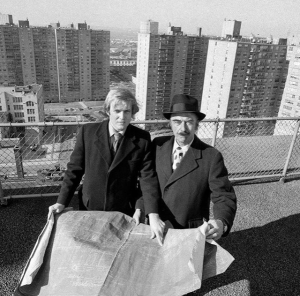
Fred Trump with his son Donald. Photo from Instagram Trump
How did it all begin?
The developer Fred Trump made his first gift to the children in the late 1940s (Donald Trump was born in 1946), when he decided to transfer eight residential buildings from 1032 apartments in Brooklyn and Kuins worth $ 13 million to them. It was easy money for Fred children: he bought land, built houses with mortgage loans, and the profit was already inherited.
Hundreds of thousands of dollars of Trump Sr. giving tax did not pay. As he succeeded, Nyt did not recognize. His tax returns show that he paid only a few thousand dollars of tax for only one of the eight buildings. But in this way, the large developer Fred Trump created a “mini-imperian” for his children .
For Donald Trump, this meant a good source of income - when he studied in high school, he earned $ 17 thousand a year in terms of modern money. Soon after the end of the college, his fortune exceeded $ 300 thousand.
Insolent hard guy
Having graduated from Pennsylvania University in 1968, Trump began working for his father-Fred Trump made him vice president of a dozen companies. As Nyt explains, in those years Fred Trump began to see in his son his successor-the eldest brother of Donald, Fred Jr., his father considered it too soft, lazy and dependent on alcohol. Donald, who saw a deep disappointment of his father, behaved as the exact opposite of Fred Jr.: as an impudent tough guy with the instinct of the killer, writes Nyt.
Fred Trump began to work more with Donald and showed him all the advantages of residential construction on cheap state subsidies. In 1972, the father and son joined the partnership for the construction of a high-rise building for the elderly in East-Orange, New Jersey. Subsidies of the authorities in the amount of $ 7.8 million covered 90% of the costs, the rest was paid by Fred Trump. But Donald Trump received all financial benefits, including money for construction management, although Fred Trump employees did this. By 1975, Donald Trump earned $ 305 thousand a year on the building.
Another large “acceleration” for Trump from the father is investment in the Starret City residential complex in Brooklyn, the largest project subsidized by the federal authorities in the country. Investments also implied large tax benefits (provided by the US authorities for investments). Fred Trump himself invested $ 5 million in the project, a special company created for his children-$ 1 million. The benefits allowed Donald Trump to avoid paying any federal income taxes in 1978 and 1979. In addition, Fred Trump instructed his son to sell his shares Starret City - Trump earned more than $ 1 million commission in modern money.
Secret partner
The newspaper describes in detail how Donald Trump, in fact, appropriating his father’s achievements and merits, managed to create an image of a successful young businessman , citing a 1976 of his own material about a young businessman as an example, “more than $ 200 million”. “How could he claim to be more than $ 200 million if he informed the managers of his casino in a few years that in 1976 his taxable income was $ 24,594?” - The publication asks.
For this, the material of 1976, Trump arranged a tourist for NYT to a tourist on the luxurious Cadillac (leased by his father). He talked about his plans to turn one of the hotels on Manhattan into Grand Hyatt (his father organized a loan for construction) and told about the “philanthropic” project-a height of the elderly in East-Orange (funded by his father), showed the residential complex on Staten Island (belonged to his father), and also demonstrated Trump Village in Brooklyn (belonged to his father) and Beach Haven Apartments in Brooklyn (the project belonged to his father).
A week before the publication of that material in NYT, Fred Trump created more than a hundred ramps for his children, transferring to each of them the amount equivalent to $ 4.3 million. Even in the early eighties, calling himself one of the richest people in the United States, Donald Trump still lived at the expense of his father, receiving an amount equal to modern $ 260 thousand.
Fred Trump himself and his companies at the same time began to actively give Donald Trump loans. In January 1979, Trump received $ 1.5 million, in February - $ 65 thousand, in March - $ 122 thousand, in April - $ 150 thousand, in May - $ 192 thousand, in June - $ 226 thousand, in July - $ 2.4 million and $ 40 thousand in August. Most of the loans did not actually imply a refund, and according to those that Trump were reluctant to pay, often missing payments.
When Trump began his own expensive projects, the flow of loans increased sharply. This happened, including before the construction of Trump Tower in the early eighties. By the nineties, Fred Trump transferred about $ 46.2 million to his son in modern money. In 1988, Donald Trump bought Plaza Hotel for $ 407.5 million, in 1989 - Eastern Airlines for $ 365 million. And his new Trump Taj Mahal casino required at least $ 1 million per day for debt service. Fred Trump took all the risks, the newspaper claims.
Annoying restrictions
Helping his son, Fred Trump did not disdain and completely unusual cash transmission methods. So it was with the famous Trump's Castle Casino (now renamed and redeemed from Trumps). Trump spent too much on the reconstruction, which is why the hotel decreased the surgery. “Naturally,” Nyt writes, neither the hotel nor Trump had money to pay a debt of $ 18.4 million in November 1990.
Then Fred Trump sent to the casino his trusted accountant with a check of $ 3.35 million. He bought casino chips for this amount and left without making a single rate. But this was not enough, it ironizes Nyt: on the same day, Fred Trump wrote another check for $ 150 thousand to his son.
As this episode with chips shows, the father and son were equally related to various rules and restrictions, considering them something annoying , which, if desired, could be ignored, Nyt notes.
This feature was clearly manifested in 1981, when Fred Trump Jr. died at the age of 42 from alcoholism. Its largest asset is the share in those very multi -apartment seven houses in Brooklyn and Kuins. A few years after the death of Fred Trump Jr. Trumps, these houses will estimate $ 90.4 million. With such an assessment for the share of the deceased Trump, it was necessary to pay $ 10 million, however, Trumps claimed that only $ 737 thousand-they underestimated the cost of seven buildings up to $ 13.2 million.
A similar story happened with another residential complex of Park Briar. 18 days before the death of Fred Jr. Trumps, the building was estimated at $ 17.1 million. The tax return after his death Fred and Donald Trump indicated the cost of the building of $ 2.9 million. The fall of 83% in two weeks did not embarrass the auditor-he raised the cost of only $ 100 thousand, to $ 3 million.
Father and son, including earned Greenmeil , claims Nyt. In the 1980s, Donald Trump bought stocks of companies and, threatening with absorption, or sold their shares at an inflated price, or knocked out other “profitable concessions” from them. Father helped his son in this endeavor.
Trumps, according to NYT, also made fictitious transactions with shares : in 1987, one of such transactions with securities allowed Donald Trump not to pay his father a debt of $ 11 million (Fred could simply forgive the debt - then Donald had to pay millions of taxes dollars). The scheme was as follows: Fred Trump bought 7.5% in Donald Trump Trump Palace for $ 15.5 million, actually receiving Trump Palace for debt. After 4 years, in December 1991, Fred Trump completely sold his share in Trump Palace for only $ 10 thousand - as Nyt found out, Donald Trump back, in fact, giving his son $ 15.49 million. Fred Trump did not report this about this, saving 55% on a gift tax that was supposed to amount to about $ 8 million.
The will of Fred Trump
In the 1990s, Fred Trump began to think about what would become with his empire after death (this happened in 1999). He hired one of the best lawyers in the country to draw up a will. In December 1990, Donald Trump sent his own proposals to his father. From them it was followed that Donald Trump would alone control the father’s empire.
Not wanting to go to direct confrontation with his son, Fred Trump consulted with his daughter, federal judge Marianna Trump, who confirmed that Donald was in an “unstable financial situation”. As a result, the lawyers of Fred Trump drew up a new document that did not give Donal the sole control over his father’s business empire.
For several years, Fred Trump has stubbornly rejected advisers' proposal to transfer their assets to children in order to minimize the number of taxes. Every year, the probability that Fred Trump will die the owner of his empire worth several hundred million dollars, became higher. In this case, when transferring to children, they had to pay a 55%tax.
Simply put, the heirs of Fred Trump could lose hundreds of millions of dollars, writes Nyt. As a result, despite the differences, Trumps developed a plan to avoid this fate. Donald Trump played the main role in this process.
Football firms
For several years, the children of Fred Trump transferred his fortune to their accounts with the help of fake companies . One of them was called All County - 20% in it belonged to the long -term ally and nephew of Fred Trump John Walter and four children of Fred. All County became an intermediary between companies managing Fred Trump, and counterparties who were delivered to everything necessary for a business empire. After the mediator appeared in the person of All County, the cost of procurement of the same equipment (for example, hotel refrigerators) increased by tens of percent - 20%, 50%and even 122%. Now Fred Trump through the All County bought thousands of items from his suppliers - in high, sometimes more than two times.
“This, of course, looks like a disguised gift,” said Mr. Tritt professor of law at the University of Florida, Nyt.
In 1995, Trumps began transferring ownership of assets to children. This was done through the creation of special trusts known to American lawyers under the abbreviation GRAT (Grantor-ReTained Annum Trust). They are often used in the United States to transfer the assets of the heirs that are ultra -creature. As NYT explains, GRAT trains allow transferring assets without paying property taxes.
If you do not go into details, then the process of transferring property from the older generation of Trumps to the youngest was extremely simple. Fred and his wife Mary transferred their property to two trusts. After that, they transferred the rights to two -thirds of the assets in the rags for children, and the children acquired the rest of the children, making annuity payments to parents over the next two years. By November 1997, the process was completed, and the empire was re -registered.
According to NYT, when using GRAT trastes, the cost of assets is often underestimated, which allows you to pay less taxes on donation. Trumps did the same. In the Trump tax return of 1995, which was at the disposal of the newspaper, 25 housing complexes with almost 7 thousand apartments were estimated at $ 41.4 million. In 2004, banks will evaluate these assets at $ 900 million.
Since Trumps also artificially underestimated the value of the transferred assets, the transfer of the Empire cost Fred and Mary Trump $ 20.5 million, which they paid as giving taxes, and children in $ 21 million annuity payments. This is hundreds of millions less than they were supposed to pay based on the market value of assets (about $ 1 billion) , NYT emphasizes: the real amount of tax should have been at least $ 550 million.
Sale of the Father's Empire
In 2004, Donald Trump sold his father’s empire - about 27 thousand apartments in elite residential complexes and high -rise buildings - for $ 737.9 million. The reason for the transaction was also the next problems with creditors, writes NYT. At the same time, according to banks that financed the sale, the value of assets actually amounted to $ 1 billion.
The article by The New York Times was retold by Artem Gubenko