
Translated material
Soviet African novel
That the film "Our Africa" can tell about the future of "Our Crimea"
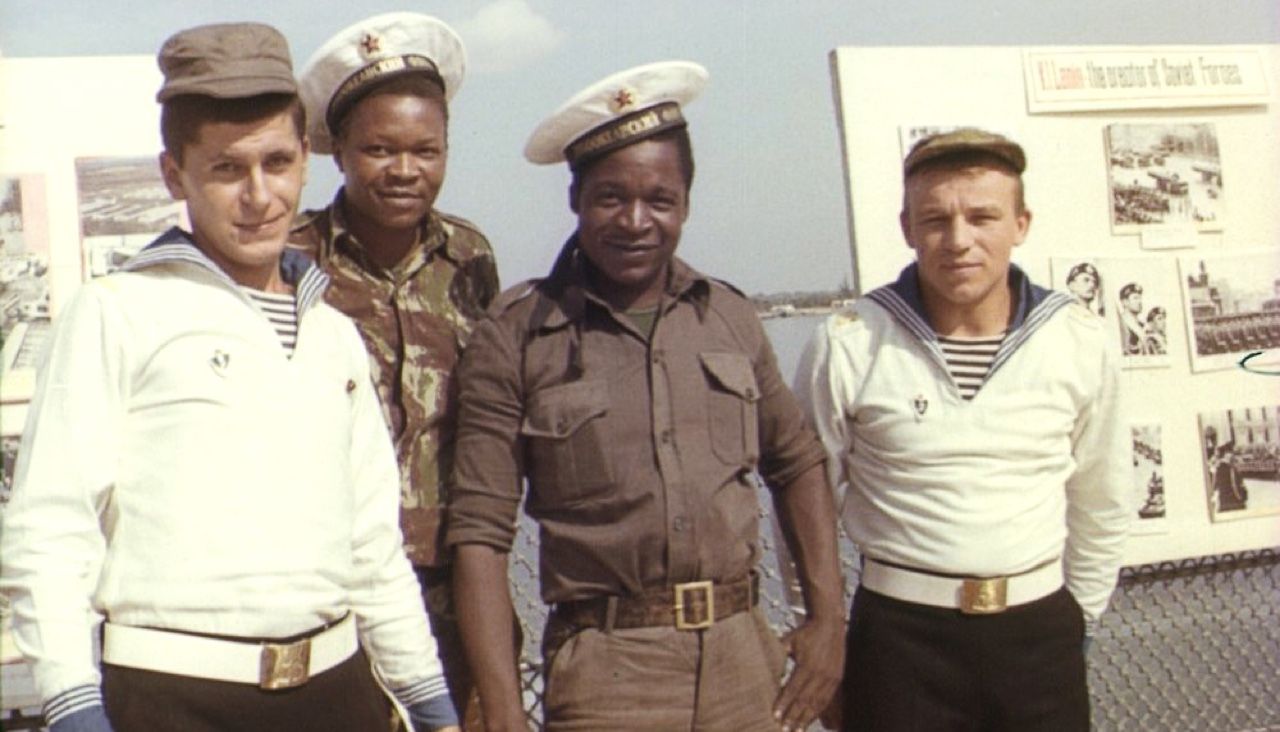
Medusa continues to present films from the competitive program of the Artdox Festival Festival - it will be held from October 19 to 23 in Riga and from December 6 to 12 in Moscow. This time, Medusa journalist Dmitry Kartsev talks about Alexander Markov’s painting “Our Africa” -the history of relations between the USSR with 17 African states from the 1960s to the 1990s, mounted from Soviet documentary propaganda films.
The 1960s largely became decisive for the confrontation of the capitalist and socialist camps in the Cold War. Both superpower, the USSR and the USA, which declared idealistic goals (one - the construction of a new world, the other - the fight against dictatorship), almost synchronously demonstrated the imperialist inside out of their policy.
The decade has passed under the sign of the Vietnamese War and the smell of the American Napalm, but the “Prague Spring ”, which showed the face of socialism, was not human at all. The great confrontation of ideologies began to obsessively resemble the banal redistribution of the spheres of influence in the spirit of the 19th century. And, perhaps, his own leaders inflicted a decisive reputation defeat to the Soviet project. Frantically grasping the excited Czechoslovakia, they buried under tanks not only a hundred Czechs, but also the faith of Western intellectuals that the USSR could become an avant -garde alternative to their own political system.
This is the European background of the events shown in the film by Alexander Markov "Our Africa." Mounted from the personnel of 60 Soviet documentary tapes, he tells the history of the Soviet-African “Roman”-from gaining independence by 17 states of this continent in 1960, nicknamed the “year of Africa”, before the collapse of the USSR itself in 1991.
All these films were propaganda, and within the framework of the traditional positivist approach to history trying to find genuine facts and identify objective trends, have no particular value as a historical source. In the best case, it is possible to see some contradiction between the bravura ideological messages of the authors of these ribbons and the complex emotions of people, involuntarily caught a camera. But an attempt to determine what people really thought and felt, in the expression of their faces, in itself, too much looks like speculation.
Modern postcolonial and decolonial approaches help to better understand the information value of propaganda. Soviet announcements are ironic over the confidence of the Western governments that they “granted” the former African colonies independence, that is, that they were fully treated with Africa exclusively as an object of application of their own power. The drama is that the USSR itself also refused new "friends" in subjectivity.
Here Soviet geologists teach Africans to look for minerals. Here are Soviet doctors conduct the first vaccination among the local population. And Soviet teachers teach the Russian language. Achieving is when the USSR manages to make Africa similar to it.
From the point of view of Madina Tlostanova, perhaps the main Russian adherent of the decolonial approach, almost the main historical drama of Russia (and her neighbors) is that it has become an imperial metropolis, while feeling the periphery of Western civilization itself. As a result, she “took a catch -up position, as well as overgrown with a number of psychological anxieties, schizophrenic collective complexes, the ideology of the besieged camp” and “projected its own inferiority complexes in its non -European colonies in the Caucasus and Central Asia, using the self -proclaimed role of the reformer and civilizer”.
Africa was never a colony of the USSR, and the new African elites to the Soviet project promised the rapid modernization and entrance to the “First World” immediately from the “third”, bypassing the “second”. This is a fundamental difference from Eastern Europe, which Russia has never promised to give something that it would no longer have.
But the kisses of the Secretary Generals with the presidents are replaced by the “our Africa” first by friendly meetings of the Soviet troops, and then with shooting, explosions and burning African villages. The problem is that, having proclaimed itself a world -class new type, the Soviet Union never broke it off the pre -revolutionary imperial tradition. And it was sharpened just for the competition with the West - and everything else was only a function from this global goal. To some extent, this obsessive desire even intensified, since the very dominant ideology of the USSR, Marxism, was of Western origin. Perhaps that is why Africa was doomed to become the next battle of the battle of two systems.
The film is called "Our Africa", and the reference to "Our Crimea" is not accidental. In Russian propaganda discourse, two motivations of the attachment of the peninsula are competing. One refers to the restoration of the “Russian world” and the protection of “their own”, the other - to counteract NATO and America, which supposedly prepared to expel the Russian fleet from the Crimea and turn it into their outpost. The farther, the more active the geopolitical justification comes to the fore, and it seems that they should explain the actions of the Russian authorities in 2014. In our Africa, the geopolitical game ended with the war of all against all.
The problem is that a good script is not visible. As the events of the last decades show, not one of the large regions freed from imperial guardianship was able to calmly survive the departure of the first generation of the post -colonial elite. Everywhere this led to instability, wars, sometimes to genocide. Our Africa was followed by the Middle East. Who is next in line - Central Asia?
The left supporters of the decolonial approach blame the colonialists in all and urge to abandon the notions of the Unified World and the Universal Route of Development: after all, frustration about the inconsistency of this path and provokes violence. But is it exactly the reason? Will the rejection of this idea lead to the final restoration of ancient forms of oppression multiplied by new technologies? Still, in “Our Africa” (and before that, in “non-Nash”, that is, in the west belonging to the West), at least some time did not fought.
Dmitry Kartsev