
Translated material
A translator without a mask
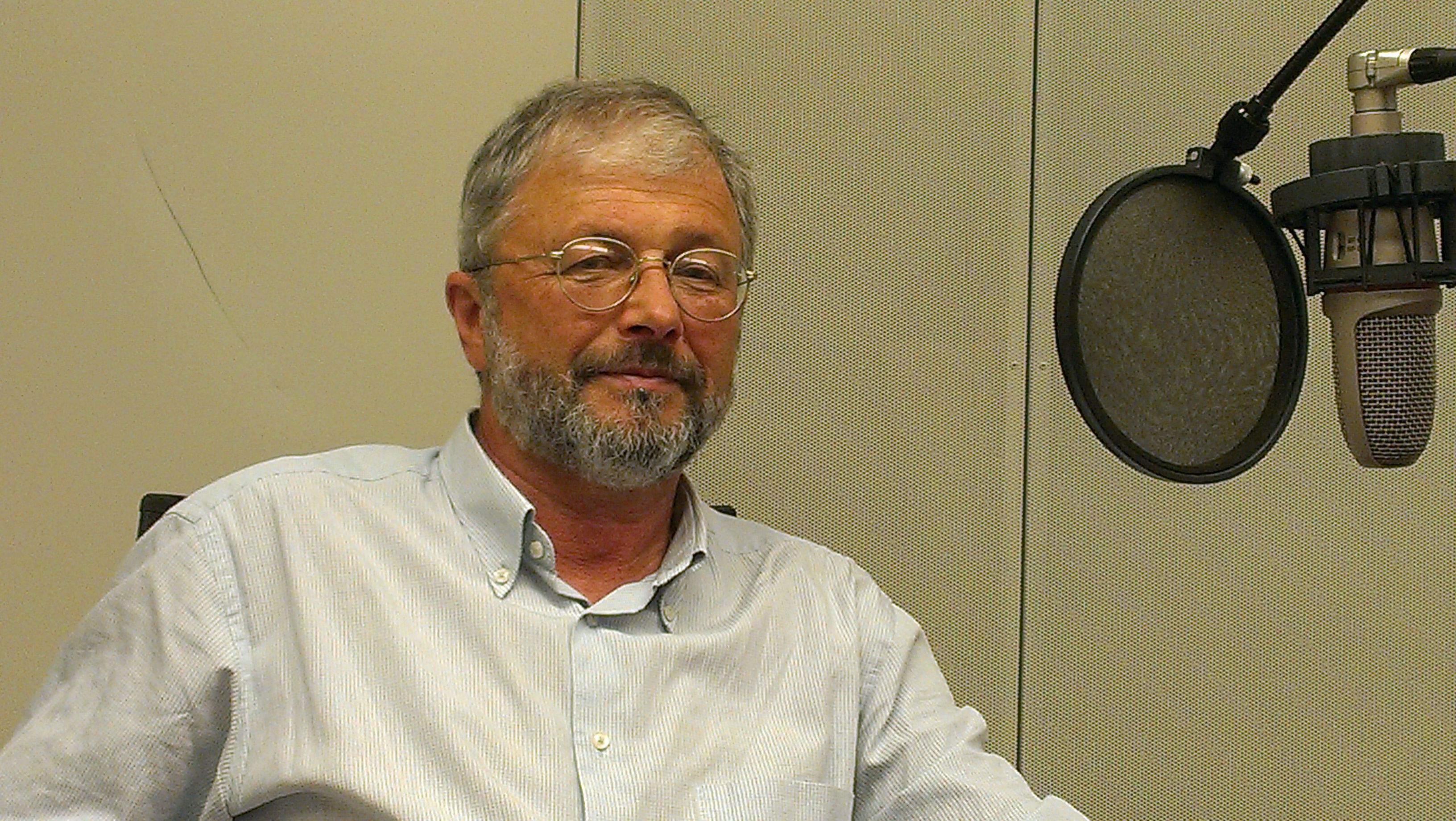
How the first Soviet James Bond was preparing
Ivan Tolstoy: Guest of the Prague Studio-historian, researcher of Russian-Italian cultural ties Mikhail Talalay. True, Mikhail Grigoryevich appeared in our studio in some mask, and today he will remove this mask from himself. Those who wish can timid our conversation for the World of Agent 007 - October 5, even if this date is not generally accepted.
Mikhail Talalay: It seemed to me that it was time to arrange a certain self -disclosure, as I call today's act, because my literary activity began with translations, and the first large work that I translated and published was Yana Fleming’s novel “From Russia with Love”. This novel came out under the name of the translator Nikolai Pishchulin, and so far he is reprinted as a translation of Pishchulin. And the time has come, finally, to say that I am hiding behind this name and surname, Mikhail Talalay.
Ivan Tolstoy: Nikolai, tell us how it was? Why did you get? What was the year in the yard and what did you count on?
Thirty years have passed and, holding the first edition in my hands, I wanted to tell about that long history
Mikhail Talalay: It was the mid-80s. I then met alternative literary circles, Club 81 in Leningrad, there was a section of translators. Basically, I was already engaged in the history of St. Petersburg, the white spots of St. Petersburg - the destroyed temples, toponymy, forgotten biographies ... Therefore, James Bond accidentally arose at the then my young life thanks to the request of Dmitry Volchek, who formed an editorial portfolio and turned to me as a person who was already translating from English. I translated several essays of George Orwell, such small forms, and here - a novel. And Dmitry Volchek said: “Here, Misha, hold this book and translate it for my Mitin magazine. I agreed. All this was voluntary, no one was waiting for a quick job, there was no time, I was mastered, read, I was penetrated. I couldn’t say that this genre was far from me, such a triller detective, but I was interested in myself, but I was interested The intrigue is the Russian presence, Russia - Europe, the struggle of the two worlds, and the opportunity to try their forces as a translator.
And I began to slowly translate. Dmitry constantly said to me at the meeting: "Where" from Russia with love "? Where is the translation?" But I pulled and pulled everything, and this lasted a couple of years (Dmitry was angry with me) for several reasons. One of the reasons-because in those years, in the mid-80s, we were free, but still a little scared. And when in the circles of "Club-81" I said that I had a Fleming’s novel on my desk, they said: “Michael, be careful, people are being planted for more innocent things now. From Russia With Love is considered an anti-Soviet book, if you pull it that you translate it, and, thereby, are harmful to the Soviet Union, you will have troubles. Not necessarily a prison, a link, hard labor, but there can be serious troubles. It a little alerted me. Not that I stopped translating, but with somewhat less enthusiasm I took up this matter.
Ivan Tolstoy: From Russia was, but already without love, with caution.
Mikhail Talalay: Yes, with some detachment. Then a series of Fleming, Bond episodes began, some of which I still cannot decipher. At that time I wrote by hand, and I needed to transfer my manuscript to a machine. And in the same circles close to Samizdat, there was one girl who, having become interested in my translation, offered to reprint for free. She took my manuscript, already almost finished text, and disappeared. I had her phone, I called her, the girl apologized and said that she did not have time, she left somewhere all the time, I was terribly inconvenient for Mitya ... In the end, I came to the address that I still had, on the Petrograd side, and my communal neighbors say that she left for a month for potatoes. I even found out what state farm she left for, even went there, but she never appeared there, and I have never seen this girl since then, I don’t know what her name is, and I don’t know what the fate of my first translation of the novel ended, he disappeared.
Ivan Tolstoy: Did you give the only manuscript?!
I was interested in the intrigue itself - the Russian presence, Russia -Europe, the struggle of the two worlds
Mikhail Talalay: I wrote all this by hand and gave it to an unfamiliar person who agreed to make such a good deed. And I somehow already forgot about it, well, the case died, and Mitya was tired of asking me. And at this time, perestroika struck, I began to officially participate in various kinds of social movements for the preservation and salvation of the old Petersburg culture, including writing in the Aurora magazine - my short essays called that I did not come up with, I didn’t like it, “cultural units” were working. Here in this "cultural units" I felt something late-Soviet.
Ivan Tolstoy: assault.
Mikhail Talalay: I wrote on my topics: the return of historical names (Sennaya Square instead of the world Square in 1989–90 seemed a challenge to the Soviet space), about the abandoned estates of the Leningrad Region, about the palace in Ropshe, where Emperor Peter III was killed, and many other stories that fell into the general direction of my culture, where I worked. And communicating with the editor, who edited my manuscripts, the deceased Alexander Sharymov, I dropped by chance that I translated Yana Fleming, but the manuscript was lost. He caught fire: "Michael, tomorrow bring this manuscript, we will publish it right there."
This is 1989. No manuscripts. He even made me sign the contract because I bluffed, said that I was a translator. Unlike Mitin's magazine, Aurora set tough conditions so that I rather handed over at least a hand written. They had engineers there, everything is in sight, and it was no longer possible to steal the manuscript. Therefore, I went to the cottage, we had a cottage in the Pskov region, in the city of GDOV, and there I locked myself for two months.
Ivan Tolstoy: There are wonderful sands and pines!
Mikhail Talalay: I was just in imprisonment, my mother brought me apples from the site, put the flowers on the table, I looked out the window at the beautiful Pskov landscapes and translated this evil anti -Russian book. I was torn by conflicting feelings. Some people had acquaintances there, came from St. Petersburg, people of the same sphere of cultural ecology, and when I told them how Fleming characterizes the Russian people-barbaric, uncultured, evil, cruel-they were terribly amazed at the culture fund and at the same time engage in such (there was no this word) Russophobic book. But it was too late to retreat, and I wrote a second time by hand.
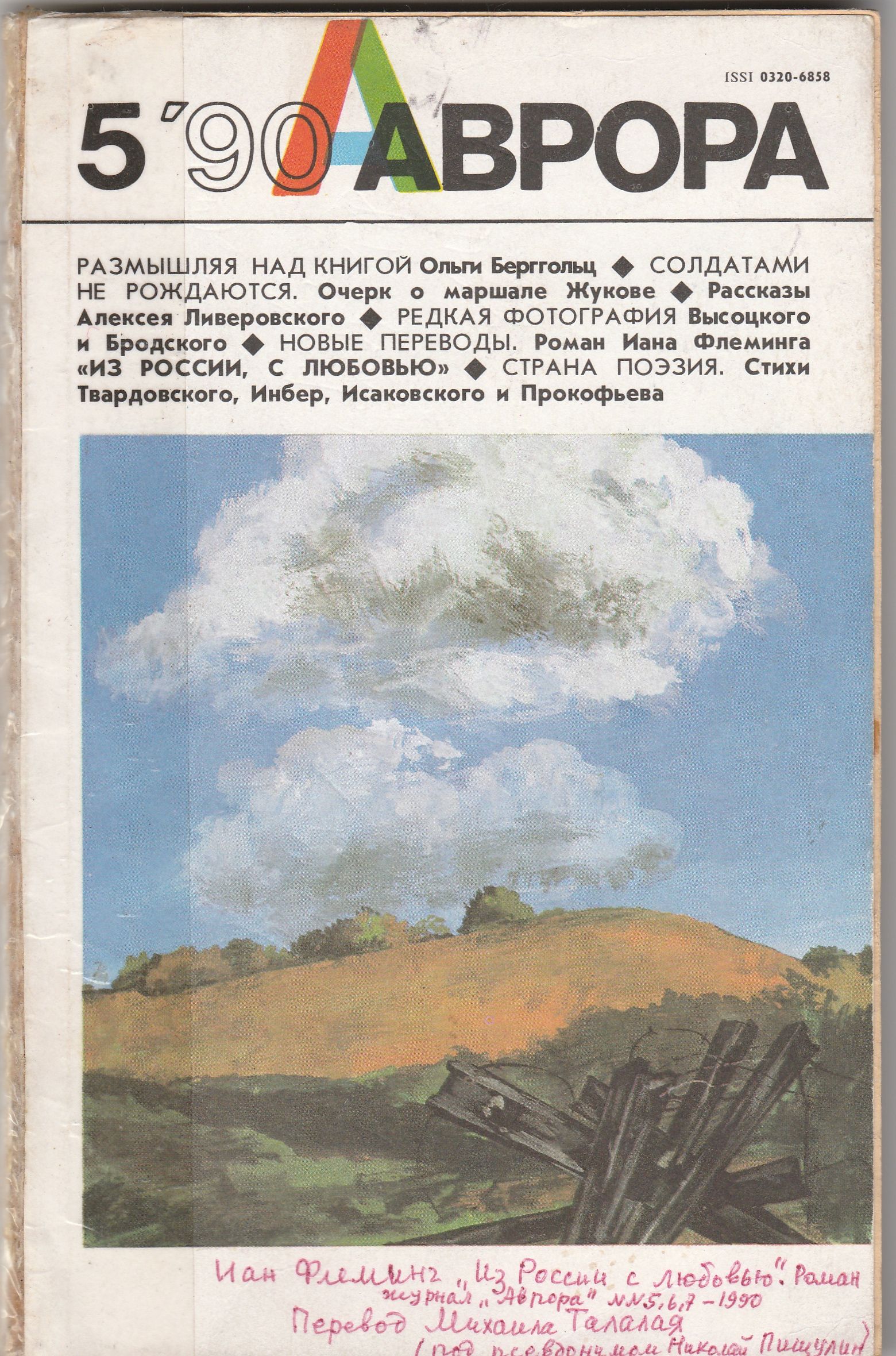
I handed over this manuscript in time, it was printed inside the editorial office, part of the fee was given to the driver, and in the middle of 1990 the text “from Russia with love” was released in three magazines. In the same magazines, on the last pages, my correspondence was printed "Culture detachments" work, so I could not internally put "the translation of Mikhail Talalai." And, having talked with Alexander Sharymov (and he did not see any contradiction in this), I set up "Nikolai Pishchulin." This is the maiden name of my mother, Galina Vasilievna Pishchulina. There is even a living Nikolai Pishchulin, her cousin, my uncle, whom I love, God forbid him health. When the book had already published, I gave him - "from" Nikolai Pishchulin "to Nikolai Pishulin." He blushed with pleasure, receiving such a gift.
Ivan Tolstoy: And if this translation came out in the Mitin magazine, would you save the pseudonym or think to sign with your own name?
Mikhail Talalay: I did not sign my publications in Samizdat, I signed materials on local history topics with such a transparent abbreviation "M.T." -Some kind of fear, fear existed. And since there were some anti-Soviet fluids around James Bond and Fleming, I doubted it with an open hare. Therefore, perhaps Pishchulin would have remained.
And Alexander Sharymov had some doubts. When he got acquainted with the text, he said that we, of course, will publish, there is already a third year of perestroika, but we need to come up with some move in order to protect ourselves. And he came up with this move. The novel, as you know, is dedicated to the struggle of James Bond and Smeresh, and he invited the former SMERSH employee, who wrote a preface to my translation.
I have never seen this girl since then, I don’t know her name and I don’t know how the fate of my first translation of the novel ended, he disappeared
This is Vasily Ivanovich Gorbushin, already deceased, who, having subscribed to the Major General in retired (which exactly-he did not designate), wrote such a preamble on two pages, a blessing from Smersh dedicated to the struggle with Smeric. He got acquainted with the text, found obvious punctures at Fleming. In Fleming, the action of the novel takes place in 1955. Fleming himself in the author of the author, and then in the text writes that SMERSH is a powerful Soviet organization, numbering 40 thousand members in its ranks, which is still existing at such an address. And Vasily Ivanovich Gorbushin melancholy writes that Smersh existed only three years, from 1943 to 1946. Therefore, this is the first puncture. The second, and the humor of Vasily Ivanovich is already connecting here, Smersh, of course, could not set such a frivolous task of his forty -thousandth organization as the liquidation of an English spy. And the novel was built on this that Smersh was going to the lead under the leadership of various nasty and disgusting characters, the most vile of which is Colonel Rosa Klebb, ardent of the hater of Bond, and they develop a plan for how to kill James Bond. They came up with to kill and disgrace, because it is not enough to kill. Therefore, as Vasily Gorbushin designated this, the "frivolous" operation could not captivate such a serious organization. Then, in this preface, he also ironically said that we also had his own James Bonda, the famous Major Pronin, who, of course, had “the appearance of moral” was much higher than Donjuan Bond, nevertheless, he also famously dealt with his enemies.
It seems to me that Sharymov had already prepared, because at the time of compiling a preface to Vasily Gorbushin was eighty years old, and the last paragraph sounds very frivolously in the lips of the former SMERSH employee. Why can we read this novel now? Because we are now entering Europe, a common house, and this book exists on the book regiments of a common house. And at the time of Russia entering the European common house, it came to get acquainted with what they read, and be prepared even for such manifestations for our country, for our culture and history. On this ends his preamble Vasily Gorbushin.
By the way, it was Vasily Gorbushin who commanded the operation of Hitler's corpse. Then, being Colonel SMERSH, he received the task to lead the group to search for both living and dead leaders of the Third Reich. He published his notes. It was he who discovered Hitler’s charred corpse, it was he who thought that maybe he could calculate his teeth, and he writes how he traveled to Hitler’s dentist in Berlin, took a folder, photographs and wrote that Fuhrer had crazy, reined and overwhelmed. And with these photographs, they then merged the charred corpse of Adolf and Eve. So the person was outstanding, since he received such a task. As a result, now pink salmon and Pishchulin are adjacent to the same pages.
Ivan Tolstoy: What serious people write accompanying texts to your translations, Nikolai!
Mikhail Talalay: Because the publication was serious. The Mitin magazine was published no more than forty copies, and Aurora published my translation with a magazine circulation, a million hundred thousand, so the whole country was littered with this Fleming.
Ivan Tolstoy: Were there any reviews on this book? Were you welcoming crowds at airports and nascent supermarkets?
Mikhail Talalai: The fact of the matter is that, hiding under the pseudonym, I thus lost the opportunity to track a possible resonance. First, I will say a few words about the intricacies of the translation. In the book of this truly a number of moments that annoyed me as a person engaged in Russian culture. Therefore, in order to remove the resistance of the translator, I chose the method of literal translation, which allowed me to simultaneously ironize the text itself, because I did not perceive it as a high, serious literature, such as Conan Doyle, beloved in childhood.
An example that I remembered. The main Bond Gel, the girl who falls in love with Bond, is SMERSHA employee Tatyana Romanova. The author writes that "enters Tatyana Romanova, a corporal of state security." And I leave this “Corporal”, I write a footnote from the translator that “Corporal” is a military rank that existed from the Petrine era, but that disappeared in the mid-19th century and, perhaps, the author had in mind the corporal or sergeant. If he writes that in 1955, Beria "was already sent to the gallows," I put an asterisk that Beria was shot. That is, some element of removal and irony, which could not but arise in a Russian person.
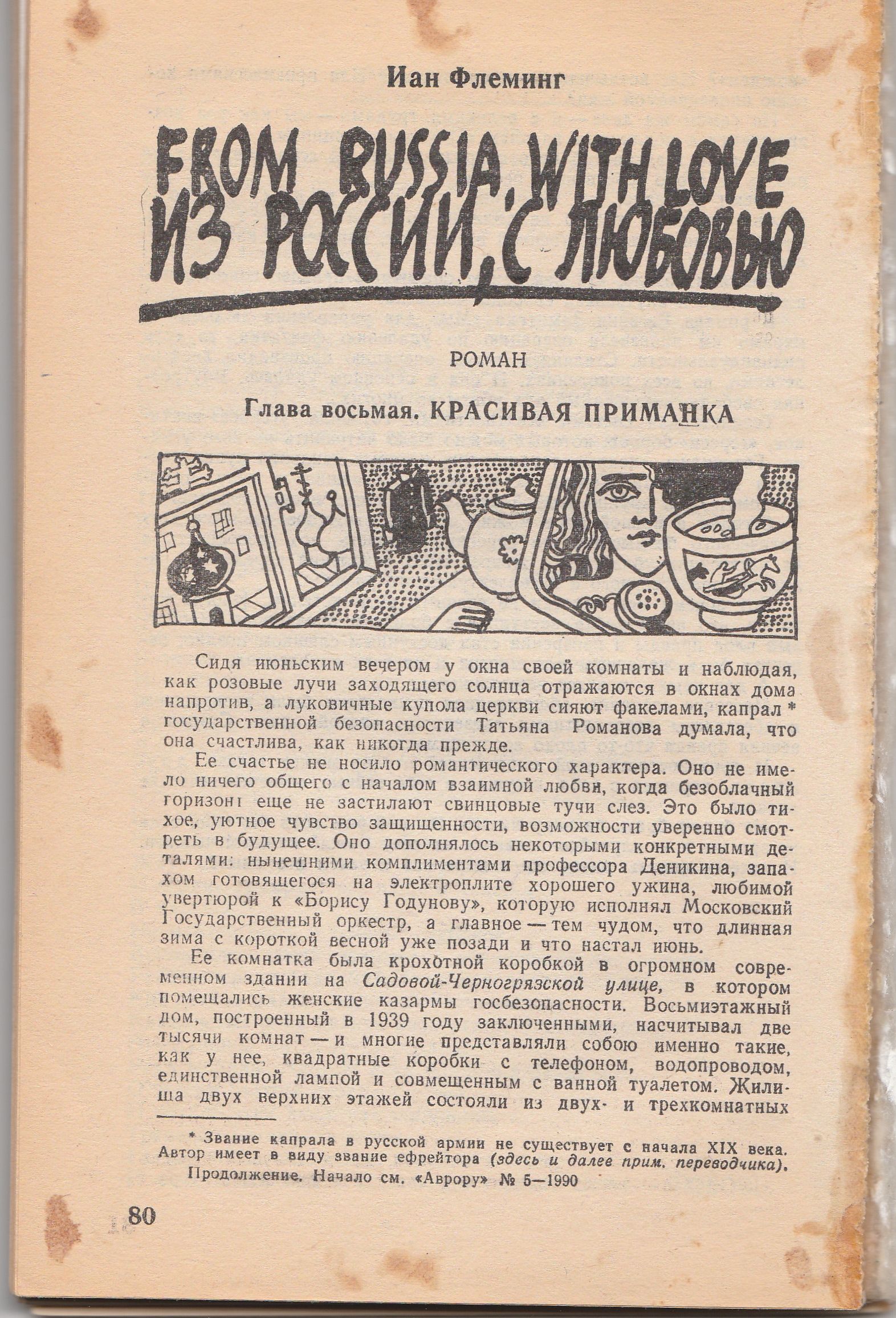
I already understood that this novel, thanks to such details, would never become a mass reading of the Russian people, as happened in the West, where, thanks to the film and music, it became the property of mass culture. Indeed, despite reprints, this novel was not among the cult books. Even a reader who is not familiar with the realities of Russian history will be wary of anti -Russian manifestations and a very distant acquaintance even with the Soviet reality that the author attacks. In particular, the main character, beauty Tatyana Romanova, she is a bait from Smersh, who needs to be caught, killed and discredited by James Bond. In England, the Secret Service and James Bond thought: she has the surname Romanova, perhaps she belongs to the Romanov House, perhaps she is less “prompted” and will be easier for sincere contact, perhaps this is not a trap and a girl with the surname Romanov will really want to fight against the Soviet Union and the killers of her ancestors. It is clear that I left such things without comment. Bond examines the photo and thinks: what a beautiful girl! She really looks like a “princesses” from the Romanov House. I leave it - "princesses" in order to further aggravate my reception of a literal translation.
There was another difficulty. The main opponent of Bond, the evil anti -hero, with whom they come closer for a long time and then there is a death fight on the train, - the Irishman recruited by Smaresh. It is clear that Fleming has such antipathy, root, indigenous. And the main executioner Smersh - Donavan Grant, the killer who himself fled from West Berlin to East, in order to enter the service of state security and fulfill the most dirty and disgusting instructions, including the Englishman wanted to kill. So, Donavan Grant, who received a ridiculous nickname in the SMERSH - Krasno Granitical or Granite organs. Here is the subtlety that, perhaps, I decided, or maybe not. When he went to Bond, he was given fake documents with the name of Nash. This is a common British surname. But Tatyana Romanova is connected there, she meets Nash, and then tells Bond that she has a suspicion (already Tatyana Romanova, thanks to the call of blood, betrayed the Soviet Union) that he was an agent of secret Soviet services, because Nash denotes "ours." And here I stumbled. As a result, everywhere I began to write his last name not “Nash”, but “ours”.
I don’t know how another translator decided this, because two years after the journal publication and after the book was published separately, a translation of a certain venestin was released. Bond had already gone to other areas, I did not compare, at first it seemed to me that it was just written off from me. So there are two translations, but my mainly published and transformed. I looked at the summary: in recent years, seven reprints of Nikolai Pishchulin and three reprints of venestin has come out. Bond stories began to unfold after this journal publication. The first book publication of Nikolai Pishchulina came out in the Baltic states, Lithuania was the first to react to an affair with such a focus. The first book in a soft cover was published. This is the beginning of the 90s. This happened as follows. "It is inconvenient for us to send all this by mail, a man will come from Lithuania, you will meet in the subway, he will give you an envelope." Indeed, a man arrives, gives me an envelope, it was uncomfortable for me to recalculate the money in the subway, and there was a great shortage at home. Who to call? Where to protest?
But I will return to 1990. When I worked in GDOV on the translation, various feelings were torn apart. I talked a lot with the Gdovsky priest, already the late father Mikhail Zhenocin, and told him about my work of the translator. He only shook his head. As a result, I found, as it seemed to me then, a way out, which took my remorse. I sacrificed most of my fees for the restoration of the Gdovsky Cathedral. I also talk about this for the first time, because I am not supposed to talk about my own sacrifices. At that moment, the Cathedral destroyed during the Second World War was restored in GDOV. This was a unique enterprise - the very first restoration of the deceased temple in the Soviet Union. Тогда строились новые церкви на периферии больших городов, а вот в Гдове в конце 80-х решили восстановить погибший. Потом, в 90-е годы, это стало распространяться. Мы имели дачу в Гдове, очень сочувствовали этому проекту, который облагородил весь Гдов и старую крепость, где стоял этот собор, мы отдали туда наши старые иконы, рушники семейные для украшения икон, и я пожертвовал туда большую часть своего гонорара именно от Джеймса Бонда. А гонорар был приличный, один из самых больших в моей жизни. Таким образом какое-то противоречие было снято.
Прошло уже тридцать лет и, держа в руках первое издание, мне захотелось поведать о той давней истории, потому что занимаюсь я делами совсем другими, но это часть моей биографии творческой. Мой покойный отец когда-то любовно вырезал из журнала "Аврора" страницы с Джеймсом Бондом, и на первой странице написал: "Ян Флеминг. "Из России с любовью". Роман. Перевод Михаила Талалая (под псевдонимом Николай Пищулин). Так что это еще одно свидетельство того, что это одно и то же лицо. Мне очень приятно сейчас разглядывать отцовскими руками склеенную книжку, он даже здесь аккуратно склеил страницы, которые случайно вылезли из других статей журнальных, чтобы читающий Флеминга не отвлекался на какие-то вставки, и из одного журнала можно перетекать в другой, не отвлекаясь на другие авроровские публикации.