
Translated material
Troyanker without a book
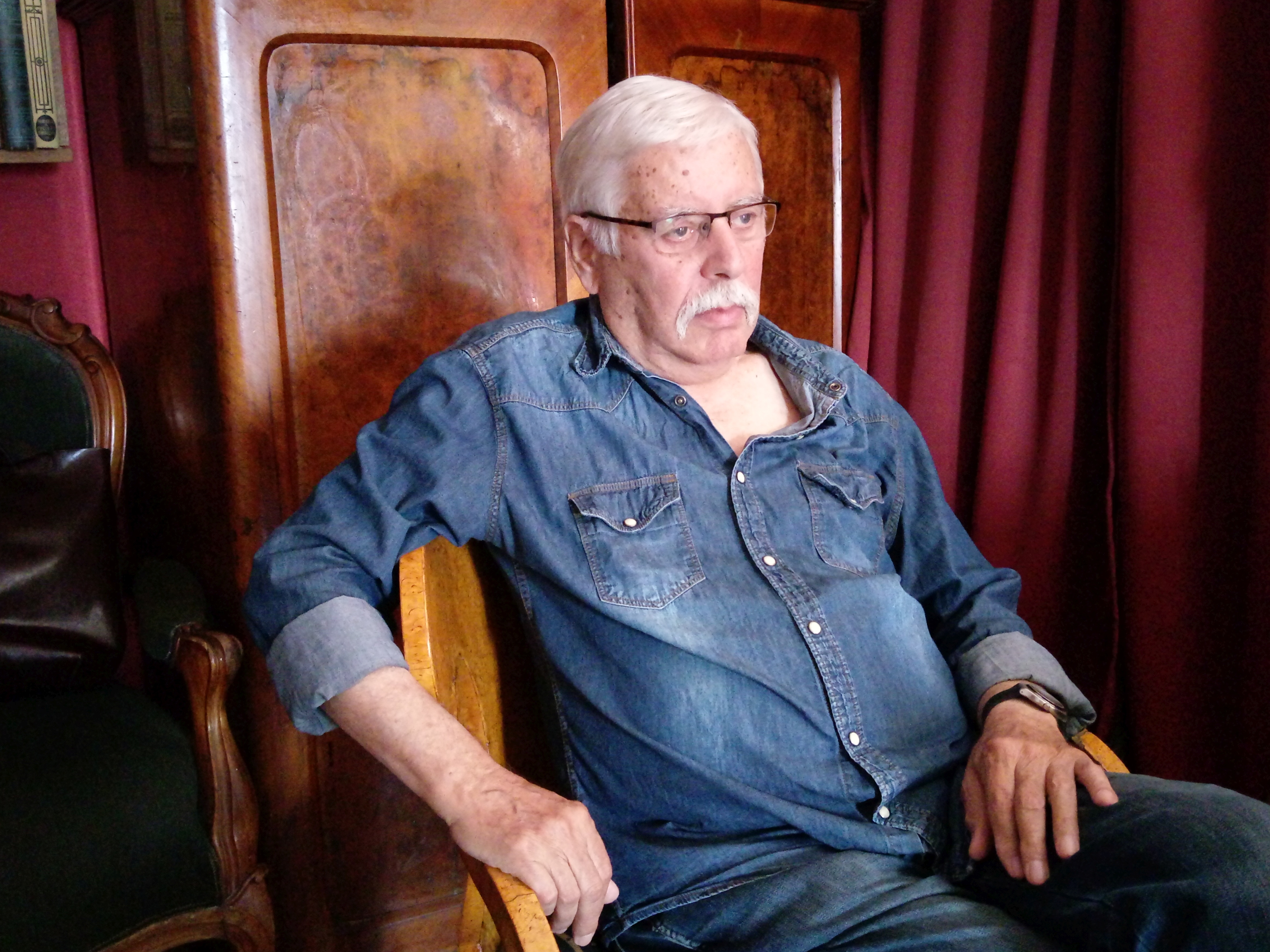
Ivan Tolstoy: Fans of well -designed domestic books are undoubtedly familiar with the name of one of the best Soviet and Russian book designers, Arkady Trojanker, who worked for many years in the Moscow publishing house "Book" and, in cooperation with colleagues, who created a unique appearance of a number of branded book series.
Recently in Moscow, I recorded two conversations with Arkady Tovievich. Actually, we will talk about books next time. Because today I proposed to name the "Troophael without a book", it is dedicated to the child’s childhood. At first I did not assume that my interlocutor’s childhood would be so dramatic. And the conversation began with the fact that on the screen of the computer I saw that Arkady Trojanker was preparing his new book - his own memories.
Arkady Trojanker: It is quite easy for me to talk on this topic, because I have comprehended a lot now, over the past couple of months when I have been engaged in this book. I put forward a very strange idea. It seems to me that for the start of the human, two positions are needed. One position is the bottom of human existence, and the other, on the contrary, is the top of human existence within culture, inside traditions. The middle does not bear fruit. Unfortunately, I belong to the first category. I had a family of Soviet inhabitants, without prosperity, without traditions. I know very little about my family and my past, my ideas and knowledge are limited to parents, I do not know the previous generation. They arrived in Moscow from Uman in the mid-1920s. I even suspect the mechanism of their resettlement. The father had a large family, there were five brothers and three sisters. The youngest of the brothers became interested in the revolution, in 1918 he plunged into this confusion monstrous, survived and made a career. So by some time he turned out to be a corps commissar of the Political Administration of the Red Army, was in Moscow, already had a rank, had some kind of reputation, and he managed to call a family here. This migration is Soviet, it is very wretched. Then, when I was born, and after the war, when I could see something, I rarely visited this relatives and I know that they lived in communal services, as was then strongly accepted throughout Moscow. We also lived in a communal apartment on Bakhmetyevskaya Street with all the joys and the hardships of this life.
She entered there, and there only the wind walks and the papers fly. And she never saw her son again
When the war began, two weeks before that our family took a family photo in the studio. There are parents, my three brothers and me. This is the only material for me to have some kind of communication with my loved ones. The brothers were distributed in this way. One brother was born in 1922, the next-in 1924, and the third year in 1930. Consequently, by the time of this photograph, the older brother had already served in the army, he is there in military uniform, in a cap, beautiful, as women who see this photograph say. Beautiful, wonderful small, he is there 18 years old. The second brother is also with a difficult fate. The third brother is a little boy yet, he is there 11 years old. And I, such a beak, are neatly dressed. Mother is still with traces of beauty, father is already a serious person, already a non -partisan Bolshevik. Once, when I asked him about something, he said that he was not a party, but a non-partisan Bolshevik. I could neither then, nor now understand what it was. Either you are a Bolshevik, or you are not a Bolshevik, but who is the non -partisan Bolshevik? This is all. Who is not a non -partisan Bolshevik, he sits, he doesn’t. So here is a prosperous family that was destroyed simply in two weeks.
June 22, 1941, Sunday, such a quiet morning that the fascist reptiles violated, and people learn about this only at 12 a.m. And this tells them Vyacheslav Mikhailovich Molotov. In my book, I picked up pictures when people are at a loss, at school, raising their heads, they listen to this speech from the reproducer. And Mother immediately appreciated everything that was happening, and rushed to the station, sat on Povik (there were no electric trains in the suburbs, there were such steam compositions), drove to some station, I don’t know in which direction, where was the camp of my older brother Boris. Walked, walked, came to the camp. I imagine that this is some kind of space behind a fence with barbed wire, some gates that I have never seen, but I think that they are about such an open gate. She says that she entered there, and there only the wind walks, dust and papers fly. And there is no one. And she never saw her son. He, as much time later, we learned, went missing. And in the reports that some military historians printed already in the 80s, was his last name, name, patronymic and it is written that he died in October 1941. For me, this was still hidden, I was not four years old then. The war began, I remember this very clearly. In our country, two anti -aircraft guns stood on the roof of a one -story kindergarten, I remember how they hung the sky at night. I stood, looked at these spotlights. It seems to me that I remember all this very well, this picture. I remember how she grabbed me when they announced the alarm, we fled down from our fifth floor to Mit, which was not far, two hundred meters, there was a bomb shelter, there we were sitting there. I hear these sounds, such a heavy atmosphere, without air, crying for children, female conversations.
Children's memory is incredibly selfish and closed on its own existence
The second brother decided, because it was autumn, because nothing was known about Boris ... I want to say that Boris was really admirable to the guy, he graduated from the school with a round excellent student, by the age of 18 he was already a master of sports in classical struggle. Then his coach raised this sport to some height. In addition to these advantages, I think that this loss was terrible for parents. And the second brother, Lenya, went to the military enlistment office, he was 17 years old to take him to the front and he would take revenge on his brother. But they did not take him to the front, because when they recognized his surname ... Some military men, officers, they knew this name and knew that this was a relative of the enemy of the people. And they did not take a relative of the enemy of the people, because he is unreliable. Then, when it was not up to the fat, he was called up, he was at a lieutenant school, they were cooked quickly and threw them at the front for a couple of months. He was wounded twice.
He talked little about these times, I only know that he was near Stalingrad, and then in 1943 he miraculously survived. He once told me how they were in the forest somewhere in the forest, there was a village nearby on a hill, but they did not know if there were Germans there, and he went with two soldiers or crawled to find out if the village was free. And they went outside, but there was Ferdinand. This is such a self -propelled installation as a tank, only there the gun caliber is huge. They were seen and pulled with shrapnel point blank. Only pieces remained from two soldiers, and his hand was torn off, he was all in the holes, it was two hundred holes. And he went down with this sleeve, ran to the forest, and then some were hospitalized. We saw him already in June. We returned to Moscow from evacuation in mid -1944.
From evacuation, I also remember a lot, she was not an easy business. Parents worked, I was alone. I remember my mother, she was black as your shirt. She was generally black, but her hair turned gray, she had a strong one, she was exhausted, black, gloomy, unhappy.
Ivan Tolstoy: How did evacuation go and where? What number? How old were you by that time? And what do you remember?
Arkady Trojanker: I had few years, this is the fall of 1941, I was 4 years old. I remember little. In general, the memory is very selective. I remember some scenes on the train already, and they are quite impressive. I remember how the train stops at some station (mainly the population of this train are women and children), women run to water pump, there are such a drinker for steam locomotives, and they run there to get boiling water. And I still can’t understand how it was possible, because the train could stand there for several hours, and could move in a minute, and how did they manage to return to the warmths? I remember an infinitely long bridge, farms that swim past, and below - a swamp, water. When I remembered this for the manuscript, we climbed into the map and I found out that it was somewhere in the area of the Saratov bridge, which was built under Nicholas II, an old bridge, because there is no other way.
The train came to Ufa. In some hut we stopped, we were distributed somewhere, and I am lying on the stove, early morning, the end of the night, I am alone there, because my mother went in line to stand, to make cards. And I feel strong hunger, find the bulb, begin to bite it, and it, according to my memories, is huge, more than my head. I take her with both hands and try to satisfy hunger. We stayed there, apparently, until the beginning of 1942.
I'm lying, getting alone. It’s dark, the blizzard howls, and I say aloud so that everyone has heard: "Now, if someone comes here, I will take and shoot"
But we were evacuated with the Fatherland factory, he was relocated far to the east, and I find myself again in the new reality, and I also remember very fragmented what happened there. This is far, this is some kind of land of the Kemerovo region, I now find out all this, and then I had no idea about anything. Some mining village called Anzhero-Sugene. There the plant stopped, unpacked its machines. This is a chemical factory, they did some medicines, it was then very relevant. We lived on the outskirts, apparently, because I don’t remember anything resident around. On the outskirts of the territory where there is such a typical four -story Soviet school. And I remember what life consists of in this house. The first floor is machines in clogged boxes, the entire floor is busy evacuated. The second floor is empty, we live there, we have a cool huge room with three huge windows, confusing absolutely.
I want to make a retreat. Children's memory is incredibly selfish and closed on its own existence, on itself. So, I sleep in some kind of box in the far corner, several more boxes that replace the furniture, there are inverted (apparently stools, a table), on one of these boxes there is a primus, which is excited in the evening. My memories are connected with fear, such a horror. Because the parents leave neither light nor dawn, and the father, and the mother work there, I am alone in this room, which is huge, exorbitant, and I am negligible there. These huge windows are black. In the middle of the day there is already night there, howling a blizzard, the snow knocks out the window. The fear is unthinkable. And I am alone there. And I know that there is no nobody around anyone around.
On the third floor, I then find that some fabric girls live there, I’m visiting them a couple of times, and I’m just such a Lalka, a gift, they squeeze me, drag me, I like it. And life associated with such anxiety is eternal - where are people, who will protect me? Another family lives on the territory of the plant, where there is a boy of about my years, and everything else is an unknown area where I do not show my nose. And this is what the Soviet government means: there are large aunts and uncles, a local or party committee, they decided that these "Gavriki" needed to make toys, we need to take them. And some carpenter made us a gun and a saber. These were real guns with a butt, with a tube in which there is a barrel, with some kind of chicken, real weapons. And the sabers were scabbard. And all - the fears are over. I remember how I am lying, sick, the throats of the frequent haunted me, I get sick, dark, howls a blizzard, and I am not scared already, and I say aloud, so that everyone has heard: "Now, if someone comes here, I will take and shoot." And I am protected. These are such strange flashes restless to that life. I was four to five years old when we returned to Moscow, I was not yet seven years old, so this age between four and seven years, it is such an animal age.
Ivan Tolstoy: I want to ask the animal what they read to him? Not only he had a gun and a saber, were there any books?
Arkady Troyanker: No, I don’t remember anything there at all. It was a life completely devoid of any ideas. I existed separately, my parents worked, tired, I do not remember any communication between us. It was probably. The strangest thing that I had a brother who was five to seven older than me. He was a schoolboy, he went somewhere to study. I don’t remember him, he does not participate in a single moment in his memory.
Ivan Tolstoy: And after the war, you discussed with him how it was his eyes?
Arkady Trojanker: After the war, we returned in 1944, and at the beginning of 1945 he died, he had some kind of serious illness. I don’t remember him here. I remember that I am at home, my father returns from somewhere, and he and his mother somehow stop at the door, hug each other and stand silently for a long time. And I understand that something happened fatal. I don’t remember him at all, I don’t remember what he was, what he could do.
I raised five children, three of them boys. The first boy, stepson, 1961, the second-1966, between them a difference of five years. And they, in addition to family ties, had a terrible rivalry, they mocked each other, behaved like small animals. And I thought that children at some age are small animals, and they only then, over time, study some human rules. And before that, they are animals and for them there are only those who serve them, parents. They depend on the courtes, they love parents, respect, because without them they understand that life is with a penny. Either I am a completely unthinkable person who does not remember kinship, or this is this effect. I don’t remember his brother, I did not do anything for me, I did not need him. These are strange conclusions to which memory leads.
Ivan Tolstoy: Where are you returning when you return to Moscow?
Arkady Trojanker: This is already 1944, this is the beginning or middle of the year, and we return to Moscow by train, and this is no longer warm, it is already a reserved seat car, also very much inhabited. I remember we drive up to the platform of the Kazan station, slowly the train enters the city, on the platform some kind of mess, people meet, run ... Many years have passed, my mother and I clung to the dirty window, and suddenly she says: "He!" We are met by the middle brother Lenya. I see some guy, he is not yet 20 years old, who is he? He also notices us on the train, and I see that he has his whole face in cotton swabs. He was discharged a week ago from the hospital, he had been lying there since 1943.
I don’t know how he succeeded, but he conquered our room in a communal apartment. The military family lived there, they left, and we drove there. And here is the house, we are entering there, an empty large room, two windows, something returns, I remember this interior since childhood. There stands a bourgeoisie, a pipe comes out from it somewhere out, and, in my opinion, one bed and a closet. The furniture that was with us, it is all exhausted in this bourgeois. Another life begins, a new completely unfamiliar life, a new return to the ordinary.
Ivan Tolstoy: We will talk about this new routine, about the Trojanker with the book with the famous book designer the next time.