
Translated material
In the wrong sector
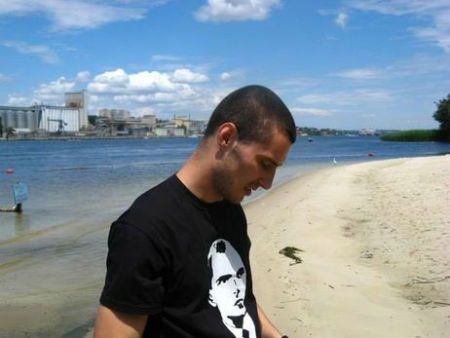
Alexander Shumkov. Photo with personal FB page
Criminal cases of participation in the "right sector" are a debugged conveyor. Not as productive as the persecution of supporters of the Hizb Ut-Tahrir, but the technology is the same: any indication of a person’s belonging to any kind of PS unit is enough to qualify the crime under part 282.2 of the Criminal Code (participation in the activities of an extremist organization). At the heart of cases - the decision of the Supreme Court of the Russian Federation of November 17, 2014 on the ban on the "Right Sector". Both Russians and Ukrainians who found themselves in Russia fall under the rink.
In the Sevsky District Court, near the border with Ukraine, the trial in the case of Ukrainian soldier Alexander Shumkov is actively developing. On October 5, he testified in which he spoke about the activity as part of the Right Sector, and how he ended up in Russia.
I have nothing to present purely according to Russian law - I was a member of the "Right Sector" only until November 2014. And the main thing that worries me is that the Russian Federation allows itself to prohibit the activities of organizations, political parties in the entire globe. I do not like that Russia intervenes in the internal affairs of other states.
So Alexander Shumkov expressed the essence of his attitude to the charges against him. He claims that he left the Volunteer Battalion of the "Right Sector" and became the personnel military forces of Ukraine before the corresponding decision of the Supreme Court was issued.
Maidan and further events
Yes, indeed, on the Maidan in December 2013 - January 2014 I was the commander of the Right Sector detachment called Poltava, ” says Shumkov in his testimony. - Later, after the overthrow of the power of Yanukovych, I was appointed personal guard Dmitry Yarosh. In the personal guard of Yarosh, I stayed until the end of May - early June 2014. Until November 2014, I was a member of the Right Sector, took part in the ATO, although this does not concern. In November 2014, leaving the Right Sector, I joined the Armed Forces of Ukraine. Later, although this also does not concern, I was seconded to the military prosecutor's office of the Kherson region.
Prosecutor Vladimir Minakov is interested in what rules of entry and exit from the "Right Sector". We publish further excerpts from the transcript of interrogation.
A.Sh.: November 28, 2013 - in fact, the day of the creation of the "Right Sector". Then there was neither the charter nor the rules. It was an informal movement into which members of several nationalist organizations ("Trizub", UNA-UNSO, "Patriots of Ukraine" and others) united to counteract the dispersal of demonstrations. There were a large number of people who had a certain goal. All my participation in this informal organization consisted in participating in a protest campaign on the Maidan and in other regions of Ukraine.
V.M.: Did these shares be non -state in nature?
A.Sh.: Yes, these shares were anti -governmental in nature, since we were against that government.
VM: What served as the basis for joining this organization?
A.Sh.: My inner views.
VM: Have you taken part in the capture of administrative buildings on the Maidan?
A.Sh.: This issue does not apply to the fact that they are charged with me: at that time the “right sector” was not banned in Russia.
V.M.: When you joined the "Right Sector" did you swear?
A.Sh.: I gave the oath of the Ukrainian nationalist, but this again does not apply to what is charged to me.
VM: Can you name the period when you were appointed commander called "Poltava", and how many members included in the specified group?
A.Sh.: December 2013 - January 2014. By quantity - 20-30 people.
V.M.: What actions did that detachment perform?
A.Sh.: Different actions that were aimed at overthrowing the power of Ukraine acting at that time.
Shumkov speaks in Ukrainian, using the services of a translator. This proposal is given to the translator with special difficulty. She picks up the words and says:
Various actions ...
... Gryamovani to the fuel of the Dihogo regime of Yanukovych, - repeats Shumkov.
Actions that are directed ...
... to the hollow of Vladi Yanukovych, ”Shumkov stubbornly dictates.
On the overthrow of the power of Yanukovych, - finally, the translator manages. The interrogation continues.
V.M.: Have you taken part in clashes with the "Golden Eagle"?
A.Sh.: I refuse to answer.
V.M.: When did you receive an offer to join the security unit Dmitry Yarosh?
A.Sh.: The end of February 2014.
V.M.: What was the responsibility when joining this position?
A.Sh.: Ensuring the protection and security of Yarosh and his family.
V.M.: Only Yarosh or the highest leadership of the "Right Sector"?
A.Sh.: In my duties - only Yarosh and his family.
V.M.: Until what moment?
A.Sh.: Until the beginning of June 2014.
VM: May 2 participated in some promotions?
A.Sh.: I refuse to answer.
VM: What happened after you left Yarosh's guard?
A.Sh.: After that, I joined one of the units of the Volunteer Ukrainian Corps - the 7th intelligence battalion. This is a structure created under the auspices of the "Right Sector", but not only members of the "Right Sector", but also, for example, the Sheikh Mansur battalion, which consisted of citizens of now occupied Ichkeria, included.
VM: Have you taken part in the hostilities?
A.Sh.: He took part in the hostilities against the terrorist organizations "DPR" and "LPR" in the territory of the Donetsk region.
VM: Did you find the assistance of the 93rd mechanized brigade?
A.Sh.: Both the 93rd mechanized, and 95th high-mobile brigade, and other Brigades of the Armed Forces of Ukraine.
VM: Was interaction in the brigades in Peskov and Karpovka?
A.Sh.: There is no such settlement - Peskovo. In general, I refuse to answer. You need to go yourself and find out.
V.M.: When did you get a contusion?
A.Sh.: The beginning of August 2014.
VM: What happened after rehabilitation?
A.Sh.: The process of issuing my contract with the Armed Forces of Ukraine went.
VM: Subsequently, did you maintain relations with the "Right Sector"?
A.Sh.: Specify what you mean: to sit drinking coffee or beer or participation in stocks?
V.M.: When you were already a soldier, did you take part in the actions of the Kherson cell of the "Right Sector"?
A.Sh.: No, he did not take part in this cell or in general in the organization.
V.M.: The commander of the 7th intelligence battalion took the decision to let you go when you reported that you were leaving the battalion?
A.Sh.: He could not make any decision of another. This is a volunteer battalion.
VM: Did you take part in September 15 in the food blockade of Crimea?
A.Sh.: No, I did not accept.
VM: "Ivanov" (secret witness. - Ed.) Said he saw you.
A.Sh.: Maybe he confused me with someone, maybe he invented it. But I was not there. If objectively looking at this situation, I cannot confirm that I was not there, so he cannot confirm what I was.
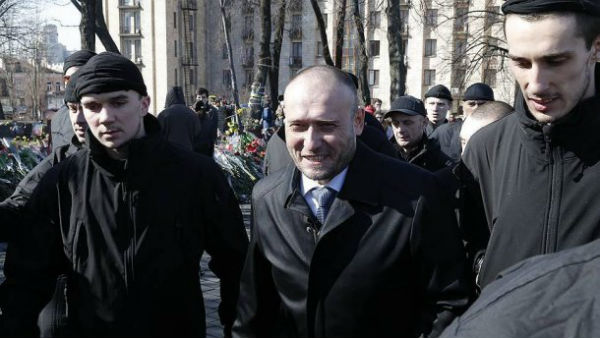
In the center - Dmitry Yarosh, on the right - Alexander Shumkov
The interrogation continues Judge Viktor Rukhmakov:
VR: You were at the Chongar checkpoint in the fall of 2015?
A.Sh.: In the fall of 2015, I was once according to military duties in Jongar and once on a red chaban.
VR: What did you directly do there? A.Sh.: The first time there was an incident in the border unit - careless handling of weapons or loss of ammunition. I left the investigator and I.
VR: At this time, a promotion was held at the Chongar checkpoint to block vehicles in the Crimea?
A.Sh.: Yes, as everyone knows.
VR: Were there representatives of the "Right Sector" there?
A.Sh.: On the checkpoint - no, but there were representatives nearby. I don’t remember if I talked. Someone could say hello to me.
VR: How were you dressed?
A.Sh.: In the military uniform of the Armed Forces.
VR: Was it symbolism of the "Right Sector"?
A.Sh.: No.
VR: Have you participated in October 2015 in promotions in the city of Kherson to intimidate the inhabitants who are against the blockade of Crimea?
A.Sh.: There were no such actions.
VR: Have you participated in the action to prevent the action on November 7?
A.Sh.: There were no such shares on the territory of Kherson.
Mysterious background
The Shumkov case could be ordinary among the repressions of the Russian authorities against citizens of Ukraine for actions committed in Ukraine. But there is also a mysterious story of how Shumkov was in Russia, as well as the events that took place in Kherson during the period when he worked as an interrogator in the military prosecutor's office. These circumstances were not completely clear. In many respects, they are connected with the key witness in the Shumkov case, his former colleague Mikhail Allanazarov, who declared in court that Shumkov actively participated in the activities of the Right Sector until 2017. According to documents from the Ukrainian Embassy attached to the case in court, Allanazarov is persecuted under Part 1 of Art. 263 (wearing, storage, acquisition, manufacture, repair, transfer or sale of firearms, combat supplies, explosives or explosive devices without the permission provided by law), part 3 of Art. 309 (illegal production, manufacture, acquisition, storage, transportation or transfer of narcotic drugs, psychotropic substances or their analogues without the purpose of sales in an especially large scale), part 4 of Art. 407 (unauthorized abandonment of a military unit or place of service, as well as non -appearance on time for service without good reason, committed in a special period, except martial law) of the Criminal Code of Ukraine.
The first two articles were charged with him when on May 17, 2017 a search was held at his house and ammunition, units of military weapons, and amphetamine packages were seized. He was placed under house arrest, he fled on fake documents to Russia, after which he was also charged with desertion. Earlier, he had already sentenced him to leave the military unit - three years in prison with a delay in the execution of the sentence.
In September 2017, Allanazarov became a witness to the charges of Shumkov, who by that time was in the hands of Russian investigators. In the summer of 2018, it became known that Allanazarov received a temporary asylum in Russia for a period of a year: he informed the Russian Ministry of Internal Affairs that he was forced to fight in the ATO.
The last time I promised to publish what Allanazarov told me in correspondence and by phone. I will start with his version.
Stand and Blablakar: the version of Allanazarova
In May 2017, Shumkov was visiting him, they drank. In the evening, Shumkov left, and in the morning Allanazarov found pistols and amphetamine bags at home. He called Shumkov and "asked what a garbage." He replied, "what will come, take it." 4-5 hours after the call, Allanazarov was a search. At this time, Shumkov came - to take what he left. As a result, the case of storing weapons and drugs was started on both. Law enforcement agencies, according to Allanazarov, counted eight weapons. - Did you leave for Russia because of this persecution?
- I would have left anyway. Since winter, I tried to quit the military unit. I did not go out of vacation due to rotation to the east (ATO). I was condemned for three years ... This is not quite a conditional term (but something like). Next, I just violated the daily routine, did not go to outfits, simulated illnesses. This is so that they do not get a criminal case, but simply dismissed by official inconsistency.
- This is due to the fact that you fundamentally did not want to fight in the ATO?
- Yes. I do not want to fight against my brothers.
Allanazarov says that he escaped the pre -trial detention center because he was aware of the criminal activity of the Kherson military prosecutor’s office and warned the interrogator about it. According to him, Shumkov under alcohol and mild drugs "told him a lot of what it is not necessary." He is sure that the prosecutor’s office did not fight the spread of drugs in Kherson, but actually created a monopoly in this area: the security forces, together with the civilians, took money and goods from the sales, sometimes beat and forced to work for themselves, and Shumkov participated in this. At the same time, "part of the money went to finance the right sector."
Allanazarov fled from arrest to Russia at the same time - in May. He lived in Moscow with relatives and waited for him to bring his real documents to ask for asylum.
In August, Shumkov contacted him.
- He began to explain that he had nothing to do with, that he did not want to substitute me, and he himself framed that the authorities decided to throw everything on him. He asked if I could help with work and housing in Moscow. He gave the coordinates of the maintenance station, at which I myself used to work. I did not work there, but I could arrange it.
Shumkov found a car to Moscow in Blablakar (a site for searching for fellow travelers and passing cars). On the way, he corresponded with Allanazarov, and then the last message came: "I give up the FSB." Shumkov’s phone no longer answered, but later the driver called and asked why he, along with fellow travelers, costs 12 hours on the border.
By the way, the FSB border guard operative Ruslan Kokulov, who actually began the pursuit of Shumkov in Russia, also said that Shumkov arrived "in Blablacar" when he testified at the trial for the second time (he was called twice), but said that he almost immediately released the driver and other passengers. However, for the first time, Kokulov did not remember anything about the car in which Shumkov was driving, and even found it difficult to say whether he was a driver or passenger.
In early September, they came to Allanazarov with a search: Shumkov told about him to investigators and called him, like himself, a member of the "Right Sector". The initial testimony of Mikhail states that he filed a questionnaire for joining the "Right Sector", but subsequently he explained that it was just a questionnaire to receive a newsletter from the organization.
Subsequently, Allanazarov claims, Shumkov threatened him both at a full -time bet and in court - in court, he gestured that he would cut off his head.
- Allanazarov at the time of my appointment by the head of the organization in the Kherson region for a certain time was in the “right sector,” Natalya Voteychkina, head of the structural unit of the Right Sector in the Kherson region, tells the Franes. - It was 2015. My task was to clean the ranks from marginal-criminal elements, as well as from all kinds of agents. Allanazarov ("Lumen") immediately came to sight. He incited various provocations and frankly criminal actions. Somehow “gulp” drugs. Do not close, if that. Namely, gulp. He offered to redo weapons. He was excluded from the organization.
Voteychkina sent a certificate to the court about this, the paper was attached to the case file.
Allanazarova was not forced to fight in the ATO, she said:
- As far as I know, in the part where Shumkov and Allanazarov serve, rotation to the east were in 2014-2015. Later no. Allanazarov is not a great specialist to have a need for war in him. At one time, mechanics were directed, and then voluntarily who had a desire. And pilots. But it was 2014. And in the battles they did not take part, performed transport functions. He did not drive his [Allanazarova] in his neck. That part is generally half Separ, many who do not understand at all that there is a war. None of that part is forcibly mobilizing.
Fatal jamb: Version of Shumkov
At the end of 2015 - early 2016, in the military unit A1604, I met Allanazarov Mikhail Yuldashevich. He showed the initiative to meet. Someone told him that I was in the personal guard of Yarosh, and therefore he became interested in my personality. From the first minutes of our communication, he began to talk about what was an activist of the Kherson team of the Right Sector, and even said that he was heading one of the structural units of the Right Sector. According to him, this was a unit to counteract the spread of drugs in Kherson. He said that this unit is engaged in searching and subsequent transfer to law enforcement agencies who distribute drugs. Shumkov continued to communicate with Allanazarov:
I had an official interest, I was the investigator of the military prosecutor’s office, and the circle of my duties included the search for operational information about possible offenses of military personnel and law enforcement officials. Allanazarov more than once informed me of corruption actions in the military unit, as well as among employees of the military registration and enlistment office. Thanks to his information, one law enforcement officer was detained, who organized a drug sales scheme through third parties. Further, during meetings with Allanazarov, I noticed that he himself was sitting tightly on psychotropic drugs. Subsequently, information from third parties went that Allanazarov began to openly use drugs on the territory of the military unit and offer them to other people. I decided to conduct a conversation with him so that he would change his mind, but, seeing that the person could not cope, he stopped his dense contacts.
Once in May 2017, says Shumkov, Allanazarov called, said that he had interesting information, and offered to call on his house. Shumkov was able to come in two hours:
- Arriving, I saw that he had a search in his apartment. SBU employees invited me to be present - not as a realized one, but simply to attend. I agreed, and the SBU employees found a large amount of amphetamine and several units of firearms in his apartment.
Shumkov says that he himself was brought to administrative responsibility and later fined for the fact that he had a gun, but there was no permission to carry it with him.
- I continued to go about my business, two weeks later in VKontakte, from my friends, I don’t remember who, I saw in friends of Allanazarov, dressed in the uniform of a Russian soldier with sergeant shoulder straps. Видно было, что страница недавно создана. Буквально на следующий день мои коллеги из военной прокуратуры сообщили, что Алланазаров исчез из-под домашнего ареста и в данный момент находится в розыске. Я ради интереса решил написать на этот аккаунт, он назывался "Михаил Иванов". И действительно, написав: "Миша, где ты, чем занимаешься, ты понимаешь, что тебя ищут?", - я получил ответ: "Коротки руки у вас, я служу России, Херсон ждет та же участь, что и Донецк, и Крым". Я ответил: "Ну ждем вас", - и прекратил с ним общение.
Спустя неделю-полторы, утверждает Шумков, ему пришло на электронную почту письмо от Алланазарова, который предлагал "сдержать эмоции" и сообщал, что у него есть информация о поставщике наркотиков. Он передал Шумкову контакты некоего мужчины и организовал возможность договориться о встрече и сделать контрольную закупку.
- В середине августа я созвонился с этим человеком, сказал, что я от Миши Люмена (у Алланазарова такой псевдоним) и что интересуюсь одним интересным делом. Человек предложил перенести наши разговоры в Телеграм, там он сообщил, что ему надо время, чтобы подготовиться. Через некоторое время он написал, что готов со мной встретиться, что мне нужно подъехать в город Бровары Киевской области. Выбрав определенный день, я выехал в город Бровары, мы с данным лицом обговорили детали встречи, встретились и поехали на машине кататься, по ходу обговаривая все детали. Мы договорились, чтобы этот человек изготовил мне амфетамин, торговались о цене и сошлись на 30 или 40 тысячах гривен. В конце нашей встречи он предложил мне попробовать амфетамин, я отказался, потому что химические наркотики не принимаю. Тогда он спросил, употребляю ли я марихуану, и мы раскурили небольшой косяк. Первый закурил я, почувствовал себя плохо и потерял сознание. Когда я пришел в себя, увидел, что нахожусь в машине не один, а были и другие люди, затем снова потерял сознание. В следующий раз я пришел в себя на территории РФ.
Признательные показания, по словам Шумкова, уже подготовили сотрудники ФСБ:
- Это была полная прострация, абсолютный стресс и шок, когда я понял, что нахожусь в руках ФСБ. Мне давали подписывать какие-то документы под предлогом, что если быстрее подпишу, то меня быстрее обменяют на военнопленных, которые находятся в Украине, а если не подпишу, то живым не вернусь. Я в тот момент не до конца в себя пришел. Была приглашена адвокат Иванцова (возможно, речь идет об Инне Иванцовой , адвокатский кабинет которой зарегистрирован в Брянске. - Д.К. ), которая повторила мне те же слова.
What is wrong
Ранее адвокат Фарит Муртазин, в настоящее время вышедший из дела, пересказывал Центру журналистских расследований версию Шумкова иначе. Шумков должен был встретиться неподалеку от российско-украинской границы с информатором по имени Михаил, у которого якобы были сведения о распространении наркотиков в зоне АТО. По словам Муртазина, когда солдат в дороге остановил машину и задремал, не доехав до границы, к нему заскочили несколько неизвестных и оглушили Шумкова ударами и электрошокерами, а очнулся он уже в России на допросе в ФСБ. Из цитаты в материале ЦЖР, правда, непонятно, ехал ли Шумков на своей машине и был ли он водителем.К сожалению, возможность задать вопросы Шумкову есть только у участников процесса. Целый ряд моментов остались для меня неясными. По какой причине изменилась версия о попадании в Россию. Какого числа Шумков поехал в Бровары и что происходило с 17 августа, когда, по словам как семьи, так и военной прокуратуры, с ним прервалась связь, и 23 августа, когда было оформлено его задержание в России. Почему он доверял Алланазарову уже после того, как тот бежал в Россию и заявил о пророссийских взглядах. Входили ли в его полномочия расследования только в Херсонской области и только преступлений, в которых замешаны силовики, и если да, почему он поехал в Киевскую. Как дым от предположительно отравленного косяка не подействовал на другого человека, находившегося в машине.
Еще больше странного в рассказе Алланазарова. На суде он говорил, что Шумков оставил у него только один пистолет, а мне - что среди найденного оружия был один пневмат Алланазарова, остальное принес Шумков. Как именно Шумков занес такое количество оружия, в отдельном пакете или достал из рюкзака, Алланазаров не рассказал. "Вы знакомых досматриваете при входе?" - задал он встречный вопрос. Он утверждал, что, когда он находился под домашним арестом, его сторожили "бойцы Шумкова", - но зачем, если они вдвоем проходят по одному делу? И после этого он все же согласился помочь с работой человеку, доставившему столько неприятностей, - Алланазаров объяснил, что Шумков ехал с большой суммой денег (и сказал ему об этом), а он рассчитывал убедить его поделиться, чтобы компенсировать моральный ущерб. Водитель блаблакара позвонил лично Алланазарову, чтобы узнать, почему его держат пограничники. На очной ставке Шумков угрожал прямо в присутствии следователя, будто бы бравируя связями в "Правом секторе" и "Азове".
Более или менее очевидным мне кажется одно: вряд ли Шумков в здравом уме поехал бы в Россию добровольно, даже спасаясь от преследования, - вот уж спасение так спасение.
- Я с 2014 года знал, что нахожусь в списках ФСБ, в списках врагов так называемой Новороссии. Я знал, что мне дорога в Россию закрыта.
Напомним, что по версии погранслужбы ФСБ , Шумков въезжал в Россию в ясном сознании, а внимание пограничников привлек тем, что отказался показать багаж. Подъехавшему на место инцидента оперативнику Кокулову он якобы сам рассказал, что состоял в "Правом секторе" и был охранником Яроша, а сейчас бежит из Украины, потому что СБУ нашла у него дома во время обыска огнестрельное оружие.
Военная прокуратура Херсона 20 октября 2017 года публиковала релиз о том, что еще в июне 2017 года в Херсонский горсуд были переданы обвинительные акты по делам о незаконном хранении пистолета и психотропных веществ в отношении Шумкова, а после его исчезновения 17 августа заведено также дело о дезертирстве. Родственники и сторонники Шумкова, в свою очередь, утверждают, что он не знал о преследованиях за хранение оружие и наркотиков до того, как оказался в России. На суде вопрос об уголовном преследовании Шумкова на Украине не поднимался, поэтому его позиция неизвестна.
В начале судебного процесса мне казалось, что постепенно многое прояснится. Но это возможно лишь в результате гораздо более глубокого расследования. Необходим интерес к этому делу со стороны украинских властей: ведь основная часть детективной истории происходила на территории Украины.
Но в любом случае глубоко ненормально положение дел, при котором Россия присвоила себе право "расследовать", кто и чем занимался на Майдане или как проводятся акции по блокаде транспорта в другой суверенной стране.