
Translated material
Walk from uprising to summer garden
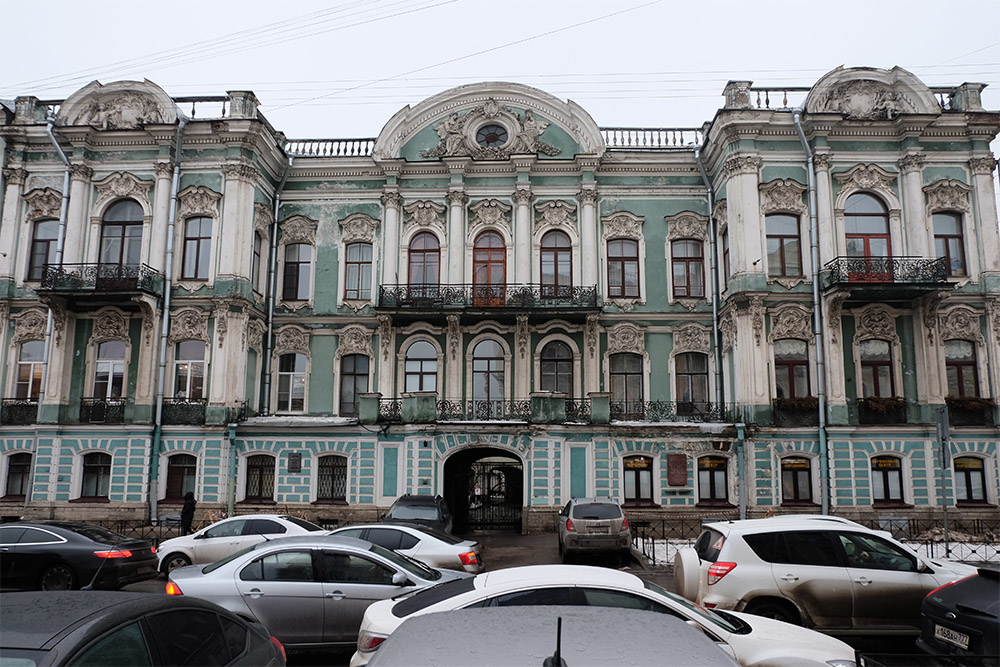
Every week, in the mailing list of Papers , the local historian Alexei Shishkin tells the amazing story of one of the St. Petersburg buildings, which we walk past every day.
Based on these letters, the “ paper ” was a guide for a walk in the center of St. Petersburg: from the building where the “St. Petersburg Jack-Righter” killed to the housing of Anna Akhmatova past the house with the “communal Mike” from the film “Summer”.
To read the stories of houses completely and every week to receive letters about city palaces and mansions, it is enough to subscribe to the newsletter here .
Kaplun's house
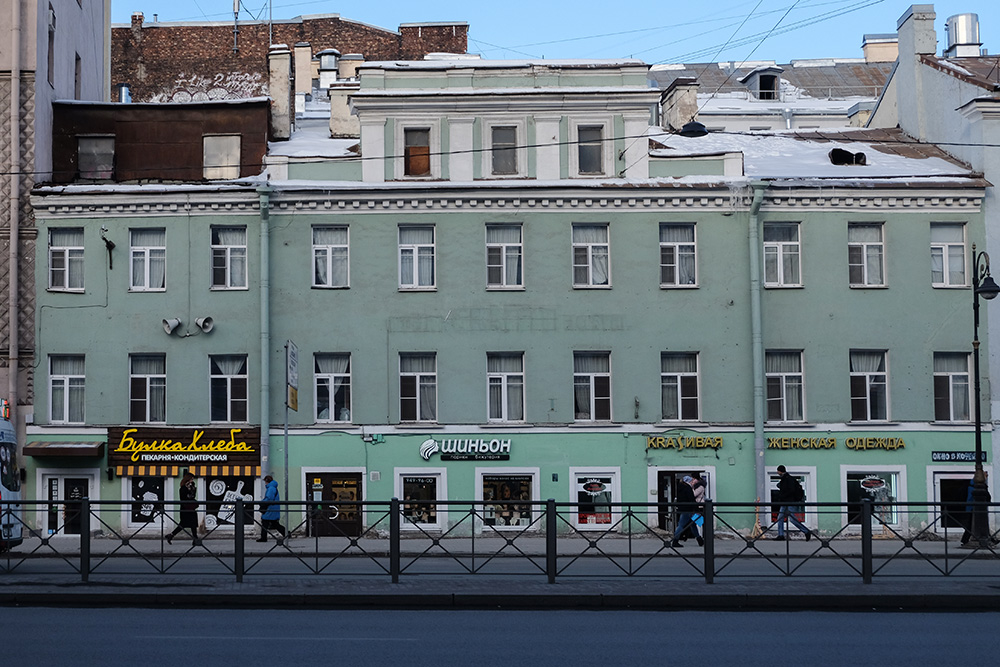
At the turn of the XIX-XX centuries in a dark green house with a mezzanine and murals in the courtyard, the Chocolate and Confident Factory S. Vasilieva, a meat shop of Zastlotsky, a POCHAMAN PAPTICE, a Linetsky hairdresser, an official wine shop and a beer, home Jewish chapter, furnished rooms “Versailles” and a hotel and a hotel "Danube." The owners of the building were a merchant Abram Kaplun with his son, also Abram.
It was in the “Danube” that the prostitute of Ekaterina Gerus, committed by former sailor Nikolai Radkevich, “St. Petersburg Jack-Rush”, who killed spectacular brunettes under the motto “Death to the Beauty!”
In Soviet times, the former hotel was transformed into a working hostel: here weavers and workers of the Pyotr Anisimov factory on the Obvodny Canal lived here, where the weave's loft is located today. Now in the house on Ligovsk there are office premises, the hostel Graffiti L, the Rude's Coffee Coffee shop, a bakery, a pharmacy, a hairdresser and a tattoos-salon.
Barcon's apartment building
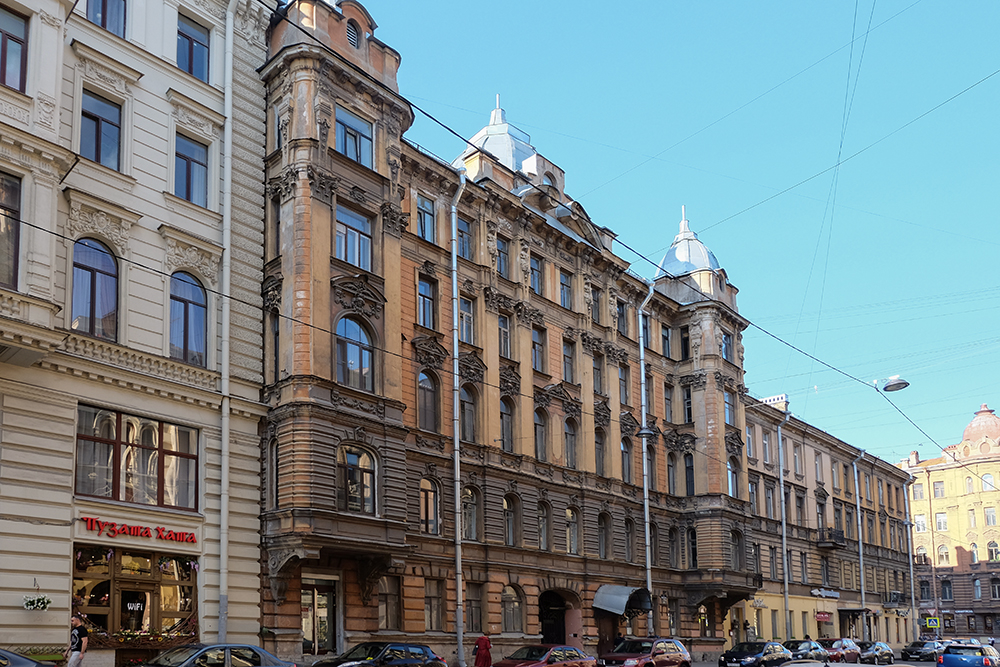
They began to build this house on the site of the old wooden in 1902. The owner of the site on the 42 basin (now - Nekrasov Street) was Mikhail Barkon. A native of the philistine family moved from Kolpin to Petersburg and began to trade with hay. It went, Barkon moved to the merchant class, moved to Nevsky Prospekt and decided to invest in a apartment building.
In 1906, Evgeny Fredericks, maid of honor and good friend of Empress Alexandra Fedorovna bought out the house at Barkon - the empress calls Fredericks in her letters only as “dear Nini”. After the revolution, the new government sent Nini to a concentration camp of special purpose for hostages-bourgeois, equipped in the former Ivanovo monastery in Moscow. She spent four years in the camp, after which she was able to leave the country and leave for Finland.
Immediately after the nationalization of the building, the artist Vadim Schulz, a student of Ilya Repin and a member of a group of artists-forwarding artists settled in it. Schulz lived at this address until 1942 and died in a blockade from exhaustion, was buried in the Bolsheokhtinsky cemetery.
40 years after the death of Schulz, a major overhaul was carried out in the house. In fact, only facades and internal capital walls of the central staircase remained from the original. Everything else was dismantled, changed, eliminated. In the early 2000s, when the announcements of the sale of real estate were published mainly in the newspapers and it was required to accommodate all the characteristics of the object in a few letters, such houses were described as “SF with the Kyrgyz Republic, ZhB”. That is: the old foundation, completed overhaul, the ceilings are replaced by reinforced concrete.
House with "Municipal Player T -shirt" from the movie "Summer"
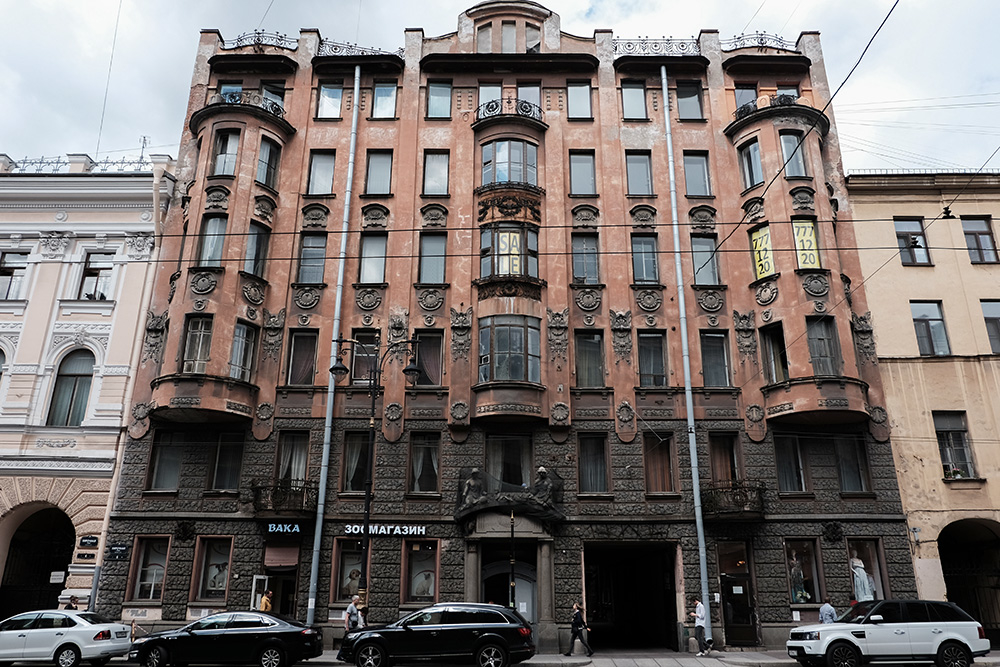
Eremeev’s apartment building, aristocrats and weapon designers lived here, and Kirill Serebrennikov shot a movie about Mike Naumenko and Viktor Tsoi.
Before the revolution, among the residents of the luxurious building, for example, the widow of Count Shuvalov, the nee Countess Alexander Vorontsov-Dashkov. Neighbor Shuvalova-Courland Baron, Major General and inventor of Russian “trench guns” Mikhail von Rosenberg.
There was no chance of avoiding the compaction in 1918 by Yeremeyev’s house. The new residents were working and technical intelligentsia. For example, designers of Leningrad factories and research institutes. The most luxurious living space went to the warrior engineer Vladimir Bekauri. Once Bekauri made a special unfinished safe for Vladimir Lenin's office. In the 1930s, Joseph Stalin decided to get this. The gunsmith was happy and executed the order with brilliance, but the head of the NKVD Lavrenty Beria demanded to provide drawings of the safe in the secret part of the Kremlin. Bekauri refused, in 1937 he was arrested. Under pressure, he “sincerely admitted” that supposedly for many years he spied on the third Reich and conducted subversive work. In 1938, Bekauri was shot.
By the 1990s, the house was not in the best condition: there was no overhaul here, the decor was dilapidated, dozens of families huddled in luxurious apartments. A long and difficult process of resettlement of communal apartments has begun. The new owners of apartments tried to sell them, but it did not always work out. For several years now, an apartment has been in the exposition on the third floor of the facial outbuilding. It takes more than half the floor. It was this apartment that played the role of a communal apartment in the film “Summer”, in which Mike Naumenko and his wife Natasha, who are attended by young Victor Tsoi, live.
House at the foundry
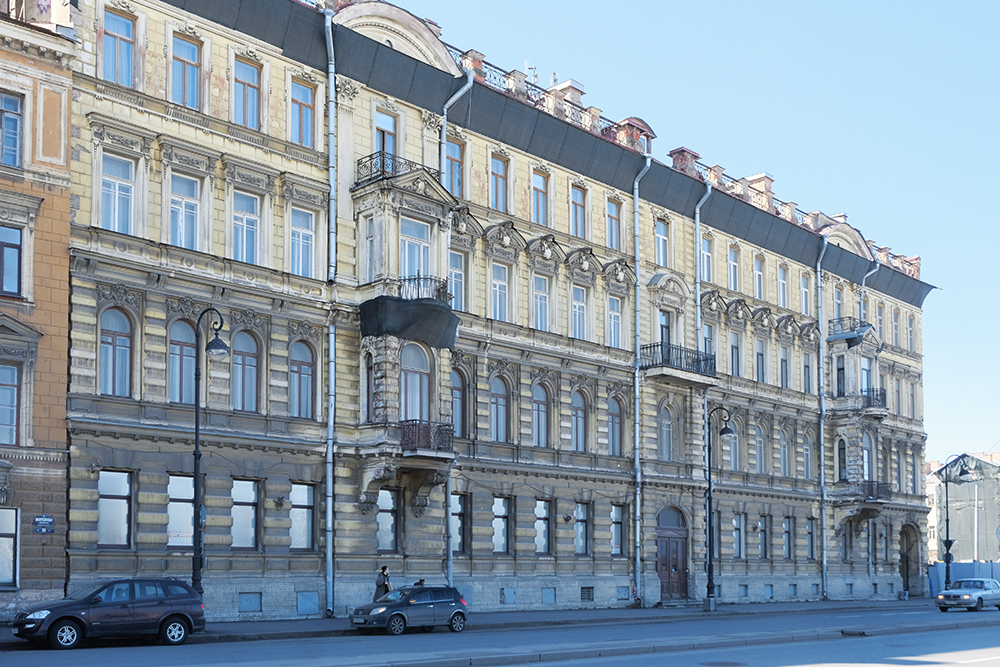
This house was built by order of the largest Jewish magnates of St. Petersburg Lazar Polyakov and Leon Warsaw, who were engaged in railways and banking. They were even called "Russian Rothschilds."
Almost immediately, they sold the house of the merchants of the Poluboyarinovs. The head of the family Dmitry Poluboyarinov owned a large publishing business; After the death of Dmitry, his wife, radical nationalist Elena Adrianovna not only continued her family business, but also actively began to engage in politics. She sponsored the Black Hundreds, was the faithful companion of the founder of the “Union of the Russian People” Alexander Dubrovin and in her own “domestic printing house” printed the newspaper “Russian Banner”.
Poloboyarinov was arrested in 1917, even before the October Revolution. The emergency investigative commission issued a verdict in favor of the merchant, but it was not released from the "Crosses". In 1919, the Bolsheviks shot Poluboyarinov.
As the building was used in Soviet times, it is not known exactly. In the 1990s, apartments returned to private property, now they are mainly used for offices and trading representatives. The owner of one of the apartments put up for sale today, several years ago, carried out the restoration of the front door: he restored stucco molding, doors, tiles and stained glass windows. Like many buildings of the “high eclecticism”, that is, the end of the 19th century, this house boasts a luxurious interior.
Ophenyak Buturlin
For centuries, the mansion was shot, set fire and rebuilt.
At the beginning of the XVIII century, the section of this luxurious house belonged to the closest associate of Peter I Vasily Korchmin-military, intelligence officer, and former engineer. After the death of the Korchmin, the site changed the owners several times. In the 1840s, Elizaveta Mikhailovna Buturlin bought the land in the 1840s: then the building was rebuilt in the style of Elizavetinsky Baroque (which by that time was almost a century as it went out of fashion)-for Buturlin it was a sign of belonging to an old noble family. Buturlin herself did not manage to appreciate the elegant appearance of her own mansion. She died in 1859 a year before the completion of work.
At the end of the 19th century, the Austria-Hungary Embassy was located here. In 1914, Count Frederick Sapari led the diplomatic mission, it was he who, on behalf of the Austria-Hungary government, declared war on Russia and left St. Petersburg. Soon, a patriotic crowd came to the embodied embassy mansion and defeated it. The former diplomatic mission was set on fire. Firefighters extinguished the flame lazily, mainly trying to prevent the fire of neighboring houses.
After the revolution, the mansion was turned into a residential building. During the Great Patriotic War, the facade of the house was actually destroyed by the air jacket - one of the organizers of the defense of Leningrad, the head of the local air defense, Emelian Lagutkin lived here; It was restored, but the last fragments of historical interiors were lost. The most famous inhabitant of the house in the Soviet period was the chess player Mikhail Botvinnik. Today the house is still residential: most of the building is reserved for multi-room apartments.
Baur's house. Residential building of the court department
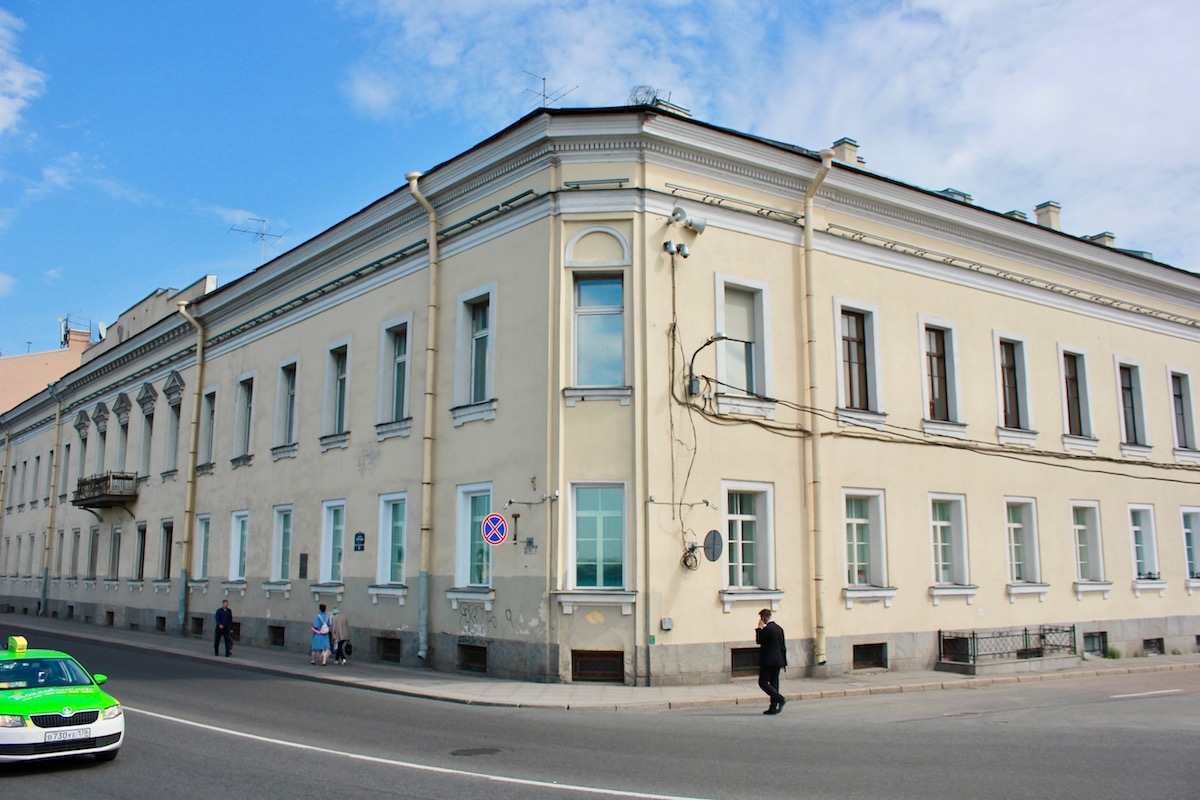
The building in the era of the reign of Catherine II was built for himself by Friedrich Wilhelm Baur, a military engineer. At the beginning of his career, Baur fought under the banners of Prussia Friedrich the Great for a decade and a half, but then decided to engage in science. In Russia, he was at the invitation of the empress.
In Russia, Baur designed fortresses, channels, ports, the first sewer for Moscow, the Bolshoi Theater for St. Petersburg. Today, his most famous creation remains the Taitsk waterflower - the water supply system of the parks of Tsarskoye Selo, guarded by UNESCO. Under the estate, Baur bought a plot of land at the source of Fontanka - the project of the granite embankment of the river with descents to the water, still developed by Baur himself.
After the death of the engineer, the house was bought by the court department. Until 1917, ministers of the imperial court of various specialties lived in it: doctors, architects, palace bureaucrats. The latter belonged to the father of the writer Dmitry Merezhkovsky Sergey Ivanovich. It was in the house on Fontanka that Merezhkovsky spent his childhood.
In 1924, Anna Akhmatova took one of the rooms turned into a hostel with her friend, the first fashion model of St. Petersburg and the artist Olga Glebova-Sudeikina. A friend left for Paris, and Akhmatova changed her place of residence, having managed to describe the view from the windows of Baur’s house in a “poem without a hero”.
Today, the address appears in all lists of informal attractions of St. Petersburg. People have been attracted by “mosaic courtyards”-from the mid-1980s, the artist and teacher Vladimir Lubenko, the creator of the studio on the Fontanka, who became known as “Club“ Volcano ””, the school of Vladimir Lubenko, and subsequently, the Small Academy of Arts, created the mosaic canvases.
In order to receive letters with stories of St. Petersburg houses every week, subscribe to the thematic newsletter of “Paper”