
Translated material
The promised three years are waiting
At a meeting of the Council of Ministers of Defense of NATO, they again talked about the expansion of the alliance, and on this occasion, disputes about the legitimacy of the process again boiled
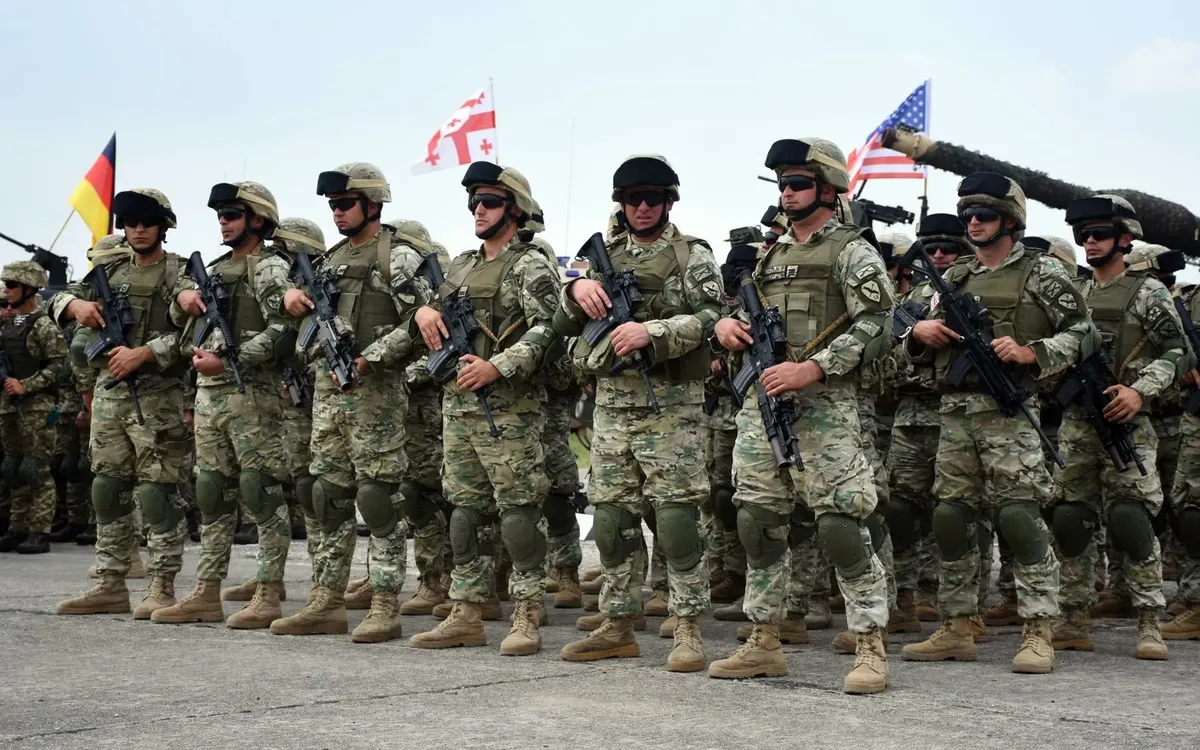
NATO Secretary General Jens Stoltenberg said, firstly, that Macedonia, who has been standing in line since 2009, after his renaming (and, accordingly, the removal of the Veto Greece), can be accepted into the alliance at the beginning of next year. Secondly, he noted that two years after the entry into NATO Montenegro, direct Western investments in its economy doubled. Finally, he made it clear for the first time that the problem of Abkhazia and South Ossetia would not fundamentally prevent Georgia in the Western block: “Georgia is completely optional to choose between territorial integrity and membership in NATO; She will become a member of the alliance as soon as she fulfills his standards. ”
In Moscow, they started talking about history again. The fact that the West treacherously violated the promise given by the USSR President Mikhail Gorbachev not to expand NATO east. They expressed Fe in connection with the fact that Montenegro and Macedonia chose NATO, and at the same time once again dumped Gorbachev with his restructuring and new thinking. The main document, which is quoted as a certificate, is a declassified recording of Gorbachev’s conversation with US Secretary of State James Baker on February 9, 1990. Moreover, not only convinced cheers-patriots, but also commentators such as the respected Vladimir Pozner.
“Mr. Stoltenberg is lying,” he writes confidently on his website. “Baker clearly promised Gorbachev that if Germany was allowed to unite, then NATO would not move beyond Germany.”
Gorbachev graduated from his presidency in 1991. In early 1990, when a conversation with a beaker took place in Moscow, it was unlikely that NATO could be discussed about the real expansion of NATO to Eastern Europe. The current disputes about whether the West promised the Soviet president not to accept new members to the alliance or not, brightly painted by today's consciousness and missed through his prism by the perception of earlier events.
At that time, tectonic changes took place in Europe. But no one in Washington or in Moscow even thought about the expansion of NATO, and this issue did not rise to the countries of Central and Eastern Europe. He could then be discussed only in the context of the hot topic of the unification of Germany. What should it become if it is currently divided between blocks? Shortly before the meeting of Baker and Gorbachev, the Genesher formula appeared (then the head of the Foreign Ministry of the Federal Republic of Foreign Ministry): not to deploy NATO military structures and troops in the territory of East Germany, even if the united Germany is entirely a member of NATO.
Both the West and Moscow recognized the undeniable: the process of internal integration of Germany gained strength, and it cannot be stopped. It was important that the reunion was not just as a result of the will of the Germans, but with blessing and under the control of the victorious powers in the Second World War. The care of the great powers was to prevent the revival of German nationalism and militarism, to restrain the transformation of Germany into a powerful military force in the center of Europe. I obliged the memory of two world wars.
On the morning of February 9, before entering Gorbachev’s office, Baker told the USSR Foreign Minister Eduard Shevardennadze: “Neutral Germany will undoubtedly acquire its own independent nuclear potential. While Germany, which is firmly connected in the reformed NATO - the organization is much less military, and much more political - it will not be needed its nuclear potential. Of course, there must be iron guarantees that the jurisdiction and the NATO armed forces will not advance east. And it is necessary to make in such a way that Germany’s neighbors are satisfied in the East. ”
From the context, it follows that this refers to the undesirable promotion of NATO structures to the eastern border of Germany, which would concern its eastern neighbors, primarily Poland.
Gorbachev told Baker about his morning conversation with Polish Polish Yaruzelsky. He expressed the opinion that the presence of American and Soviet troops in Europe would be a stabilizing factor. Gorbachev said that the Soviet Union did not want to repeat the script of Versailles, which allowed Germany to arrange.
“If Germany is neutral,” Baker reasoned, “this will not exclude its militarization. On the contrary, she can create her own nuclear forces, instead of relying on the American forces of containment. All our Western allies and many East European countries let us know that in their interests to preserve the military presence of the United States in Europe. ”
When Shevardnadze admitted that the leadership of the united Germany could want the Americans to leave, Baker firmly said: “If this happens, then our troops will return home; We will not leave them in countries that do not want our presence. ”
Baker summed up the conversation on this subject with the question of Gorbachev: which is preferable to Moscow - “United Germany outside NATO, completely independent and without American troops; or a single Germany, preserving NATO membership, but with a guarantee that the zone of jurisdiction and NATO troops will not advance a inch east of their current border? ”
Gorbachev said that the expansion of the NATO zone "would not be acceptable." “We agree,” Baker answered.
Whether they had one and the same thing, it remains to guess. Some commentators, including American ones, doubt that Baker had in mind only East Germany, and not at all any NATO extension east. For an experienced negotiator and a cautious lawyer, it seems very unlikely that he did not use a certain terminology, they say. But this is only an interpretation.
The recording of the conversation of February 6, 1990 between the Minister of Foreign Affairs of Germany General and his British colleague Douglas Herd also gives. The German minister said that the Russians should have confidence that if, for example, Poland once leaves the Warsaw Treaty, then the next morning it will not join NATO. Gensher and Herd talked about this Shevardnadze. But it did not reach specific agreements. Poland, Czech Republic and Hungary joined NATO 9 years after the dissolution of the Warsaw Treaty.
In subsequent contacts at a high level between the United States and the Soviet Union, which there were many before the collapse of the USSR, the question of the expansion of NATO was never raised and clarifying words according to the agreements of Baker and Gorbachev, judging by the affordable sources. Apparently, really the problem was not relevant.
Now the illusion of the inclusion of Russia in the world system built on Western principles, like other post -communist countries of Europe, is an illusion. Then it didn't seem so.
The historian Ron Asmus, who in 1997–2000 served as deputy assistant to the US Secretary of State and was actually the main “Sherpo” of the NATO expansion process, told me that the movement to receive new members from Central and Eastern Europe began only under Clinton's administration. With Bush Sr. in the American establishment against the backdrop of general indifference to foreign policy, after the end of the Cold War, this idea would be more than cool. Even when Clinton in the spring of 1993 personally set her a positive tone and, responding to the request of Vaclav Gavel, Lech Valenes and Arpad Gyetz, invited them for a conversation on this subject, there were many skeptics in Washington. But these countries themselves - Czechoslovakia, Poland and Hungary - were already persistently knocking on the door of the Western Alliance.
If we talk about the legal side, then in 1990 the United States and the USSR discussed the future of Germany from the perspective of powers - winners in World War II. They exercised legal rights and obligations to determine the orientation of new Germany in the field of security. But they did not have such rights in relation to the sovereign states of Central and Eastern Europe.
In the same 1990, having adopted, along with 32 European states, the USA and Canada, the Paris Charter, the Soviet Union recognized the right of all European countries to participate in defense alliances. Their expansion, including NATO, is not the seizure of territories, but the voluntary entry of states into the organization. Russia could offer Montenegro and Macedonia to join the CSTO or, say, in the SCO. But they chose NATO.