
Translated material
Most, say ...
The answer to the chairman of the Constitutional Court Valery Zorkin, who published in the Rossiy newspaper the article “Letter and Spirit of the Constitution”
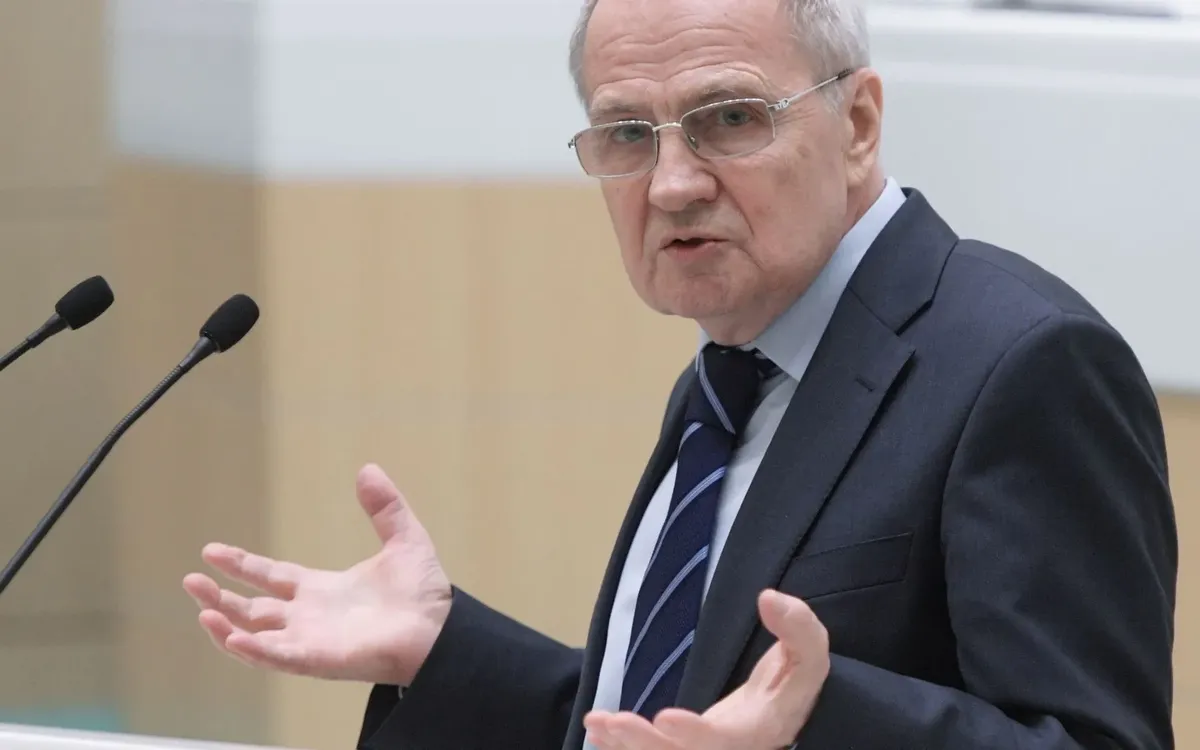
Valery Dmitrievich, with part of your text, you can certainly agree, although what you have said is well -known and has already been discussed many times. I, like you too, are disturbed by calls for cardinal constitutional reforms. I, like you, are convinced that the constitution is not to change dramatically. That its defects and other shortcomings are “quite corrected through point changes, and the deep legal meaning embedded in the constitutional text allows you to adapt this text to changing social and legal realities within the framework of the doctrine of the“ living constitution ”adopted in the world constitutional practice.
There is no doubt that "we need to continue to follow this path, trying to understand deeper, reveal and constantly develop the legal potential of our basic law." In this way, including our youth, in the framework of the “Read the Constitution” project, is going on. The guys really read it on the streets, and together with the text of the very basic law they are delayed for the "inconsistent public event." Don't you know about it?
There is no doubt that "talking about the fact that you can change the structure of life with the help of legal decisions alone is naive idealism." I absolutely support you that “it is necessary that the opposition has a real opportunity to come to power within the Constitution, i.e. On the beginning of honest political competition, ”and that“ we need a search for a new, more effective model of democracy ”. But why are you addressing these conclusions to the population, and not to the parliament, which created special legislative conditions for the opposition to the authorities and to which, in accordance with the Constitution and the Law on the Constitutional Court, can you apply publicly and officially with special messages at any time? Why aren't you doing this?
You write: “We now need such an adjustment of the liberal-individualistic approach to law enforcement (dominant in today's world theory and practice), which would bring to the very concept of the right of the idea of solidarism, we need a legal theory synthesizing the concept of the right of individual freedom and social solidarity.” Who would argue ... But at the same time, the Higher Attestation Council rightfully rejects the brilliant dissertation of Professor Irina Alabastrova, dedicated to the study of relationships and the mutual influence of constitutional law and social solidarity, which is evaluated by the author as a paradigm of constitutionalism, manifested in all its principles and institutions. Read. You will be interested. As well as it will be curious to look at the arguments of experts of the Higher Attestation Commission.
However, part of the arguments raises questions. For example, what do you mean by “state charity, dictated by considerations of political expediency”? This, apparently, about state grants to the "night wolves"?
Because it is politically inappropriate to support, for example, observation of elections, counteracting torture and the fight against corruption, but the state needs Cossacks with nagikes.
What “the majority expressing folk mentality” are you talking about? Who is the majority? Is this a VTsIOM? Or is it the majority that is formed by an unscrupulous television propaganda? Or the parliamentary majority, which became such as a result of not quite free and not quite fair elections? Give the definition, professor!
Having studied your theses, a member of the HRC Anita Sobolev was expressed absolutely for sure: “If slaves are a minority, then you can not free them if the majority is against it. If the old ones are a minority, you can not pay pensions at all if most young people vote for it. ”
You write that we "we must be able to combine collectivism inherent in the Russian people on the basis of the constitutional principles of the legal, democratic and social state - with the creation of a competitive economic and political environment." But where did you get this collectivism from? This is what scientists write about this:
“Our society, our society is complicated, multi -application and diverse. If you try to highlight some public opinion, a certain general idea of the values separated by the inhabitants of Russia - and this also has numerous confirmations in research work - we will see the next picture. We will see a society that separates those values that are commonly called European. We will see an individualistic, consumer, largely atomized, very low-religious, mainly second, with a rather low tolerance of state violence. ”
And no collectivism.
You argue that Russian society is characterized by some specific ideas about the dignity of a person or, in strict accordance with your text, "the idea of the dignity of a person that is not characteristic of society." That is, in your opinion, Russian society is not characterized by ideas about dignity? And it is to this that you are urging to “adapt” the Russian constitution?
About the alarm. I was extremely surprised by your claims to the 12th article of the Constitution. Yes, local self -government may well contrast itself with state authorities, since it is not its "lower, local link." This is an independent system with its powers and tasks. You are contradicting yourself, leading to the example of the commune of Switzerland.
Well, the last. Your course of thought about Russian constitutional identity and the long -term term “limit of pliability” is extremely unsympathetic to me. And if in previous texts you were not so frank, now, perhaps, some clarity comes. It seems that you are claiming that the court you head is officially endowed with the status of “truth in the last instance” in case of disagreement with the ECHR. After all, do you mean this by the “limit of bluntness”, which has already been tested in some decisions? You complain that the European Court is more free in choosing its position, and the Russian Constitutional Court has a more stringent legal framework. That is, expand me the framework, and I will determine all the limits to you - within the boundaries of political expediency. Or did I still misunderstand you? Well, if so. But doubts gone.