
Translated material
Two paths for three churches
After the decision of Constantinople, the Orthodox in Ukraine are faced with a choice between the new local church and fidelity to Moscow. The choice will be historical
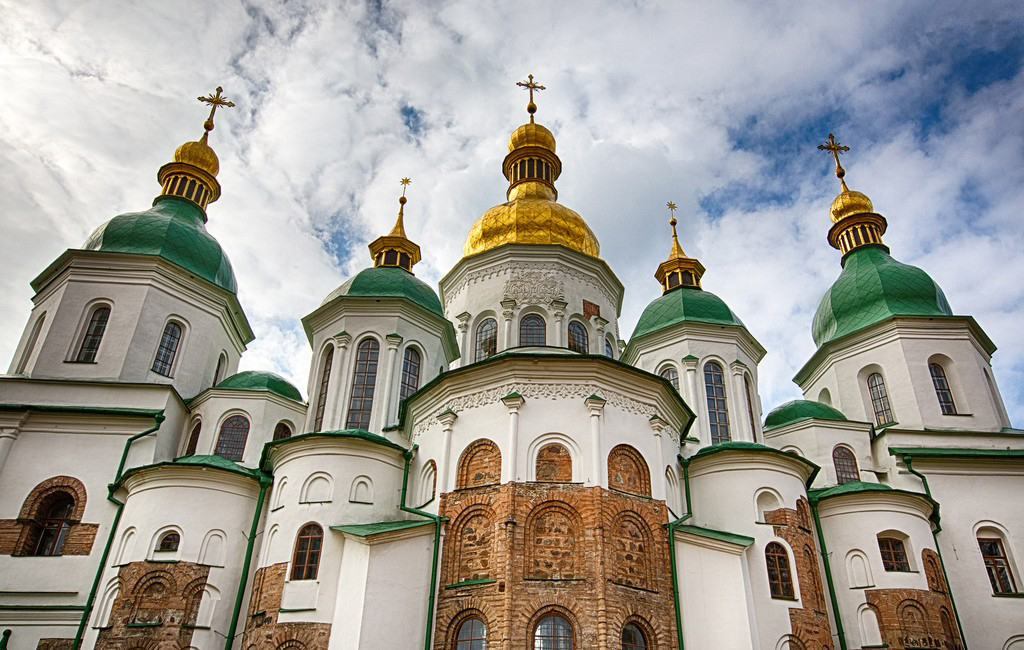
Sofia Cathedral in Kiev Photo: Wikiway.com
The process of creating a local church in Ukraine continues. On October 10, the Synod of the Ecumenical Church took another important step. Earlier, only the parishes and dioceses of Metropolitan Onufry, subordinate to the Moscow Patriarchate, and two other jurisdictions, the Kiev Patriarchate (UOC -KP) and the Ukrainian autocephalous Orthodox Church (UAPC) were considered canonical. Constantinople lifted the prohibitions from these two jurisdictions and thus equalized all the Orthodox parishes of Ukraine in the situation.
A completely new situation arises. After receiving Tomos, the old idea that Ukraine is the canonical territory of the Ukrainian Orthodox Church of the Moscow Patriarchate (UOC MP) will disappear. The canonical territory of the local church of Ukraine arises.
Promoskovsky parishes
Before the parishes of the UOC -KP and the UACC, the choice is less complicated: if they do not pour into the unification process, then they will lose all hope to gain canonism. After all, they previously expected that in the future they would receive the recognition of the Ecumenical Patriarchate. And this opportunity arose.
And for Metropolitan Onufry, this is a difficult choice. And he is historical. To remain in the canonical subordination of Moscow - this means putting parishes in a rather strange position. What is their future? In the new historical situation, they will inevitably be marked as “Moscow” parishes. The Kyiv civil authorities emphasize that the state will not interfere in the process of unification. But even if this is so, it is obvious that the “mirror coup” of the whole picture will occur. The Moscow parishes were the only canonically recognized both Constantinople and all Orthodox churches, and now - although they will remain canonically recognized, but already in the position of the “Diaspora parishes”, that is, in the position of obviously “promotional” parishes - against the background of the new canonical local church.
Looking at the future, it is difficult to understand why the Ukrainian episcopate to associate himself with the concept of the “canonical territory” of the Moscow Patriarchate, which will inevitably crumble. Since it rests only on the “geographical map” of the Russian Empire, the Soviet Union and the geopolitics of the period of the two -block system.
In the new reality, none of this. Whatever the dispute around the 17th -century documents about the powers of the Moscow department today, it is clear that Moscow will not be able to rely on its imaginary imperial map in the future.
There is even an opinion within the Russian Orthodox, which for Russia would be better to complete the entire history of the “exarchates” outside the borders of the modern Russian Federation and remain within the “National Church”. For example, Archimandrite Kirill (Govorun), speaking in Prague on October 9, said that the process of creating a local church is so complicated that we cannot predict its results for Ukraine, but for Russia it would definitely be good.
Russian -speaking church
The local church of Ukraine - like any national church, will not be national in an ethnic sense. Exactly just like the Ukrainian army - after all, soldiers and officers with Russian surnames are fighting and dying in it on the side of Ukraine, fighting against the aggression of Moscow.
The temples of the canonical church, recognized by Constantinople, will create a new phenomenon - this will be not only a large Ukrainian -speaking church, but also Russian -speaking.
And this forces us to recall the “Russian Exacaart” by Metropolitan Evliy (controlled Orthodox parishes in Western Europe in the 20-40s of the last century). Indeed, in the 30s, the Russian Orthodox in Paris were subordinate to Constantinople. Georgy Fedotov, Anton Kartashov, Vasily Zenkovsky, O. Georgy Florovsky, and then O. John Meyendorf - the heritage of these theologians is studied in the Orthodox seminaries of all countries. They are a common heritage. And they were "Constantinople."
It is clear that there can be no “split” of world Orthodoxy on the basis of creating a local church in Ukraine. For the Orthodox, temples of all jurisdictions are open.
But there will be a formation on the one hand, a large local church within the boundaries of European oriented Ukraine. And on the other hand, the deterioration of the image of the Moscow Patriarchate, which decided to tie itself to a specific political course in post -Soviet Russia. It is clear that Metropolitan Onufry and his episcopate will inevitably have to consider the consequences of this grandiose historical choice.
The probability of conflicts
It is still unclear at what pace the creation of a local church will go. The civil authorities of Ukraine, for which it is important to comply with European norms for freedom of conscience, will, of course, be careful for Moscow parishes. But there will be conflicts.
It is already evident how the line of propaganda conflict is being constructed: part of the Russian -speaking Ukrainian resources publishes a deliberately distorted picture of the entire plot with autocephaly, then this is picked up by the Kremlin media. All this falls on the head of a wide Russian -speaking audience of both countries. The Kremlin also acted in the Baltic countries in many cases, encouraging the inactive local Russian -speaking resources, and then widely using their messages in their media networks with a huge audience.
The Moscow Patriarchate is drawn into the Kremlin’s game against Ukraine. But this will end exactly in the same way as her forced cooperation with the Politburo of the USSR once ended-a severe historical injury.
* Alexander Morozov - Russian political scientist, researcher at Karlov University (Prague).