
Translated material
Karo Alabyan as a myth
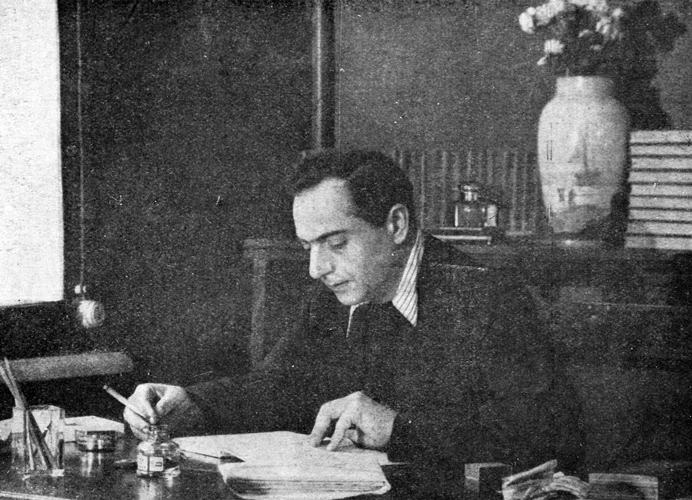
At the end of October, the Moscow City Duma must make the final verdict on the project of installing the monument to the architect Karo Alabyan. The idea of the monument proposed a month ago by the Armenian embassy received a positive conclusion from the Department of Cultural Heritage of Moscow and the Committee on Architecture and Urban Planning, but caused a surge of polemics and even a noticeable split in the professional community of architects and researchers. Alexander Selivanova , head of the Center for Vanguard at Shabolovka, an architectural historian and a post -constructivist turning specialist, who is commonly called the “1935 style”, spoke out with the protest and petition against the installation of the monument. The letter against the monument from the professional community was signed by more than forty people; Among them are the architect Yuri Avvakumov, architectural historians Dmitry Khmelnitsky, Ilya Pechenkin and Nikolai Malinin, art historians Milen Orlova, Anna Romanova, Tatyana Levina and Evgeny Kikodze, Markhi teacher Vladimir Davydov, leaders of the Institute of Modernism Anna Brovitskaya and Olga Kazakova.
Selivanova has been fighting for several years to revise ideas about the role of Karo Alabyan in the history of Soviet architecture. The conflict, which is in the focus of her attention and about ten years ago was one of the topics of her dissertation, is associated with the activities of VORO - the All -Russian association of proletarian architects. In many respects, a similar RAPP in the literature and AHRR in painting, the role of Vopra was expressed in stripping art from “formalism” on the eve of the creation of a single and controlled party of the Union of Soviet architects, the initiator and responsible secretary of which was Alabyan. By the end of the thirties-the beginning of the forties, the architect concentrated in his hands and other key leading positions-the first vice president of the Academy of Architecture of the USSR and the organizer of the Commission on Scientific and Technical Problems of Construction, the head of the design and mastery workshop of the war years, a member of the Committee on Architecture Affairs of the USSR and the author of the project of restoration of Stalingrad; He also controlled the main professional publication - the journal "Architecture of the USSR". Alabyan’s active participation in the fight against “formalist architects” (who then considered such leading masters as Barshch, Sinyavsky, Burov, Ginzburg, Golts, Leonids and Melnikov) and his close relations with the party leadership allow us to read the proposal to establish the monument as the next point among significant non-stop cultural gestures of recent years, such as the exhibition . Alexander Gerasimov in Gima or “romantic realism” in the Moscow arena .
The history of party interventions in Soviet art is gradually fading and losing its acuity. The prospect of heirs is replaced by the general descriptions of the art process, and the details of the private life of individual figures temporarily are more important than their socio-political role. It is likely that Karo Alabyan will remain in collective memory not as an official, but as a co -author of the unusual project of the five -pointed building of the Russian Army Theater. Nevertheless, it is impossible not to notice that there are already three commemorative signs in Moscow (or rather, even four, if we consider the well -known monument in the Novodevichy cemetery) - and these signs are known to almost everyone. This is a memorial plaque on the house where the architect lived with his second wife, actress Lyudmila Tselikovskaya, named after him Alabyan Street and a recently built Alabi-Baltic tunnel.
About what is the reason for such intense attention to one figure and how much it clarifies or obscures the real personality of the architect himself, the architectural historian, the specialist in Armenian modernism Karen Balian, the grandson of the schedule and poster Tchat Khachwankyan (1896-1940).
There are people and events of the past in the history of which the facts are mixed with myths. It is difficult to judge them objectively. This is especially true for those who lived in monstrous Stalin's time. I think that the name of Alabyan turned into such a myth, containing more questions than answers.
I heard the name of Alabyan since childhood. Grandfather’s sister in the thirties worked in his workshop, and I knew that it was a famous architect, that he was friends with his grandfather when they studied at Vchutemas. I have not seen my grandfather - he died in the Magadan camp long before my birth. But everything that was connected with him was very interested in. Much of my grandfather’s life had no exact actual confirmation and seemed to me a kind of myth. Part of this myth was the figure of Alabyan.
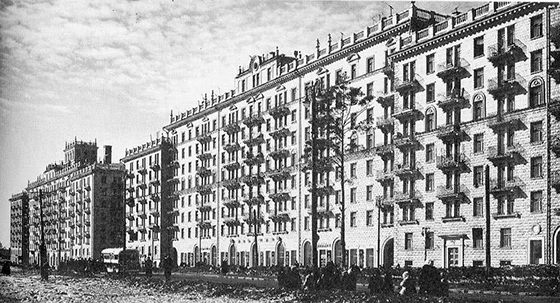 © Oldmos.ru Alabyan Street in Moscow. Mid-1950s
After the end of Vhutin (as since 1926 was called Vhutemas), Alabyan worked in Armenia for two years. In 1931, he returned to Moscow. During these two years, he and his two friends - Gevorg Kochar and Michael Mazmanyan - created a new direction in the architecture of Armenia. I call it "Armenian constructivism." Selim Omarovich Khan-Magomedov, the main authority in the history of the Soviet avant-garde, believed that "the innovative architectural school of Armenia of the late 1920s-early 1930s can be considered as one of the first (not only in Soviet, but throughout the world architecture) successful attempts to form modern national characteristics." All the buildings of Alabyan in Armenia were strictly constructivist. Among them is the “chess house”, house-community. I think this is the best work of Alabyan - the project begun, by the way, was begun in the last Vhutemasov course, the project was completed together with Mikael Mazmanyan.
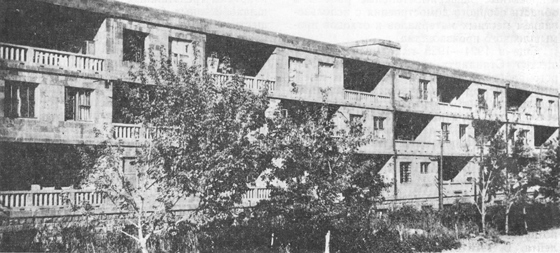 Yerevan. "Chess" residential building. 1930. Architects K. Alabyan and M. Mazmanyan
But constructivism in Armenia will be defeated, repressed, and still by and large is not rehabilitated. Today, almost all buildings are either destroyed, or are in a dilapidated state. Mainly late, post -constructivist works have been preserved. A purely constructivist trace left by Alabian is almost erased. At the same time, in Yerevan there is a street named after Alabyan, and there is a memorable sign dedicated to it.
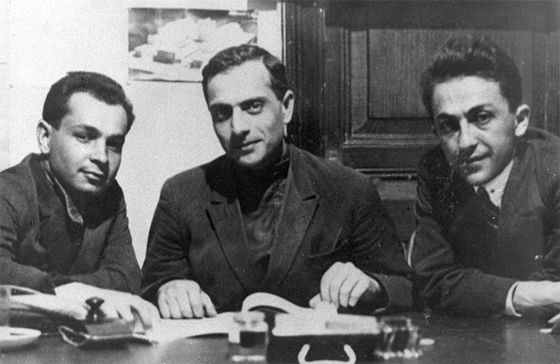 From left to right - Gevorg Kochar, Karo Alabyan, Samvel Safaryan. 1930s
Five post-constructivist years-from 1932 to 1937, when interesting works were created in this style that subtly combines with the rational, constructivist compositional basis of the elements of the classics and ar-deco-will not save the founders of constructivism in Yerevan. In 1937, Kochar and Mazcanyan will be arrested. Nikolai Buniatyan, chief architect Yerevan, invited to this position, Tamanyan, will be arrested. The Buniatyans, like Shchusev, knew how to work in both “Super-Was” (again the term Khan Magomedov). At the same time, Alabyan was at the top of the architectural power in Moscow. At the same time, Kochar and Mazcanyan will not find themselves in the camp, but in the sharashka, survive, return to Armenia and still have time to build modernist buildings. Buniatyan will be able to rescue from the Yerevan prison. He will leave for Moscow, will manage the graduate student of the Academy of Architecture. Did Alabyan attitude towards this series of events?
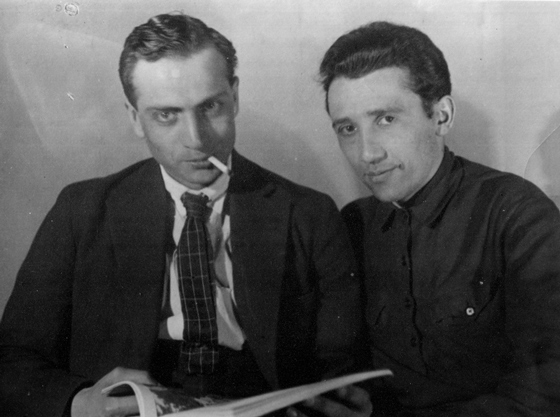 Karo Alabyan and Michael Masmanyan. 1930s
The most famous building of Alabyan in Moscow is the Red Army Theater (together with Vasily Simbirtsev). The architecture of this building, similar in terms of a five -pointed star, is also an architectural myth transmitted from generation to generation. The myth that Kaganovich circled the inkwell with a pencil is the myth that the idea belongs to Stalin. At the same time, there is no story about the emergence of an image in the imagination of the architect himself. Meanwhile, to think that this cannot be, it means obviously to simplify the ideas about the architectural process. How many buildings of the late Soviet time are there in the same Armenia, in the plans of which the architects entered the forbidden cross, subordinating the functional decision to its contours?
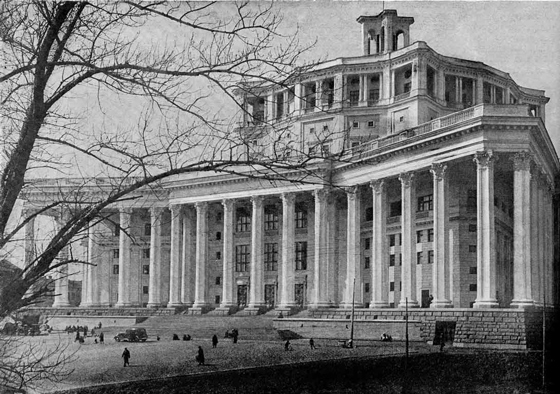 Moscow. Red Army Theater. 1934-1940. Architects K. Alabyan and V. Simbirtsev. Photo of the 1950s
Alabyan was an outstanding organizer. This happens when a creative person also has the talent of the organizer. In the history of architecture, we know the close example of Albert Speer. To emphasize the role of Alabyan - after all, both the Academy and the Union of Architects formally, he was the second - he was assigned the mythical post of the chief architect of Moscow. But Alabyan was not the chief architect of Moscow.
Jim Torosyan, a former Alabyan graduate student at the Academy of Architecture, told the stories about the incredible influence of Alabyan, who remained at the Academy even in the early 50s, when, after a famous story, he was deprived of all his posts. The story that came to us thanks to the testimony of Yu. Savitsky is not a myth, but it is very similar to it. Alabyan opposed Beria, saying that the projected Moscow skyscrapers would not be economically justified. And after some time, according to the persistent demand of the relevant “comrades” he accepted the person to his workshop, who soon turned out to be a “foreign spy”.
 I Congress of the Union of Soviet Architects in the Hall of Unions. 1937
Alabyana was waiting for an arrest. Mikoyan saved him. They were friends, studied at the famous Armenian Nersesyanov Seminary in Tiflis. The author of the monograph on the Alabyan Tatyana Malinina gives this fact: Mikoyan calls Alabyan to himself, gives a train ticket and for a year sent to Armenia.
I was extremely surprised by this plot. How have not been preserved certificates of Alabyan in Armenia? Where did this very famous and very noticeable person live? What did he do? And how has not been preserved a single evidence of this time, while every arrival of Alabyan in Armenia is known for photographs, the memories of architects?
When I think about the real, not mythologized Alabian, the name of Alexander Fadeev comes to memory, in 1956, when it was already ending, who shot himself.
More recently, I met Vladimir Sergeyevich Mikoyan, the grandson of Anastas Mikoyan. We are talking about Alabian. From the words of his father, he retold this plot a little differently. It turns out that Mikoyan called Alabyan to the station - a meeting in an office or at home instantly “would open all the cards”. Having introduced the hopelessness of the situation to the Alabyan resisting departure, he ordered to go to Armenia, wait for this time in a remote village.
Dissolve in a deaf Armenian village? But where, in which village? How to dissolve such a prominent metropolitan person among peasants? Is this not a myth?
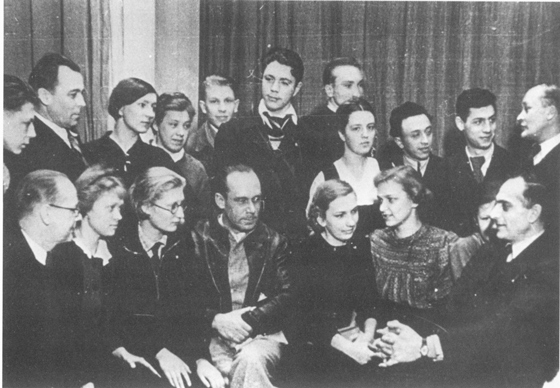 Nikolai Collie (extreme on the left), Ivan Leonidov (in the center) and Karo Alabyan (right) at a meeting with employees of the Moscow Palace of Pioneers. 1936
Documents, official letters of Alabyan, his speeches in the Union of Architects of the late 1930s have been preserved. Their rhetoric is similar to the one that was accepted in this terrible period, the “revealing” voice of Alabyan, of course, looks like the voices around, although sometimes it sounds stronger in the general choir. The choir of the repressive Stalinist system acted in all the architectural structures created by it - from workshops to the Union of Architects.
This is not an attempt to justify Stalinism. No, I’m not going to justify Stalinism at all, rather, if I can allow me to declare this, I try to expose it, especially when I see still live certificates.
The choir of the repressive Stalinist system acted in all the architectural structures created by it - from workshops to the Union of Architects.
All in different forms, realizing or not, were the victims of the Stalin system. Khrushchev, Mikoyan were performers of atrocities. But without them there would be no XX Congress. There would be no truth. And innocent people would not be justified. Including my grandfather. I am grateful to them for that.
When I think about the real, not mythologized Alabian, the name of Alexander Fadeev comes to memory, in 1956, when it was already ending, who shot himself.
Was the Alabyan attack against Beria with such a shot in himself?
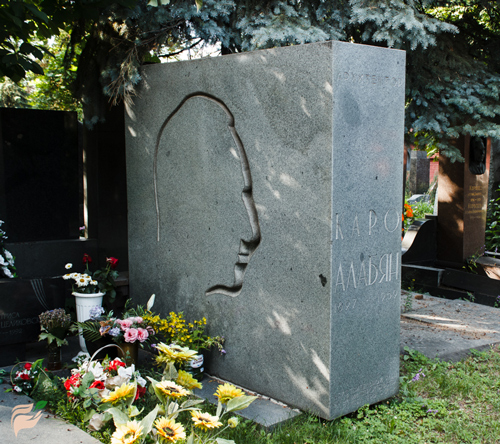 Nikolai Nikoyasyan. Monument to Karo Alabyan in the Novodevichy cemetery. 1959
Alabyan possessed extremely bright external data - profile, posture, voice (he sang wonderful). Appearance, apparently, hypnotic and not least contributing to the complexity of the myth. At the very beginning of the nineties-in fact, it was August of the 91st, it is impossible to forget-in the days of the coup, my wife and children rested in Sukhanov. Once, waiting for the bus at the stop, they turned out to be involuntary witnesses to the conversation of two women. One (she was much older) told her young visa about work in the House of Creativity. And she recalled how, along with other employees, she was idle on the main alley, waiting for the moment to see Alabyan leaving the main building. By the time of her story from the death of Alabyan, more than 30 years have passed. The real image turned into a myth - and, it seems, not only for her alone, but for many, many others who only heard about him ...
 Moscow. Novinsky Boulevard, 18. Memorial Board Karo Alabyan
For me, Alabyan is quite real in his architecture. This is an avant -garde and at the same time national “chess house”, a formal theater. And he himself was not so far from me - just in one handshake. I mean not even my grandfather’s sister - she has been not alive for a long time - but Jim Torosyan, whose hand I held in my own recently. But is this handshake itself not another myth?
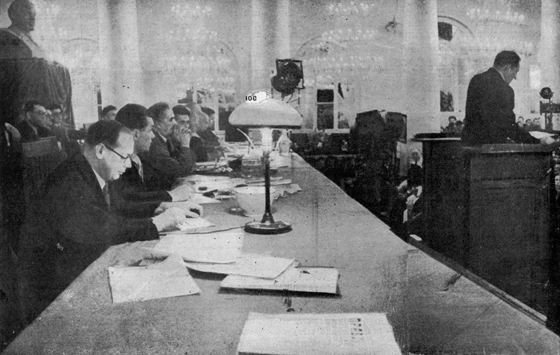 I Congress of the Union of Soviet Architects in the Hall of Unions. 1937. Caro Alabyan acts (right, from the back)