
Translated material
The constitution is in danger
The federal authorities are discussing constitutional reform. The previous one led to a small civil war in the center of Moscow, the execution of parliament from tanks and the death of one and a half hundred people.
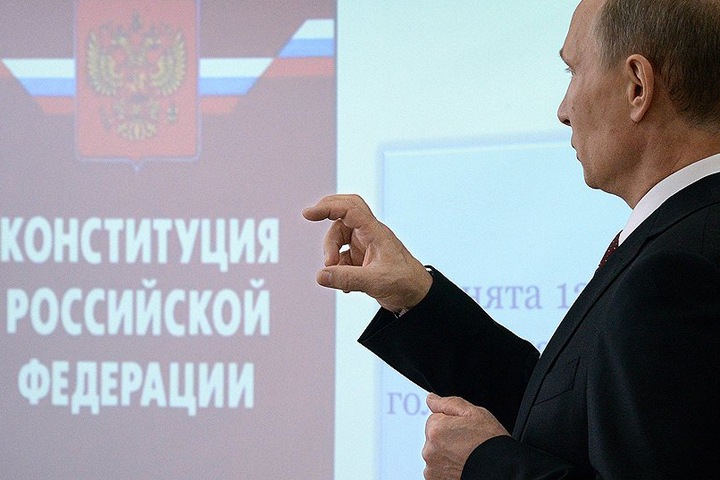
The head of the analytical department of the taiga. Info Alexei Mazur argues about the possible change in the Constitution of the Russian Federation, the dangers of the initiative and the “first swallows” of the rebellion of the deputies of “United Russia” by party servants.
English joke. The reader in the library asks: "Please give me the Constitution of France." They answer him: "This is for you in the periodical department."
Passions were ranging under the unexpected article of the Chairman of the Constitutional Court Valery Zorkin about possible changes to the main law of Russia. With careful reading of the material, it turned out that Zorkin did not call to change the constitution, but, on the contrary, opposes certain calls to its radical change. Yes, she has disadvantages, Zorkin writes, but they can be gradually corrected in a working order.
I categorically agree with him and at the same time note that almost for the first time in many years the head of the Constitutional Court fulfilled his direct function, standing to defend the fundamental document of the state.
Since we have not heard these proposals, it means that they spoke out non-publicly, at some meetings in the Kremlin or in the presidential administration
As we understand, there is no smoke without fire. If Zorkn publicly opposes certain proposals to change the constitution, then there are these proposals, and they are serious.
And since we did not hear these proposals, it means that they spoke out non-publicly, at some meetings in the Kremlin or in the presidential administration. In his blog on the Echo of Moscow website, Valery Solovya confirms this version:
“The changes were developed in the following areas:
a) the formation of a new configuration of state power and administration;
b) a cardinal reduction in the number of constituent entities of the Federation (up to 15–20) by combining them with the aim of convenience, leveling levels of development and neutralization of ethnosagratic tendencies;
c) a decisive edit of laws on elections and political parties (not in the sense of liberalization);
d) the introduction of state ideology.
Well, something else. "
According to him, it was not supposed to make changes simultaneously due to their unpopularity.
But the election results in September show that in a year or two changes in the Constitution can hardly go through approvals in the regions. Indeed, of the 16 constituent entities of the Federation, where elections to the Legislative Assembly were held, in 11 United Russia could not gain 50% on party lists.
A year later, the faithful United Russia will begin to vote “against”. "The first swallows" in the form of Poklonskaya and several senators have already arrived
Now the “EP” has a constitutional majority in the State Duma (remember the elections in 2016, which you most likely did not go to?) And most in all the leaf -assemblies of the regions, except for several, where the party of power (so far) lost in September.
But after a year later, the faithful United Russia will begin to vote “against”. The “first swallows” in the form of Poklonskaya and several senators have already arrived.
If the “transit of the authorities” in 2024 is planned to be made through constitutional reform, then there is time left for it for a year or two. Surely such scenarios are being discussed, and someone in the presidential administration may already rewrite articles of the Constitution or even write a new one. Its adoption requires the convocation of the Constitutional Assembly, the law of which has not yet been adopted.
If suddenly the State Duma approve the law at a forced pace, this will be a very poor omen. For the new constitutional reform does not portend anything good to Russia. The previous one, I recall, led to a small civil war in the center of Moscow, the execution of the Russian parliament from tanks and the deaths of one and a half hundred people, only according to official figures.
The current constitution was written by the winning party (presidential) and, as it seemed to its authors, consolidated the achievements of this victory.
It is since then that we have a skew towards the executive branch, the powerlessness of the representative power, the dependence of the judicial, infringed self -government, the possibility of the appointment of governors, senators and ambiguity with “two -time periods in a row”.
Why, you ask, if there are so many shortcomings in the Constitution, not change it and not adopt the constitution better?
A request for changes, justice and real democracy is growing in society
Good constitutions were obtained in two cases. The first - if people were gathered, united by concern for the future of the state and did not assume the spelling of the Constitution "for themselves." History knows such an example.
But most examples were different. From the already mentioned France to numerous constitutions in Latin America.
Given the absence of knights, patricians and gentlemen in the Russian elite, I would not advise counting on the rapid appearance of disinterested and thinking for centuries ahead of the “fathers of the nation”, whether they are at least from the current government, even from the opposition.
The second “good option” is when the Constitution “grew up” for decades and centuries from existing laws by the consistent resolution of conflicts and the elimination of vicious practices. So, for example, England lives itself without a constitution at all, which does not prevent it from being the oldest and stable democracy in the world (with the exception of dwarf states).
Today, the ruling Russian elite and Russian society are moving directly in opposite directions. A request for changes, justice and real democracy is growing in society. The elite is trying to consolidate the existing state of things, including the profanity of the elections, the glaring social injustice, the ineffective economic system and the regime of the “besieged fortress”. Obviously, in the case of radical changes in the Constitution, only the wishes of the “elites” will be included in it, which, most likely, will very quickly lead to social cataclysms. It is possible that these changes will serve as a “trigger” for them.
Therefore, the task of all good will in Russia is to resist the proposals of sharp changes in the Constitution, regardless of who they come from.
Alexey Mazur