
Translated material
Alexander Galich
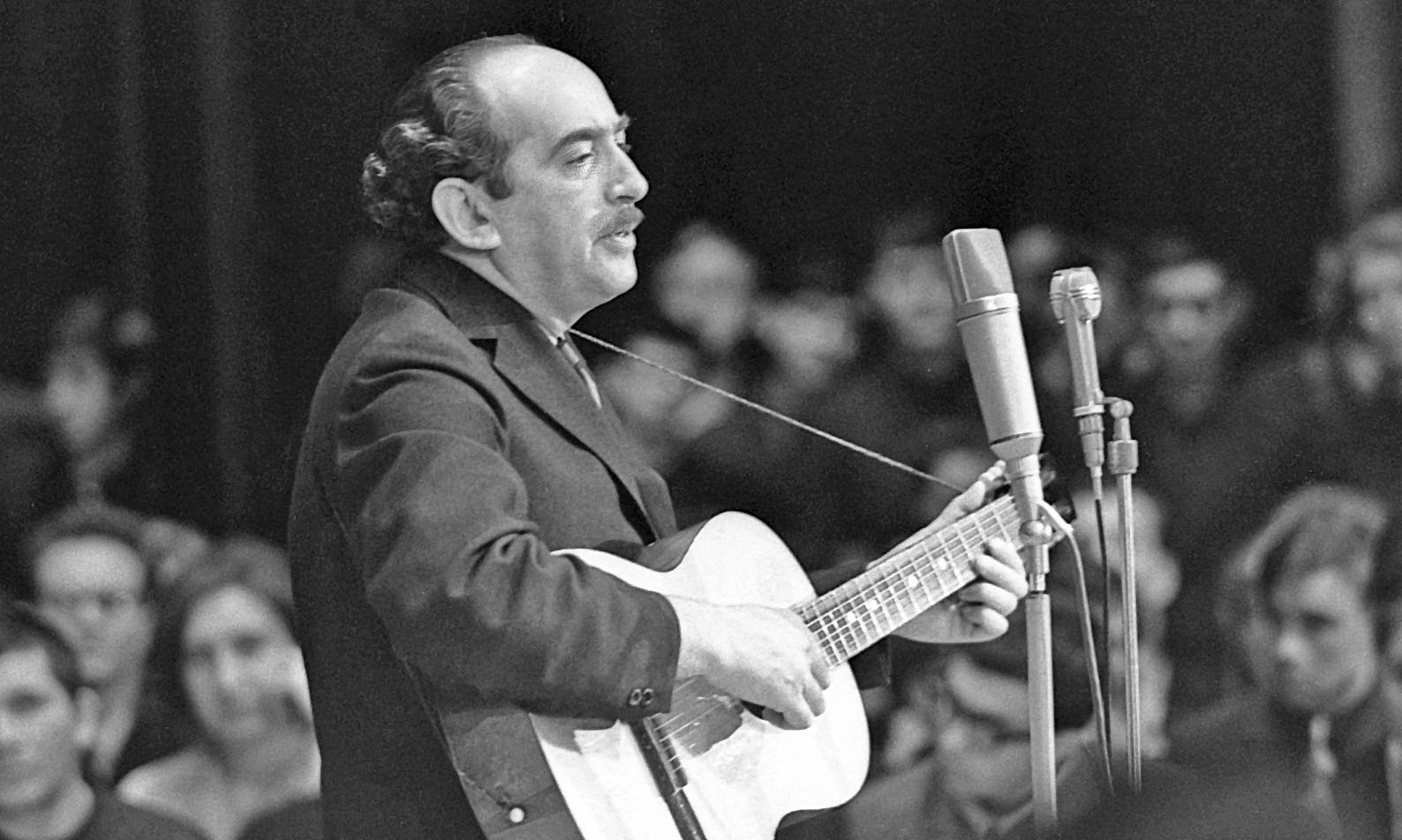
About the wonderful poet and Bard, his son, Grigory Mikhnov-Vyatenko-in the program of Leonid Velekhov
Leonid Velekhov : Hello, on the air of freedom, radio, which is not only audible, but also visible, in the studio Leonid Velekhov, and this is the new release of the program "Cult of the Personality", which you also watch on the TV channel "present time". Our program, as I always repeat, is not about tyrants, it is about real personalities, their fate, actions, their outlook on life.
On October 19, it turned one hundred years since the birth of Alexander Galich - Bard, the poet, the dissident, the exile, the person who left a very deep mark in our culture and the history of our society. Forty years have passed since there is no Galich, and his songs have been living, and many lines from these songs have long become aphorisms and turned into folklore. Actually, the poet has nothing to dream of more, as you know.
Today I have a poet’s son, Grigory Mikhnov-Vitenko .
( Video of Alexander Galich. Sailure text :
The life of Alexander Arkadyevich Galich, which began in the Ukrainian city, which was then also called Yekaterinoslav, was then re -called to Dnepropetrovsk, and now just the Dnieper is called, and tragically breaking in Paris, primarily connected with Moscow. And the Galichev places in Moscow are interconnected by a special, symbolic chain.
... a crooked-row lane, an old mansion, to which there is now no approach due to the total renovation of the capital. His childhood passed here. In the first half of the 19th century, the house belonged to the Venevitinov family, who gave Russia a wonderful romantic poet. And here on September 25, 1826, Pushkin first in public read his Boris Godunov. In the 20s of the 20th century, when the family of the Ginzburgs settled in one of the communal apartments of the rebuilt mansion, there was no trace of the previous owners and their life, but the shadows of Pushkin and Venevitinov were still, apparently, hung here. In 1926, during the centenary of the first reading of Godunov, at the evening in memory of this event, seven -year -old Galich listened to excerpts from the Pushkin tragedy in the performance of the great artists of the Moscow Art Theater on the balcony of this house. Later he himself said that this impression determined his desire to become an actor.
... Leontyevsky Lane, the house in which in Soviet times lived the founding father of the Russian theater, Konstantin Sergeyevich Stanislavsky. Here Alexander Galich, then Ginzburg, studied at the actor. Stanislavsky accepted him in 1935 in his studio, it was the last set, which Stanislavsky did not have time to bring to the release, and all classes took place here, at his house. Indeed, in the last years of life, as we recall in the Bulgakov “Theater Roman”, Konstantin Sergeyevich, aka Ivan Vasilievich, actually did not leave the house.
... Herzen Street, now again Bolshaya Nikitskaya. Somewhere here, opposite the conservatory, there was a 133rd secondary school. Where exactly - I could not find out. In her physical education hall, the theater studio "City at the dawn", invented and organized by young, a little older than Galich himself, Alexei Arbuzov and Valentin Pthuk, found the refuge. The studios themselves composed the play in the course of rehearsals, wrote poems and songs to it, and they themselves played. Thus, the poetic talent and artistic ambitions of Galich were first combined in this "city at the dawn").
Studio
Leonid Velekhov : I want to start not with Pushkin, but with Lermontov: "The terrible fate of his father and son live rose and die in separation." Is it suitable for your case?
Grigory Mikhnov-Vitenko : Classic lines are usually approaching anyone.
Leonid Velekhov : Universal. ( Laughter in the studio. )
We’ll clarify for the public that you and Alexander Arkadyevich have never seen each other, because he emigrated in 1974, in 1977 he was gone. Did he take some participation in your fate?
Grigory Mikhnov-Vitenko : Of course! Well, which one could take part? Sorry for such a rough materialism - material.
Leonid Velekhov : I'm talking about it. Life was not easy.
Grigory Mikhnov-Vitenko : quite hard. Grandma had a pension of 50 rubles. Father tried to regularly help with money and some things. When I had already left, some premises.
Leonid Velekhov : How did my grandmother treat him? Grandma, as I understand it, in our history there is a very important figure, right?
Grigory Mikhnov-Vitenko : Grandma was wonderful, but the grandmother was, of course, a person who survived all the most terrible times in this country. Therefore, when the mother did not become, and at that moment the persecution of Galich was in full swing, I know that they had a conversation. She asked not to appear anymore, because a sufficiently large number of relatives in 1937 and in 1947 left for places not so remote, many did not return. What will happen in 1972-1973, there was no idea ... Yes, in fact, at some point, Galich was said in quite direct text that he had a choice-to go either to the west or east. Grandma therefore asked him to simply not appear. Father accepted the concept. Then, as far as I know, because after his death he corresponded with his widow, Angelina Nikolaevna, he still had an idea to somehow send a challenge when everything would finally get a job. And finally they ended up in Paris. And finally it seemed that everything was satisfied and it would be necessary to do next year ... But ...
Leonid Velekhov : The next year did not happen.
Grigory Mikhnov-Vitenko : Yes, next year did not happen.
Leonid Velekhov : And now the question, if it does not work out any intelligible answer, we will cut it off. But one cannot help but touch this topic. Why were there so many intrigues around your sonism?
Grigory Mikhnov-Vitenko : Yes, no, what are you, an absolutely normal question. 1967 - this was the last year that the previous civil code of the RSFSR was in force. According to this Civil Code, if the child was born out of marriage, a dash was put in the column "father". Since 1968, another code has already been in force. There it was possible to enter anyone. In 1986, we wrote a statement to the Internet, to which the answer came to in 1987, and ten years after the death of our father, we finally received a copy of the death certificate. This is a normal procedure - the so -called establishment of paternity, when a person is no longer alive. This is usually done very simple. People who have the attitude to this file a lawsuit, come and say: "Here is Vasya. Here are witnesses. Here we have documents." It usually takes about five minutes. We got almost four years. Unfortunately, at that moment, very different people existed some kind of foreboding that Galich’s legacy, a creative heritage-are some kind of giant millions of money. Accordingly, I really did not want to share. Moreover, I must say that in fact the initiator and inspirer of these illusions was by no means my sister Alena. People who then spun around the book publications at that moment played their rather unsightly role. Because we met Alena in 1977, still a grandmother, mother’s mother, was alive. Initially, there were no contradictions. But all this stretched in this way. The court took place. Then there was another Supreme Court. As a result, there is a solution that has been operating since 1991. Since 1991, I have been a co -owner of copyright to the legacy of Alexander Galich.
Leonid Velekhov : Among other things, the fact on his face is similar to Alexander Arkadyevich! .. And if you shake a beard ... ( Laughter in the studio. )
Grigory Mikhnov-Vyatenko : Well, I don’t want to shave a beard yet.
Leonid Velekhov : In no case is needed, just more would have been discovered. Here nature put its clear seal. Amazing! I figured out details. And now from the details we will move on to a more generalized one. When did you and your father meet spiritually? At what age did you begin to follow his work, somehow delve into it? Or maybe there was some period when pride prevented you from approaching this? Was there any difficulty or not?
Grigory Mikhnov-Vitenko : No, there were never difficulties. I think that after fourteen years. To understand the texts of Galich, especially software texts, not only satirical songs, although there is also a very layered pie, there are also a lot of meanings, you need to know something. I found that I don’t understand something in his texts, for example, in the text “Again August”, I don’t know who Anna Andreevna Akhmatova is, what difficulties there are, what kind of relationships are there, and began to look for something, read something. And through an attempt to understand the poetic text, he learned a lot simply from the history of the country, from the history of literature. For me, it was, of course, a very serious period of growing up.
Leonid Velekhov : What do you think, by virtue of what this big metamorphosis occurred: the pamper of fate, the author of the scenarios of absolutely Soviet films such as “Faithful Friends” and in life quite, as I understand it, Bonvivan, a lover of life pleasures, turned into a person who abandoned the authorities, condemning himself to persecution, to all possible life difficulties? What happened?
Grigory Mikhnov-Vyatenko : "The whole thing began with the song, and then-went to write!" ( Laughter in the studio. ) Apparently, several circumstances played a role. Few people know that Alexander Arkadyevich at sixteen received a very serious vaccine from fear. Within the framework of one criminal case on counter -revolution, he was supposed to put him together with a whole group of comrades, but, fortunately, the whole case fell apart.
And everything else ... Once he himself wrote quite clearly about this, saying that he was always honest in these most naively Soviet, idealistic, romantic, as good plays, songs "Goodbye, mother, do not grieve or sad." There are no words that sing their native party, government, comrade Stalin, Khrushchev, Malenkov and everyone else. There about human relationships, about love for life, about love for relatives, about love for their land. In this sense, he has a text that is very important in the autobiographical story “General Rehearsal” that after the twentieth congress “we were linked to all, and we, like rams, rushed to this green grass, which, in fact, turned out to be a groove.”
Leonid Velekhov : Good as said!
Grigory Mikhnov-Vitenko : The hopes that arose in connection with the "thaw", due to the fact that the cult of personality is exposed, the camps were disclosed, and millions of people were released and rehabilitated. But everything begins to be repeated, and the processes of Sinyavsky and Daniel, and Czechoslovakia, and then on the list begin. We return again to the same swamp. And here I am tired. At some point, a person is tired of hiding, bored to keep the figure in his pocket. Of course, this was also connected with spiritual searches, because at some point a person is trying to understand for himself, tries to identify himself - who he is! Therefore, his coming to Christianity, to baptism is largely connected with this - with an attempt to understand himself.
Leonid Velekhov : We are all, "like rams, we went to this green grass that turned out to be a sulfur" ... But the majority, realizing that it was a swamp, found some of its own maneuver ...
Grigory Mikhnov-Vitenko : his bump.
Leonid Velekhov : ... And her Kochka, and addicted to the Aesopov language in the expression of her views. And Galich went "on you."
Grigory Mikhnov-Vyatenko : Yes, I went "on you" because it turned out that I did not want to lose what was found inside yourself, I did not want to lose that intonation ... And then, you know, it turned out to be such a slightly strange thing. Having begun to realize in this genre of songs, it was no longer possible to stop. Because it turned out that this genre has its own audience. Yes, they will not let the film be put, no one will give a film under some dubious thing ... Nobody will give a theater platform, no one will print a book. But there is a tape recorder of the Yauz system, and this is enough.
Leonid Velekhov : As Vysotsky said: "I am in every house in a twisted form."
Grigory Mikhnov-Vitenko : Yes. I think that this tape recorder, tape recorder - it was such a blogging of the sixties.
Leonid Velekhov : Network praculture.
Grigory Mikhnov-Vitenko : Yes. And the same repost, and the same like ... And here it turned out that everything was worse - to abandon yourself. In the professional environment of filmmakers, Members of the WTO can always be said: "Well, you understand what final I wrote, but these bastards were broken!"
Leonid Velekhov : And everyone will understand.
Grigory Mikhnov-Vyatenko : And here to whom to lie? These millions of unknown, but sincere people who look at you who listen to you? It’s impossible to lie here! Here it will immediately be clear and it is known that everything - they bought you. And on the other hand, you still live. And how many people were told in the 90s, in the 2000s: "Listen, we, it turns out, heard these songs, but only my parents did not tell me who it was, so that I am nowhere, God forbid, did not tremble." And here I think that he very accurately understood that this cannot be betrayed, it is impossible to abandon it.
Leonid Velekhov : We still will not forget and recall the public that he dreamed of becoming an actor. And this acting in it apparently lived. If he went along this line, maybe he would not become a great actor, because there were too many heads. Apparently, this is Leonidov and meant when he wrote on his statement something like "to accept sure, the actor will not come out of him, but something will certainly work out."
Grigory Mikhnov-Vitenko : Yes, yes, yes.
Leonid Velekhov : But, of course, there was acting in him. And all this was connected in the performance.
Grigory Mikhnov-Vitenko : Of course!
Leonid Velekhov : And he inflated in this genre in a very special way.
Grigory Mikhnov-Vitenko : Of course. It turned out that this is the freedom of self -expression, and there is a grateful audience.
Leonid Velekhov : He is also an actor in these songs, like few of the other bards.
Grigory Mikhnov-Vitenko : He wrote completely and wrote songs as plays. Of course, for him the opportunity to do this turned out to be very important. And he did not want to refuse it at all. Actually, he did not refuse.
Leonid Velekhov : And in this, with a completely exceptional fullness, he was realized, realized. You said that many told you that they listened, but did not even know whose songs they were. I also remember this in my childhood: Galich-it was some kind of household name, not so much my own as a common house. Moreover, the surname itself was so invented, this pseudonym is so invented. It’s like in the 20th and 30s the surname Zoshchenko turned into a common name, generalized.
Grigory Mikhnov-Vitenko : “But this is a pure Galich,” they said when the absurd situation arose.
Leonid Velekhov : Yes, yes, yes. So we came to the conclusion that what seems to be metamorphosis was actually dictated by absolutely internal logic.
Grigory Mikhnov-Vitenko : Because at some point he really grew up acting, then the work in the theater grew as a playwright, and a new genre arose here. The tragedy of this genre is that the novelist can still write "on the table", but the bard cannot write like that. If he does not convey to the audience, if he does not communicate with the audience, then no one needs it.
Leonid Velekhov : Was the departure for him a tragedy or gave a new impulse?
Grigory Mikhnov-Vyatenko : 1972 turned out to be absolutely tragic, because at first there was an exception to the unions, then, the beginning of 1973, the death of my mother. Although their relations seemed to have formally ended, but, as I understand it, still internally people are alive, in their situation, he clearly had some other hopes for the possibility of their development. It turned out consistently that he had all the possibilities and all the prospects of life in the Soviet Union. Therefore, it was such a jump into the pool upside down: I swollen - so I sail.
Leonid Velekhov : Did you swim, what do you think?
Grigory Mikhnov-Vyatenko : I think that thanks to the radio station, freedom has surfaced. This is true. I now listened to the entire archive of the program, thank God, very large, it has been preserved for more than twenty hours ... This also arose as if a new genre of such a conversation, almost a daily conversation with radio listeners.
Leonid Velekhov : And yet I think that the main listeners were here for him, right?
Grigory Mikhnov-Vitenko : Of course. Of course, when Galich spoke to the old emigrant public, it was such an element of surrealism, because they did not understand half of the words. ( Laughter in the studio. ) They did not understand who the turntables were, they did not understand who the ass was, they did not understand all such trade union committees and so on. In this sense, there was no contact with the audience that was in the Soviet Union. But work on the radio - it was just the very contact that he needed. He understood with whom he was talking to, he understood what he was talking about.
Leonid Velekhov : There is a version that his death was actually adjusted. And it was a special operation of the KGB. Do you believe in this version?
Grigory Mikhnov-Vyatenko : Today, in 2018, to say that the KGB is not involved in some kind of accident that happened in the West is simply indecent. It is decent to say that all door handles around the world are smeared with different employees and so on.
I honestly say that it is not ready to defend any version with foam at the mouth. But by a number of signs, I understand that the French police no coincidence still classified the results of their investigation. Another thing, by and large, is that it changes?
Leonid Velekhov : Yes, firstly, it doesn’t change anything, and secondly, forty years have passed, and we understand that Galich died, but Galich survived.
Grigory Mikhnov-Vitenko : Yes. On the other hand, he was still killed for a long time and consistently, forcing him to leave the country. Because, despite the fact that I said that he found himself sufficiently, work at large brought him not only money, but also satisfaction, but it is clear that if he had the opportunity to continue to live in Russia, work in Russia and communicate with his audience, he would be much happier.
Leonid Velekhov : Undoubtedly. At one time, when I first visited the cemetery in Saint-Genevieve-de-Bois and saw the inscription on his grave, I was shocked that such words, so accurately and at the same time, were attached to this fate so. Who came up with this inscription?
Grigory Mikhnov-Vitenko : This is Vladimir Emelyanovich Maksimov.
Leonid Velekhov : Recall that the inscription reads: "Blessed are expelled truths for the sake."
Grigory Mikhnov-Vyatenko : Gospel of Matthew, commandments of bliss.
Leonid Velekhov : You can’t say better.
Grigory Mikhnov-Vitenko : Yes. And as Father Alexander Men loved to emphasize, who baptized him, blessed - this means extremely happy. Because it turns out, indeed, that a person who has expelled from his country, devoid of all rights and in this world, has not left behind either villas or estates, in fact, nothing but his texts, and then most of these texts were even lost and remained only on tape recordings ... It turns out that this person can be extremely happy because he fulfilled his purpose here.
Leonid Velekhov : What is this "Galich House", which you supervise, lead, inspire and everything else in St. Petersburg?
Grigory Mikhnov-Vitenko : This is a project, as it is now commonly called, which at the same time exists and virtually, that is, it is a platform in social networks, but this is an offline project. This is an open space where a variety of things can occur, based on the personality of Alexander Arkadyevich and his interests. This is the theater, music, cinema, poetry, spiritual searches, public and human rights activities, that is, it can be anything. So we started by mentioning the Venevitinsky house. We opened the "Galich House" with an exhibition of Pushkin's drawings. The first in two hundred years, by the way! She was prepared by my remarkable comrade, poet and researcher Andrei Chernov with his wife, artist Natasha Vedenskaya. Then there was an anniversary related to the memory of Korchak, the presentation of some books, and lectures, and exhibitions, and so on. These are open spaces that, in principle, can be created anywhere. They should work according to one and only principle-what do you think is it interesting or not? If interesting, then this has a relationship to him. So this is not a memorial museum, this is a living business.
Leonid Velekhov : I am extremely grateful for you for this conversation.
Grigory Mikhnov-Vyatenko : Thank you! Thank you for calling, as they say!
Leonid Velekhov : Thank you for coming! Thanks to this opportunity to recall the grandiose personality of Alexander Galich, who, on many of us, for several generations with his work, had a great influence with his songs and, I think, continues to have.
Grigory Mikhnov-Vitenko : continues.
Leonid Velekhov : I have no doubt about that. Thank you very much!
Grigory Mikhnov-Vyatenko : Thank you!