
Translated material
Distrust of power is growing. What will the Kremlin do?
An attempt to revive a political life without the admission of a real opposition to it will be a response to the fall of the ratings. But all scenarios of the Kremlin strategists are obviously failure
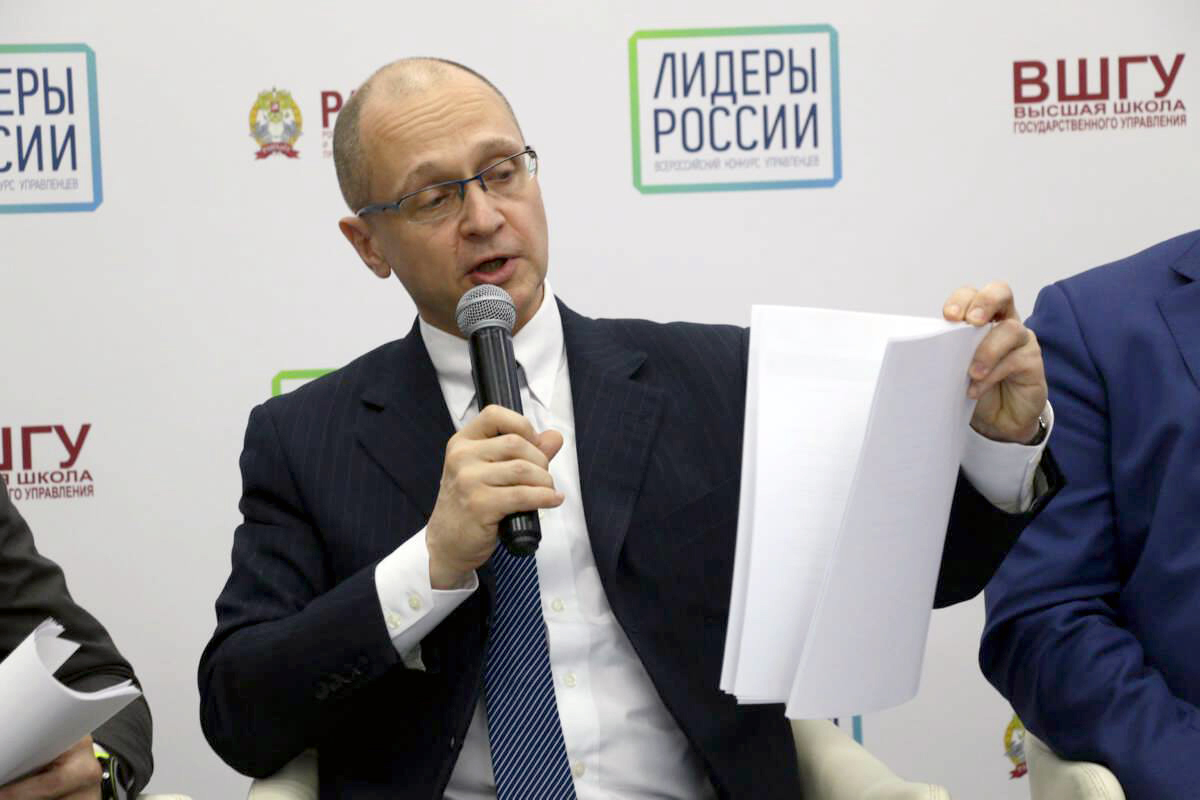
Curator of the competition "Leaders of Russia" Sergey Kiriyenko photo: ftimes.ru
Three areas of the answer
All analytical reports record the fall of the rating of Vladimir Putin, the collapse of the so -called “postcrymist majority” (energy has disappeared) and the focus of different age and social groups on justice/injustice. This justice is ideologically and politically blurred. It is attached to the policy of the government, and to migrants, and super -rich, and to the position of pensioners, etc.
Society is waiting for changes, but the protest potential does not grow-this is fixed by the reports of the Levada Center and the reports of KGI Kudrin. And a recent study on the lowest voting age groups (18–24 years old) Denis Volkov showed that the young perceives politics as a natural landscape, are not interested in her and do not associate any expectations with her. Only 7% in these age groups trust Putin, but there is no active distrust behind this - this is just a reaction to the landscape in which the generation has grown. And Belanovsky in his report recalls that the two previous crises of trust-the monetization of benefits (2005) and the elections (2011)-ended with nothing: in the first case, the protest energy faded by 2006, and in the second-by 2014.
Political managers and experts working within the “system” are considered to be these reports. They have three directions of answer. The first is demonstrated by Sergey Kiriyenko with his contests of young leaders. The answer boils down to encouraging the weakening muscle of social energy due to the funny models of “personnel growth” and “social elevator”.
If you continue the cyberwater, conduct active military actions abroad and constantly discuss preparations for a large war on federal channels, then specialists in the "spiritual revival" get a good chance
The second is to direct the energy of the masses to civil defense. If you continue the cyberwater, conduct active military actions abroad and constantly discuss preparations for a large war in federal channels up to the Duma elections of 20121, then specialists in the “spiritual revival” receive a good chance. In early November, they will gather for the next World Russian People’s Cathedral in the Kremlin and there will be seen their offer in the market for the fight against the depolitization of the population and an increase in distrust.
The third response is presented the other day in the report of the expert group Yevgeny Mintchenko . He, as is now accepted in the Kremlin, draws parallels between Russian public sentiments and the European and world lift of populism, and wonders: what opportunities have, to deceive the population in the next parliamentary elections. He counted three such opportunities: to launch a new party project of the type of “Motherland” of the 2003 model, to modernize “Fair Russia” (making it “Motherland” again), try to institutionally revive the situation due to the transition to completely majority elections or to party blocks. It is meant that the monopoly of United Russia should be preserved regardless of a steady fall in confidence in it and the inability to modernize it.
Outdated model
But now, any first-year student already knows that parties in a corporate state play a different role than in liberal democracies. And it is useless to “modernize” parties that cannot form a responsible government as a result of elections. Therefore, no one perceives the plans of the further party -standing.
Of course, the Kremlin is interested in those who have parties skillfully manipulated by public moods, he is even ready for the parliamentary parties to have several of its governors. But this has little effect on the fall in confidence in general.
The revival of the entire political life could have occurred in two cases: if the Kremlin let into the elections of Navalny and its supporters, and if the Kremlin made it possible to enter the elections to the numerous loyal organizations that KGI Kudrin patronize. But even in the second case, the leader should enjoy complete independence from the Kremlin, otherwise the level of trust will be like Sobchak. In other words, the Kremlin should let either either those or these "without reservations." It is impossible to imagine. No one will take responsibility for such a decision.
The revival of the entire political life could have occurred in two cases: if the Kremlin let into the elections of Navalny and its supporters and if the Kremlin made it possible to enter the elections to the organizations that KGI Kudrin's KGI patronage
The system is going to step over distrust at the expense of all three directions at once: at the expense of the competitions of young leaders (Kiriyenko), due to the swelling of militarism for the population (Shoigu) and due to the least risky scenario of the party “reform”, that is, due to the fencing of Turchak and Mironov.
All this together forms a harsh cocktail, with which the system will approach the Duma elections of 2021. In short, young careerists should actively participate in civil defense, relying on the spiritual revival and this should revive the parliamentary parties. There is no alternative sentence.
It is easy to predict how parliamentary elections-2021 will be held with such strategies. Instead of weakening and leaving the historical scene of the old post -Soviet parties, the exact opposite will occur: the EP will lose their voices, and the LDPR and the Communist Party will swell. There are no other options.
At the same time, the real axes of the conflict will not increase where sociology fixes, i.e. Not between "power" and "society." Since we are talking about a corporate state that reproduces the estate structure, the conflict will increase between the estates. And first of all, between the "super -rich" Putinians (new aristocracy) and the "patriotic" civilian and military bureaucracy. But in general - between all corporations that received their estate privileges in the middle of the zero and tenth years of the new century - in the golden time of Putinism.