
Translated material
How future bioinformatics and engineers from all over Russia want to change the world
The Olympiad of the National Technological Initiative (NTI) is the first engineering Olympiad in Russia for schoolchildren, where teams compete in solving real problems. For each of the three stages, schoolchildren are preparing in the technology parks of their native cities: they work in laboratories and engineering equipment.
Three finalists of the NTI Olympiad - 2018 told “such matters” as they decided to engage in science, the useful electricity from bacteria and what is more important in programming.
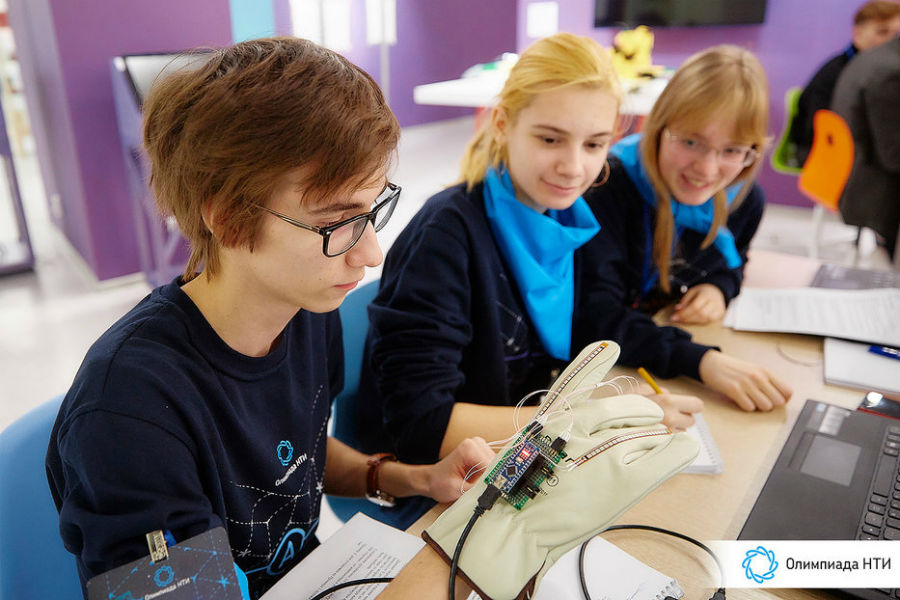 Photo: provided by the press service of the NTI Olympiad
Polina Filchak
11th grade student, Kaliningrad
Profile prize -winner "Engineering Biological Systems"
“My mother is a doctor, but bioinformatics and molecular biology that I want to do in the future are very different from medicine. For the first time I heard about bioinformatics on the radio, new words sounded: DNA, genetics of the future, and I was interested in seeing what it is.
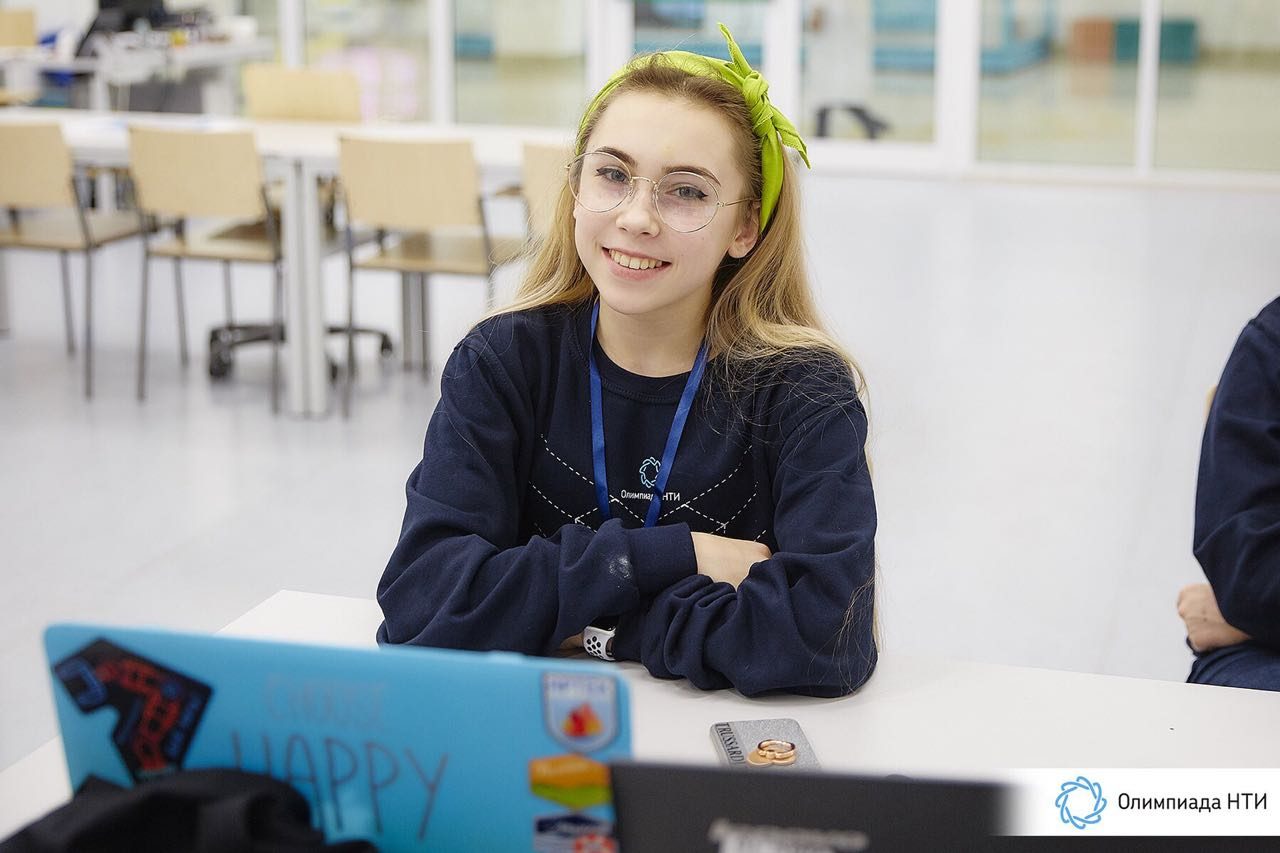 Photo: provided by the press service of the NTI Olympiad
About the NTI Olympics, I was already told at school, at the qualifying stage I decided options for chemistry and biology. In the first stage of the Olympiad, only school knowledge is needed, but further the tasks are much more complicated, absolutely not the school curriculum. For example, in the third, final stage we had genomic editing: it was necessary to explore the pancreatic cell and see how long the DNA section is on electrophoresis. It was lucky that I was allowed to work in a laboratory at the Institute of Living Systems of the Baltic Federal University named after Kant in my city, as a result, it was laboratory skills and the ability to work with biological materials that helped at the Olympics.
After participating in the Olympics, I continue to go to the school of gifted children of the Institute of Living Systems. There, other students and I are developing our own project. We do a genetic analysis of honey: we compare honey from the middle strip of Russia with Kaliningrad -made honey, look at its quality, and also determine whether it is falsified, whether there are impurities there. I began to work on the project at the beginning of the school year, now we have finished allocating DNA from the samples and soon we will make electrophoresis to check the length of DNA sections. The plans to make a biochemical analysis of the samples of honey, but this is much longer, so the project is far from complete.
This year I also participate in the NTI Olympics (the first stage began in October 2018, the registration of participants until November 4, the final will be held in April 2019. - Approx. TD) . Despite the fact that I, as a winner of last year, immediately go to the final [I participate in all stages], I want to keep aware of what topics this time will be. In the future, I plan to enter [study] abroad, to France, and in the next month I am going to take an exam for knowledge of the language. I want to connect life with molecular biology, it is very interesting to me. ”
Dmitry Boldin
1st year student of MGTU named after Bauman, Moscow
The finalist of the profile "Intellectual robotics systems"
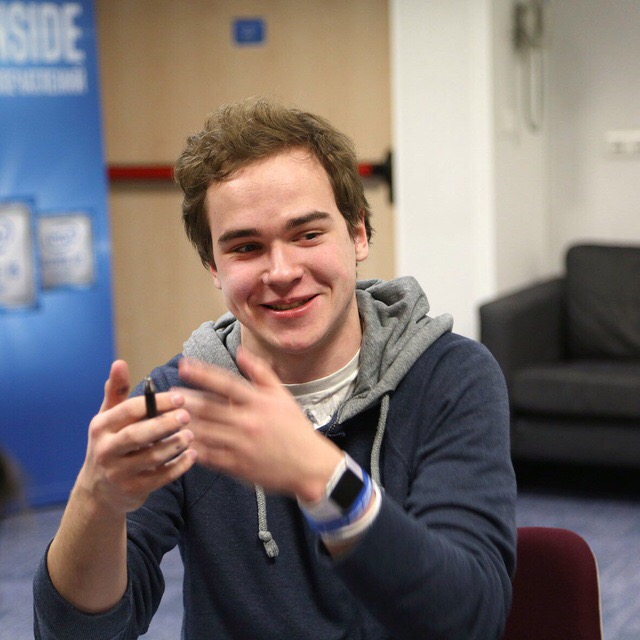 Photo: from personal archive
“I am studying at the Bauman MGTU in the direction“ Informatics and computing technique ”. I already know the main course of programming, but the university has a “technopark” project, organized together with Mail.ru-their specialists give lectures on web development. There you need to take a selection, a competition - about 10 people per place, but the course gives very deep knowledge on how to write a code. In the “Technopark” I have been studying programming on Python - it was on it that I wrote for the last two years, but, having come here, I realized that I don’t know him at all.
In part, this understanding came to the Olympics. Of all the directions of the Olympiad, I was most interesting to Data Science, but then it did not give benefits for admission, so in the end I chose the profile “Intelligent robotics systems”. Our team was given a robot, lost in the maze, and it was necessary to make him get out without knocking anything along the road. On the robotics platform with which we worked, the code was written on JavaScript - it is joking a lot about it, how uncomfortable it is. Therefore, the team and I decided to write something like his library, but on Python, which was worse and more familiar to us, almost like homemade slippers. As a result of the month of preparation, we spent to ensure that the robot simply drove forward, and in the end we had to write everything on JavaScript, because otherwise we would not have time to finish. In the finale, another team went around us anyway, but this gave us an understanding of how the robot was arranged from the inside, because we worked with the sources of the program of the robotics platform itself.
While I am in the process of finding what to do in the future. I hesitate between mobile development and to be a bacenter . Bacend is the magic that occurs, for example, when you press the Enter button on the Google website and get the results. In addition, I am still interested in Data Science, although only the lazy does not speak of it now.
Actually, I regard programming as a path to IT startups. Now my friends and I have gathered a team where there is everything - from the designer to the mobile developer, and we are trying to write our own application for a remote order of food. One wrote, they realized that it is not necessary, and we do another. I hope these attempts will lead us to something sensible.
In my opinion, the most amazing thing in programming is to find a problem, isolate it and write your own solution. Money is not important as the fact that we can help solve the problem, which, like me, is experienced by other people. ”
Olga Berezhnaya
9th grade student, Barnaul
Profile Profile "Neurotechnology"
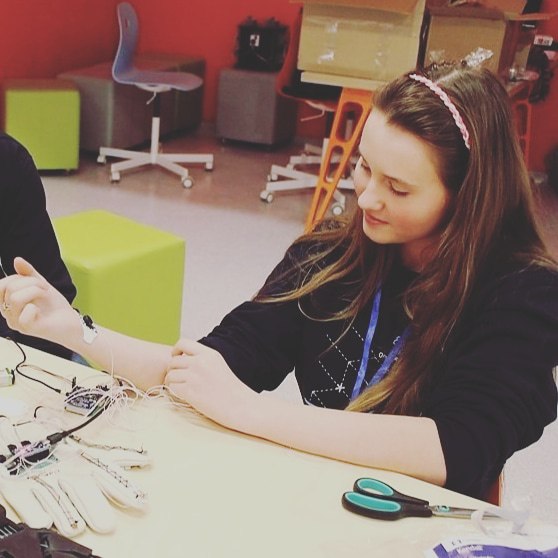 Olga Berezhnaya at the NTIPOTO Olympiad: from the personal archive of Olga Berezhnoye
“Since childhood, I have been interested in a lot of things-from literature to chemistry and programming, and I am trying to somehow develop myself in all areas. I think that in the future I will go in the direction of biotechnologies and bioinformatics. I don’t know where I will go, while I need to choose a school in which I would like to study in the 10-11th grades. I would like to tie together several areas: programming, biology and mathematics.
At the NTI Olympics, the profile of “neurotechnology” was interesting to me because of a combination of mathematics and computer science. In the final, our task was to configure the functioning of a biomechanical prosthesis, which works on the signals of the electromyogram and electroencephalogram. There were two of us in the team, I was responsible for the biology of the process, and my partner was for programming. The difficulty was just to hang the prosthesis movements from the point of view of the program code and adjust the interference.
Now I am studying in the Kwantorium Children's Technopark. Studying in the technopark is radically different from the school: there are no assessments, they just set the tasks for us, and we solve them. The main project, which we now carry out with the team, is a microbial fuel element, we will represent it in the final quantiads (annual All-Russian Scientific and Engineering Olympiad.-Approx. TD) .
At the moment, energy is actively developing, and especially alternative energy sources. There are special electrogenic bacteria, with which you can produce electricity, and also purify water - this is also important, because in Russia quite a lot of lakes and reservoirs are contaminated. Thanks to a simple fuel element, you can put electrodes and receive electricity, so it will be a pity if we do not use all available sources of energy. ”