
Translated material
How the card will lie down
Local protest of the inhabitants of Ingushetia can provoke a federal constitutional crisis
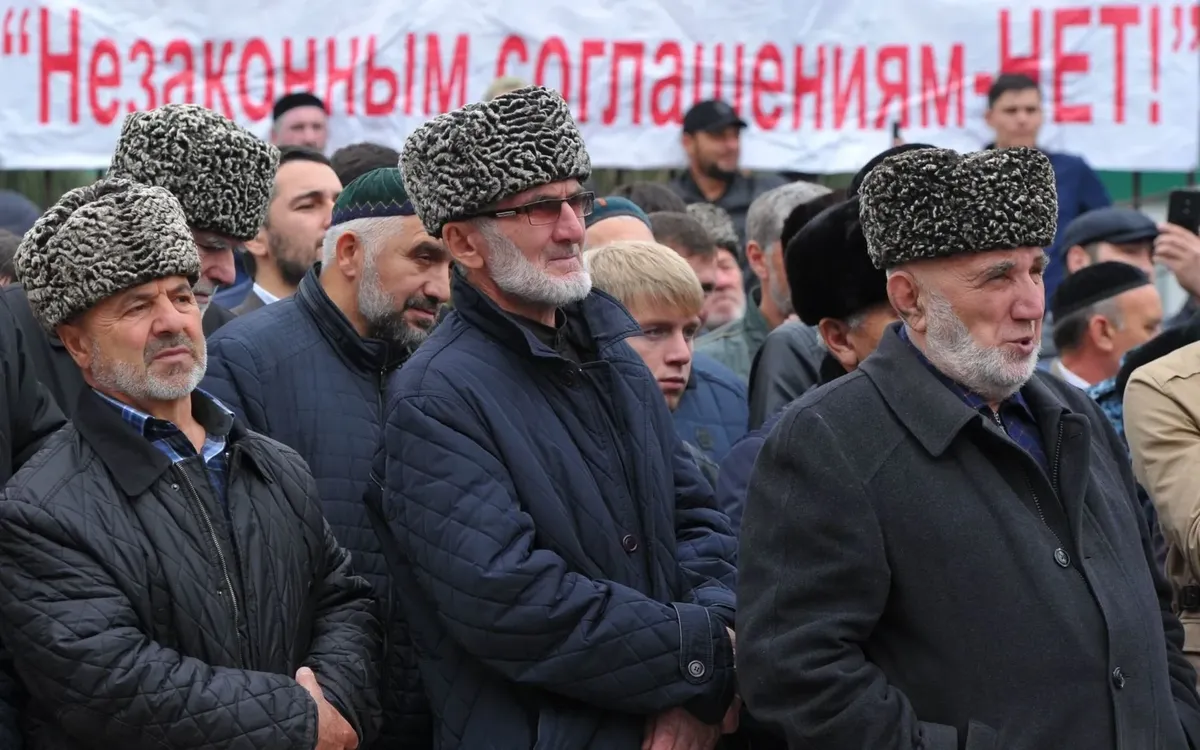
The Constitutional Court of Ingushetia canceled the Border Law with Chechnya, adopted by the People’s Assembly. The special corner of Novaya Gazeta Irina Gordienko talks about the conflict for the Russian legal practice of conflict, which arose as a result of a court decision - and how he was met in Ingushetia.
Tuesday, October 30, in Ingushetia turned out to be tense.
The meeting was opened in the Constitutional Court of the Republic - the judges decided whether the law on the demarcation of borders with Chechnya, the Constitution of Ingushetia, adopted by the People’s Assembly. The law ratified the previously signed by Yunus-Buck Evkurov and Ramzan Kadyrov an agreement on the border between Ingushetia and Chechnya.
At the same time, the center of the largest city in the republic - Nazran was paralyzed: military equipment, police officers, the Russian Guard and OMON in full combat readiness stood around the perimeter - protecting the approaches to the House of Culture. There was the World Congress of the Ingush people. He had to decide how to live on if you disagree with the border agreement.
Both that and another event became the result of indignation, which covered the republic on October 4 - on the day of ratification of the agreement by the People’s Assembly. People finally understood - the demarcation of the border - no one asked the failed fact and the opinion of the people.
A spontaneous protest that resulted in a two -week standing in the central square of Magas was started. The scale of indignation was such that at other moments the number of protesters one and a half times higher than the population of the capital itself.
The authorities did not interfere with the rally, but they also made it clear: what was written with a pen - you can’t cut down an ax.
“This is not a folk issue, but a state. It is decided by the head of the republic and parliament. We made a decision ... the agreement is signed. This question is closed to us, ”Ramzan Kadyrov put an end to the point.
“There was an equal exchange of territories, Ingushetia did not lose anything,” Yunus-Bek Yevkurov insisted and demonstrated a map confirming his words.
In response, the protesters showed another map, which could be seen: in the Sunzhensky district, as a result of the agreement, Ingushetia lost 33 thousand hectares of tribal lands of one of the largest teypes Orkhsta (its representatives, by the way, live both in Ingushetia and in Chechnya).
Given the complex history of the Caucasus, the land issue is the most painful and acute for the peoples that survived not only war, but also deportation. The solution of these issues requires special delicacy.
An agreement on the border with Chechnya was held in a hurry and in a hurry. It passed through the Parliament of Ingushetia in a few hours and at once in three readings. According to official figures, out of 24 deputies, 17 people voted.
When rallies began, the representative of the president in the North Caucasus Federal District, Alexander Matovnikov, invited the protesters to the meeting.
“We asked to introduce a moratorium on an agreement and publicly discuss the issue of land,” said Angela Matieva, one of the members of the organizing committee of the rallies. “But they talked to us in a hard tone, pressed psychologically and did not even try to listen to our arguments.”
Negotiations broke off when the envoy abandoned the phrase: "What are the people, such are the boyars." The Ingushs silently stood up and left the meeting.
Protesters in the square interpreted the words of Matovnikov unambiguously: federal officials do not want to resolve the issue and accuse the insolvency of the residents of the republic themselves. Like, if your government does this with you, then you deserve it.
The situation is heated to the limit.
The first to come to their senses were deputies of the People’s Assembly. Three immediately stated that they opposed the agreement. Soon others began to speak publicly. In a few days, 17 “protest” votes were gained, which completely contradicted the results of the vote.
12 deputies filed a complaint with the Constitutional Court, protesting against the law. The court, having examined the complaint, ruled: "The law does not comply with the Constitution of the Republic of Ingushetia."
It violates fundamental articles, from which it follows that the establishment and change of boundaries occurs only taking into account the opinion of the people.
The head of Ingushetia reacted immediately: “This decision does not cancel the agreement, it has already entered into legal force, agreements between the two subjects affecting the interests of both regions should be verified only for compliance with the Constitution of Russia and exclusively by the Constitutional Court of the Russian Federation.”
Immediately followed by the response of the Deputy Chairman of the Constitutional Court of Ingushetia Ibrahim Doskiev: “The decision is not subject to squeezing. A normative act recognized by unconstitutional loses strength. The People’s Assembly of the Republic is obliged to cancel the law recognized as unconstitutional. As for the possibility of contesting in the Constitutional Court of the Russian Federation the competence of the constitutional court of a constituent entity of the Russian Federation, such a procedure is not provided for by the current legislation. ”
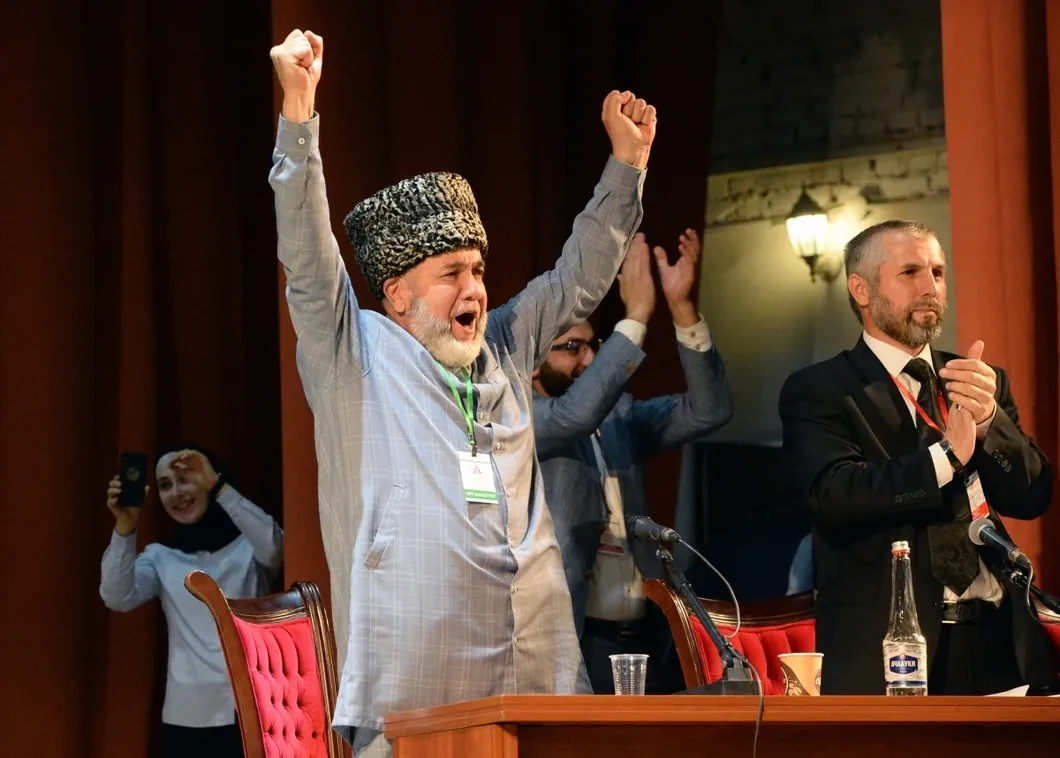
The news of the decision of the Constitutional Court was announced at the Congress of the Ingush people at three in the afternoon. The hall exploded with applause. Five hundred delegates - representatives of Teyp and Ingush Diaspass - congratulated each other. The Congress, which had every chance of becoming a protocol event, was not in fact. For the first time, the Ingush society united. People from previously irreconcilable groups gathered in the hall: representatives of the official muft and Salafites, deputies from United Russia and opposition, human rights activists and employees of the E -E Center. The organizers of the congress emphasized:
“Our collection is not opposed to the authorities, we do not put forward political requirements, we do not oppose our native Chechen people. We demand to convene a bilateral commission in order to achieve a decision on the border that would suit everyone. ”
After the announcement of the decision of the Constitutional Court, the agenda changed. If earlier the organizing committee of the Congress planned to continue the rallies, now he elected the executive committee and decided: from now on the Ingush people have an executive body that is designed to protect the rights and interests of the people, which he will now take care.
“We understand that the decision of the Constitutional Court is only a small step towards justice. We showed that we will not allow us to take away our land from us, ”one of the members of the organizing committee of the Clara Chemurziev Congress City Organizing Committee came to the next day. - On our part we did everything to hear us the authorities. Therefore, at this stage, we decided to stop rallies. Now the case is for lawyers who will prove our rightness in the courts. ”
I must say that the court decision was a complete surprise to everyone. Regional constitutional courts in Russia are a kind of “sleeping authorities”. The circle of their specialization is narrow, and the percentage of appeals is small. As a rule, they serve as a place of honor for federal judges. Now, in accordance with the Russian Constitution, Vladimir Putin has the right to create a special commission to resolve the dispute between the Constitutional Court of Ingushetia, parliament and the government. This is a precedent, and the federal center will be forced to take responsibility for the decision of the created conflict.