
Translated material
Once again about the "garbage dump No. 8"
Memory of Burliukov
Dydya died, 84 years old.
Trab, brothers, remember him.
Once upon a time
Dydya,
Kolya
And Volodya.
And now there is no left
Nobody.
Only Henry votes psalms.
Only Rabin gives out canvases.
Only the tomb.
And Aigi.
Jan Satunovsky, March 7, 1967
I once wanted to write about Oscars Rabin, but not a book, not a detailed study, but something else, probably, just shout out how important the artist is for me and all of us. And I really didn’t want it to be an obituary ... Therefore, instead of an obituary, I wrote a small article in memory of him, which, it seems to me, can begin or a discussion of his work in a new, not yet tested direction.
Rabin seems to be well familiar to everyone - he has a completely recognizable “corporate” style and a honed biography (or almost hagiography). But when you are considering exhibition catalogs, albums - the most important thing is, as it were, not. The main thing can only be seen from an unconventional distance - very large or very close.
As for the close peeping, when ten years ago I participated in the preparation of an exhibition of unofficial artists in Moscow in the Minotaur gallery in Paris, I looked at his work of the early period, who were in the artist in the workshop, and they formed my idea of the level of his work. No personal exhibitions, where there were many things of different quality, made in different years, could no longer change it. There was some kind of core from which then everything developed-and this core is a rabin-writer for me. Another thing is that at some point he turned his painting into a kind of public project, while donating to many and changing it.
In an environment that was literally permeated by the struggle for priorities, he was distinguished by a special modesty and did not fought with anyone.
For this reason, Rabin, to my regret, was a beloved artist of those who believed that Moscow non -conformism was an act of resistance and that its representatives are heroes, but their art is a secondary phenomenon and a repetition of Western styles. So qualified the achievements of this circle Michael Skamel ( Michael Scamell ) in the preface to the catalog "Unofficial Art in the Soviet Union" ( "Unofficial Art from The SOVIT Union ” ), released by Alexander Glezer and Igor Golomstok in 1977 with a reproduction of Rabin’s picture on the cover. And he added: in order to find its original content in this art, we lack knowledge of local culture, which is as far from us as the culture of Papua - New Guinea. Subsequent art history actively developed this colonial discourse, telling the reader about the local culture of community, which this art represents, and thus “selling” it as a colonial product. But still I suspect that Russia is not a papua and that it only broke away from the West for some period, being connected with it with a root system.
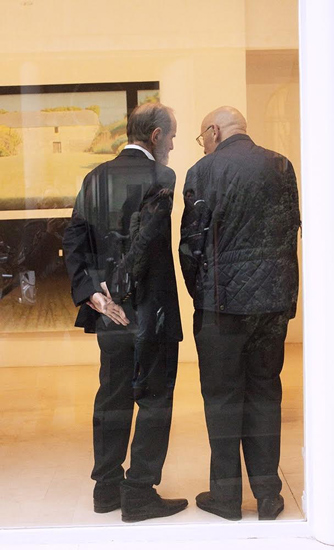 © Olga Akhmetyeva Oscar Rabin and Eric Bulatov at the Bulatov personal exhibition in Paris. 2011
The case of Rabin is a good example of what it is. In his art there are problems common to the entire artistic process of that time, despite the “bipolarity” then still divided by the iron curtain of the world. The first problem (which was actively discussed by philosophers in the West in the 1960s) is the question of whether the autonomous art can be an act of social criticism and what happens to it. Unofficial art in the Soviet Union with Rabin at the head was the best training ground for studying this issue, but Slavists and translators from Russian could not see it in such an angle. The only one who came to this was John Berger - but his essay about non -conformists was written for a popular magazine where he could not develop this theoretical theme. This issue must be devoted to a separate study, and I will not touch it in detail now. The second point that I want to write about is concerned with the basic topics of the early Rabin - they were important and new, and today they need to pay tribute to him. Moreover, in an environment that was literally permeated by the struggle for priorities, he was distinguished by a special modesty and did not fought with anyone.
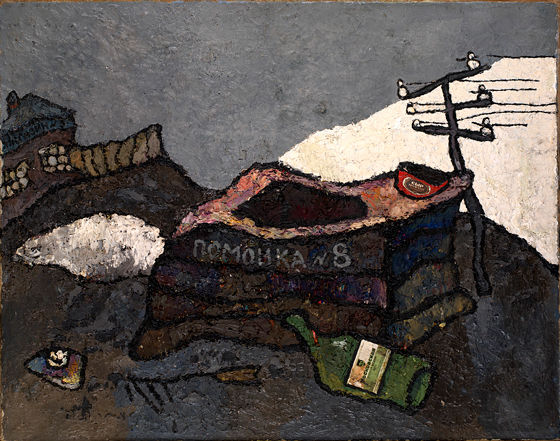 © Tsukanov Family Foundation Oscar Rabin. Mushroom No. 8. 1958
And yet, for me, as for many colleagues, it is undoubted that he discovered the topic, which was then used in Moscow conceptualism and entered his artistic dictionary. It seems that in common between Rabinsky, written in an expressive manner, “Embrays No. 8” (1958) and a cold-conceptual “schedule of the embezzle of the garbage bucket” Ilya Kabakov? The answer is everything: they have, in fact, one concept. Kabakov continues (of course, in his vein), the connection of the topic of garbage, the discharge, chaos of life found before him), connecting it with the theme of a clear bureaucratic protocol (he does not have enough sex in the garbage can, which is in one of the options for Rabin; Kabakov’s main instinct is depressed by its main theme - the fear of punishment). With the “garbage dump No. 8” and other works of that time, Rabin was at the turn of art to that distinct vision of the everyday and ordinary, which in Russia was initially associated with “pop art”, not very distinguishing between pop art and neodadaism.
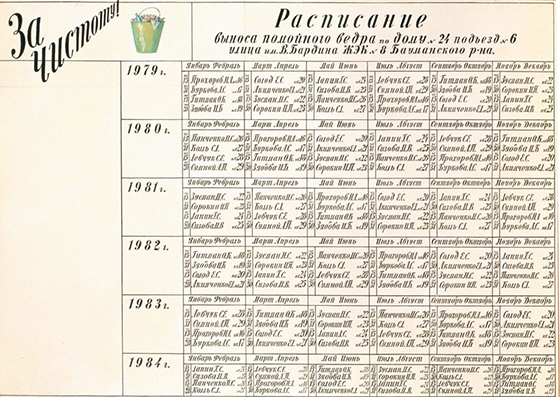 Ilya Kabakov. The schedule of the garbage bucket. 1980
There is another well -known narrative about the beginning of this turn in Russia, namely, Mikhail Chernyshov’s memoirs: he divided his colleagues into three categories - those who painted figurators “with big eyes”, those who were not afraid to simply throw colors on the canvas (abstracts), and themselves, who dug all the Western journals in the library of foreign literature and realized that the next step in the development of art, if you want to be, if you want to be. Ahead, on the contrary, the departure from the abstraction into a specific one must be. Relatively speaking, his approach instead of “apocalyptic wallpapers” (as Harold Rosenberg called abstract painting) became just wallpaper or Metlah tile, which was drawn by Roginsky who was friends with him. This was not at all stupid - but Chernyshov’s story about the progress of his thoughts is given by the typical approach of an external observer trying to appropriate the observed process. It’s completely different - Rabin, who did not try to appropriate or integrate into any column, because he was already there, in that column.
Rabin, to my regret, was a beloved artist of those who believed that Moscow non -conformism was an act of resistance and that its representatives are heroes, but their art is a secondary phenomenon and a repetition of Western styles.
The garbage, which he “proposed” to the viewer, had the prospect of becoming one of the main topics of the second half of the 20th century, and although Rabin approached the topic by means of painting, it was a breakthrough: in the late 1950s, he fell into the topic of the relevant searches of the American avant-garde, remaining original and not being outwardly and technically similar to it. I will say a little about where the garbage comes from in contemporary art. Although we are accustomed to him as something like a native, and artists-for example, Kabakov-love to talk about him, this is not such a simple motive. It cannot be called evidence, because it, as a rule, is not visible around us, and if you can see, we close our eyes to this. In order to detect garbage, you need to break away from visible empirical reality, as realism portrays it, even critical. And, on the contrary, garbage is certainly detected on the boundaries of abstract painting, having a special internal connection with it. The entrance and access to an abstract vision and vice versa are associated precisely with the image of garbage. Kandinsky wrote about how he discovered the possibility of abstract painting, the following: “This solution liberated me and revealed new worlds to me. <...> Not only praised forests, stars, moon, flowers, but also a frozen cigarette butt lying in an ashtray, a patient, meek white button peering out of a street puddle, a humble piece of bark, drawn through a thick grass with an ant in its mighty jaws for unknown, but important calendars, to which a confident hand stretches, to draws up to be a confident hand, to which a confident hand stretches. To force him from the warm neighborhood of the leaflets remaining in the calendar - everything showed me its face, its inner essence <...> so I came to life for me and each point at rest and in the movement <...> and showed me my soul. This was enough to understand with the whole being, all feelings the possibility and cash of art, now called as opposed to the abstract object. ”
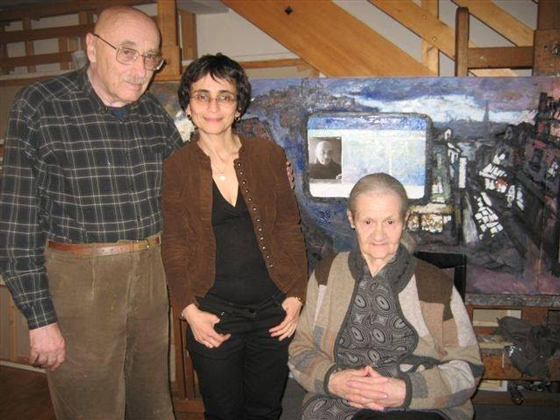 © Lyolya Kantor-Kazovskaya Oscar Rabin, Lyolya Kantor-Kazovskaya and Valentina Kropyvnitskaya in the artist’s workshop in Paris. 2007
In 1958, Allan Caprove described the reverse trajectory “from abstraction”, when, starting from the heritage of Pollock in an article on his memory, he predicted the further development of art and the direction with which he himself identified himself. He suggested that the artists of the future would abandon the abstraction, leaving himself her view of the world, which consists in the fact that there is no object and background, important and unimportant. Thus, they, these future artists, “will not only show us, as for the first time, the world that we are not familiar with, although he always surrounded us: they will deploy in front of us unheard of incidents and events taking place in garbage tanks, police papers, a lobby of hotels ... The smell of crushed strawberries, a letter from a friend, an advertisement“ Dreino ”, three buttons on the entrance door, a scratch, signs. An endless lecture, a dazzling flash, a hat-hat-everything will become a material for this new specific art. ” I will not deny myself the pleasure of noting that what seemed to him a matter of the future - incidents and events in garbage tanks - appeared in the same year in “garbage dump No. 8”.
The garbage, which he “proposed” the viewer, had the prospect of becoming one of the main topics of the second half of the 20th century, and although Rabin approached the topic by means of painting, it was a breakthrough: in the late 1950s, he fell into the topic of searching for the American avant-garde, not being externally and technically similar to him.
So what is an abstract vision, the essence of which are trying to convey both author who are on its borders? Both describe it as spontaneous spiritualism of everyday, giving a feeling of fullness of existence at each point of reality, and literally everything is endowed with this completeness, even that which is devoid of value to such an extent that it is eliminated and ceases to be visible, that is, garbage. With an abstract way of perceiving reality, not dividing reality into an important and unimportant, this world with which we are not familiar with, although it has always surrounded us , becomes visible. In all evidence, in American art the source and nutritious environment of “everyday poetry” was Zen, who was given tribute to Cage, the former student of Suzuki, and then taught art at the new school of social research and influenced Raushenberg and Jones, who began to introduce bouncers, old blankets and other garbage in their paintings and assemblies.
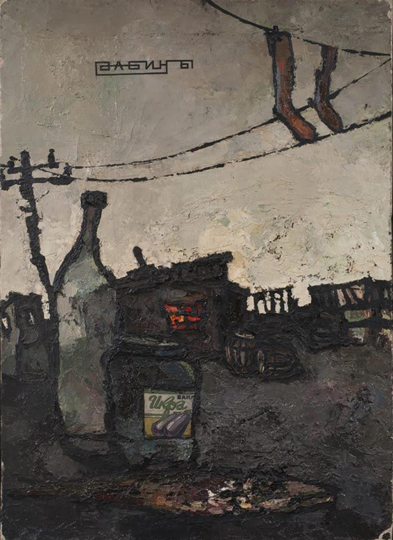 © Aktis-gallery.co.uk Oscar Rabin. Bottles and electric wires in the city. 1961
It is this kind of garbage "edge" of an abstract vision that is represented in the poetry of the Lianozovsky circle and in the painting of Rabin. What was the source of this phenomenon there is a separate question that I do not want to touch now. The abstractions on Dolgoprudnaya even before the Western abstract painting was shown in Moscow, almost everything was given tribute: Evgeny Leonidovich Kropyvnytsky himself, the inspirer of this circle, his wife, Olga Ananievna Potapova, and almost all the young members of their circle, including their son, Leo Kropivnitsky. Evgeny Leonidovich insisted that the art of modernity is abstract, that, as he wrote, "the artist only in abstract things can be sincere." But at the same time, he called the abstraction not indiscretion as a style, but a special approach to reality.
Opening their house for everyone who wanted to see his work, creating a continuous stream of visitors and guests in Lianozovo, he gradually conquered the whole increased patch of freedom from the Soviet regime, on which half-Moscow was placed.
According to him, “it is naive to think that this is only a workshop of lawless people”, abstract art can be subject, but “objects from an abstactivist are not presented naturally, but abstractly.” Exactly so, “abstractly”, his poetry is built, which makes the “world, unfamiliar, although it is always with us”, his poems describe harmful insects, worthless, thrown into the human garbage dump, their divisions and dark aggressive and sexual instincts as if every smallest point of the Universe is equally important and not one of the subjects, whether it is an ant or a person. He produces what he compresses, according to the above expression of Kandinsky, "in powerful jaws." Some Morilshchik Klopov or a fight in the village can be described by Kropyvnytsky as if it contained the entire fullness of the universe and the “world secret” (which he wrote in his more clearly symbolist period).
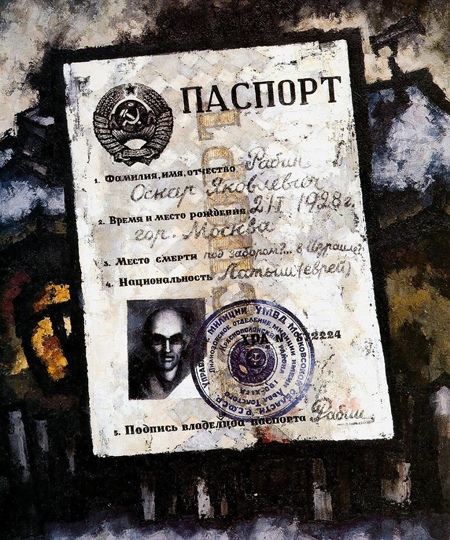 © Museum of Majole, Paris. Dina Foundation Oscar Rabin. Passport. 1972
Rabin's early works fit very organically into this context of the “art of abstract perception”. Although, although drawing objects, he was engaged in abstract painting of a special kind - expanding his vision to such objects that, such as a herring ridge, a garbage pile, an old newspaper or a Soviet passport, are not considered by a simple, intensely directed vision. His first, written in the 1950s-early 1960s, has a special intensity-he affirms his objects in the reality of our gaze, clinging it to what we would never look at, while the korezh, distorting and caring out already miserable forms. Soviet criticism called him the “priest” of the garbage dumping number eight and in this in its own way was right. (It is interesting to note in brackets that this work coincides with both descriptions of abstract experience-at the entrance and output-also in the fact that in addition to the discharge of life, they all include its bureaucratic protocol: Kandinsky’s calendar, police officers at Kaprow, Rabin's garbage number-and the same motive will have a continuation of Kabakov.)
I am trying to imagine how the artist felt, being part of this focus of a new attitude. I think that thanks to this experience he could be so hard and free in life. Opening his house for everyone who wanted to see his work, creating a continuous stream of visitors and guests in Lianozovo, he gradually conquered the whole of the increased patch of freedom from the Soviet regime, on which half-Moscow was placed-and for which we should all be grateful to him. Supporting this activity - the first free exchange of ideas and the art market, playing according to its rules, he expanded his production, slightly burdening it with too literary motives - but it is difficult for me to reproach it. He paid for his position forced emigration - but in exile remained himself and continued to work and love the visible and invisible world.