
Translated material
The winemaking of ancient China
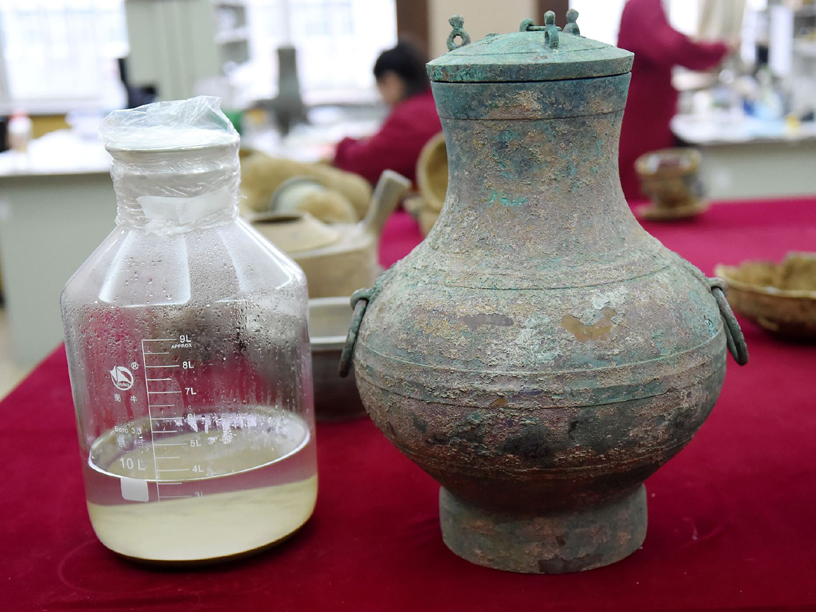
The Sinhua agency reported that when excavating the tomb in the city of Loyan, archaeologists discovered a bronze vessel about two thousand years old. The liquid in the vessel has been preserved in a very large volume - more than three and a half liters. Chemical analysis has not yet been carried out, but the appearance, smell and context of the finds say that this rice wine is a popular drink of ancient China, which was also used in funeral rituals.
The first certificates of consumption of alcoholic beverages in China are still in the Neolithic era. On ceramics about 9,000 years from the settlement of Jiangu (Henan Province), traces of a drink were found, which chemists were defined from a shot mixture of fruits, rice and honey. True, it is impossible to accurately determine the fruits used for the preparation of wine. It could be grapes (its bones were found in Jiang), but there could be, for example, kizil or hawthorn.
The archaic form of the hieroglyph of Ju (酒), which is usually translated as “wine”, is found in the earliest written monuments of China - fortunetelling inscriptions on the shells of turtles. The rulers of that time were very worried about the correctness of sacrifices, so when wondering they asked questions whether to use the young or old wine when sacrificing the ancestors of the ancestors. Before using the wine in the ritual, it was necessary to clean. To filter wine, stems of one of the types of reed, known as Jing-Mao, were used. Regular deliveries of this reed were one of the duties of vassal princes. Reproaches to one of the negligent suppliers have been preserved: “You can’t imagine in the bundles the reeds of the Mao, which is among your offerings, which is why the victims [spirits] are not brought, since there is nothing to clean the wine ...”.
Chalice and Frying to heating the wine from the time of the West Han dynasty (Museum of the city of Loyan)
There were legends about the creators of wine. In the historical essay “Zhangho CE” (“strategies of the fighting kingdoms”), the inventor is called I-Di, one of the ministers of the mythical emperor Yuya. who presented the drink he created to his lord. Yu tried the wine, found it pleasant, but said: "Between subsequent generations, people will certainly appear who, thanks to the blame, will lose their kingdoms." Therefore, Yu refused to drink wine in the future.
Another inventor of wine was called Du Kan, about which little is known. Sometimes he is identified with Shao Kan - no less mythical emperor from the dynasty. It is said that Du Kan had a negligent son Hei, who did not keep track of his wandering rice wine. True, as a result of Hei, she became the inventor of the famous black rice vinegar from Zhenjiang.
But it should be remembered that all this wine was not grape, it was made of rice, millet and other types of grain. At first, apparently, Chinese wine from cereals was a rather weak drink, similar to that they were known in many corners of the world, starting with ancient Egypt and interfluve. Most often, historians use the word "beer" to designate it. But then the Chinese took possession of the technology, which allowed them to receive a stronger version of wine.
The fact is that usually malt - sprouted grains of cereals are added to it to ferment grain. The malt contains an amylase enzyme necessary for the process. The Chinese, making their wine, found another way out - adding a mold fungus to the grain, which also produces amylase, and the interaction with starch in this case is more efficient. For the first time this method was mentioned in the July Treatise (Zhou rituals, about 300 BC).
Plane fermentation is still used in the manufacture of traditional alcoholic beverages in China and other countries of East Asia, in particular, this is how Japanese sake is done. As a fungus is most often acted by Aspergillus Oryzae , sometimes other species are used. The discovery of mold fermentation was one of the two largest achievements of China in the field of winemaking (the second is an independent invention of distillation).
Aspergillus oryzae fungus on rice grains
We recognized Chinese winemakers and another secret. If, in the process of fermentation, add grain with a fungus to wine several times, then the wine fortress will increase. Such an operation was called "killing grain." For a result of strong wine (up to 20 % in volume), a special term of Chun was used.
The theoretical comprehension of mold was made in the spirit of the traditional idea of the bright beginning of Yang (in this case, rice acts in this role) and the dark beginning of Yin (mushroom leaf). Their meeting causes an increase in the temperature of the drink, which is the cause of fermentation.
Gray old man -
I cook wine from a millet.
The rain knocks
At my window.
I'm on fate
I don't look askance:
In solitude
Glory is not needed.
Du Fu “surrender to my thoughts”, the translation of A. Gitovich
Even in the XIII century, when the Chinese already knew grape wine, the wine from cereals remained more common. Marco Polo wrote: “All the almost people in the area of Katai drinks this wine: they cook it from rice with other good spices, and drinking comes out better than any other wine: both clean and tasty; The wine is hot, and you get drunk from it rather than from another ”(“ Book on the variety of the world ”, II, C. Translation of I. M. Minaev).
Wines with a variety of additives appeared early. They could be vegetable, such as the flowers of the osmantus fragrant ( Osmanthus fragrans ) in the fault of Guyuhuju (桂花酒), which they traditionally drank on the holiday of the middle of the fall. Or mineral, as in Senoangu (雄黃酒) - wine with a crushed realgar - a mineral, which is arsenic sulfide. The wine with arsenic was treated to the fifth day of the fifth month, at the festival of dragon boats. It is still often prepared at home, adding 50 - 100 grams of arsenic sulfide per liter of wine and insisting for several hours. It is believed that a toxic arsenic in a realgar cannot cause serious harm to health, since the realgar is poorly dissolved and, accordingly, is poorly absorbed in the digestive system. However, modern doctors are wary of custom, since in the realgar more dangerous compounds of arsenic may contain as impurities.
Wine from rice, millet or other cereals (Juanju, 黄酒) is now popular in China. But in China, grape wine is also produced (Putazyu, 葡萄酒). Triostron girl’s girlish grapes ( Vitis Thunbergii ) and Haynan Enlard grapes ( Vitis Heyneana SSP. Ficifolia ) have been growing in China for a long time, and their fruits were used to make alcoholic beverages: you can recall archaeological finds from Jihu. Written references to grape wine from local raw materials can be found in the book “Shen-Nui Ben Cao Jing” (“Canon Shen-Nuna on the roots and herbs”)-the most ancient monument of Chinese pharmaceuticals. Cultural grapes ( vitis vinifra ) enters China in the II century BC. e. From the west. And this time this event occurred thanks not to a mythical hero, but by a completely historical person - the famous traveler and diplomat Zhang Zian (d. 114 BC). Zhang Qian visited the countries of Central Asia, where at that time there was already developed winemaking, and, returning, brought with him the vines of grapes, which were planted near the imperial palace in the city of Sian (Chan). Perhaps not all of China’s grapes comes from vines brought by Zhang Cyan, but he certainly contributed to the spread of this culture.
In the era of the three kingdoms (220–280), Emperor Cao Pay noted that grape wine is sweeter than grain, and, having drunk it too much, it is easier to come to his senses later. Grapes began to be diluted in China, especially in Gansa province, but it was grown a little, so grape wine remained an exotic product available only to the elect. It spread under the Tang dynasty, when China won the principality of Gaochanes, who was in an oasis in the Turfan hollow. The inhabitants of Gaochan have long grown grapes, and the Chinese adopted agricultural technology from them and received a variety of Mazh (“nipples of mares” 馬乳) with elongated berries. Since then, many Chinese poets glorified the wine “from the Western Territory”.
The figurine of the Tang era depicting a Sogdian merchant with a wine wineswoman (Royal Museum Ontario)
The Chinese authors, starting with the Han dynasty, are often mentioned in descriptions as rituals of veneration of the gods and the spirits of the ancestors (“if order and prosperity reigns in the country, then pure wine and ritual dishes will always be found to accompany the sacrifice,” the book “Mo-Tzu” says), and secular entertainment (“[Emperor Zhou] loved wine, loved wine, love Deadness and entertainment, nourishing an addiction to women, ”says Sima Qian). Many official ceremonies were not thought without wine. When the army of the Chinese emperor was returning from the campaign, it was necessary to carry out the rituals of Zhen Lui “putting [troops] in order” and yin chi “the final [wine] drink”.
The rulers in ancient China were attentive to the quality of wine. A legend has been preserved that once at a meeting of Vanas, the Chuky ruler of the vine, under the guise of the famous wine from the kingdom of Zhao, poured a cheap wine from Lou. He was angry, but did not understand that the substitution was committed, so he attacked the capital of Zhao - the city of Handan. Since then, the saying arose: "The wine from Lou turned out to be crashed, and Handan was subjected to the siege."
Wine in reasonable doses was recommended by Chinese doctors. Drinking wine was believed, conveys the vitality of fruit to a person. The art of Tszyu Sh no wine has turned into one of the types of the doctrine of Yang Shen, which is important for Chinese medicine, “feeding / standing life”, consisting in the correct regulation of qi energy. It was believed that intoxication activates the flows of this energy in the body, but, in the end, a person loses control over it, and Qi evaporates, and a person remains broken and exhausted. The purpose of the art of wine drinking is not to miss qi , but to accumulate it in your body.
The use of wine has become an important part of the culture. “In the sky there is a constellation Tszyu-vi (“ wine banner ”), on Earth there is a district of Zyutsuan (“ wine source ”), and people have an innate tendency to savor wine. If Yao had not drank thousands of guilt measures, would he have become perfect? ”Said historiographer Kun Jun (153 - 208).
There is wine - strain it for us,
But there is no fault, so buy for us,
Like thunder, drums, rattling for us,
Live, dancing, dance for us!
And time will come to rest for us - again
We will drink the wine transparent.
(Shi-jing ("Book of Songs"), II, I, 5, translation of A. A. Stuyn).
The Chinese learned another method of increasing the fortress of wine from the nomads of Central Asia. Those in the 5th century were regularly supplied as part of tribute to the Chinese emperors “Highless Wine” (Dun Ju). When freezing the wine, a small amount of imperishable fluid with a high concentration of alcohol remained. Subsequently, the Chinese themselves began to make "frozen wine."
But already in the 7th century, the need for “frozen fault” disappeared, as the Chinese have mastered the most effective way to increase the fortress of the drink - distillation, creating it regardless of Byzantine and Arab scientists. An overturned alcohol was received in China, the name of Shao Tszyu “burning wine”. Some researchers even suggest that the Dutch name Brandewijn “burning wine”, which has become the source of the English word Brandy , arose as a translation of the Chinese Shao Tszyu during the trade between the Chinese and the Dutch East India Company.