
Translated material
Nature reflected in Google
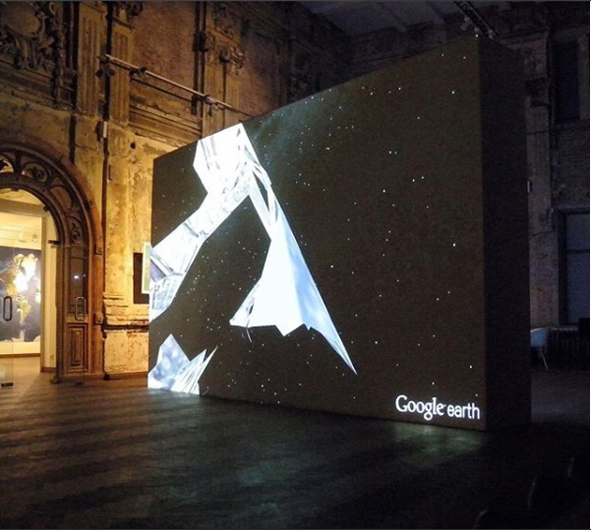
Kasya Klimpel and Esther Hunzicker came to Russia as part of a program organized by the Basel cultural and educational center "Philosophymum" with the support of the Swiss Council for Culture about Helvetius , the Canton-Stadt Culture Department and Switzerland embassy in Russia. Elsa Abdulkhakova met with them on the only Moscow day of their visit and asked about joint work for the Nizhny Novgorod Gallery of Futuro and modern digital art.
- How did you be invited to Russia?
Kasya Klimpel: The organizers saw in Basel my work “Mountains” [1] and decided that it was consonant with the topic of the program . Unfortunately, the exhibition in Krasnoyarsk was canceled at the very last moment. Therefore, our participation was limited to the exhibition and presentation in Nizhny Novgorod and my master class in Reutov.
- Is this collective work of several authors or participation in one program of individual authors?
Esther Hunzicker: Rather, individual authors, art in the program is still a little separate from literature.
Klimpel: And there are more show of individual works than a collaboration.
Hunzicker: But at the same time, the organizers of the program made great efforts to combine us all.
Klimpel: In this sense, yes. We were at the presentations of Ariana Koch at the local university and watched her play “Homo Digitalis” , attended the lecture by Roberto Zimanovsky, in general, tried to follow what was happening.
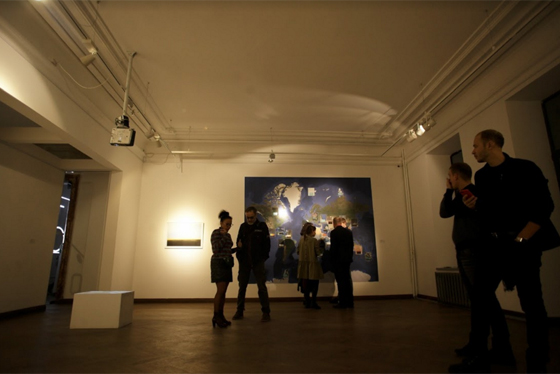 © Futuro Gallery Opening of the exhibition Kasi Klimpel and Esther Hunzicker in the Futuro Gallery
- Is this your first visit to Russia?
Hunzicker: For me, yes.
Klimpel: For me too. I was here very briefly a few years ago, but in general the first.
- What were your expectations?
Hunzicker: It is a pity that the exhibition in Krasnoyarsk was canceled, but I was glad to show the invitation to show work in Russia. I almost did not have time to prepare, and I had no idea about the country, but this was an excellent opportunity for traveling and meeting new people.
Klimpel: And I, first of all, was interested in showing work in a new space. Maybe get a new video, photo and media peppers. We are exhibited in the Futuro gallery , most of its employees are Nizhny Novgorod artists that we managed to get to know each other. It was interesting to see street art in Nizhny Novgorod. Unfortunately, all the artists could not meet, there was very little time.
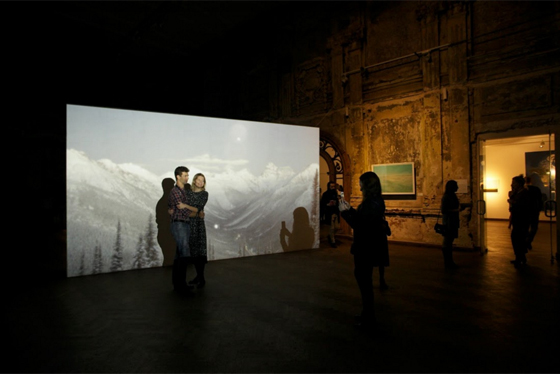 © Futuro Gallery Opening of the exhibition Kasi Klimpel and Esther Hunzicker in the Futuro Gallery
- Describe your exhibition in Nizhny Novgorod. Are these two solo or duet?
Hunzicker: I would say that the duet.
Klimpel: And I would not say that. From the very beginning, this exhibition was rather two solo projects, and we have no joint work.
Hunzicker: But you offered my candidacy, and we both work with cards. We have a common topic, and work goes well with each other inside the same exhibition. Still, this is a duet.
Klimpel: O'Kay, duet. The Futuro gallery is located in a very beautiful and old building. Its space is literally pierced by a sense of history, there are very high ceilings and a lot of air. We installed a wall inside the gallery, on which video works were projected on both sides. In my opinion, it turned out very, very good. By the way, it seems that there was once a cinema in this room, it complements the sensation of the viewer in its own way.
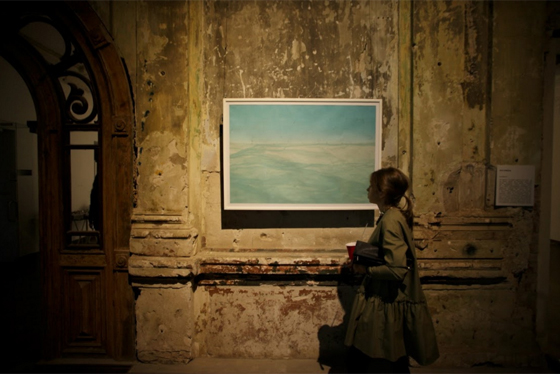 © Futuro Gallery Opening of the exhibition Kasi Klimpel and Esther Hunzicker in the Futuro Gallery
- Kasya, but you presented another job?
Klimpel: Yes, the Grand-Tour project. It can be seen in space that adjoins the main hall of the gallery.
- Preparing for the interview and looking at your sites, I was looking for visual rhymes, general methods in your work. You have already mentioned that you both work with cards, but, as I understand it, you are interested in the algorithms of automatic processing of random images (including documents and images with webcams ), interactivity ( “most beautiful sunset” , “ Streamers ” ) and “errors” of large systems as Google Earth or Google Images ( “ Panoramio ” ). It seems to me that the work of “ Streamers ” and “Analogue - Digital” are similar in shape, and the screenshots from the work of “ Loop ” are visually close to “the most beautiful sunset”. What do you say?
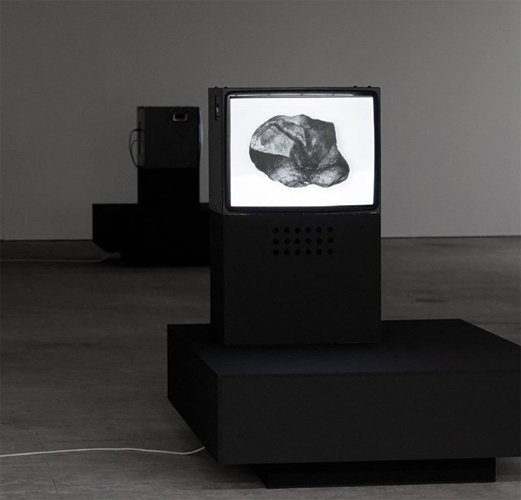 © Esther Hunzaker / Kunsthaus Baselland Streamers. Videoinstallation. 2018. Kunsthaus Baselland
Klimpel: Perhaps we really have a common interest in using errors, if I may say so.
Hunzicker: And to surfing Google systems ... to a very long surfing ...
Klimpel: This is true ...
Hunzicker: It is interesting that you mentioned the work of “Analogue - Digital” ! I think that many of the listed digital works have an additional dimension, as in the landscapes of Kasi, where it starts work on paper, and then places it in a digital environment.
- And if you look from afar, in the light of the fourth industrial revolution - how do you combine an analogue and figure?
Hunzicker: Here we must mention one more similarity - we are about the same age. This to some extent affects our type of creativity and the attitude to analog shooting that we both studied.
Klimpel: We have experience both in the analogue and in the number.
Hunzicker: And at the same time we use both media. But we, of course, relate to digital communication differently than the younger generation, and in this sense more belong to the analogue world. I use the figure, first of all, for reading, and not for private life or self -presentation (like a Facebook or Tinder that is common among young people). This is my working tool.
Klimpel: My experience is close to Esther's experience. What Roberto Zimanovsky is talking about in his lectures is “I am writing a post, then I exist” is not my case. I believe that to some extent I have time for the modern world, but for me reality is not limited to the screen.
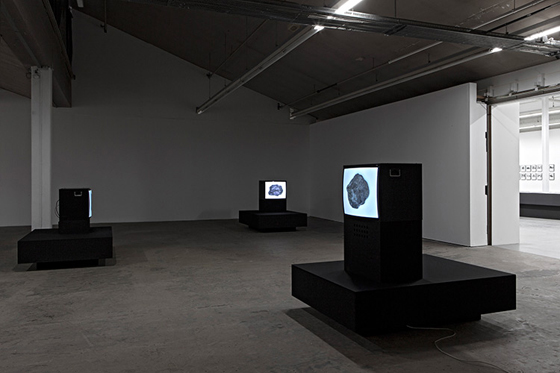 © Esther Hunzaker/ Kunsthaus Baselland Streamers. Videoinstallation. 2018. Kunsthaus Baselland
- What is the role of the numbers in your artistic practice?
Klimpel: I, perhaps, disagree with those who believe that analog photograph is of great value than digital. For me, it all starts with a concept, with an idea that I later embody in digital photography. I think, in comparison with an analogue, digital photography as a tool gives me more opportunities.
Hunzicker: I have been working with the figure for a very long time and I am afraid that digital art still remains only a small part of modern art as such. It is still not enough at exhibitions. And this is very sad. People still think in the material, they want to have material things that have value. And it seems to me that for collectors of the future it would be very convenient if the possession of work was reduced to access to the screen. Not only material has value. Art-world is divided into material and digital work, and the latter are more unstable. For example, no art. For me, these types of art are equally significant: after all, I can travel and open exhibitions, using only my computer.
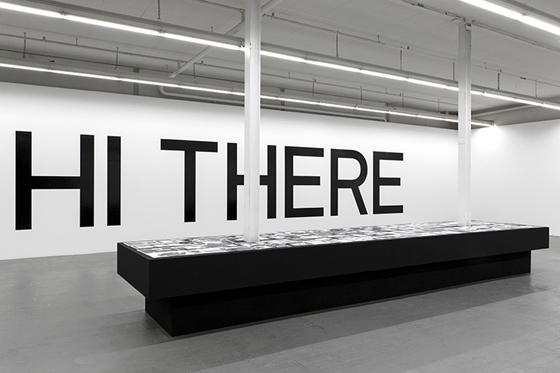 © Photo by Gina Folly / Esther Hunzaker / Kunsthaus Baselland Esther Hunzaker. Hi There. Solo Exhibition. Kunsthaus Baselland
- Tell us how you came to practice. Do you remember the moment that inspired you from which it all started? What does it mean to be artists for you?
Hunzicker: It took me a long time for me. I sewed clothes, studied its design, then I wanted to become a designer - and I became them ... Then it stopped interested in me, I began to study the video art. Education was divided into three directions: sculpture, painting and videoart, which at that time was perceived as something separate (now it is already united with them into a single group). But even at that time I did not think that I would become an artist. That is, there was no moment when I decided to become an artist and chose a video art as my media - it was a way of developing interest, and not a conscious solution from the very beginning. Interest came from the cinema, then I thought that I would make music videos, but I still did not do a single one. We can say that I began to use the media and this has grown into art.
Another part of my interest was related to technology. When I studied, the artist had to be able to draw well, and I believed that there is enough technology to understand art and creating his own works - including the ability to work in photography.
Klimpel: I was always very interested in photography. I took off a little myself, watched how and what other people take off. Several years passed before I went to study photos at the Netherlands Academy. There were also departments of visual arts and graphic design, and the separation of photography existed separately from visual arts. Probably, I can call myself an artist working with a photograph. This is my way of thinking, it is a media that has a significant influence on me. But I don’t remember some special moment, my path was also a development.
Hunzicker: Perhaps at the beginning of the journey we do not think about art as such, but begin with interest. In your case, this is an interest in the photograph, which eventually became your main media.
Klimpel: More video and Internet.
For some reason, many believe that artists should be happy just because they are shown and paid attention to them.
- What artists influenced you?
Hunzicker: They changed ... At first these were filmmakers - for example, Tarkovsky. A little later - Jonas Mekas, Bruce Conner, Robert Frank, Andy Warhol. I can call us June Pike (as the first, who began to engage in media installations, be interested in technology). For me, this was not only inspiration, but also to some extent by the discovery of art. Today I can no longer name concrete names, but the sounding had influenced me.
Klimpel: It is difficult for me to name specific names, I watched a lot of films. My inspiration is a visual culture in a broad sense. I look at a large number of images that are found daily in newspapers, on TV, films, books, old photos, images from webcams, on the Internet, in painting. The read books also probably have an influence on me.
- What projects are you working on now?
Klimpel: I continue to work on my big project, which includes the installation of the “mountains”. Another important media seems to me a book. I hope I will be able to publish another book: it will not necessarily be made manually, but I hope to call it the artist’s book.
Kasia Klimpel Publication - "Still"
© Kasia Klimpel
Hunzicker: I have no specific work right now. I recently opened a large personal exhibition, which included video installation, a book, and several other works. The main task within this exhibition was to connect the components in one space, to knit them among themselves. I would like to do the same on the network, return to network art. I do a lot of network work, but sometimes they are lost ... I also think about an electronic or multimedia book. I am very interested in media that allow you to combine text, moving images and sound.
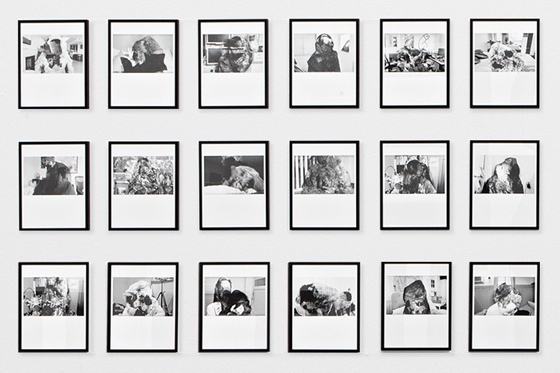 © Photo by Gina Folly / Esther Hunzaker / Kunsthaus Baselland Esther Hunzaker. Hi There. Solo Exhibition. Kunsthaus Baselland
- In addition to an analogue and numbers, I would like to talk about online and offline modes. How do you work with them? And are you not afraid (I, for example, are very afraid) that modern technologies know us better than ourselves?
Klimpel: Perhaps it is a matter of realizing what is happening to us. Smartphones have long been called parts of our bodies - maybe it is worthwhile to accept, because we ourselves are part of a large process that surrounds us everywhere. Technologies have become an element of our reality, it is almost impossible to avoid contact with them. It will be appropriate to recall the documentary of Werner Herzog “Oh, Internet! Dreams of the digital world. "
Hunzicker: Perhaps cars know us better. We still do not know what we want, but Google has already identified. It is very difficult. These algorithms are everywhere, and no one knows exactly how they work. Many do not even know about their existence. While working on Streamers , I encountered YouTube users and YouTube work as a resource. There is an algorithm that puts the video in the top of recommendations, in the sheets of recommendations for users, and there should be someone who makes a decision, what users want. YouTube is an extremely customizable resource and a very complex behavioral digital structure. And we do not fully know how it works, but we want to be part of it. We want us to subscribe to us, we want to make content that will fall into the listings. I think it is very dangerous.
Klimpel: Also, for example, I read about the existence of an algorithm that can determine the depression of a person by his notes on Facebook. Algorithms are a very mobile object. It is difficult to comprehend it.
In Nizhny Novgorod, we saw a situation similar to Swiss: young employees of the Futuro galleries are engaged in art not because of money, not for money, in their free time.
Hunzicker: Yes, we continue to live in a structure that sets a certain order what a person should be, just today the name of this structure is Google . This is a negative side, but at the same time we are free. If we have difficulties, we do not feel loneliness and we can always find someone with a close problem. If you look back, recall the time of my youth, in this sense there were much more restrictions ...
- The more freedom, the more difficult the choice. The depth of knowledge has also changed.
Klimpel: And these are the changes that come with the development of society.
Hunzicker: And we will see what will happen next.
Klimpel: It is important that reflection is leaving today. People do not comprehend their actions. Especially on social networks.
- Despite the fact that, as a rule, these networks are several: Facebook - for business, Instagram - for personal.
Klimpel: A few months ago, a large action about the dangers of Facebook was held in the Netherlands. The fact that he sells personal data of his users to other companies monitors our behavior. About ten thousand people participated in the action, reporting hit on TV. Many promised to leave Facebook, but after a while they returned. People found that outside Facebook they do not receive invitations to birthdays and parties. It turned out that everything is happening online. They did not receive information and felt excluded from the usual social life. It's complicated. The unwillingness of a person to be part of the online social life begins to influence his life offline. This is a single space.
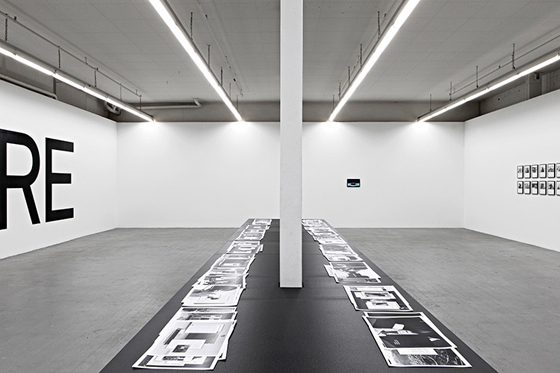 © Photo by Gina Folly / Esther Hunzaker / Kunsthaus Baselland Esther Hunzaker. Hi There. Solo Exhibition. Kunsthaus Baselland
- What do you think about state control over digital communication?
Hunzicker: Didn't this happen?
Klimpel: In Germany, similar attempts are already making. I don’t know how things are with this in Russia.
Hunzicker: In Egypt ... It's great that we can follow what is happening around at any moment. But it is impossible to believe everything until you see confirmation in reality. OFLINARISE-a powerful tool in front of BIG Eye ... the Internet becomes more and more a commercial platform, and it is becoming increasingly difficult to use for other purposes. If you consider the network as an artistic space, it turns out that for some reason you cannot at the same time lose all sounds and videos: each time you must click a button that allows viewing. Everything is aimed at sales.
Klimpel: And what about Haking? A few years ago, if you were looking for google Certain words related to terrorism could begin to observe you.
Hunzicker: Do not give a visa in the USA ...
Klimpel: This process has a lot of levels ...
- What do you not like in the chosen profession?
Hunzicker: Like in any profession, I do not like it when it comes to money when the arts and large art fairs go to the arena. When art becomes a product. I'm talking about the market, about the value of money, about the complexity of communication with museums and galleries.
Klimpel: I think so not only in Switzerland, so in all European countries. One of the difficulties of work is that artists are often not paid, although there should be some standard level of payment for participation in the exposition. For some reason, many believe that artists should be happy just because they are shown and paid attention to them.
Hunzicker: I think there is also a curatorial trend. Curators are more influential and more important than artists. Not all artists can be mentioned in the project announcement, but the curator is certainly indicated.
- Do you manage to sell your work?
Hunzicker: I am not part of the art market. Most often, I manage to get money for the production of works, in Switzerland there are many opportunities for this. But the reason is the digital format of my work. They are bought in public meetings, but not in private ones.
Klimpel: I have the same thing. It is very good when there is an opportunity to get support for the project or win a grant for it. It seems to me that about 90% of the work in Europe is carried out on this basis.
- Can you call yourself successful?
Hunzicker: In Nizhny Novgorod, we saw a situation similar to Swiss: young employees of the Futuro galleries are not engaged in art, not for money, in their free time, and thus they develop their city. When you begin to engage in art, you do not think about success. You do not try to make your work successful. You do not earn money as an artist. This is another problem of the profession.
- Is it possible to single out a certain topic in your practice that you are constantly working on, which you are developing from the project to the project?
Hunzicker: Kasi always had a landscape. I do not have such a long topic. It is constantly changing how the daily information flow affects me. Для меня темой становятся те вещи, которые мне непонятны, которые захватывают меня, и я пытаюсь в них разобраться. Это не академическое исследование, а, скорее, личное. Попытка понять тему и справиться с ней. Если я понимаю, что ответ мне так и не удается найти, я работаю просто для идеи, для себя.
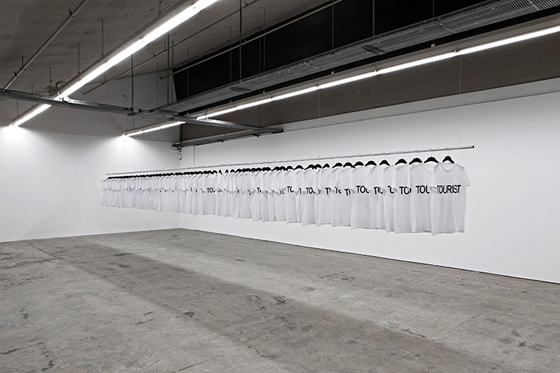 © Photo by Gina Folly / Esther Hunziker / Kunsthaus Baselland Esther Hunziker. Hi There. Solo exhibition. Kunsthaus Baselland
— В каком вопросе вы хотели разобраться во время создания «Earth» ?
Хунцикер: В то время я работала в Берлине и много пользовалась Google для перемещений по городу. Возможно, из этого опыта появился новый взгляд на небо. Но вообще каждый раз внутри одного произведения сочетается несколько тем. К сюжетам, с которыми ты уже давно работаешь, внезапно добавляется что-то новое, и все складывается в единое целое. Это счастливые моменты. Этот процесс нельзя описать последовательностью «исследование — результат исследования»: скорее, это какое-то количество однажды соединившихся блуждающих мыслей. Иногда результатом становится беззвучная картинка, которая собирает все воедино, и ты понимаешь, что «да». И я ищу не ответ, а эту картинку.
— Кася, почему вы работаете именно с пейзажем?
Климпель: Это не только пейзаж. Прежде всего, я задаю себе вопрос о симуляции, меня интересует не только сама природа, но ее восприятие, ее воспроизведение в фотографиях, в инструментах Google . Я пытаюсь симулировать не реальность, а то, как мы видим реальность. И это очень связано с фотографией. Ведь люди все время делают одни и те же фотографии, потому что знают заранее, как они должны выглядеть.
[1] Kasia Klimpel. «Berge». Solo exhibition curated by Roman Kurzmeyer. TANK, Institut Kunst HGK FHNW, Basel . March 2018.