
Translated material
In Russia they want to legalize “cyber vigilantes.” Will they help jail people for memes?
At the beginning of November 2018, United Russia deputies announced a bill on “cyber squads”. According to the authors, they will have to help law enforcement agencies find illegal information on the Internet. Cyber squads will be formed from volunteers who are over 18 years old. According to the deputies, cyber vigilantes should notify Roskomnadzor about their activities.
We don’t know for sure - the text of the bill has not yet been published. In one form or another, many different departments are involved in regulating work on the Internet. For example, extrajudicial blocking is carried out by Roskomnadzor, Rospotrebnadzor, Rosalkogolregulirovanie, the Federal Tax Service, the Ministry of Internal Affairs and the Prosecutor General's Office. Courts mainly block websites based on claims from “cyber prosecutors.” This is what the Prosecutor General’s Office informally calls prosecutors involved in supervision in the field of information technology.
It's hard to say. According to journalists who have read the explanatory note, we are talking about the wording prescribed in the law “On Information, Information Technologies and Information Protection”:
It is prohibited to disseminate information that is aimed at promoting war, inciting national, racial or religious hatred and enmity, as well as other information for the dissemination of which criminal or administrative liability is provided.
That is, this is a very wide list: from extremist reposts on social networks to child pornography. The most interesting phrase here is about “other information, the dissemination of which is subject to criminal or administrative liability.”
This is a favorite point among prosecutors who, through the courts, seek to block sites that, in their opinion, violate the law. Roskomnadzor keeps records of such blockings: according to the agency, the variety of reasons increases every year.
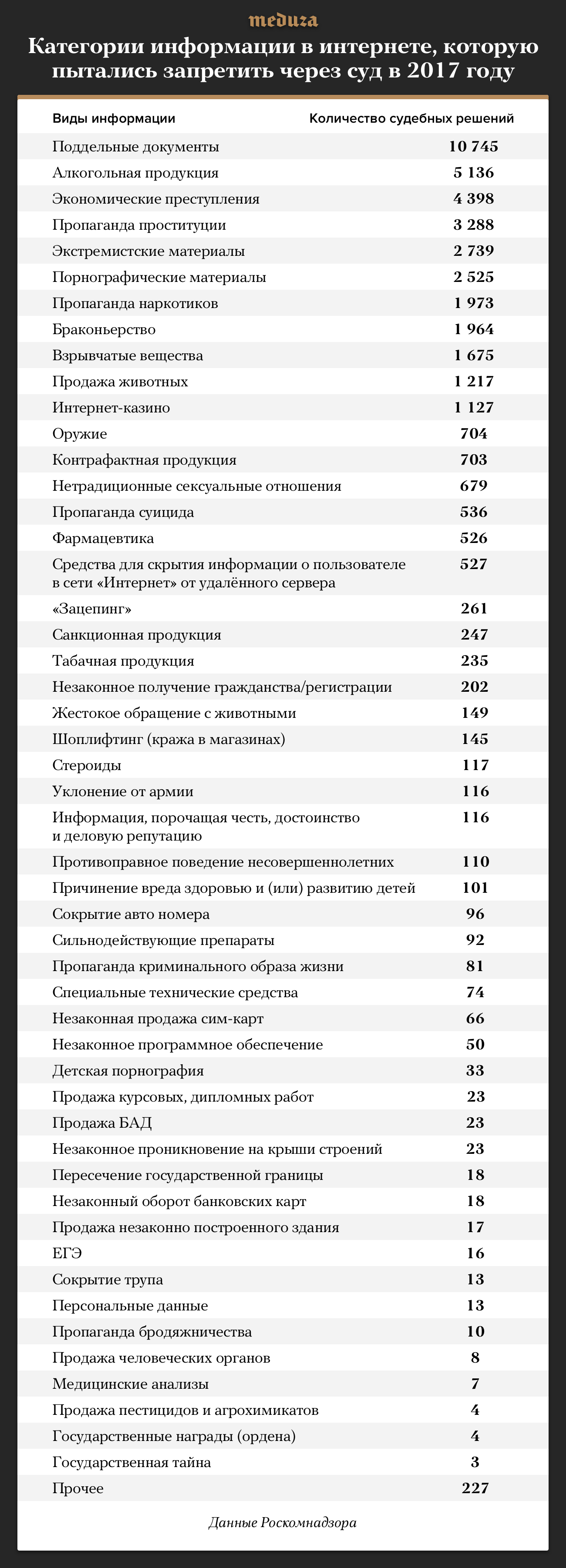
According to the Roskomsvoboda project, more than 76 thousand sites have been blocked by court decisions over the entire period. Some local prosecutors' offices and courts have established such good cooperation that they block websites en masse using a “simplified” scheme. With the advent of cyber squads, the number of such blockings may increase by orders of magnitude.
Prosecutors choose some hot topic like corruption. They find a dozen or two websites that describe the algorithm for giving a bribe, and file lawsuits “in defense of the rights, freedoms and legitimate interests of citizens, an indefinite circle of persons or the interests of the Russian Federation.” Each lawsuit states the same reasons for blocking: unrestricted access to information that “promotes illegal actions” harms the “moral and spiritual development of society.”
The courts, as a rule, unconditionally support the demands of the prosecutor's office. According to Stanford Law School graduate student Sergei Govyadinov, who found more than 33 thousand court decisions on blocking requests, only in 46 cases did judges refuse to recognize information as prohibited for distribution.
Govyadinov found several examples where courts satisfied dozens of similar demands from the prosecutor’s office in one day. For example, on October 30, 2015, a judge of the Kirov District Court of the city of Ufa satisfied 59 claims from the local prosecutor’s office to block online casinos, spending five minutes on each case. Identical court decisions differed only in different Internet addresses of the sites.
The fact is that in many cases sites that do not violate the law are automatically blocked. In the few cases where prosecutors have lost cases, judges have emphasized the need to distinguish illegal activity from information about such activity. In other words, advertising and selling alcohol on the Internet is prohibited, but information that they do so is not. You cannot falsify documents, but you can talk about the possibility of purchasing a fake.
In addition, site owners are often not invited to court at all. Even if the site owner later tries to file an appeal, he may simply be denied this right. After all, the court did not impose any obligations on him, he was not asked to delete the information; blocking is a matter for Roskomnadzor.
Is this right?
The Supreme Court of the Russian Federation decided in April 2018 that this interpretation of the laws is incorrect, and website owners should be brought to trial.
Actually, there is. The first cyber squads appeared in Russia back in 2011 with the advent of the non-profit partnership “Safe Internet League” - an organization that lobbied for the emergence of a unified register of prohibited sites and extrajudicial blocking. On his initiative, the interregional youth public movement “CyberDruzhina” was created, which was supposed to fight child pornography and extremism on the Internet. But the activities of such volunteers are not regulated in any way. Local agencies decide for themselves whether to pay attention to them or not.
The authors of the bill want any state authorities (including law enforcement) and local governments to cooperate with cyber squads. But how this will be spelled out in the law is still unclear.
Denis Dmitriev, Alexander Borzenko