
Translated material
Aimuntas Nyakroshus died. We tell how the Lithuanian director created a unique theater that is known all over the world
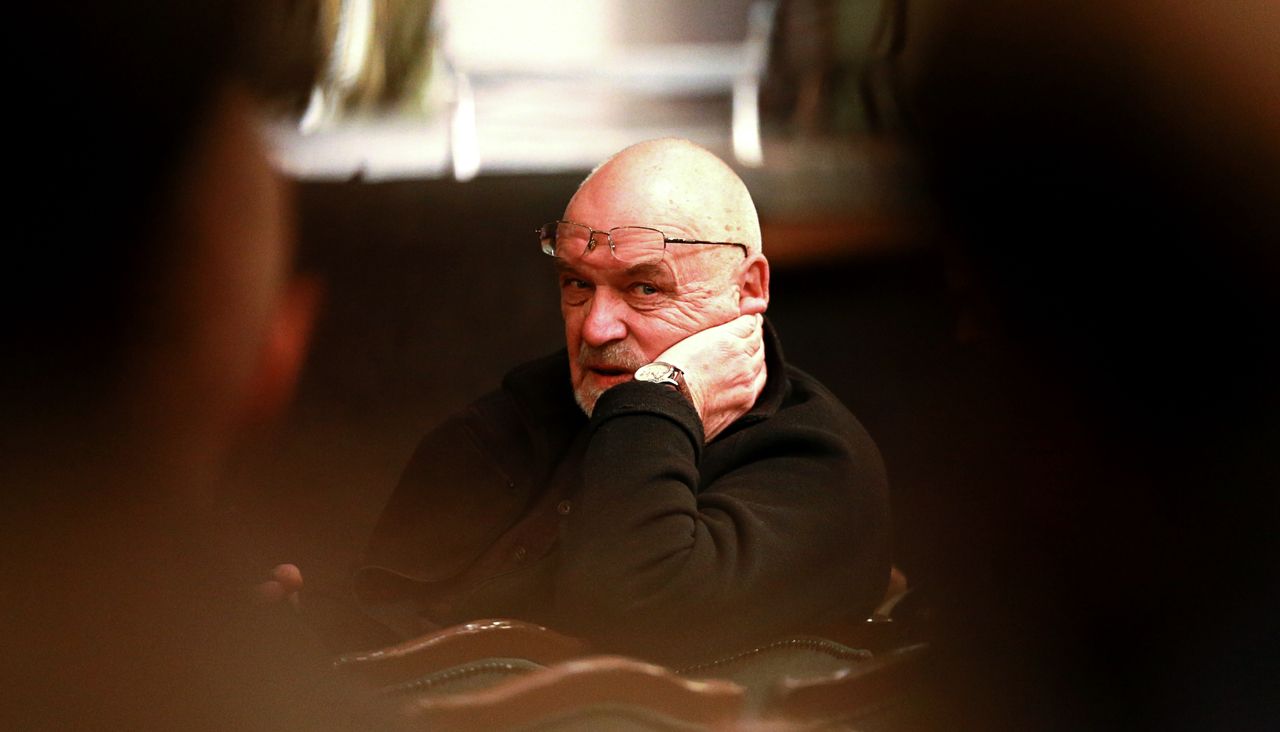
On November 20, Emuntas Nyakroszus, the creator of the Meno Fortas Theater and the most famous Lithuanian director, who were known all over the world, died in Vilnius. On November 21, he would have turned 66 years old. For the Russian theater, Nyakroshus was an equally important figure than for Lithuanian: he studied directing with Andrei Goncharov in GITIS, worked a lot with Russian classics, released several productions in Moscow, and his Lithuanian performances came to Russia every two or two years. At the request of Medusa, the theater critic Anton Khitrov tells what Aimuntas Nyakroshus and the theater he created was remembered.
Nyakroshus did on stage without modern technology and topical topics - but his theater did not become obsolete
Until the age of 18, Aimuntas Nyakroshus lived on the Lithuanian farm. In essence, it doesn’t matter if he grew up as a real peasant - this is already part of his legend, the same as the children's autism of another great theater director, Robert Wilson. Another part of this legend is Lithuanian paganism: the Baltic countries became Christian later than other regions of Europe, only in the XIV-XV centuries, and there is still strong memory of traditional beliefs.
Nature, magic, and the proximity of the other world were mandatory components in the performances of the Nyakoshus. His farm childhood all the time reminded of himself: either with troughs in “Othello”, then spinning in “Faust”, then copper boilers in “Macbete”. It doesn’t matter who the literary prototypes of his heroes were - Shakespearean kings and princes or Chekhov landlords - they always lived in the same mythological space. For example, in the Moscow production of the Cherry Garden (2003), Lopakhin tapped the floor to tell the late ancestors-fortified people about the purchase of the estate-and they immediately drummed in response.
Nyakroshus is the only major theater director of our time, who worked exclusively with archaic in all his best performances, as if not caring about what is happening in the world right now. He did without cameras on stage, screens and talk about the current agenda. Usually, when the theater is torn off from today's date, it seems naive, inadequate, outdated - but the production of a nanny (even unsuccessful ones) could not be called naive or outdated. Rather, it was some kind of alternative directing, not coinciding with theater mainstream.
Not only people played in his performances, but also things
No one in the theater works with objects as inventive as Nyakroshus was able. In his performances, something burned every minute, spilled, broke, raised something, suspended, dragged. The director almost did not use things with a unique design - unlike the same Robert Wilson, with whom he, in principle, has much in common. He took the usual item - a piece of slate, a door, a log, an ax, a flower pot, a dried tree - and found him outstanding use. This thing did not always mean something concrete: to decipher the metaphors of the nurse-an interesting, but not at all compulsory activity. They work not with logic, but with unaccountable associations.
Perhaps the most famous example is the monologue of “be or not to be” from the 1997 Hamlet. The actor reads it, standing under a chandelier. It is made of round saw, wheels, candles and ice pendants. Fire melts ice, meltwater drips the artist by the scruff of the scalp, and now his white shirt spreads into pieces-it turns out that it is sewn not from the fabric, but from something like a paper cloth. Ice and water in this performance are connected with Hamlet's father: we can say that under the influence of the father the prince changes the skin, degenerate for a new life.
He almost always put the classics - but he knew how to work well with modern works
The director knew how to find an approach to modern authors: it was he who in 2005 set the scandalous “children of Rosental” at the Bolshoi Theater, the postmodern opera Leonid Tratnikov on the libretto of Vladimir Sorokin, against which the predecessors of the “ours” movement were protected . Nevertheless, his main performances are in classics: Shakespeare, Dostoevsky, Chekhov, Goethe. Nyakroshus is a director-interpreter, but very special.
When you watch Othello, even in the production of such talented European directors as, say, the Luke of Persianal or Thomas Ostermayer, you can easily understand what for reading you are offered and how it differs from the previous ones. Nyakroshus never argued with old interpretations and did not try to make the story closer to the viewer - he simply transferred the plot to his own fictional universe and saturated it with new bizarre details. In the same Othello, the hero’s punishment was not so much death itself as the prospect of conducting an afterlife with Iago - his eternal double and satellite.
He invented a special manner of acting
The directorial method consists of many things: from the approach to the text, space, music, light, from relations with the viewer, from ideas about the theater as a whole. The most difficult thing is to show individuality in working with artists. It is almost impossible to come up with a way of actors, possible only in the performances of one particular director.
But you can’t confuse the actors of the Nyakroshus with any others. They do not strive for naturalness, but do not repeat theatrical stamps. Their task is to invent a new intonation, new facial expressions, new gestures for expressing clear emotions: joy, anger, despair. There was something from the choreographer in the nurse-he instilled in the performers a special plasticity, which is only characteristic of his performances, which is difficult to describe, but easily portrayed if desired.
Nyakroshus influenced many directors. But he did not have direct followers - and could not be
Remembering the nanny, directors, actors, theater studies repeat the same thing: we studied on it, we grew up on it, it was our main theatrical experience. Acquaintance with its performances was not only an important point of the theater program-minimum-for many it became the fact of a personal biography. For some reason, theaters love to retell to each other the productions of a nyakoshus-not to analyze, but to retell, as if the director’s ingenious finds are only better if they describe them endlessly.
Any director from Eastern Europe, who is engaged in a metaphorical theater, felt the influence of Aimuntas Nyakroshus. This is his compatriot Rimas Tuminas, who leads the Vakhtangov Theater in Moscow, and Ukrainian Andriy Zholdak, who staged performances in large Russian and European scenes, and Russians Yuri Butusov and Kirill Serebrennikov. Butusov, perhaps, got to the style of the nyakroshus closest: his version of “Hamlet” in the Chekhov Moscow Moscow Ring Road can generally be considered an Ommazh of the Lithuanian performance of the same name.
At the same time, the nyakroshus does not have and cannot have real followers. This is his difference from the great directors of the beginning of the last century: Konstantin Stanislavsky, Vsevolod Meyerhold, Evgenia Vakhtangov. His theatrical method is not a system of intelligible ideas that another artist is able to learn and process. This is a directing based on an amazing attitude of one particular person. We will never see anything similar again.
Anton Khitrov