
Translated material
"Cherry on the cake, but it is worth a lot"
What will change for the Russians a decision in the case “Navalny against the Russian Federation” in the ECHR
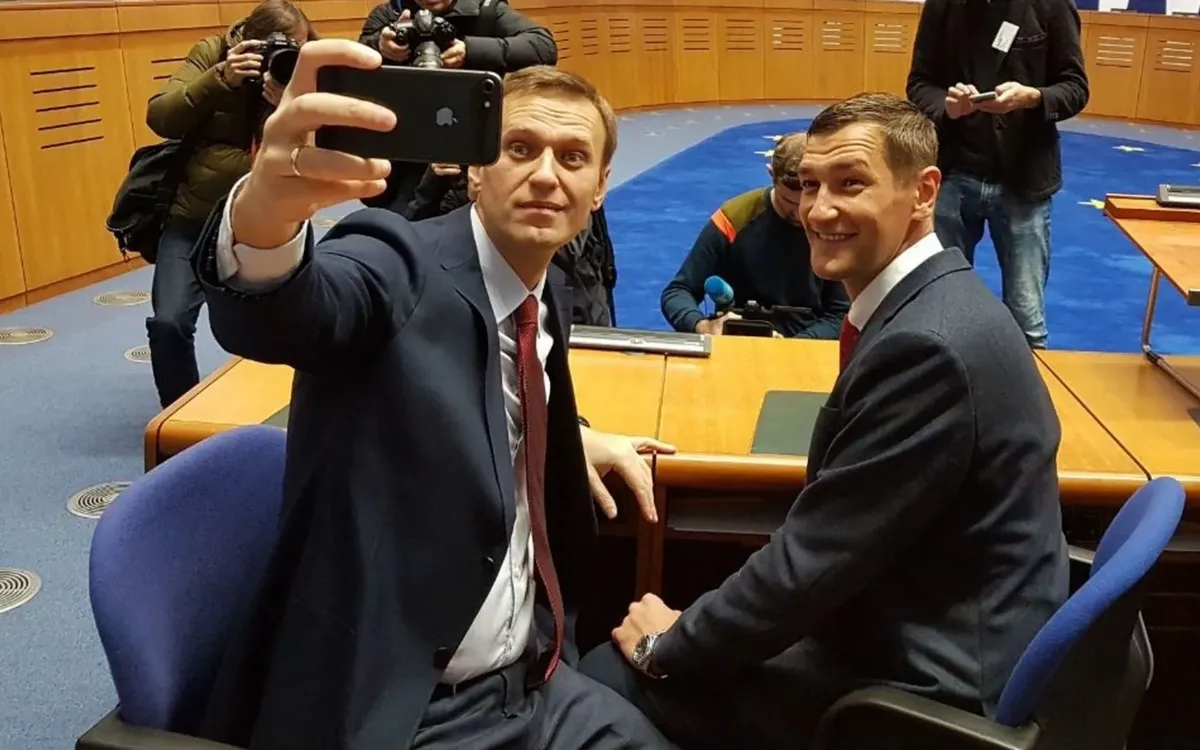
The decision in the case of Navalny against the Russian Federation, which was made last week by the Grand Chamber of the European Court of Human Rights, is evaluated as “political” - either with the sign “minus” (government circles), or with the sign “plus” (opposition). Lawyer Karinna Moskalenko, head of the Center for Assistance of International Protection, preparing Navalny’s complaint to the Great Chamber of the ECHR, along with his lawyer Olga Mikhailova and the expert of the center, lawyer Anna Maralyan, insists that in Article 18 “there is not a word about politics”, although this decision itself may have important political consequences.
- Article 18 of the European Convention on the Protection of Human Rights and Fundamental Freedoms is rarely applied (this is only 11 case in the practice of the ECHR) and only in addition to other articles. It sounds like this: “The restrictions allowed in this Convention regarding these rights and freedoms should not be applied for other purposes than those for which they were provided.” In both the Convention and the legislation of each of the states - its participants, there are various restrictions on the rights of individuals, since their implementation can violate the rights and interests of others. But in Art. 18 We are talking about such situations where, under the guise of legal goals, the state is pursued by other, illegal goals. So, in the “case of Navalny”, the dispute was about whether seven of his detentions in 2012-2014 were really justified by the interests of public security (on which the Russian Federation insisted on his complaint) or he was deprived of his rights for something else.
For the first time, this article was applied “against Russia” on the complaint of Vladimir Gusinsky in 2004. But then everything was quite simple: an agreement was transferred to the ECHR of July 20, 2000 between Gusinsky and Gazprom on the sale of NTV shares in exchange for its exemption from custody.
Since then, if we have already initiated a matter against someone with some rear thought, then it was necessarily brought to the conviction, even if the court was staged.
Maybe this is one of the reasons that it was so difficult to get an acquittal. In 2013, Art. 18 was applied in Tymoshenko against Ukraine, where Ukraine honestly recognized the political motives for its detention. But Russia since 2004 and up to the "case of Navalny" was not so frankly substituted.
- And you, therefore, sat and waited for her to “substitute” ...
- I consider it a patriotic duty to protect their fellow citizens from the arbitrariness of their “law enforcement agencies”. Each case won in the ECHR also affects the Russian judicial system-regardless of whether some unknown prison or “oligarch” appears to the complaint. We tried for a long time to create a precedent for the application of Art. 18 of the Convention in all cases of Yukos, Khodorkovsky and Lebedev, especially since there - and the farther, the clearer the political and economic motives were visible behind the actions of the state. But the Government of the Russian Federation rested that a court took place in Russia in compliance with all procedures, and court decisions have the force of law. In the European court, there is actually a presumption of the good faith of states and, accordingly, the legality of all decisions of national courts, if they are made without a formal violation of the procedures in these countries. It is difficult to argue with this - this is generally the basis of all legality. We need direct, not indirect evidence, in order to accuse the state of abuse of law.
In all cases related to Yukos, our position was not refuted by the court, the decisions indicated that this case, “most likely,” there are some other motives, except for the ownership of justice.
But apply Art. 18, the ECHR, speaking in Russian, simply did not rise: such “politicization” could to some extent devalue the recognition of the violation of other articles of the Convention.
For its part, Russia also suffered when the ECHR indicated it to violation of other articles - even such as the right to freedom and personal integrity (Article 5) or the right to a fair trial (Article 6). But it is to Art. 18 We are extremely painful. The argument for the media and "internal use" sounded: since Art. 18 is not applied - it means that the ECHR did not see political motives, "Russia won." But in fact, this article of the Convention is just a cherry on the cake, although, of course, it is worth a lot.
- The Russian government itself “substituted” by appealing the decision on Navalny? After all, if the matter did not fall into the large ward, an attempt to apply Art. 18 of the Convention and this time would not be crowned with success?
- Here it should be explained that the ECHR mechanism does not provide for appeal: complaints of the parties do not oblige the large chamber to return to the decision adopted by the ordinary chamber. The Great Chamber on its own initiative and, as a rule, bypassing the “small”, accepts for consideration such precedent matters that can change the practice of the ECHR in general. Navalny was quite satisfied with the decision adopted in February 2017, which recognized violations of his rights provided for in Art. 11 (to freedom of assembly) and Art. 5 (freedom and personal integrity).
And Russia filed a complaint rather by inertia: it seems, this is not a criminal case, but an “administrative”, they are not used to taking it seriously.
Then we (the Center for Promoting International Protection) convinced Navalny to file a new complaint in accordance with Art. 18, “appealing” the refusal of the ordinary chamber to apply it.
But no “revision” would have happened if the judges, having re -recognized the acceptability of the complaint and all other violations, did not see the obvious signs of the use of restrictions on his rights not with the purpose of which they were registered in Russian legislation in the seven cases.
- such a nervous attitude of the Government of the Russian Federation to Art. 18 of the Convention is explainable: after all, we are often built on a legal basis, but on “concepts”. Everyone can guess as much as you like that the purpose of this or that criminal case is worth the goal of squeezing a business or for what someone has “arrived”, but on the surface we see only formal legality. Art. 18 “Political” precisely in this sense - it is aimed at the foundations not of an imitation, but of the actual system: the mechanism of election law enforcement. Does this decision of the ECHR for Russia “Pandora's Box” are opening?
- No, this will not happen: the standard for proving the illegitimacy of the goals of states and national courts under Art. 18 cannot be reduced. Although the path is protoptan ... for example, we are now preparing a complaint in accordance with Art. 18 of the Convention by agreement with the family of the former head of the Serpukhov district Alexander Shestun. Not even to mention the possible property background, there are signs of the use of restrictions on his rights (to freedom, first of all) in order to prevent him from elections that took place in September this year. He was warned that he would not put forward his candidacy, and this is proved; He was detained and placed on the eve of the key meeting of the election commission. And then everything was done to prevent a notary public and - thereby - to deprive the possibility of registering your candidacy in the elections, although there is still very far from the sentence.
It is not necessary to say that we again protect some “oligarch” or “opposition”: we (together with the European Court of Human Rights) protect democracy and the rights and interests of all citizens of our country.