
Translated material
The territory of bad weather

The series of Sergei Ursulyak “Bad”, taken based on the novel of the same name by Alexei Ivanov, once again demonstrates how important the punctuation marks in sentences are - even when it comes not about specific people, but about time and space, an era and country. The nineties, a black hole in the recent history of Russia, a failure in memory. Who and for what “you can not have mercy”? Who is the criminal and who is the victim?
In the novel by Alexei Ivanov, written in 2015 and telling about the events of 2008 with flashbacks in the eighties, then in the nineties, there are no answers, but the questions are asked completely different. The main one is voiced closer to the climax of one of the protagonists, Sergey Likhletov, Afghan veteran, who had served a peaceter in prison for banditry, who was won by peaceful life: “What to believe if there is no God, and we have to build communism?” Faith in man - how to preserve it in a turning point in the historical moment, when the Soviet collegiality is over, and primitive individualism is only beginning?
The “bad weather” of Ivanov is a chronicle of chaos, or, in Newbin,-lawlessness, time, unsuitable for life. But if you think about how the author whispers - are there other times in this country? The Fatherland is the territory of the bad weather, the village of Nenasty, in which a small man is sitting - a symbol of the inescapable Russian off -season gap. The old “PAZ”, nicknamed the members of the Afghan Brotherhood of the Comintern, Barbuchaka, and the six -hundredth “gelding” of their enemy, the colonel of the KGB of Shchebetovsky, and the “Gelendvagen” of the Bobon bandit, the third force, will be bogged down in it. Nobody sorry, no one - even the heroine of the novel, the eternal bride of Tanyush, who conventionally personifies the people here, or rather, that part of it in the nineties, unlike bandits and merchants, and this is another, very important, thought of the novel. “Bad” is a fairy tale with an unhappy end about real, very recognizable people. They can be forgiven and understand, but there is nothing to love them. They, both weak and strong, rush in the whirlwind of changes, pursuing the skins, stealing, killing, betraying, and each is right in one thing, and all are wrong. Ivanov’s nineties are not the time of freedom from liberal apocrypha and not dashing Godin that they are common today. “Bad” - emphasized an apolitical, outside of any ideology, statement of the reigned anarchy. Everything is possible, no obligations - not only to others, but also to oneself. To reason whether it is bad or well from the point of view of the formation of statehood, then they ruined the country or gave freedom - pure speculation, a meaningless thing, worthy of a not big writer, but a graphomaniac with patriotic ambitions.
The “bad weather” of Ivanov is a chronicle of chaos, or, in Newbin,-lawlessness, time, unsuitable for life. But if you think about how the author whispers - are there other times in this country?
Someone seems to have overlapped the "bad weather" for television adaptation. The series was postponed from 2008 in 1999. It is clear why. Already in the first series, the former KGB colonel robbed by Nenolin, and now the head of Bank Schebetovsky asks his head of Basunov’s security to take him alive: "The nineties end, Vitya." It seems like we are now ending with lawlessness and in the coming 2000 we will only take a pioneer tie. Although in the novel this phrase has the opposite meaning, and it sounds a little differently: "The nineties are over, Vitya, and they were dug up for you." In 2008, the nineties are already a meme, a household name, their dashing methods in the past, but the characters are still the same, they remained unpunished.
1999, the authors of the series need also what: the thirty -year -old heroes of the "bad weather" have a chance for another life - cleansing of the bad, they will step into a bright future under the chimes. Ivanov’s heroes have forty, and Shchebetovsky is completely sixty, there are few chances to start from scratch. These are middle -aged people in the face of eternity, and German Nenolin himself, who committed a crazy act, as if from the other world. It is not for nothing that his fever commander repeats several times: “The killed for several seconds can act” - that is, to kill, to take revenge on himself.
 © "Russia 1"
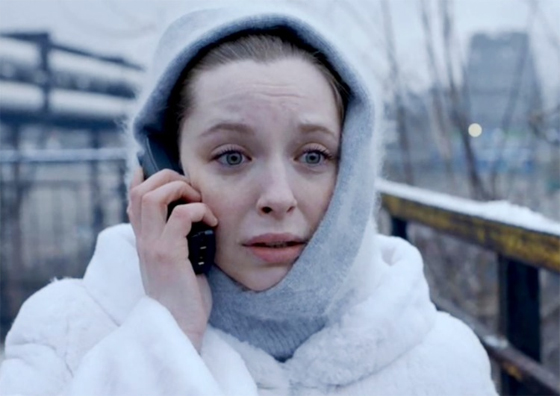
The main characters are the head of the Afghan Brotherhood of the Comintern Sergey Likhletov (Ivanov himself calls him “the hybrid of Mao Zedong with the lieutenant Rzhevsky” ), his mistress, a stupid youngster Tanyusha, drifting from a man to a man (in the film matured to adulthood and, as Ursulyak admits, deliberately made prettier, kinder, kinder, kinder, kinder, kinder, kinder, kinder, kinder, kinder, kinder, kinder, kinder, kinder, kinder, kinder, kinder, kinder, kinder, kinder, kinder, kinder. More feminine), finally, the driver of the “Comintern” German Nevolin named German, an ordinary in every sense - by military rank and by the nature, inherited Tanyusha from Likholetov - they were brought out quite sarcastically from Ivanov. Ursulyak, who carefully simplifies the playwright to “his own,” (although the essence of the Afghan idea is that all of his own, with the general experience of detachment in the Panjsher Gorge), and German, and Tatyana, and even feverish are eventually seen by almost popular righteous people, martyrs of the early-democratic era. Netolin is played by Alexander Yatsenko, who tightly stuck the role of a positive hero, a vessel of an unknown kindness. Tatyana Lyalina in the role of Tanyushi is not a girl, but an elf in a handkerchief and boots, a Snow Maiden from a kindergarten matinee. And even Alexander Gorbatov, an actor, specializing in the roles of stately Cossacks and aristocrats, eventually turns his Seryoga Likhletov almost into Jesus Christ. The commanders of the smallest, on the contrary, are represented in the series with golems that received a gangster bullet according to merits. Although Ivanov’s people are just people of wartime, for whom there are no demobilization. It is characteristic that the police captain Dibich, the investigating robbery, is transformed from the corrupt cynical cop from Ursulyak into Captain Larin from the “Streets of Broken Lights” - an imperfect, but conscientious opera who thirsts to reach everything to the very essence.
And Herman, and Tatyana, and even feverish are eventually seen by almost popular righteous, martyrs of the early -democratic era.
In the second series, the authors of the series are completing the right historical perspective, not disdaining with poster colors. The putsch, the GKChP and the resignation of Gorbachev, which the heroes are observed on TV, are accompanied by a monologue with tears in the eyes of a real Russian soldier Netolin: “I am not for Gorbachev, but for people, I gave an oath, we used to know what is good, what is good.” At this moment, on the TV screen in a dark freezing sky above the Kremlin, a red flag is lowered. Ivanov does not have this scene, but there are thoughts of Netolin, who arrived from Kuibyshev to Batuyev and eagerly looking at the landscape outside the window: “He did not know about the coup, he was interested in the city where he would live, and not the country.” The episode is also expensive, where the Afghans from the Comintern are collectively watching on TV a football match by Scotland - Russia at the 1992 European Championship, lost by Russia. One of the heroes, a passionate fan, turns to the gathered with a visionary speech: “I believe, in 20 years we will win, the championship will be in Saransk, and the walls and walls help.”
 © "Russia 1"
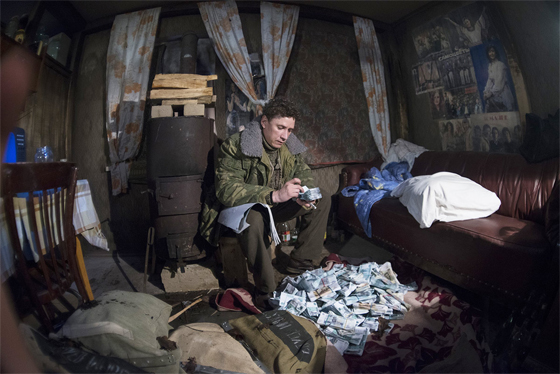
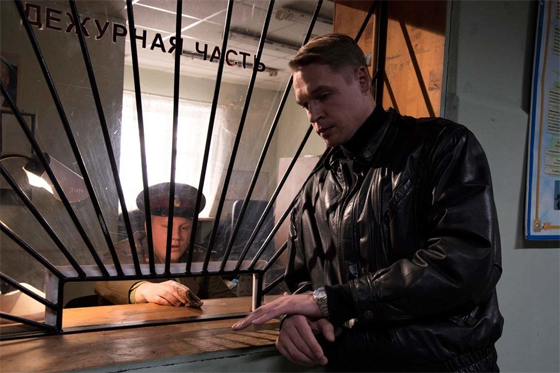
Having placed such semantic accents that do not involve discrepancies, Ursulyak floats along the waves of memory, indulging in nostalgia. The film is overloaded with musical hits of the era, showdowns and fights were shot in the best traditions of “gangster Petersburg”. It was this series, and not the “brigade” of Alexei Sidorov, which Ursulyak did not watch , is the main reference in “Napasty”, up to the scenario quotes of the famous scene of the death of the hero Alexei Serebryakov . Fragments of Afghan battles are stylized as even more ancient and naive samples-rapid, pathetic compositions by the background: here we can recall both the Soviet-French-Swiss-Swiss Tegeran-43 (1980), and the Italian series "September" (1984), and even "Professional" Lotner (1981). Ursulyaku, obviously, comfortably in this time, he masterfully reconstructs the whale abundance of the textures of a randomly built new world - clothing markets, discos, gatherings in saunas and billiards, and at the same time monochrome homb of the emerging world of the old block ruin, firing in the pipes of the city -forming enterprises - a life that has turned into ashes.
 © "Russia 1"
 However, the multidimensional universe - perestroika and publicity, committees and democrats of the first convocation, thieves in law and red directors, all this kaleidoscope of objects and phenomena, thoughts and feelings - Ursulyak seems to be tightly concreted in the last series Boris Yeltsin's farewell speech, blurted out with a shootout (which is very important) from disabilities. Evil receded, the idealist Nenolin still breathes in the arms of Tanya. Breathes and, apparently, gets out, in order to start living in the zero not by lies. At Ivanov, Nenolin took Tanyusha out of the bad weather. In Ursulyak, Russia came out of darkness.
Subscribe to the COLTA.RU channel in Yandex.Zen to miss nothing