
Translated material
Maidan. Five years later
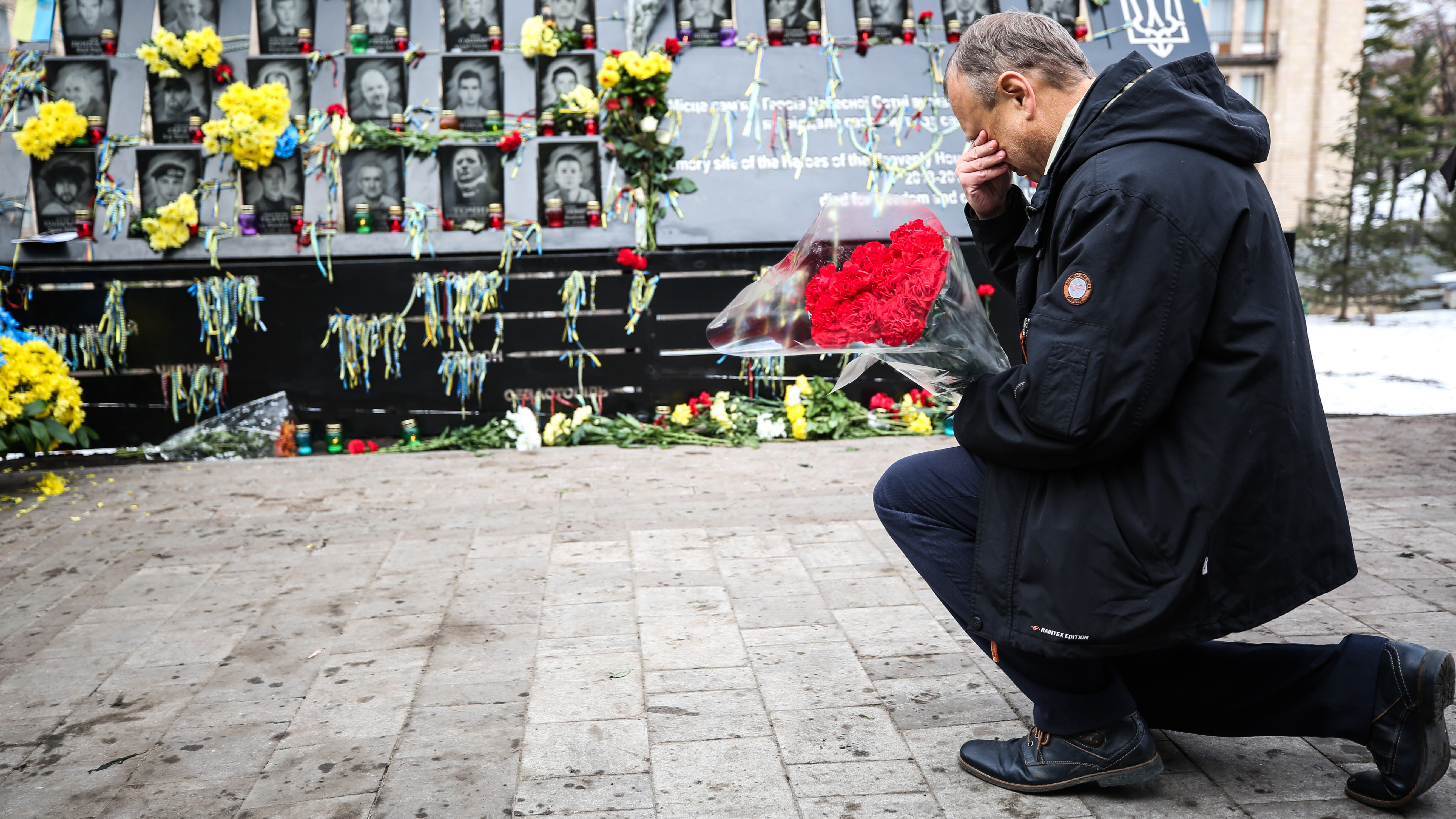
"Revolution of dignity" and the dignity of contemporaries
Vitaly Portnikov: Five years since the Maidan of 2013-14, one of the most important events in Ukrainian political and public history, one might say, one of the most important events in the history of the post -Soviet space and Europe. How can these events be considered from the distance of these five years today?
In our Kiev studio - the deputy of the Verkhovna Rada of Ukraine, the chairman of the parliamentary committee on foreign affairs , Anna Gopko and from London - galleryist Marat Gelman . Before starting a conversation, we will introduce you to our vision of what happened during this time.
Vladimir Ivakhnenko, Radio Liberty correspondent: the first protesters appeared on the main square of Kiev - Independence Square - after the Ukrainian government has suspended the preparation for the signing of an association agreement with the European Union. Early in the morning of November 30, the fighters of special forces of the Berkut Ministry of Internal Affairs brutally dispersed the students protesting on the Maidan. Already on December 1, hundreds of thousands of demonstrators in protest against the policy of the authorities and the arbitrariness of the "Berkutovites" were held along the central streets of Kyiv. The protest shares grew into a three -month confrontation, the culmination of which was the tragic events of February 2014, when more than a hundred civilian activists died in the clashes with the security forces in the center of the Ukrainian capital. A few days later, President Viktor Yanukovych fled to Russia.
In the spring of 2014, the Russian Federation, taking advantage of the domestic political weakening of Ukraine, annexed Crimea, conducting a referendum on the peninsula, the results of which were not recognized as an international community. With the support and direct participation of Russia, an armed conflict was unleashed in the eastern regions of Ukraine, where two unrecognized republics arose with centers in Donetsk and Lugansk. These events became the main reason for the economic crisis, which led to a significant fall in the standard of living of citizens.
Now Ukrainians recall the events of that time and are trying to answer the question of what has changed in the country in five years? Society is disappointed with the actions of the authorities. The president and his surroundings, who had no confidence, were replaced by politicians who also could not gain authority in society. Hopes for quick and radical changes for the better did not materialize. Unemployment, increasing prices and reduction by the Government of Social costs give the ground for the growth of protest moods. Some experts warn: in these conditions, the return of revenge forces is not excluded to the power.
The main problem of the country remains corruption, which the new generation of politicians and officials is trying to resist
The main achievements of Ukraine of the last five years are the modernization of the army, the emergence of a mass volunteer movement, the signing of an agreement with the EU on visa -free regime, the formation of a strong civilian public sector. The main problem of the country is corruption, which the new generation of politicians and officials is trying to resist. Citizens are still awaiting the conviction, including in cases of murders of civil activists on the Maidan. So far, only the correspondence trial is approaching the final regarding the accused of treason of the former President Yanukovych.
Vitaly Portnikov: Anna, when they begin to talk about the anniversary of the results of the Maidan in Ukraine, always use the word "disappointment". How do you perceive it today, people who participated in these events?
Anna Gopko: "Revolution of dignity" continues. When people went to the Maidan, they defended their freedom, the foreign policy of the state, the chances of the best future. Attempts by Yanukovych’s regime, together with the Russian Federation, expand us towards the economic customs union, the Eurasian space ... Thank you, we were already in the Soviet Union! We just tried to join the European family of peoples, to civilization - it was the choice of people on the Maidan.
As for changes, of course, it is difficult to create institutions of power, law enforcement, anti -corruption bodies, and the judicial system in five years. There were more challenges than to answer them institutionally in order to justify the overwhelming expectations voiced during the “revolution of dignity” by politicians and public activists who thought that the country would become completely different in one night. It is necessary to take into account the burden of oligarchic schemes and mentality: it cannot be changed for five years.
Most importantly, Ukraine as a sovereign state defended its right to an independent choice of where to move on. Most citizens support membership prospects in the European Union and NATO. There is an association agreement with the European Union, there is a visa -free regime, an agreement on free trade, a certain part of export to European countries is increasing.
Russian aggression began back in 2013 with trade wars, when there was a blockade of our agricultural products in the market of the Russian Federation - this was already a signal that Russia through economic complications was trying to take us even more under its influence. Therefore, in five years we simply needed to explain to people that all these changes are not designed for such a short time. If we take the experience of the countries of Eastern Europe, which are already members of both the EU and NATO, then some reforms went there for 10-15 years: pension reform, education reform, and medicine.
A question for those people who are disappointed: have they changed themselves - maybe they no longer give and do not take bribes, understand that it is at stake? Having its own state with freedom is much more promising than to have any benefits and handouts from populists, but to live in a prison of peoples without any prospects. I think the visa -free regime showed citizens that there is a fundamental right to freedom of movement. Therefore, negative sentiments, disappointment are heated not only by populists within the country, in this they are also interested in this in the Kremlin, because the Kremlin’s plan about chaos, destabilization and holding of pro -Russian forces will be more realistic than in the case when people are proud of their own country, understand the complexity of the path to the independence of energy and information space in 2019.
A lot of work ahead. But I have optimism, I believe that Ukraine as a subject in international relations passed all these tests, was able to defend its national interests, coordinate its policy with Western countries: this applies to sanctions and other economic pressure tools to the Kremlin. We have lost 20% of GDP since the beginning of Russian aggression, about 8% of the territories that are under occupation, we spend more than 5% of GDP on the security and defense sector - this also needs to be explained to people, because this money could go to innovation, education, and improve the quality of life. And I believe that we are on the right path: it is better to look into the future with the optimism of a free person, whose dignity is protected thanks to strong institutions than to be part of someone else's sphere of influence with incomprehensible prospects.
Vitaly Portnikov: Many said that both Maidans, 2004 and 2013-14 is an uprising for independence, so it is difficult to imagine the third Maidan, because the issue of sovereignty is resolved. But you see more external or internal in these uprisings? What was originally - the internal struggle, the struggle of clans, the protests of people against corruption, the mafia, or is it a feeling that if we do not rebel, then Russia will be in Kyiv?
Marat Gelman: In general, I agree with Anna. I was recently at a conference in Europe, where they showed: in Italy in the post -war period for 30 years there was not a single good government, everyone was either weak or corrupt. But at the same time, due to the correctness of the course itself, the role of the state, government in society decreased every year, and the economy and life of people became better. I think the same thing in Ukraine is the same: this is not disappointment in the Maidan, but in specific politicians who were, maybe not so passionarly, not so devoted to the country, not so patriotic, think more about themselves or about some of their clients, but this is rather a residual phenomenon than the real problem that would pose a question, it was correct or wrong-the Maidan.
As for the comparison of the two Maidans, after all, the first Maidan was a certain competitive thing; Russia, of course, participated there, but played on the side of one of the Ukrainian forces. It is important that there was a referee, that is, Kuchma, who made decisions: to use force or not. It was a sports fight, not a mortal fight. And in 2014, this was not a question about the choice of the president, but about the fact that people were deceived. After all, Yanukovych, who seemed to be so recently, until the last moment had no doubt that the European choice is the only choice for Ukrainians. At that moment, when he turned, it seemed to him that he could cope with public opinion. It was, of course, his mistake, people said: no, we don’t want to. It was a choice of life, a choice of hope.
I communicate a lot with artists, with colleagues in Ukraine. Today, despite all the disappointments, most of my friends are still absolutely sure that this was the right decision, and the victims were not in vain, despite the territorial losses and the continuation of the war. Honestly, I have not seen almost a single person who would say: you know, then we are in vain ...
Vitaliy Portnikov: Anna, and you saw people who said "we are in vain"? ..
It is better to look into the future with the optimism of a free person than to be part of someone else's sphere of influence with incomprehensible prospects
Anna Gopko: Sometimes I see people who believe that they do not live well enough to justify what was. There are no wizards, the country cannot completely transform in five years. People would like to live like in Switzerland, but these are unrealistic expectations that created certain politicians who said that everyone would sit in prisons tomorrow (we saw the slogan of the "Orange Revolution": "Bandits - Prison!"). There is a request for justice. We see that there are criminal cases, but there are no court decisions on high -ranking corrupt officials - this is just one of the most important problems.
Of course, people would like to get a better salary, live how Europeans live. But it is very important to explain to them in which Ukraine is located. On the eve of important presidential and parliamentary elections, we need to explain: we paid a huge price on the Maidan, we have more than 11 thousand dead in the east, but we are on the way to freedom. Therefore, now you can’t stop, you need to adhere to this course in order to have a specific result.
Marat Gelman: I would only like to add that Russia is not evil, an enemy. She will also follow this path. Russia, as part of Europe, is, perhaps, a more distant prospect than Ukraine as part of Europe, but, it seems to me, there is no alternative.
Vitaly Portnikov: By the way, I wanted to ask you about the elites of the East. You know these elites well, one might say, personally, you saw them in 2004, and the same elites were in 2013-14. Why didn’t these people understand how difficult the country is, which they, in fact, have already led? They had the majority of voters, the majority in parliament, was their presidential candidate, who was always the favorite, and in 2010 won the elections. But they never showed the understanding that this country cannot be sharply rocking, it is impossible to change a course of 180 degrees, we must take into account the cultural and linguistic desires of a huge number of people.
Marat Gelman: If we talk about specific people, then I am not a very high opinion about their intelligence, about their ability to understand. They understood that everything could be bought, and the Ukrainian politician seemed to confirm this to them. Moreover, maybe they would have bought if only politicians or their political opponents played.
The moment when passionaries appeared on the street ... This is not Ukrainian society as a whole, but some group of students who are simply impossible to buy, they have a bet-a whole huge life, which ahead. There were such national oriented political forces that generally wanted this conflict, because they believed that they would win it. But, I think, this illusion has reason.
In Ukraine, there was no division into politicians and businessmen, this played a role in how the politician was formed, and such a little commercial mood gave Yanukovych the illusion that he would agree with everyone, who would be bought, who would be intimidated. But the turn was too sharp, and it is impossible to buy a whole society. The society lived, watched, empathized, held meetings on integration with the European Union - and suddenly they were turned so ... The society abandoned it.
It seems to me that Yanukovych’s environment simply did not have enough brains that were, for example, Kuchma. We can say a lot about the fact that Kuchma was climbing all the time, but at least he understood that in addition to these politicians in society there are some real forces, and we must reckon with them.
Vitaly Portnikov: Kuchma maneuvered, maneuled, but Yanukovych did not catch. Marat said a very important thing: this is not so much politics as businessmen. Then I have an incorrect question: and the current Ukrainian politicians have become politicians or are they still businessmen?
Anna Gopko: They still remain businessmen. Many people are disappointed precisely due to the fact that those who came after the "Revolution of Dignity", after the "Orange Revolution", had a historical chance to change the country and even then get a visa-free regime, to bring Ukraine closer to membership in the European Union. After that there was a summit in Bucharest, where we were given the prospects for entering NATO. That is, there were chances, but the same businessmen, because of their own interests, traded the interests of the country, so there was no political consensus about the prospects for NATO membership. And then Yanukovych came.
The successes of Ukraine are a nightmare for Putin and his regime
After the “revolution of dignity”, a certain number of new people came to the parliament, but this was not the critical mass that is needed in order to push the business politicians and make more statesmen. This is a matter of the formation of a real elite, which is oriented primarily on the protection of national interests. This is still ahead. I hope that thanks to the reforms, we will be able to bring more experienced, but not corrupt people who do not belong to any clans of the formed oligarchic structure.
Vitaly Portnikov: Marat, if you intelligently translate what you said, then in the current tension between Russia and Ukraine, in many ways, the “merit” of the Russian political leadership. Russia and Ukraine diverge in different directions, and at such a stunning speed that I do not recall in history. Where is the way to ensure that some solution to the problem begins, if not between states, then at least between societies as a whole?
Marat Gelman: This is a very difficult question. For four years I have been living outside Russia and have been observing metamorphoses taking place in society. People for various reasons are forced to somehow cooperate with this authority. They cannot always feel like conquerors, oppressors, they find themselves some excuses. In general, Russian society is now in a decomposed state. The authorities for a long time checks society for some moral things, and most people, including people of my circle, instead of “good-bad” say “their own or foe”.
We understand that Ukraine has a serious ally - an international community. The Russian authorities cannot ignore him, no matter how much they would like. I think, after all, the task of Putin’s power today is to make sure that everything that happens in Ukraine is an argument for Russian society: you see, in Ukraine, an economic collapse, people flee to Europe and so on. But as soon as real successes begin in Ukraine ... For example, I now live in Montenegro, and there we have about the same number of immigrants from Ukraine and from Russia, and everyone understands that the Ukrainian passport is much better than Russian. The steps of Ukraine ahead of integration, economic stabilization, human rights, and so on should very much affect Russian society.
Ukraine is a mirror in which Russia looks. If, for example, in England they live better than in Russia, this can be explained - there was no Second World War on their territory, there was no socialism. But if there are serious steps in Ukraine, with which Russia has at least 70 years of general history: war and Stalin, and so on - and Russia, more isolated, will live worse, then I am sure that public opinion will simply turn out, and maybe, as sharply as it happened in Ukraine. Recall that the elections in which Yanukovych received the majority were less than a year before the Maidan. I believe: what will happen in Ukraine will help Russian society see Putin's viciousness.
Виталий Портников: Говоря о своем оптимизме, вы учитываете то, что общественные настроения в Украине в целом все еще очень похожи на российские по социальным ожиданиям? Да, Евросоюз и НАТО – конечно, но социальные ожидания людей все еще как в постсоциалистической стране, это не Польша и не Чехия.
Анна Гопко: "Революция достоинства" – это уход от патернализма, от того, что государство за все платит, а ты просто радуешься. "Революция достоинства" как раз и произошла потому, что больше миллиона граждан, которые были на Майдане в течение нескольких месяцев, показали готовность жертвовать собственными деньгами, разворачивать медицинскую службу, строить государство из ответственных граждан. Политики, которые обещают снизить тарифы, сделать доллар по восемь гривен и так далее, подыгрывают тем патерналистов, которые есть в обществе. Но в то же время есть люди, которые поняли свою личную ответственность за будущее страны.
Успехи Украины – это ночной кошмар для Путина и его режима, но для граждан Российской Федерации… Увидев наши успехи, от безвизового режима до внутренних: независимая автокефальная православная церковь, то, что мы смогли сделать кино, музыку, – россияне поймут, что есть независимый народ, государство Украина. Уважение из-за внешних успехов и улучшения жизни граждан будет еще большим ударом по режиму Путина. Будет понимание того, что Украина отрывается, и это надо принять, уважать и в дальнейшем рассматривать взаимоотношения с ней как равноправные. Это длинный путь, но чем больше успехов в Украине, тем больше возможностей для трансформации в России.