
Translated material
Life "on Royan"
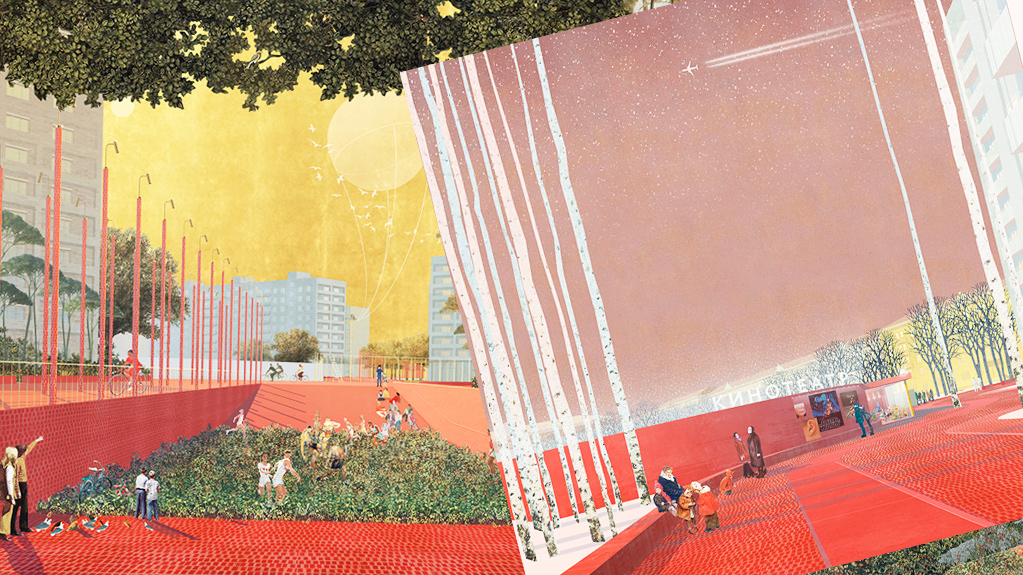
How to rewind the city periphery?
- Most citizens in Russia live on periphery, in residential arrays far from the center of cities.
- The Dvorulitsa project is aimed at the improvement of courtyards and streets of Moscow, at the creation of a convenient space for residents of the city.
- Niza yard initiatives in large Russian cities have become a generator of civil society and activism.
Sergey Medvedev: "areas, quarters, residential arrays", - how Roma beast sang. What do we know about the sleeping areas in which most of the urban population of Russia live? Archeology of the periphery in the plot of our correspondent.
Correspondent: a modest playground, an unequipped territory for garbage containers, to a cafe several stops by bus, the shortest way to the bus stop - a path that was blurred by rain. All this and even more can be seen in dozens of yards of Moscow. Sometimes the residents themselves work to be comfortable and well -groomed to be comfortable and well -groomed. Often they do not have enough funds, organization and just the ability to coordinate their actions with the authorities.
Video version of the program
"Dvorulitsa" is a project aimed at landscaping of courtyards and streets of Moscow, to create a unique and, most importantly, convenient space for residents of courtyards and quarters. Today, as part of the project, a periphery map has been developed - from MKAD to the third transport ring. "Dvorulitsa" is a project to realize the problem and responsibility of citizens for their yard. Everyone can take part in the project and improvement of their area.
Sergey Medvedev: Our guest is Urbanist Aleksey Novikov and Alena Shlyakhovaya , curator of the Dvorulitsa project.
What is the periphery for cities: just a certain function where people go to sleep, and they spend their main life in the city, or are these some spaces that can be filled with a real life? What is the main microdistan of urban planning - microdistrict, courtyard, quarter?
Alexey Novikov: Perhaps the microdistrict. In Moscow, this is especially the case, since it is a city according to the ideology of Fordist, that is, created as a three -membered division. This is a city that should produce and work - an administrative center, industrial industrial zones and residential sleeping areas. All functions are separated. This completely does not correspond to the modern concept of how everything should be. And therefore, the main problem of Moscow is how to rebuild it from the Fordist city to the city of post -industrial. This is actually Detroit, only ten times more.
Sergey Medvedev: And when did he become Fordist?
Alexey Novikov: This is the ideology of the General Plan of the 30s. He was very smart, interesting. There, of course, various free reserve zones were provided for future development. But according to ideology-not only was it Fordist and then it was fashionable ... Of course, Russia was not just in this ideology, and in our country there were just a lot of factories. But to everything else, of course, this was a state rather than a market economy. It was planned from above. Unfortunately, many architects were happy with this. And then, in particular, the ideology of such architects as Okhitovich , Ladovsky prevailed. These are completely brilliant urban builders, but they translated all their concepts into doctrines. Ladovsky planned Parabulo from Moscow, Okhitovich made a linear city and so on.
Sometimes that the yards themselves are working on the yards, the inhabitants themselves work
Sergey Medvedev: Ladovsky generally wanted to pull Moscow to St. Petersburg.
Alexey Novikov: Conceptually, this is a very interesting story. But they felt it like a doctrine, because everything was possible. If the authorities made this as an important design decision, it embodied all this.
Sergey Medvedev: That is, people as a biomass, which is directed to certain vessels formed in this avant -garde constructivist thinking.
Alexey Novikov: Rather, like a labor mass.
Sergey Medvedev: Alena, in large Russian cities there is such a unit as the court, or is it some kind of departed patriarchal nature?
Alena Shlyakhovaya: depending on what is considered to be a court. Probably, the court is some kind of internally space of the closed quarter, when residential development goes along the perimeter, and in the center there is the space of the courtyard. But in general, these large microdistricts are free layouts. They have these spaces, not formed, not closed, but open, very difficult to read from a planning point of view as a court, but this is the internal space of the area, which people use completely differently, not as an open public space. They live in this place, somehow they identify it themselves, and live. For us, the yard is, first of all, living space, which is very different from the public in its purpose, in the way people feel and worry it.
Sergey Medvedev: And the street, Alexey? There are several interesting performances on the Dvorulitsa website, including one lecture by Grigory Revzin, where he says that the institution of the street died. In these peripheral areas, the street now exists as a social institution?
Alexey Novikov: In the peripheral areas - definitely not. There is not even physical, morphological street. This is the main problem of the sleeping areas of Moscow, since they are built in the free planning concept. Revzin says that with the advent of an apartment building, the street ceased to be a street, since everything has gone: facades, representation of its social role, wealth, the sale of its goods, and so on - neither social nor economic significance remained. And these apartment buildings in the morphological space of the street are like an alien element. They are not cells supporting the institute of the street, as Revzin says.
But the sleeping areas ... He says that the street has occurred, but they are created as if in another concept. One of the authors of this kind of layout was the famous French architect Le Corbusier . This is an absolutely brilliant architect! But what he wrote, accompanied by his projects, for example, to the restructuring of Paris, is just a disaster!
Sergey Medvedev: I saw what he planned for Moscow. Actually, the entire center of the city was supposed to be destroyed. The famous line of Brodsky: "The Corbusier is in common with the Luftwaffe, // that both worked from the heart."
Alexey Novikov: Yes. In any case, the sleeping area is deprived of some economic justification. It was a area that proceeded from some ideas about comfort. Korbyuzier also had a division into social strata - managers in the same house, workers in another and so on. The Soviet microdistrict did not reach this, but this concept became the state doctrine. And the region’s economy, the economy of the trading street was absolutely destroyed.
Sergey Medvedev: In part, by the way, it came. There were elite houses: for example, the house of the party -prophetor. On the other hand, from youth - there are workers' villages, five -story buildings. In these areas, the Soviet class society was partially reproduced.
Alena, a multi -storey building killed the concept of the street. But what is happening now? These 30-story monsters on the outskirts of the city are new Vatutinka or Balashikha ... Is this problem even more scale? What to do with a 30-story house? Does your ideology not take into account such "humanities"?
Alena Shlyakhovaya: takes into account, just as examples for some pilot projects. In our project, the main idea is that the quality of the environment, the quality of life in the city does not depend on which house and what a typology of development, but on how competently you plan the space between the buildings.
Alexey Novikov: This is the ideology of treatment with layout. After all, microdistricts are not even a five -story building. There are so many of them and so many people live there that you will not be renovated even for 50 years. This is a huge burden, since such a layout spray streams, does not make it possible to sit there to small and medium -sized businesses, which makes up an element of our comfort. This is the burden on the gross product of the country. 60% of the population lives in such sleeping areas. They are uncompetitive as elements of the urban environment that create income. After all, the urban environment creates rent, and the more rents it creates, the more comfortable people feel there. The microdistrict does not give this.
The microdistrict killed everything. What to do about it now? “Dvorulitsa” is one of these concepts of setting up territories, very soft, very thin, realizing that these houses cannot be changed, demolished. Architects must do something. And there are several such projects, and this is one of them. This is actually the creation of a certain interesting space in which people could exist, to which business would react. Now there are projects that are trying to solve this problem-the creation of a certain retail space, the development of community centers around the Soviet cinemas. This is one way to solve the problem. The second way is to create the possibilities of some streams of people. And so they just scatter, because this is a green unformed mess or parking inside this round microdistrict ... What to do there? I see nothing. And all this is very far away, it is impossible to trace the sequence of stores. You have to do something with this. The share of small and medium -sized businesses in the GDP of Russia is approximately 20–21%. This is all city history. In Japan - 60%, in Poland - 45%.
Sergey Medvedev: Roughly speaking, this is undercapitalization of the city periphery, which is a potentially huge investment tank. Due to improper layout, incorrect property rights ...
Alexey Novikov: ... We cannot operate it, we cannot reveal this potential. It is clear - corruption, it is clear - administrative barriers, but they cannot be responsible for 30% of GDP. This is clearly something else. I have more suspicion that this is precisely the underdevelopment of urban spaces that simply do not give the enterprise the opportunity to sit down: there is not enough stream. If the Soviet planner appointed: there will be a hairdresser, here is a shoe workshop, here is a grocery store, and here is a pharmacy, now they will not sit there. And if you now make the tracing of these microdistricts, provide the first floors for this kind of functions, then this is nonsense. People will not go there anyway: they will get into the car and go to the shopping center. They will do this only when there will be another layout. And now the "yard" is an attempt by a half -ton between an absolutely inhuman microdistrict and quarterly development of the late 19th century, this is such a half in this direction. We are aware that there can be no quarterly development there, it is impossible to demolish this. This must be treated somehow.
Sergey Medvedev: Alena, and there are some areas that seem more successful to you, from the point of view of their face, identity, the opportunity to carry out his life cycle, remaining "in the area"?
Even in this free layout, you understand that the space itself can be very interesting and pleasant
Alena Shlyakhovaya: It seems to me that there is. If you find images of how these microdistricts should have looked, how they were actually planned, we can find that some kind of improvement was provided there, and pretty good. Take the bird cherry-there is a pretty good situation, realized even with some reservoirs inside, with something else. Even in this free layout, you understand that the space itself can be very interesting and pleasant. Yes, it is very different from the fact that we are used to considering a good public space in the historical center of the city, but it is different, in its own way valuable. In most microdistricts in other residential areas that were built up later, the implementation stage did not come to this one: they surrendered at home, and forgot about the earth and about the space and about the space. The "yard" as if a little finishes these residential areas to the state in which they initially conceived, but have never been realized.
There is still an interesting moment. Between the historical center of the city of Moscow and these residential areas on the outskirts there is, as it were, a transitional zone, which consists of special quarters, where quarterly buildings are mixed (for example, pieces of some not fully implemented Stalin General Plans) and free layouts that seem to stick to them from the reverse side. These units get a rather interesting mix of different typologies. We considered such quarters in the first place, because there very often some unfinished streets, avenues or something else come across there. And the environment there is quite rich. There you need to make less effort to twist it to the desired state.
Sergey Medvedev: It seems to me that Krylatsky is one of the examples of successful urban development. Now, after 30 years, living there, I understand that many of those ideas of Soviet Urbanists worked in Krylatsky.
Alena, have you examined the problems of local identity? Is it possible to build such an identity in a large post -Soviet city?
Alena Shlyakhovaya: The opinion that all areas are the same, they have no identity-this is still a mistake. If you talk with people who live in these areas, then they know very well what their area is better or worse than another.
Sergey Medvedev: For example, London is a city of villages where their very strong and powerful identities remained. Alexey, can something similar arise in Moscow?
Alexey Novikov: We have a completely different type of city life. By the way, so many have a demand for anonymity, for the absence of some close ties. And in Moscow it is very serious. Four years ago, we did a study on this problem. We tried to understand how people express their views on the topic of comfort, safety against certain places in Moscow on social networks, and sideways found that people write only about the center within the Garden Ring. All other territories where ten million people live are not interested in them.
The communities develop situationally, locally, only on some negative issues: for example, they cut down the park, and then some kind of association, salvation begins ... But such a positive agenda, a little festival, creative: here we are the Grandmother's, and we are Maryinsky and so on-it is almost no, or it is invisible in public space.
Sergey Medvedev: And I understand why this is so-because of the pressure of the state, because the whole Russian life is a state life. The state is pushing its line.
Alexey Novikov: It seems to me that this led to the fact that people are starting from some collective actions, and not approaching them. But for some reason there is almost no positive agenda. Perhaps there is nothing wrong with that. Starting to engage in the study of social networks, we realized that there are more than enough identity! There is an identity in Russian, it is simply arranged differently. Spatially, it is expressed very weakly. All the time we admire some fragments of this identity, and in London, for example, they just immediately catch your eye. There, a million is not morphological, not architectural circumstances, but social, public-the origin of migrants, living in this place for a long time, some clubs and so on. What is called social capital is not here yet, and I'm not sure that it will be. And I'm not sure that this should be planted with fire and sword, because life is arranged differently. This is some free choice of Russian citizens.
Sergey Medvedev: I will argue: the choice of necessity, under the dictate of the state!
Alena, you are engaged in a strip from TTK to MKAD. And all this former Moscow program "My street", all this renovation - does it engage only in the center?
Alena Shlyakhovaya: Renovation is just the fact that between the third transport ring and the Moscow Ring Road, "my street" is all that is inside the garden.
Sergey Medvedev: Is "my street" ended?
Alena Shlyakhovaya: In my opinion, yes. Now the program "My District" begins, which should just be engaged in residential areas on the periphery of the city.
Sergey Medvedev: Do you somehow interact?
Alena Shlyakhovaya: No. When there was a "yard", there was no "my area". These are two completely different things. But recently, municipal deputies, active residents are slowly starting to come to us. There is some common feeling that the program "My District" could take responsibility for the implementation of some pilot projects of the "Dvorulitsa". It seems that this program may be a chance to somehow develop residential areas-not pointing, but introducing some system, working with layout, with the organization of flows.
Sergey Medvedev: How do you solve the problem of cars?
Alena Shlyakhovaya: We are often asked what we are doing with parking spaces. We do not cut a certain number of parking spaces, but move these places from one place to another, bringing more organization to this space. Мы не сокращаем количество автомобильных проездов, убирая их, а просто переносим их чуть подальше или делаем их чуть компактнее, чтобы дать возможность пешеходам ходить по пространству, которое не перерезается автомобильными проездами или парковками, а машинам дать другое место, где они могут спокойно стоять.
Сергей Медведев: Какие существуют прогрессивные автомобильные решения для таких районов?
Алексей Новиков: Самые прогрессивные – это когда туда вообще не позволяют въезжать автомобилям. Нормальная ситуация в европейском городе – человек ищет парковку за 10–15 минут ходьбы до собственного дома. Очевидно, лет через 15 транспортное поведение людей совершенно изменится, но сейчас это большая проблема. Московские власти выбрали платную парковку как инструмент очень деликатного (на фоне всех остальных) выдавливания из города как минимум второго автомобиля.
Концепция "Дворулица" нравится мне тем, что там есть определенная гибкость и свобода адаптации к новому транспортному поведению. Сейчас это так, но, возможно, через какое-то время это пространство будет освоено не автомобилями, а какими-то другими функциями. Вообще, современный город больше не состоит из людей, которые едут с утра на работу, а вечером – с работы домой. Довольно многие уже живут в свободном графике, а дальше их будет еще больше. Поэтому город непредсказуем, и создавать нужно гибкую систему готовности к тому, что это пространство изменится по функциям.
Сергей Медведев: Как быстро люди организовались по поводу шлагбаума, закрывающего въезд во двор! Вот эти низовые, дворовые инициативы – это какой-то невероятно продуктивный генератор гражданского общества и активизма.
Многоэтажное строительство несовместимо с автомобилизацией. Это неразрешимый вопрос
Алексей Новиков: Я не уверен. Во мне все протестует против шлагбаумов. Многоэтажное строительство несовместимо с автомобилизацией. Это неразрешимый вопрос. Шлагбаумы не только не решают проблему, но и создают много всяких несправедливостей. Они закрывают возможность новым жителям этих домов, которые туда переехали, парковаться внутри, потому что все места расписаны. Это создает огромное количество всяких внутренних конфликтов, это точно не решение. Город должен быть открытым. Какие шлагбаумы?! Культ закрытости – это главный культ советского города.
Алена Шляховая: "Дворулица" должна способствовать повышению проницаемости пространства. Нам казалось, наоборот, что советский город потенциально, морфологически очень проницаем, очень открыт: ты можешь пройти где угодно. Но при этом неизвестно, какие есть способы пересечь этот квартал или пройти сквозь него. Есть протоптанные пешеходные дорожки, которые известны только людям, которые там живут, но они никак не выявлены, ты не знаешь, как ими пользоваться, где их найти, безопасны они или нет. Одна из задач "Дворулицы" состоит как раз в том, чтобы выявить этот потенциал, сделать эти наиболее удобные пути доступными, понятными, безопасными.
Алексей Новиков: С одной стороны, периферия спальных районов действительно проницаема, потому что она выстроена в свободной планировке. Но, с другой стороны, время, которое требуется для того, чтобы проницать этот город, очень велико, и оно становится барьером. Такие огромные свободные пространства, даже морфологически проницаемые, для человека – барьер: человек начинает уходить в автомобиль и перестает всерьез их использовать. Потока не создается. Это одна из гигантских проблем. А сейчас еще для этих микрорайонов и шлагбаум! Это просто "замечательно"! Это переход города из общественно блага в закрытое, клубное благо.
Сергей Медведев: Каждый двор – это клуб.
Алексей Новиков: Да. Они существуют во всем мире, но если это становится главным морфотипом города, то город перестает нормально существовать.
Сергей Медведев: Наверное, это проблема очень многих городов Третьего мира, например, Рио-де-Жанейро или Мехико.
Алексей Новиков: Рио-де-Жанейро и Мехико – это города с очень сильной внутренней территориальной сегрегацией. Москва совершенно другая. Она очень сильно выровнена, в том числе в советское время. Это огромное ее преимущество по отношению к Рио-де-Жанейро, к Мехико или к Сан-Паоло. Здесь другая проблема – это проблема собственности. У нас само понятие собственности после 75 лет советской власти только-только начинает приживаться. В городе существует понятие "совокупность прав собственности", то есть это место вам принадлежит, но у него миллион ограничений. А человек этого не понимает, он воспринимает двор как свою собственность, свою крепость, а это не так.
Сергей Медведев: Главная проблема: людям принадлежат виртуальные квадратные метры, повисшие в воздухе, но им не принадлежит земля под домом. What to do with it? В чем проблема советского наследия? В том, что не распределены права собственности между жителями, владельцами квадратных метров и муниципалами?
Алексей Новиков: Я бы не сказал, что проблема только в том, что не определены права собственности или, может быть, долгосрочной аренды. Весь Гонконг в долгосрочной аренде, и ничего страшного – это прекрасный способ организации городского пространства. Здесь вопрос в том, что многие права собственности и ответственности за участки не распределены, потому что участки не размежеваны по-человечески, либо они размежеваны по отмостке, и тогда вы как бы владеете этим участком, но всей прилегающей территорией как бы не владеет никто (формально в этом случае – муниципалитет, но это означает, что никто).
Сергей Медведев: В самом деле, люди не относятся к домам как к абсолютной собственности, как к своему автомобилю, например. Если ваша автомашина сломалась или вы ее разбили, то вы обязаны ее утилизировать, и государство не подарит вам новую. А с домами такого нет. Если ваш дом пришел в негодность, то, согласно Жилищному кодексу и статье Конституции, государство должно предоставить вам новый дом, откуда и берется программа реновации. На Западе юристы говорят: "А с какой стати? Человек отвечает за дом: разрушился дом – иди жить на вокзал. Это твои проблемы. Ты не уследил за состоянием своего дома".
В отношениях устройства городского пространства возникает, во-первых, экономический агент – собственник, а во-вторых, некое гражданское общество, люди, которые договариваются по поводу правил совместной жизни. Мне кажется, что здесь заложен очень большой потенциал капитализации городов, а с другой стороны, это потенциал свободы, демократии. Хочу вспомнить знаменитое правило Магдебургского права, когда человек, проживший в городе больше года, становился свободным, переставал быть рабом. Немецкая пословица гласит: "Воздух города освобождает". Так что наш разговор о городских проблемах производит свободных людей.