
Translated material
"I move to the tombstones of events"
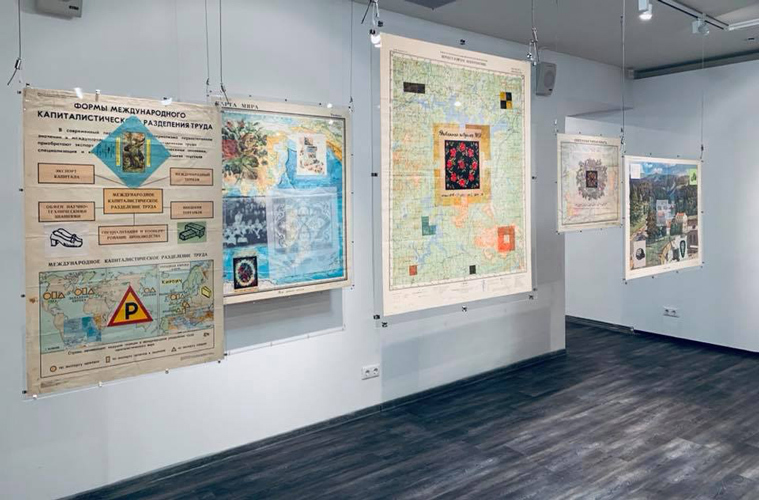
In MMSI on December 2, the retrospective of Katerina Kovaleva “Routes of Memory” ends - perhaps the most winter exhibition of November, where granite snowmen and marble penguins are found among rustling cards of the world. The journey through the exposition begins with the early works of the artist-large graphic sheets from the series “Brothers and Sisters” and “The Physical Education of a Woman”, and then reveals to the viewer the theme of personal and political borders, rethought in collages-objects of different years. This exhibition is about monumental and ephemeral: after documents, letters, receipts, photographs and sketches gather in an imaginary landscape without end and edge, the archive suddenly becomes too clumsy, gradually turning into a stone memory. The last segment of “routes” tells about Kovaleva’s journey to Antarctica as part of the I Antarctic Biennale, from where she brought a mobile exhibition, photographs of ice and stones and the idea of new sculptures. Colta.ru talked with the artist about how the paths of her imagination are interconnected.
- The exhibition, which is now ending, is devoted to the topic of memory. How do you think that art can make it really significant for it to resist history?
- Probably, I do not set me such tasks. What I do is a very personal experience, akin to keeping a diary. For me, the process of immersion in intuitive recognition, recalling fundamental internal processes through visual experience is important. The result is secondary. Although, if he turns out to be convincing not only for me, if he responds to the viewer, this cannot but rejoice. This is such a consolation that time is not wasted. And I don't know about preservation in history. "Deus conservat omnia" ...
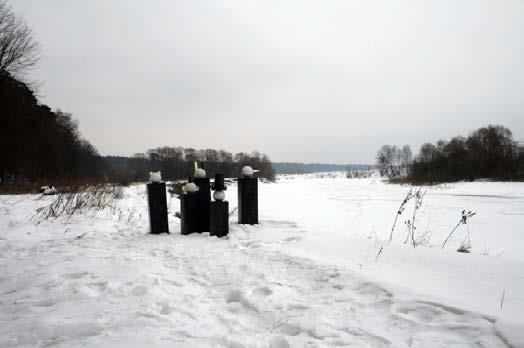 Katerina Kovaleva. Duel Pushkin. Dramatis Personae. 2009. Marble, granite, brass, metal
- At first you were engaged in cards, applying embroidery, letters, patterns on them, then returned to the drawing.
- The drawing was always interested in me. Paper, pencil ... The energy of the line is always unpredictable and unique. A drawing is a discovery that bewitching a focus with not yet former ...
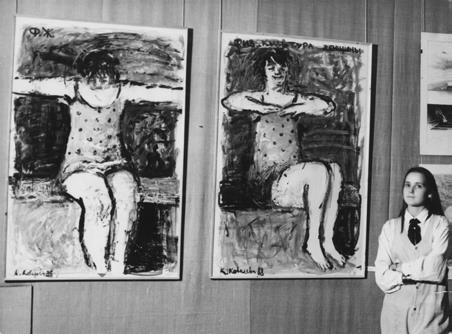 Katerina Kovaleva at her exhibition in a large arena near the work from the series "Physical Culture of a Woman". Moscow. 1988
- And how do you perceive photo archives or papers that become material for your work? Do you use found things or those related to your personal, family history?
-photographs, letters, receipts, certificates or drawings, all that I used in my works, these cooled evidence of time that stores the imprints of touch, the uniqueness of someone’s handwriting and gestures are more often not related to the history of my family. These are random findings that allow me to come up with new stories and recall the unknown.
-Did you say the “drawings-syncs”?
-Yes, blue ... These are such copies of schemes and drawings on special paper, it is blue-pink.
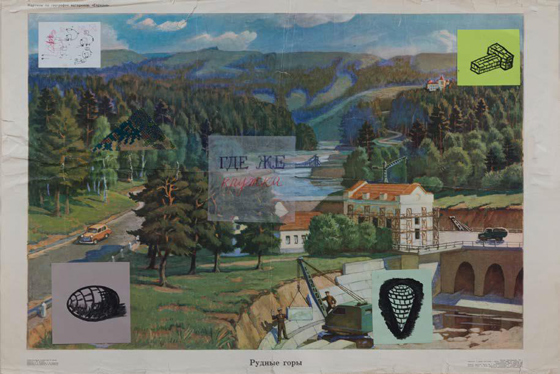 Katerina Kovaleva. Ore mountains. 1996. Paper, collage, mixed equipment. 86x58
- And how does such a detachment from history allows you to reveal the topic of memory?
- For me, memory is not only a connection with the past, it is about the present and maybe even more about the future.
I often used in my works the layering of old wallpaper, removing the layer by layer. When making a certain movement within the object, one can feel, visually feel the layers of a gone life. In addition, through these “illegal archaeological” research, using such “memory forms”, you can more accurately see the present and choose the key to the future. So my memory works.
My trajectory of visual movement can be designated as a simple scheme: memory, memo, monument. From the activation of memory through memos or forms, I move to the monuments, fossils of recall, the tombstones of events.
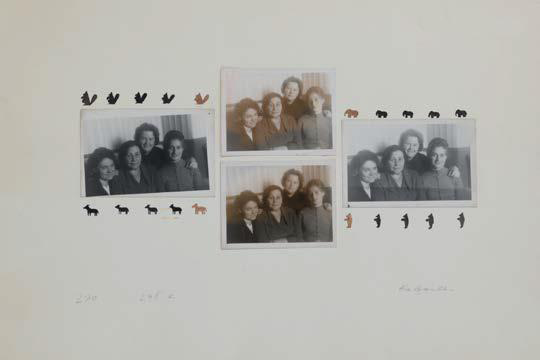 Katerina Kovaleva. Ninochka with friends. 1995. Paper, collage, watercolor. 35x45. From the series "Notebooks"
- But many Russian authors use the topic of memory to get away from talking about modernity. Do you think to what extent your work responds to the events of Russian or Soviet history? How important is it for you to monitor politics and contemporary art - and why?
- What I did, of course, is connected with the history of Russia. I used the testimonies of the passed time to my heart, archived and “sealed” what no one needed - for example, a suitcase of letters found in the garbage dump, or numerous types of paper “garbage”.
According to Baudrillard, "that which is not suitable for anything can always be useful to us." And in today, in today's Russia, in contemporary art I am interested in this particular - “unnecessary” things, phenomena, words, people. Probably I am an apolitical person.
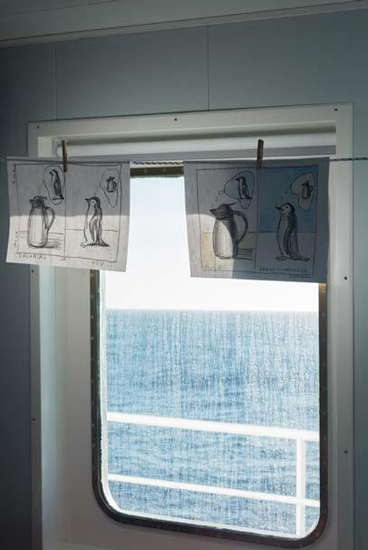 I Antarctic Biennale. Exhibition of drawings by Katerina Kovaleva “Antarctic Diary” on the ship “Academician Sergey Vavilov”. Strait of Drake, Argentina. March 2017
- Tell us about your participation in I Antarctic Biennale and about the drawings presented at the exhibition.
-Last year, I was lucky to visit Antarctica as part of the participants of the Antarctic Biennale, the ideological inspirer and organizer of which was Alexander Ponomarev, a wonderful Russian-refractor. Artists from different countries gathered on the Academician Sergey Vavilov scientific vessel who presented their projects, made specifically for this art expedition.
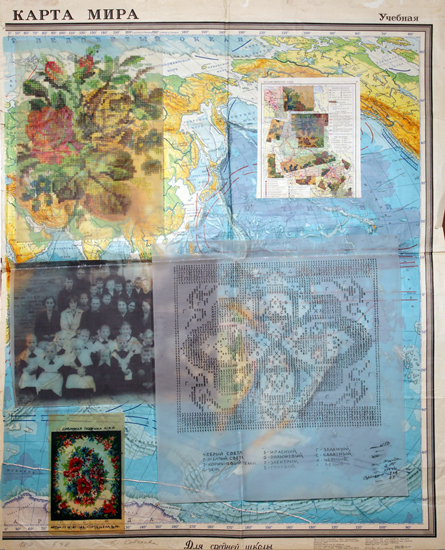 Katerina Kovaleva. World Map. 1998. Paper, mixed equipment. 112x95
My task was to keep an “Antarctic diary”, to sketch every day everything that happened around. Probably, I was the oldest artist-suburban, representing contemporary art. So a series of drawings and collages with the same name appeared. At the end of the trip, my exhibition of drawings took place right on board the ship in the Drake Strait - perhaps the first in history.
We used exposition modules designed by architect Alexei Brems. The geodetic devices on tripods were taken as their basis, which were in use by the first researchers of the Antarctic.
- Are these the modules that are now arranged in one of the MMSI halls?
- Yes, at the exhibition they became part of the installation of the Antarctic Diary and, as it were, indicate their presence in the Antarctic waters.
- And what was the most remembered from the expedition?
- At one of the abandoned polar stations, among different “unnecessary” things of forty years ago, we discovered Nabokov’s book “ Speak Memory ! " ("Memory, speak!"). It seems to me that this is a very good metaphor for all the experience of traveling to Antarctica. Here, among eternal ice, eternal water, there is an understanding that such a personal part of ourselves, as a memory, as if it is connected to the transpersonal fields of memory, as the philosopher Alexander Sekatsky, who had traveled with us, was sensitively: “If you get to them, join these fields, you can recall an incredible set of things and events. Remember how belonging to you and just waiting for reunification. ” Yes, the trip was a significant event for me.
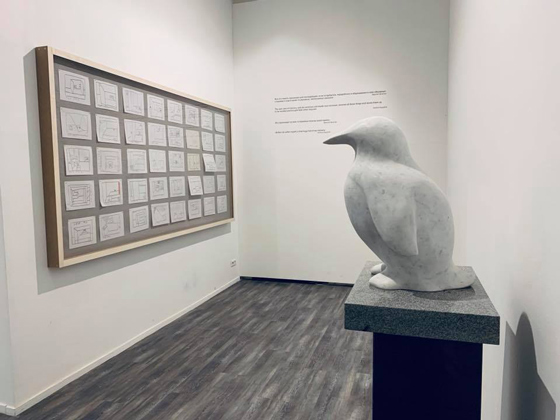 © Katerina Kovaleva photo from the exhibition
- For several years now you have been working in marble and granite sculpture. How did you come to such a material?
-As for the objects or sculptures made in stone, as I have already said, these are monuments-fenbies of events or concepts. The first such objects arose nine years ago, they were made for my personal exhibition dedicated to the snow. I wanted to perpetuate the most ephemeral: snow, snowball. So the monument to the snowman or the tombstone “The remains of the snowman”, the monument “Mysterious Russian Soul” and others appeared here. There is always an inscription on Latin on the stone, sending the viewer to ancient Roman tombstones, emphasizing the versatility of the “ideas of eternal memory”. In other pyramid monuments, the influence of Russian Suprematism can be easily noticed.
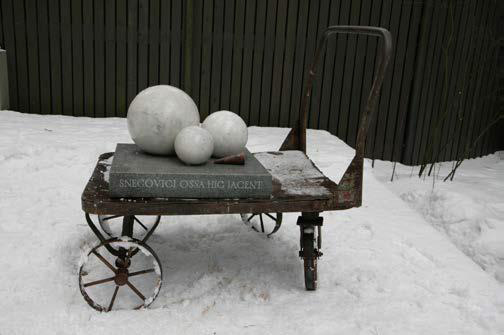 Katerina Kovaleva. Here are the remains of the snowman. Snegovici Ossa Hic iCent. 2009. Marble, granite. 60x55x4
The last sculptures - “Monument to the unknown penguin” and “bone from bones” (Kita's vertebra) - were created according to impressions of the Antarctic journey.
- And how are they produced?
- Most of the sculptures were made at the oldest stone -processing plant in Dolgoprudny, which was created more than 80 years ago in connection with the construction of the subway.
- They have a lot of irony - do you think these works are postmodernist?
- It seems to me that in modern culture and art there should always be a place of irony and especially self -irony. Do not take it too seriously, even speaking of important, serious things. I like it when people smile.
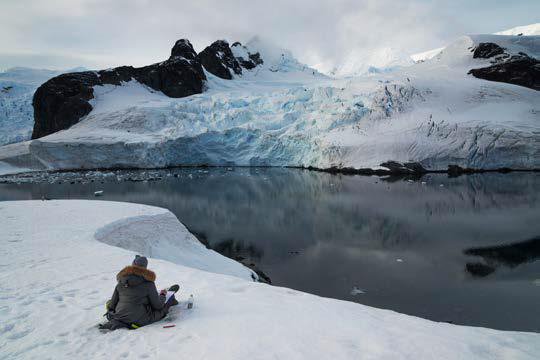 © Katerina Kovaleva Artist at work on I Antarctic Biennale. 2017
Subscribe to the COLTA.RU channel in Yandex.Zen to miss nothing